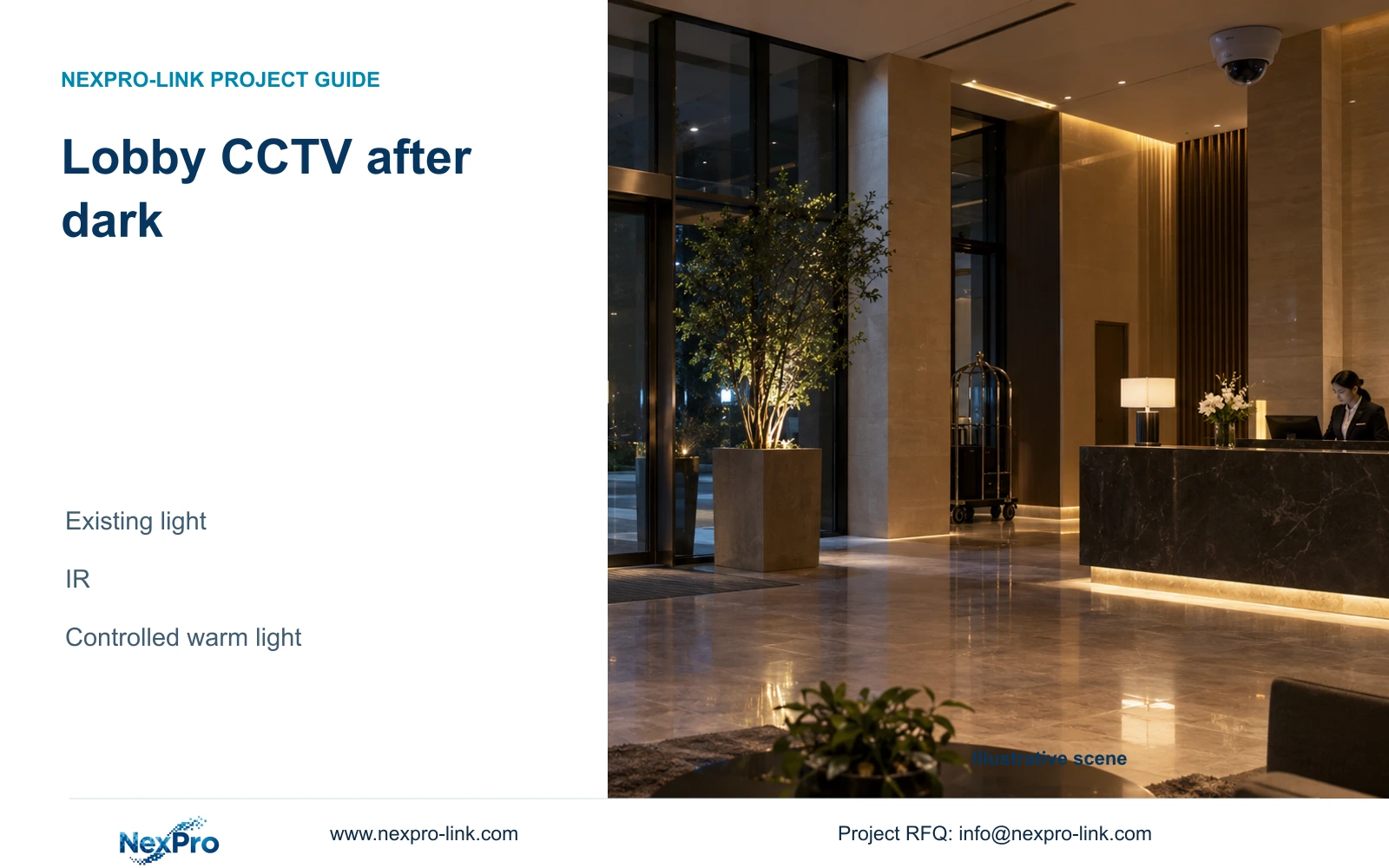
Use existing lobby illumination when it preserves the required recorded detail. Add IR or controlled visible light only where a matched night comparison shows a need.
Section 01
Decide whether existing night lighting is sufficient
Keep existing lobby illumination as the first option when recorded moving people remain useful for the agreed entrance or reception task. Compare IR and controlled warm light only where that option fails. Choose the least intrusive mode that meets the task under the hotel's actual night lighting, including dimmed periods and transitions at glazed doors.
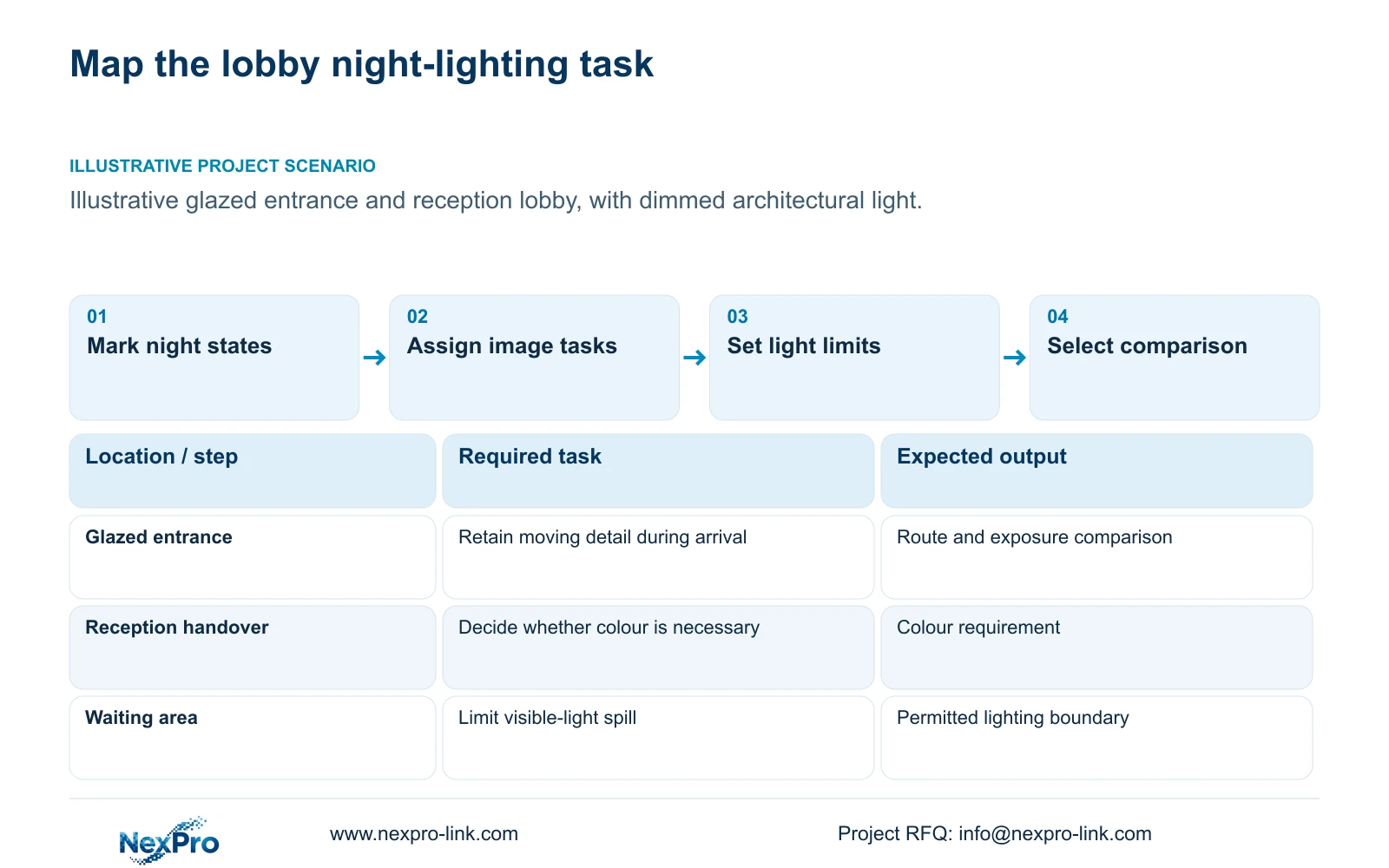
Mark the arrival route, queue overview and authorized counter handover area separately on the lobby plan. An entrance detail view may need a different exposure and position from a broad queue view. Record which architectural lights remain on, which are dimmed and whether exterior lighting changes the entrance scene. A daytime photograph cannot establish these conditions.
Define the required output before selecting equipment: a visible moving outline, useful colour information or detail at a particular handover point. Minimum-lux figures do not describe all these outcomes. The lighting record should also identify who controls the relevant fixtures, so a later decorative-lighting change does not silently invalidate the camera design.
| Required task | Given information | Decision still needed |
|---|---|---|
| Entrance movement | Glazed arrival route | Does the dimmed scene retain moving detail? |
| Reception handover | Counter task identified | Is colour necessary at this point? |
| Queue overview | Public waiting area | Which lighting changes affect visibility? |
Section 02
Compare colour and monochrome against separate tasks
Require colour where it contributes information the operator actually needs, such as distinguishing the appearance of an item at an authorized handover point. For a circulation overview, useful movement and route context may be sufficient. Keeping these requirements separate allows different lobby positions to use different night modes without weakening the approved observation tasks.
An IR option should be assessed through its recorded monochrome result. A visible-light option should retain the required colour and movement detail without unacceptable spill. Both comparisons need the same permitted view and target route. Glass, polished finishes and lighting transitions can make a change of position more useful than increasing camera resolution.
The supplied DM2812M Series product PDF identifies NexPro-DM2812M88-8MP-DIC-AI with 3840×2160 at 25 fps, a 2.8-12 mm motorized lens and dual light. These fields support a candidate comparison; they do not establish night recognition performance or the exact switching controls. The selected variant and operating mode still need to match the hotel's lighting restrictions.
| Item | IR option | Visible-light option | Effect on the hotel task |
|---|---|---|---|
| Required colour | Assess monochrome suitability | Assess recorded colour detail | Colour-dependent tasks need an appropriate result |
| Light intrusion | Check the installed scene | Check visible spill and brightness changes | Guest comfort can exclude a mode |
Section 03
Separate continuous light from event-triggered light
Continuous illumination and event-triggered illumination create different operating conditions. Continuous light must be acceptable throughout the intended night period. Event lighting also needs an acceptable transition when a person approaches, including whether useful footage exists before and during activation. Specify the required behaviour, then confirm that the exact camera configuration supports it.
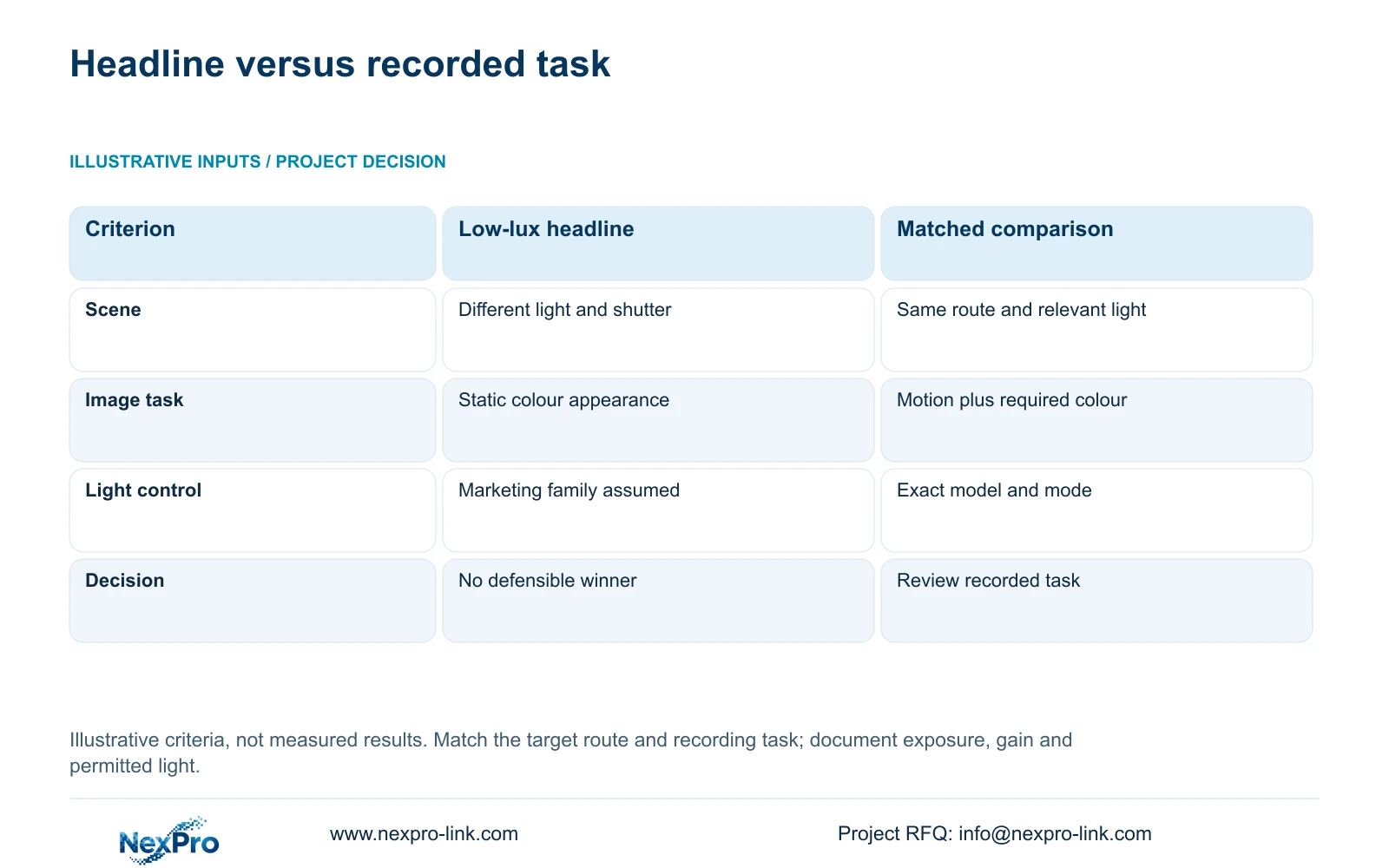
Do not assume that a product family's dual-light label defines trigger timing, brightness adjustment or every available mode. Low-light figures also depend on exposure, aperture and gain conditions. A headline without those conditions cannot support a fair ranking between candidates. No measured lighting power, trigger delay or image result is supplied for this illustrative comparison.
The matrix below changes the purchasing decision from selecting the lowest advertised lux figure to comparing recorded task outcomes. Its inputs are the target route, relevant night lighting, required colour or overview information and selected mode. There is no numerical performance formula because these criteria require observations from the proposed configuration.
| Metric / condition | Option A | Option B |
|---|---|---|
| Scene | Different light and shutter conditions | Same target route and relevant light |
| Image task | Static color appearance | Motion detail plus required color/overview |
| Light control | Assumed by marketing family | Exact model and selected mode |
| Decision | No defensible winner | Choose after recorded task comparison |
Section 04
Test moving people under matched recording conditions
Use an authorized representative movement along the arrival route and through the relevant counter area. Keep the target route, scene lighting and recording requirements consistent between options. Document exposure and gain settings so a brighter stationary image is not mistaken for clearer moving footage. Where a mode requires different settings, record that difference and its effect.
Review the stored clip through the intended hotel playback workflow. Include the approach to the observation point, the movement itself and any light-mode transition. A screenshot taken after the person stops does not answer whether the event was recorded usefully. Factory checks can establish reproducible equipment behaviour, while reflections and architectural lighting need a site-specific assessment.
Record unresolved outcomes by task, such as lost detail at the entrance transition or an unacceptable visible-light activation. Assign the corrective action to the relevant equipment, installation or lighting responsibility, then repeat the same route after the change. A limited demonstration supports the conditions observed; it does not prove performance throughout every season or lighting state.
Section 05
Check reflected light and guest comfort before adding hardware
Inspect the camera view and the visible effect of illumination from the public arrival and waiting positions. Glazing, nearby walls and reflective finishes belong in this review. Check spill towards accommodation and unnecessary views into private space. Moving the camera, narrowing the view or coordinating existing fixtures should remain available options.
The cost manager should price the corrective scope separately: mounting changes, lighting coordination, access work and any replacement equipment. A camera-only comparison can omit the work needed to make either option usable. Retain the same recorded task when comparing totals, and leave unquoted items visible instead of treating them as zero.
Where the illustrative CASE01 system is used as background, a local lighting decision must remain separate from its whole-hotel assumptions. That case is a planning reference, not a delivered project. Adding illumination may require a revised peak-power input, but neither the camera PDF nor this comparison supplies a verified maximum wattage.
| Retained outcome | Extra scope | Purchase condition | Change condition |
|---|---|---|---|
| Useful movement detail | Position or existing-light adjustment | Recorded task improves without intrusive spill | Required detail remains missing |
| Required night colour | Controlled visible light | Colour is necessary and light is acceptable | Guest-comfort limit excludes visible light |
Section 06
Choose the least intrusive qualified lighting arrangement
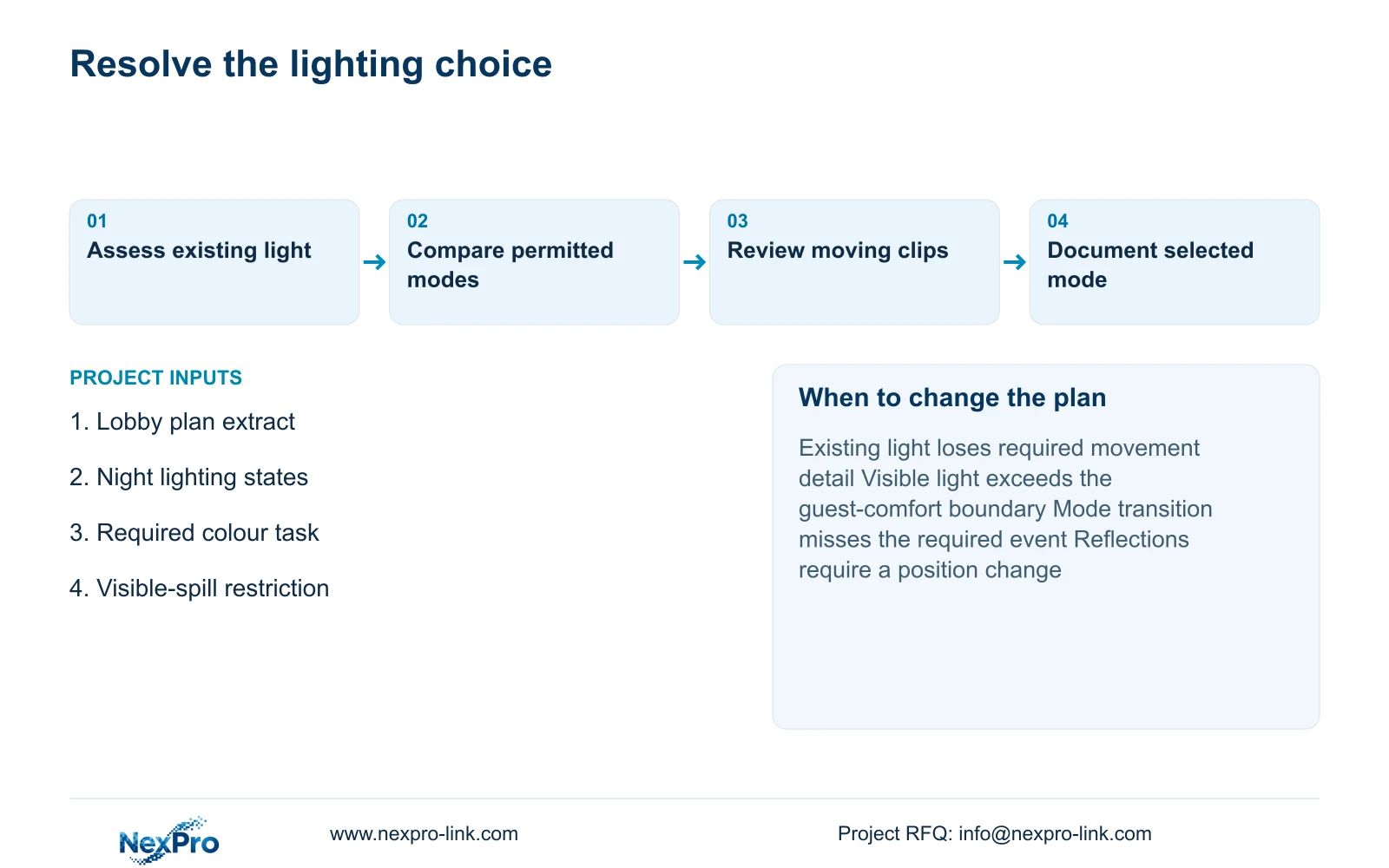
Select existing illumination when the recorded task comparison passes. Use an appropriate IR arrangement where monochrome fulfils the task and visible light is unsuitable. Choose controlled warm or dual light where colour is required, visible illumination is permitted and the transition footage remains useful. If none meets the task, revise the position or consider a separately specified solution.
NexPro-Link can support camera matching, technical documentation and a coordinated equipment proposal. Its CCTV manufacturing scope and coordination of supporting equipment should be identified separately. Site lighting adjustments and local installation responsibilities belong in the project scope; a combined equipment order does not establish that all those services are included.
Send the relevant lobby plan, night lighting states and required entrance or reception detail to info@nexpro-link.com. Include the restriction on visible-light spill and any mandatory model or platform. Hotel project equipment support and BOQ support can then address the specific unresolved lighting decision without requesting guest footage or access credentials.
Section 07
Buyer questions
Does a dual-light camera guarantee acceptable warm-light operation? No. Confirm the exact variant's supported modes and controls. Specify whether continuous or event lighting is acceptable, then assess the recorded transition and spill at the proposed position.
Can the lighting comparison be completed before installation? A representative equipment demonstration can narrow the candidates. Final judgement on glazing, finishes and guest-facing light effects needs the actual lobby conditions or a suitably representative assessment.
What should the first lighting RFQ exclude? Exclude passwords, guest images and unrelated confidential drawings. A relevant plan extract, lighting schedule and written description of the required recorded task are sufficient to start a scoped discussion.
Engineering references
These sources support the general planning principles. Always use the selected product's current datasheet and applicable project standards for final design.