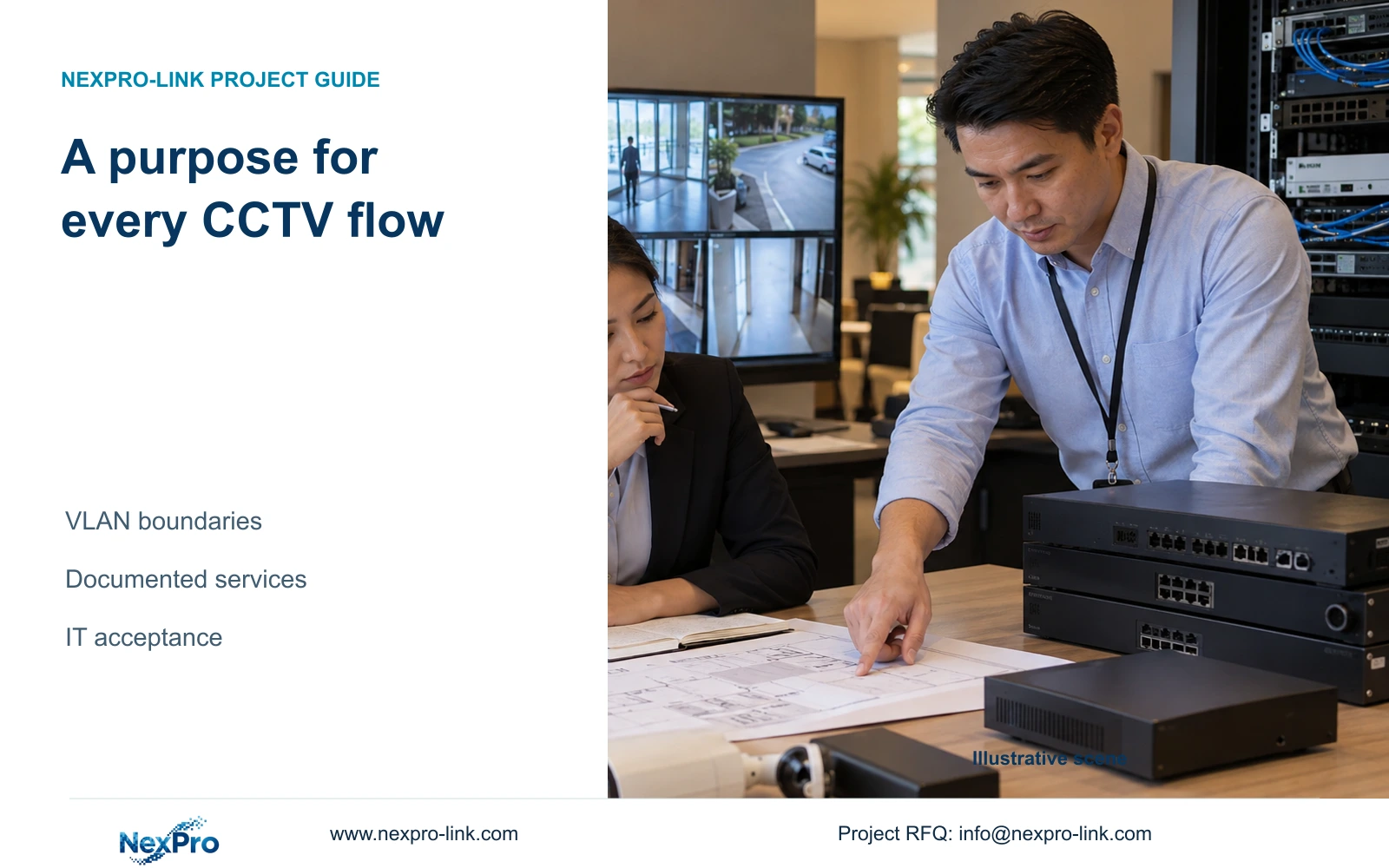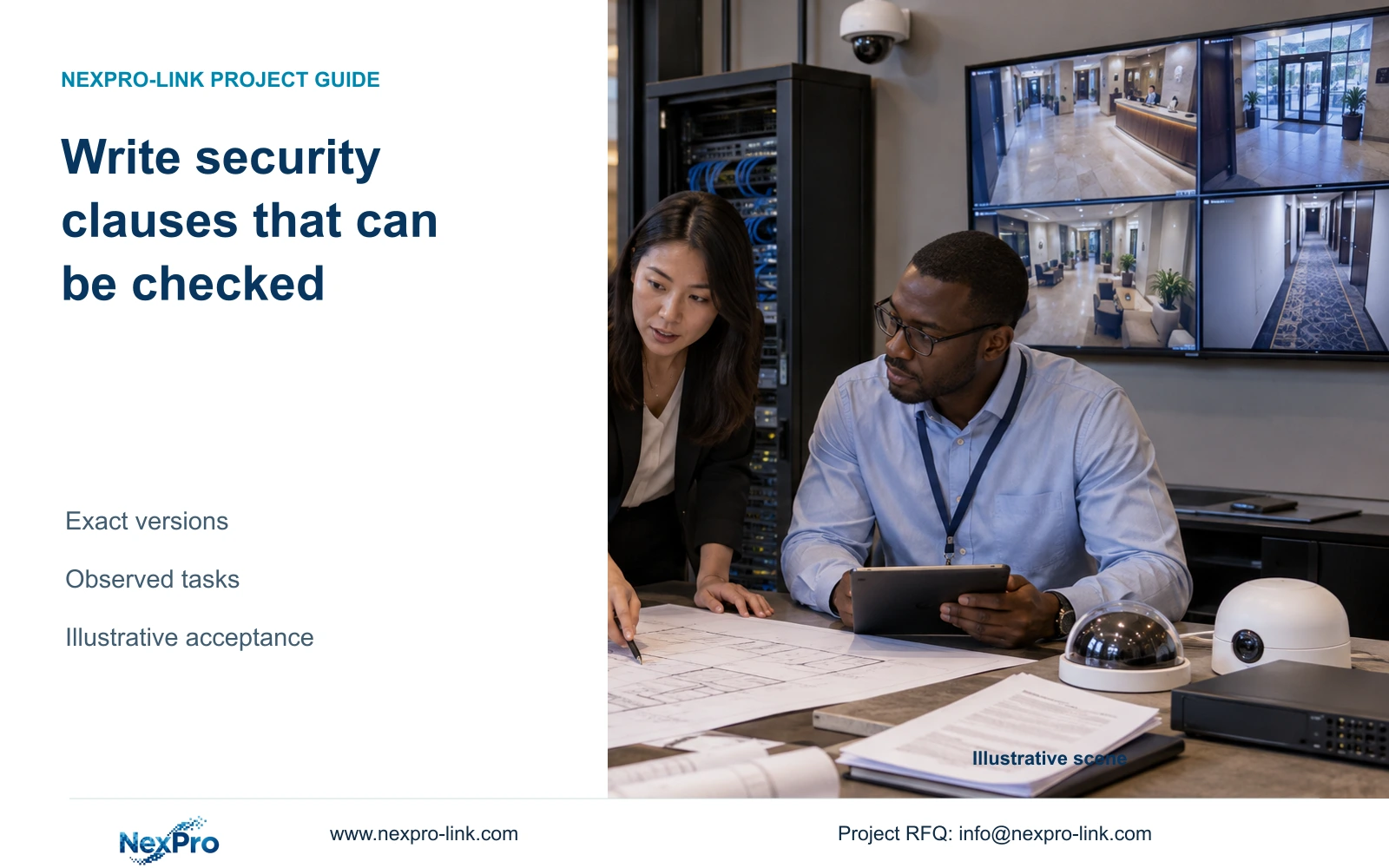
Specify the security behavior the hotel needs and how it will be observed. General claims about reliability cannot establish account control, update support or safe service configuration.
Section 01
Translate each risk into an observable task
Replace broad tender language such as 'secure and reliable' with account, update, access, logging and service-control tasks that can be demonstrated on the offered model and firmware. Accept a proposed configuration only where its evidence addresses the required behavior. If an essential control remains unsupported, require a defined alternative or an explicitly accepted deviation before procurement.
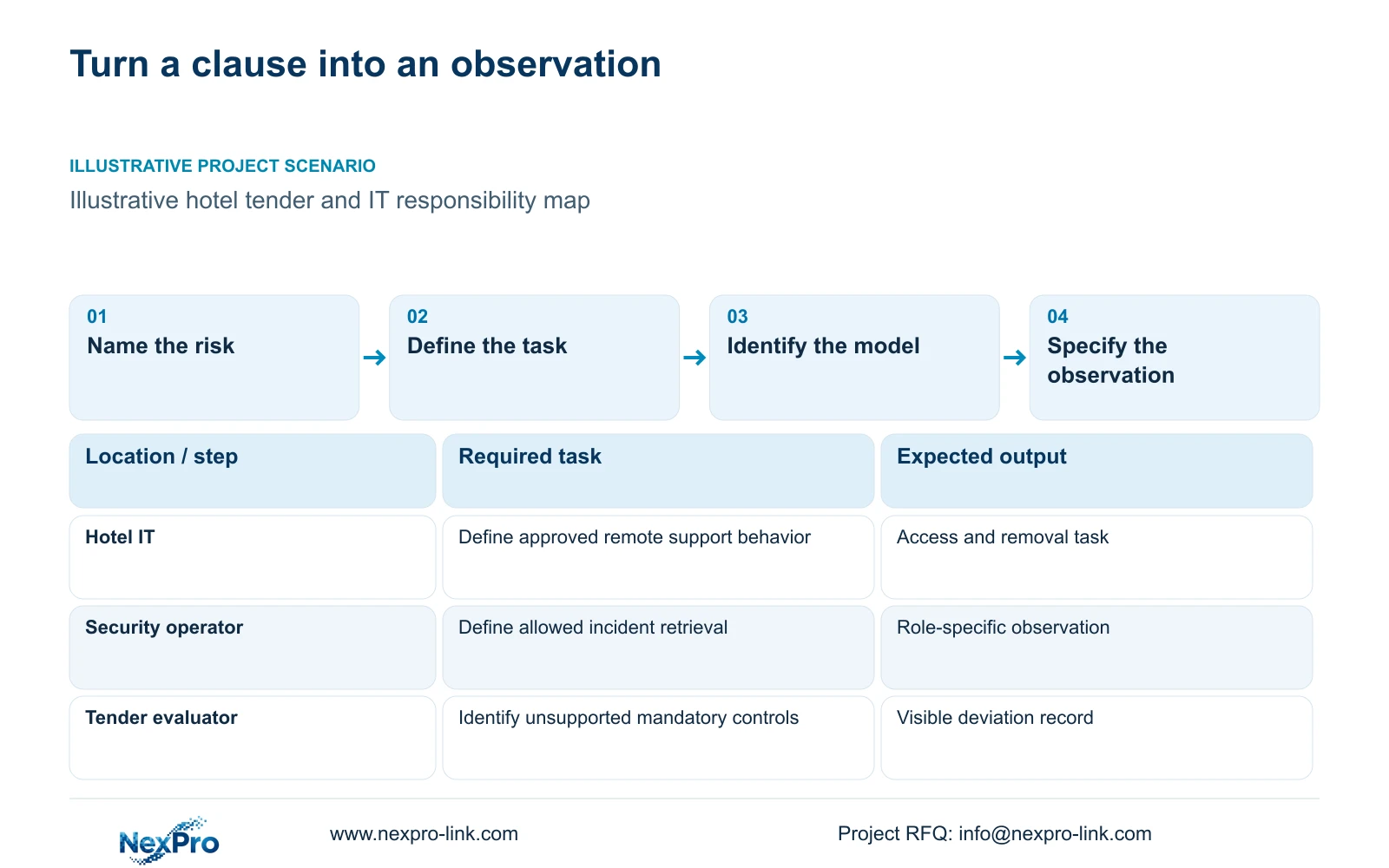
Start with the hotel's operating risks. A staff departure creates an access-removal task. External support creates a limited-authorization task. A configuration change creates a need to understand who may make it and what record is available. State the actor, operating condition and expected result for each requirement, then identify the device, client or hotel network responsible.
Keep the acceptance scope practical. A demonstration that a camera is online supplies little information about privileges or service configuration. Equally, a small pilot cannot prove every unit or firmware version behaves identically. Record the sample and conditions so the buyer can distinguish observed behavior from a supplier's proposed implementation.
| Required task | Given information | Decision still needed |
|---|---|---|
| Remove departing staff access | Local and remote access are proposed | Supported removal behavior and verification route |
| Control remote support | Supplier assistance may be required | Authorized task, access boundary and closure |
Section 02
Specify account and access behavior by role
Describe the privileges needed for daily viewing, incident retrieval and administration. Assign them to the approved hotel roles and state which actions should be unavailable to each role. This gives the supplier a functional requirement to answer. A requested second factor or fine-grained permission remains a requirement until evidence confirms it for the offered platform.
Separate account ownership, device binding and network reachability. A local recorder privilege does not describe mobile-account ownership, and network access does not establish permission to export footage. The hotel IT team should define the approved support route while the equipment response identifies supported device and client controls.
Ask for the expected result of both permitted and prohibited actions. An authorized operator should complete the agreed retrieval task; an unauthorized role should not gain the same access. Verify those observations through the actual interfaces included in scope. Keep credentials and guest material out of tender examples, demonstrations and general quotation correspondence.
| Item | Vague clause | Task clause | Effect on hotel operation |
|---|---|---|---|
| Operator access | Secure user management | Demonstrate approved view and retrieval privileges | Defines required work and restrictions |
| Remote support | Safe remote access | Demonstrate approved support access and removal | Defines the support boundary |
Section 03
Define update and support expectations
Request the supported update process for the offered hardware and software version. Identify who authorizes changes, who applies them and which operating tasks need checking afterward. The response should describe known operational effects and supported recovery arrangements where available. Do not insert an assumed update-support duration or rollback capability into the product description.
Separate routine operation from exception states. During unavailable internet access, the hotel still needs to know whether local recording and authorized retrieval remain possible in its chosen architecture. During maintenance, identify the functions affected and the party responsible for restoration. These are model and installation questions that require an explicit response.
The supplied policy record describes a 24-month limited hardware warranty baseline for applicable main equipment from customer receipt, subject to controlling written order terms. That period does not establish a cybersecurity update commitment. Batteries, storage, cabling and OEM arrangements have their own scope, while continuing technical support does not imply unlimited free repair or local attendance.
Section 04
Compare capabilities at model and firmware level
Build the compliance response around exact models, firmware and client versions. Give each requirement an evidence status, such as documented support, demonstration required or unresolved. Keep the explanation of a deviation beside the affected requirement so a broad product-family description cannot hide a missing control.
ONVIF Profiles help identify relevant device and client functionality, but an ONVIF statement does not prove every event, audio, search or cloud-binding behavior. The Seetong source supports discussion of App and PC workflows; it does not establish identical controls across all compatible hardware. Treat unsupported features as open requirements.
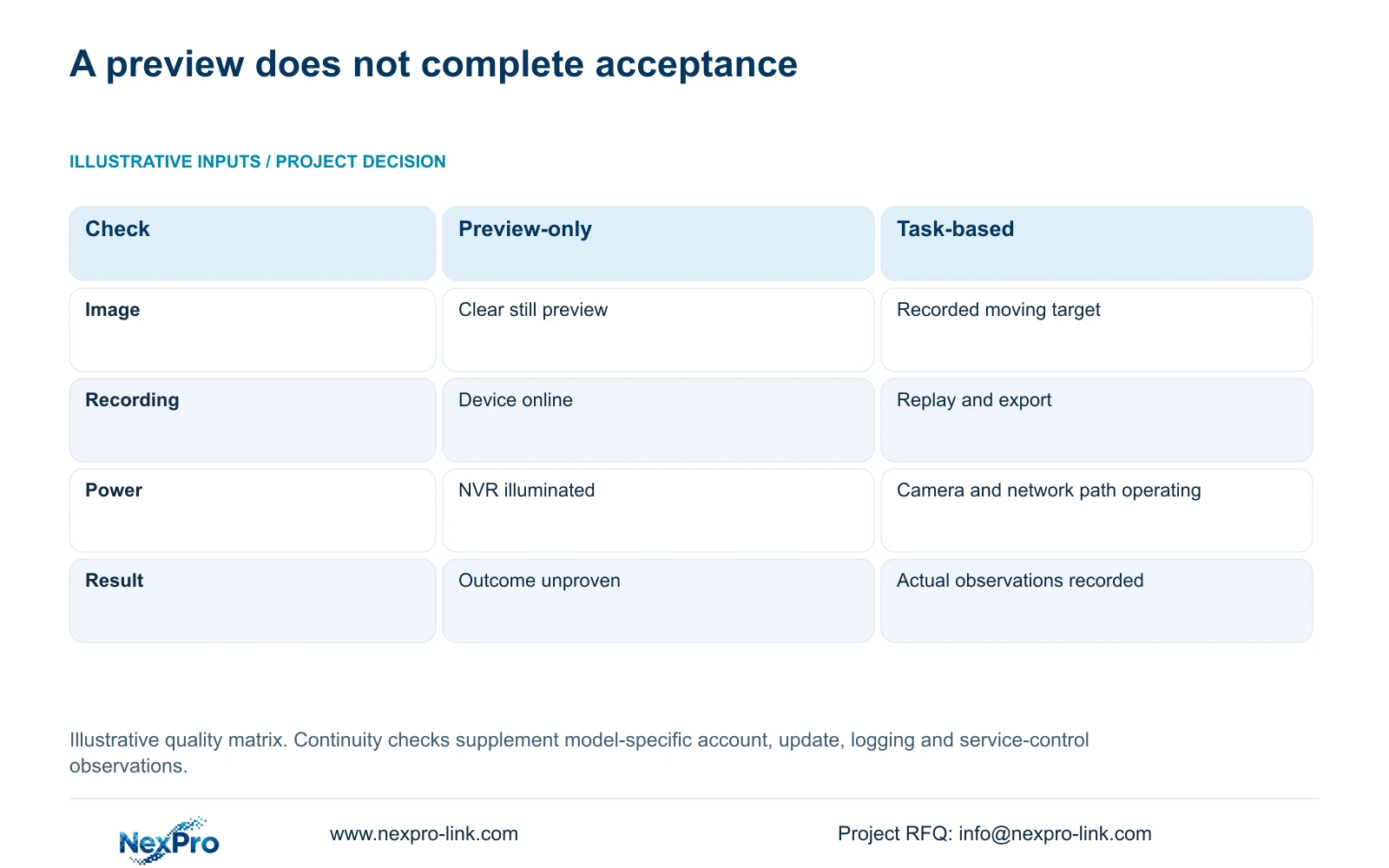
The original quality illustration checks surveillance continuity, not a complete cybersecurity assessment. Use the model-specific clause matrix below for accounts, updates, logs and service control, while separately confirming that required recording and retrieval still operate. Each entry remains a requirement until its documentation or observation is available; do not pre-fill compliance from a product-family description.
| Clause area | Required evidence or observation | Responsibility boundary |
|---|---|---|
| Account and privilege | Allowed and denied actions under each actual role | Device/client controls plus hotel authorization |
| Offboarding/support removal | Named routes and observed withdrawal of approved access | Account, binding and hotel IT owners |
| Update handling | Supported version/process, effect and recovery scope if available | Actual manufacturer support; warranty is not update entitlement |
| Required logs | Specific events and supported retrieval demonstrated | No assumption that all desired events are logged |
| Service restriction | Documented needed services and approved disabled scope | Retest required recording/client tasks under hotel IT rules |
Section 05
Set acceptance observations and repeat-test conditions
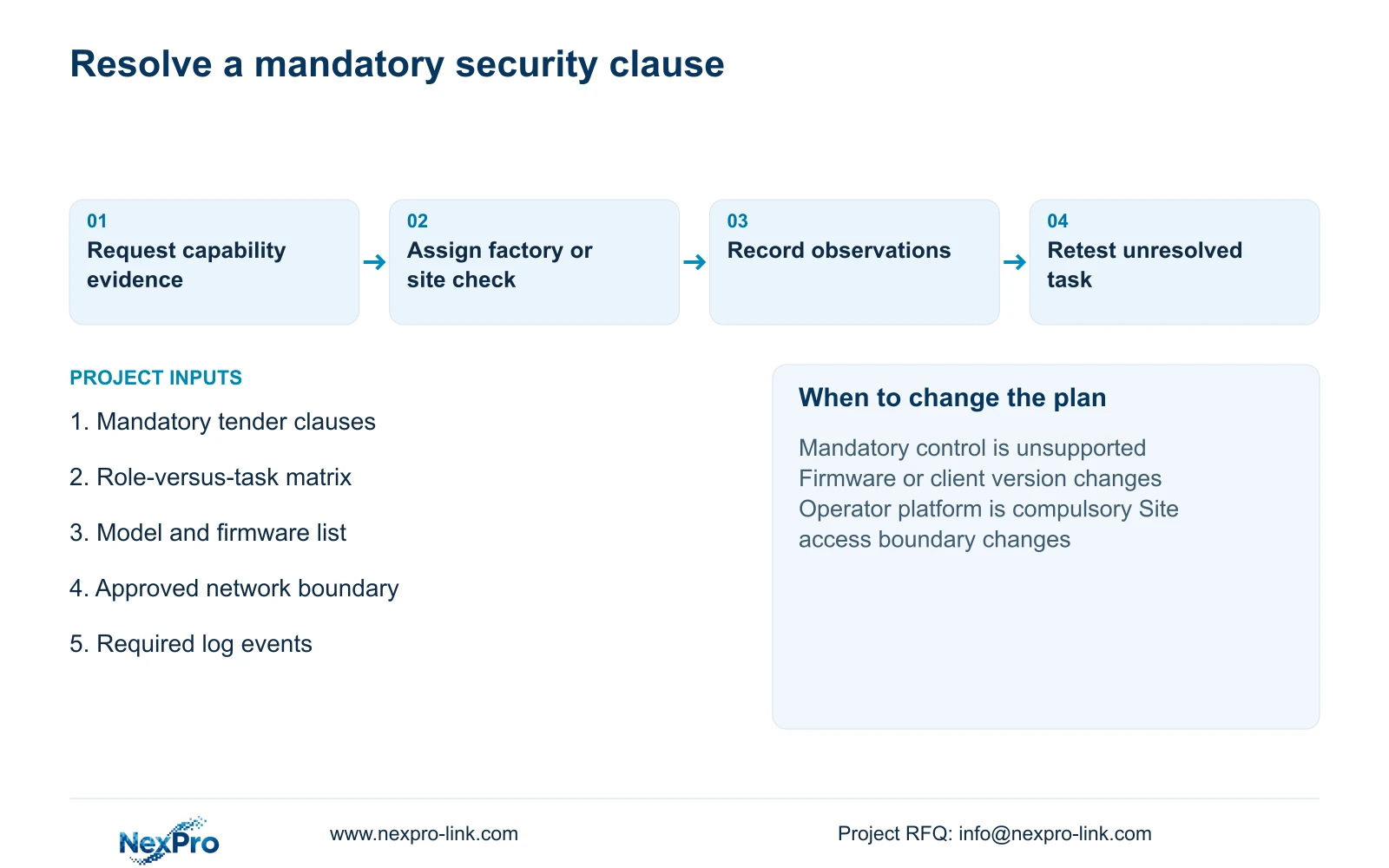
For each clause, describe the starting configuration, authorized action and observation to record. If access logging is required, specify the events the hotel needs to review and the supported method of retrieving them. If unused services must be disabled, identify those services and verify that the required recording and client workflow still operate after the approved change.
These are proposed acceptance tasks, not claims that a named product implements every control. Establish the available functions before promising a result. Record actual outcomes and retain any failed or incomplete task with its responsible party. Close an issue by repeating the relevant operating condition after correction, rather than marking the report complete without checking behavior.
Divide factory and site responsibilities. A factory can demonstrate repeatable device and client tasks in a defined setup. Hotel network paths, site permissions and local outage behavior need the corresponding site checks. Additional platform or testing scope is worth buying when it resolves an essential requirement; a larger feature list has no independent acceptance value.
Section 06
Keep unresolved requirements visible in the proposal
Retain unresolved clauses in the evaluated proposal with the missing evidence, proposed response and responsible decision-maker. Separate mandatory controls from optional enhancements. A quotation that omits a required platform, configuration service or site test should not be compared as though it includes the same outcome.
Recommend a model-specific, task-based specification when the hotel can define the required behavior and observe it through the proposed arrangement. Change the equipment or platform choice if a mandatory control cannot be supported, an operator standard requires a different system, or the approved network architecture changes the acceptance conditions. A customer-approved deviation must remain explicit.
Email info@nexpro-link.com the relevant tender clauses, role-versus-task list, proposed network access boundary and model/version references. NexPro-Link's BOQ and tender support can discuss matching equipment and recording deviations within a coordinated supply proposal. Its CCTV manufacturing core and supporting equipment coordination do not imply that every device is self-manufactured, natively integrated or supplied with local installation.
Section 07
Buyer questions
Does the hardware warranty establish the update-support period? No. The supplied 24-month main-equipment warranty baseline concerns scoped limited hardware coverage. Request the actual software and firmware support expectations separately in the project response.
Can a factory demonstration replace site acceptance? Only for the tasks and conditions actually demonstrated. Hotel network paths, permissions and site operating states still require their assigned checks. Record those responsibilities separately.
How should an unanswered mandatory clause appear in a quotation? Keep it visible as unresolved, with the missing evidence and proposed alternative. Do not convert it into a compliance claim. Include any necessary platform or service cost in the comparison.
Engineering references
These sources support the general planning principles. Always use the selected product's current datasheet and applicable project standards for final design.