Routine recording and selected incident preservation need different capacity and operating rules. Design the archive's intake, access and recovery separately from the NVR's circular recording budget.
Section 01
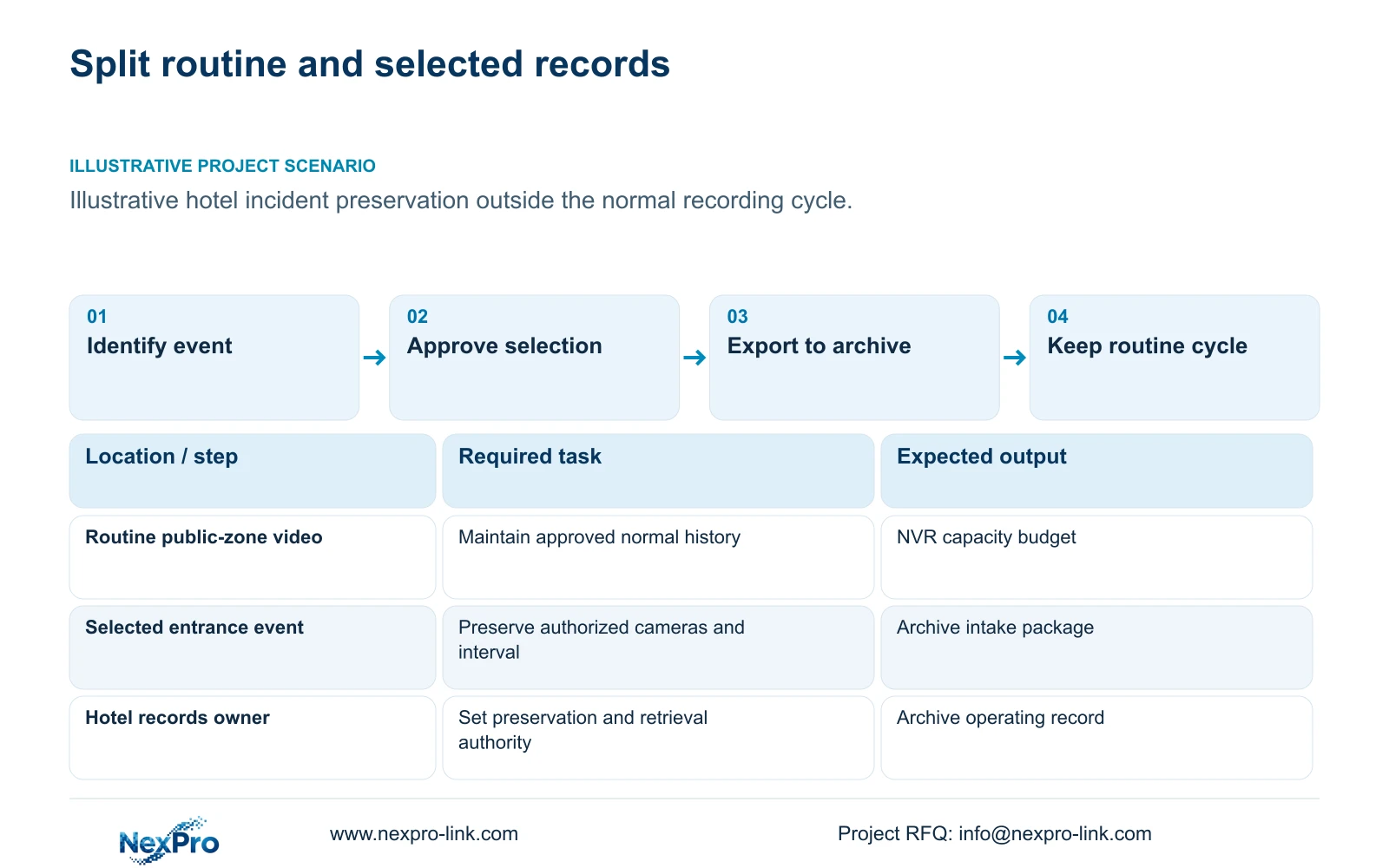
Separate routine recordings from selected events
Separate routine circular recording from selected event preservation when the hotel needs incident material beyond its ordinary retention cycle. Give each service its own capacity, access rules and operating owner. A larger NVR disk pool can extend routine history, but it does not establish an independent archive. Use a local archive for limited, authorized events when the hotel can manage it; consider a managed path when shared access or recovery duties exceed that arrangement.
Routine recording collects the approved camera streams under their normal schedules. An archive accepts selected cameras and time windows for a defined event. An entrance incident may need reception context, while unrelated public-route footage can remain in the normal cycle. Describe the selection rule before sizing the archive so 'keep important footage' becomes an actionable instruction.
Keep both requirements visible in the design. Removing archived clips from a capacity estimate does not justify reducing necessary routine history. Likewise, retaining every recording indefinitely is a different service from preserving selected events. The hotel's approved purpose and applicable requirements determine which records belong in each service.
| Service | Given input | Decision still needed |
|---|---|---|
| Routine NVR recording | Streams and normal retention | Usable circular recording budget |
| Selected event archive | Authorized cameras and interval | Preservation period and destination |
| Archive retrieval | Approved user and event identity | Playback and recovery method |
Section 02
Assign authority for each retention rule
The person authorized to operate live views need not be the person authorized to extend retention or distribute archived material. Name who can approve an event selection, its preservation period and its eventual disposition. Keep those decisions separate from the technician who performs the export or maintains the storage.
Available disk space cannot determine retention policy on its own. The supplied ICO surveillance guidance supports purpose-based retention and appropriate access in its UK scope, and the source notes that guidance is under revision. It does not establish a global 30-, 60- or 90-day hotel requirement. Apply the hotel's relevant requirements to both normal recording and selected records.
Capacity calculations should follow the approved policies. Routine video uses stream groups, recording hours and days; an archive uses selected clip sizes and the volume of events retained. When a 20% free-space target is specified, divide the video payload by 0.80 to obtain required usable capacity. Handle formatting and any redundancy separately, and avoid counting archive reserve as available NVR recording space.
Section 03
Size archive intake from the selected clips
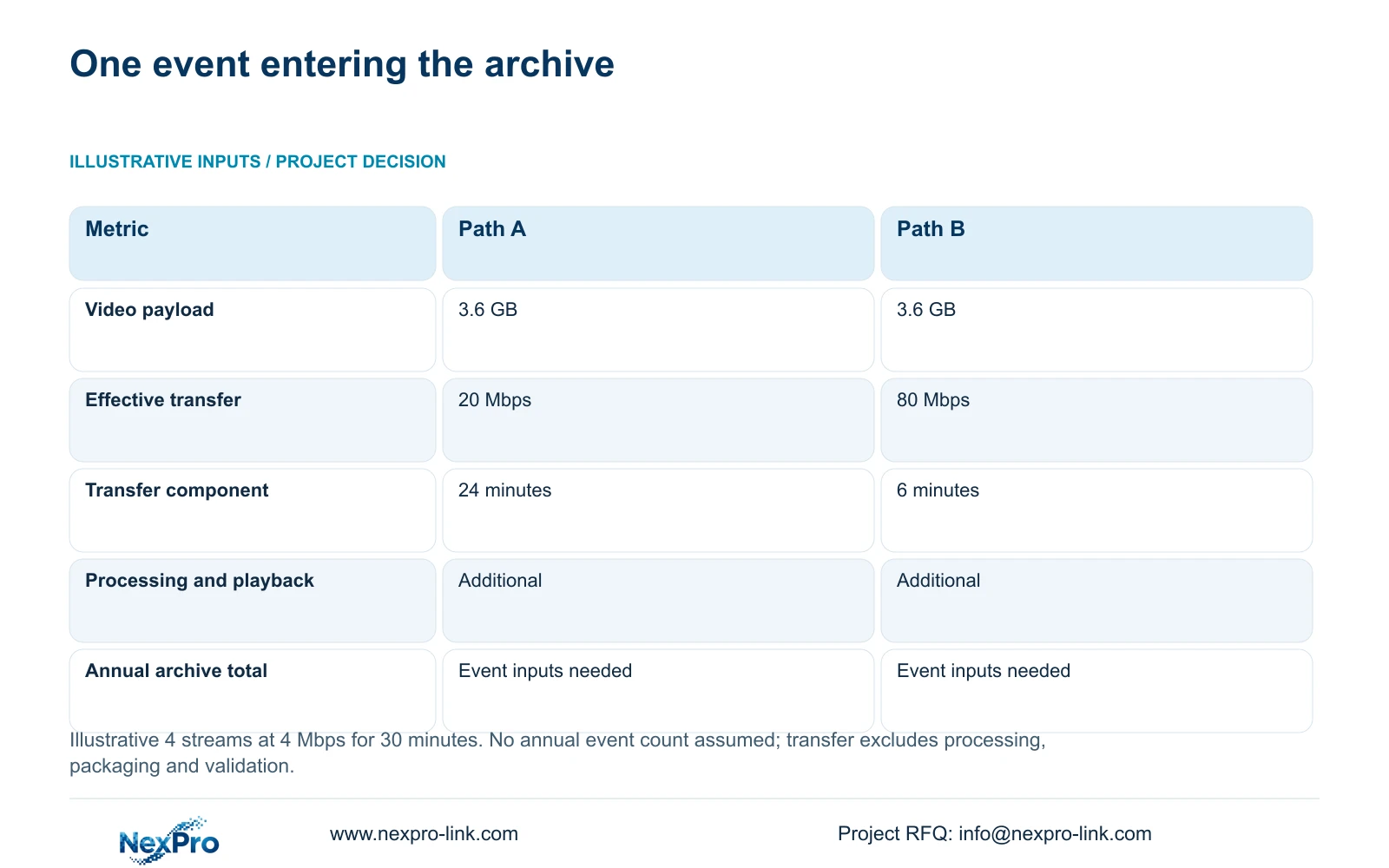
The illustrative archive intake contains four streams at 4 Mbps for 30 minutes. Decimal clip GB equals streams × Mbps × seconds ÷ 8 ÷ 1000. Using 1,800 seconds gives 4 × 4 × 1,800 ÷ 8 ÷ 1000 = 3.6 GB of video. Packaging, authorized audio and metadata can change the finished export size.
Transfer seconds equal GB × 8000 ÷ effective Mbps. The 3.6 GB payload takes 24 minutes at an assumed 20 Mbps or 6 minutes at 80 Mbps, before recorder processing and validation. These values help size the intake window. They do not prove the performance of a local archive, managed service or named recorder.
For the archive capacity budget, obtain expected event frequency, camera counts, clip durations and approved preservation periods. Sum the retained payloads and include any specified copies and free-space allowance. Without those inputs, the 3.6 GB example cannot become a whole-hotel annual archive estimate. It is also independent of the complete reference hotel's routine recording total.
| Metric / condition | Path A | Path B |
|---|---|---|
| Video data | 3.6 GB | 3.6 GB |
| Effective transfer | 20 Mbps | 80 Mbps |
| Ideal transfer time | 24 minutes | 6 minutes |
| Recorder processing and packaging | Additional | Additional |
| Playback validation | Additional | Additional |
Section 04
Compare local and managed archive responsibilities
A local archive can suit a hotel with a limited event workload and staff able to maintain the records and playback resources. Define where the files reside, who protects access and how a replacement receiving device retrieves them. A USB copy held without a custodian or recovery method leaves part of the service undefined.
A managed path may suit an approved multi-user or multi-site workflow, but its supported functions and commercial terms must be specified. Request storage, transfer, user access and recovery scope separately. Remote viewing through an app does not establish cloud storage, permanent free archiving or an enterprise preservation service.
NexPro-NVR4449-4K lists four SATA positions and 320 Mbps input; NexPro-NVR8864-4K lists eight SATA positions and 320 Mbps input. Those recording fields do not establish managed archive functions or export rates. Compare archive paths with the same event scope and deadline, adding actual software, support and migration costs without assigning unsupported prices to either option.
Section 05
Verify access and recovery beyond the source NVR
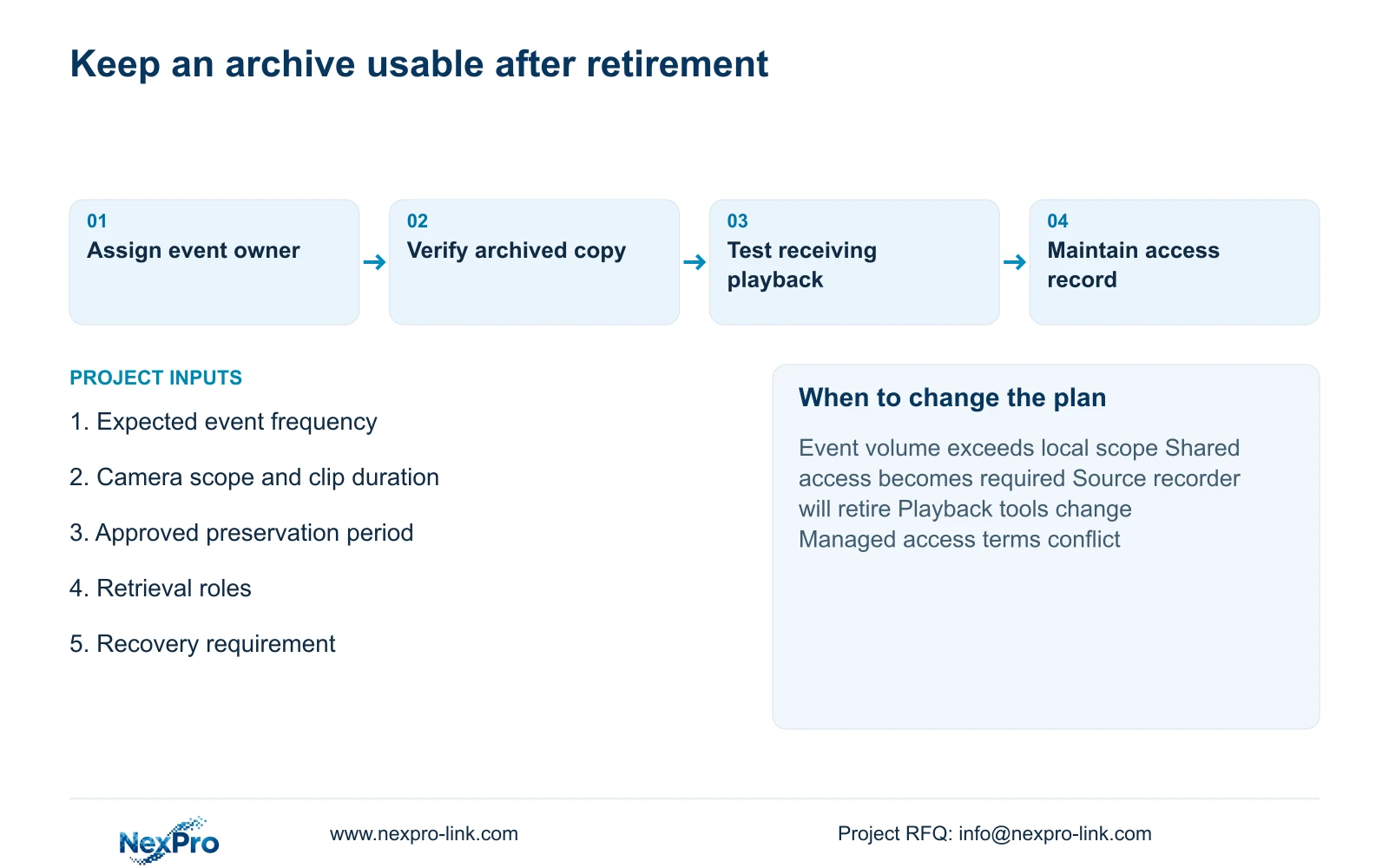
Test an archived event using its intended receiving environment. Confirm the selected camera identities, time window and useful context, together with the required player or format. Record the observed result and the person authorized to retrieve it. A successful export message does not demonstrate that the archive remains usable after the source recorder is retired.
Do not assume an old recorder disk will be readable in a replacement NVR. Preserve required material while the original system is usable and verify the archive before removing that source. Recovery planning should identify the supported playback tools and the approved location of any additional preservation copy. An array inside the recorder does not replace that independent task.
Compare the recovery scope as well as storage size. A managed service is worth considering when it meets a required recovery or controlled-access duty that the local arrangement cannot provide. If it lacks a suitable playback path or its access terms conflict with hotel requirements, retain or redesign the local option. Technical recovery checks do not establish legal admissibility.
| Retained outcome | Additional scope | When justified |
|---|---|---|
| Playable local events | Custody and playback records | Hotel staff can maintain the archive |
| Controlled shared retrieval | Supported managed access | Approved users need a shared workflow |
| Recovery after source retirement | Independent preservation and checks | Required events must outlast the recorder |
Section 06
Name the archive owner and its recurring work
Assign responsibility for event intake, capacity review and authorized access changes. The operating record should link the selected event to its approval, source and verified playback method. Include a clear path for staff changes so archive ownership does not remain with an installer or a departed employee.
Keep archive work distinct from routine NVR maintenance. Security staff can identify the event and request preservation; the authorized hotel role determines scope and period; IT or a designated service partner manages the supported storage path. Specify local work and ongoing services in the proposal. Coordinated equipment supply does not automatically include every platform function or site responsibility.
Recommend separate routine and selected-event budgets with a verified archive intake and recovery method. Change the archive path when event volume, approved users or required recovery makes the original arrangement inadequate. Send expected event frequency, camera/time scope, preservation period and intended retrieval roles to info@nexpro-link.com. NexPro-Link's hotel and BOQ support can discuss the recorder, equipment and supply boundaries without receiving guest footage or passwords.
Section 07
Buyer questions
Is remote app access an archive service? Not by itself. Confirm the actual storage destination, supported preservation workflow, access model and service terms. The ability to view an NVR remotely does not establish independent cloud storage.
Can archive capacity be quoted from the camera count alone? No. Selected-event capacity also needs event frequency, camera scope, clip duration and preservation period. Keep normal NVR retention in a separate calculation.
When should a local archive change to a managed path? When approved shared access or recovery duties exceed the local arrangement and a specified managed service meets them. Compare complete supported scope, including playback and recurring costs.
Engineering references
These sources support the general planning principles. Always use the selected product's current datasheet and applicable project standards for final design.