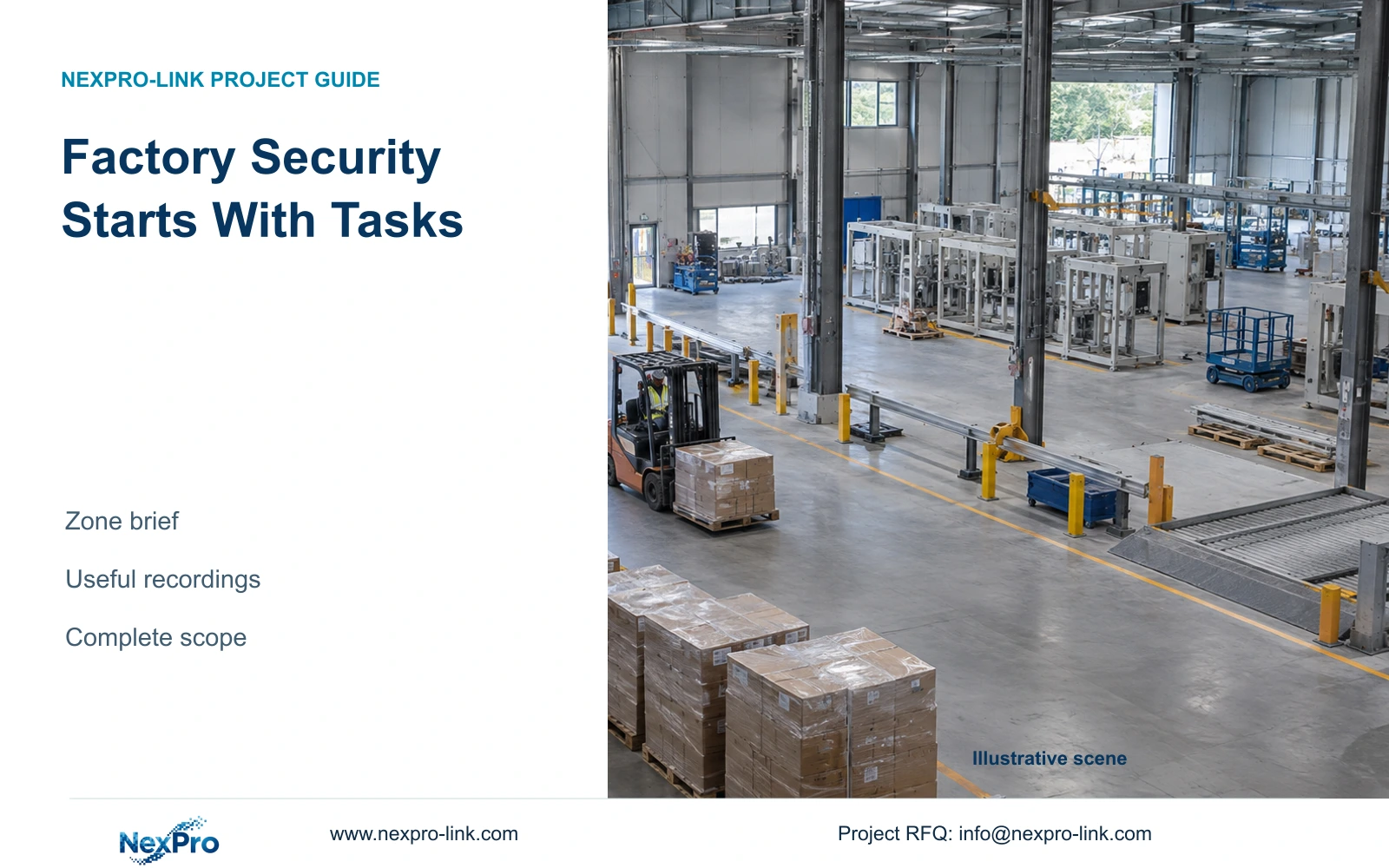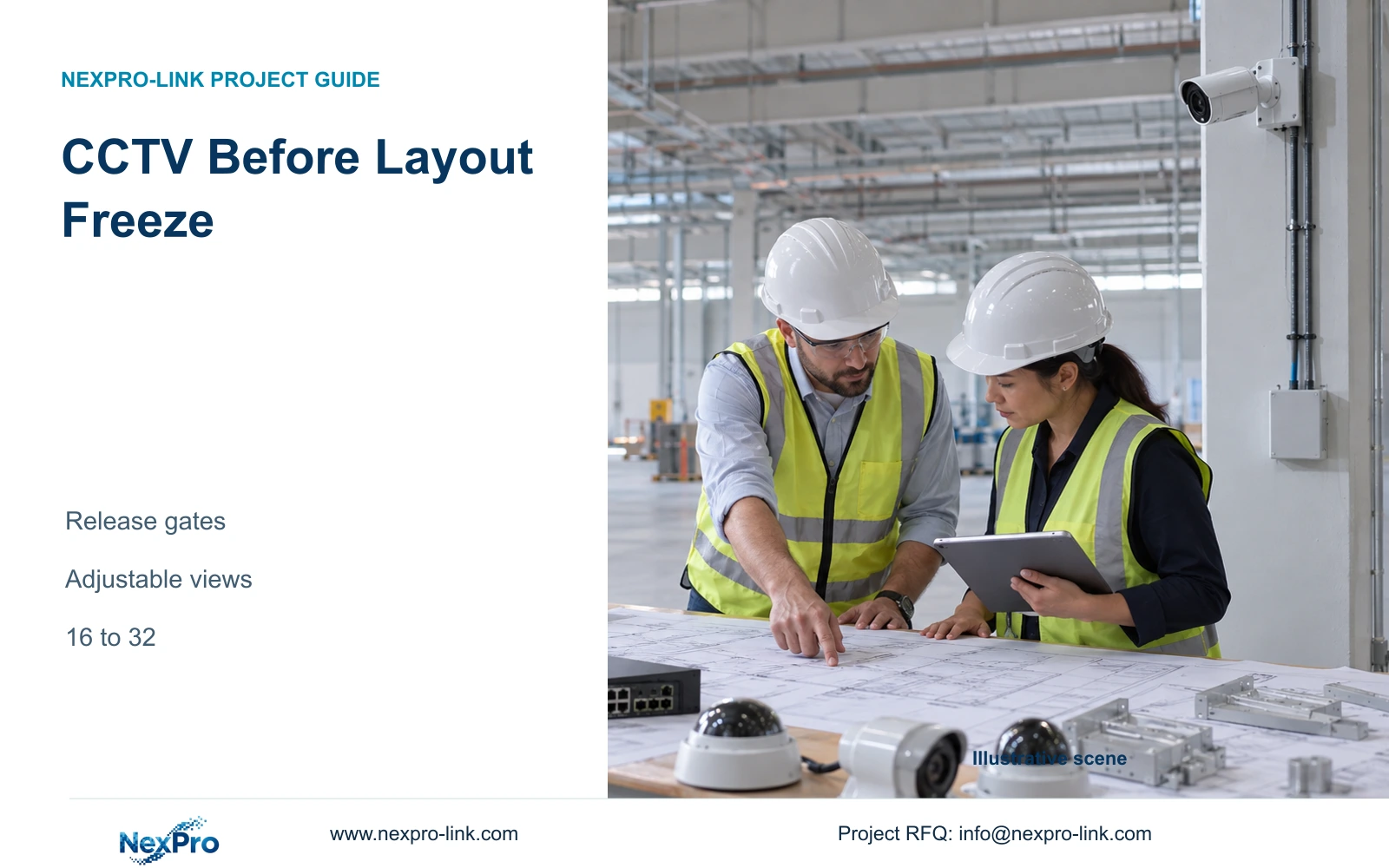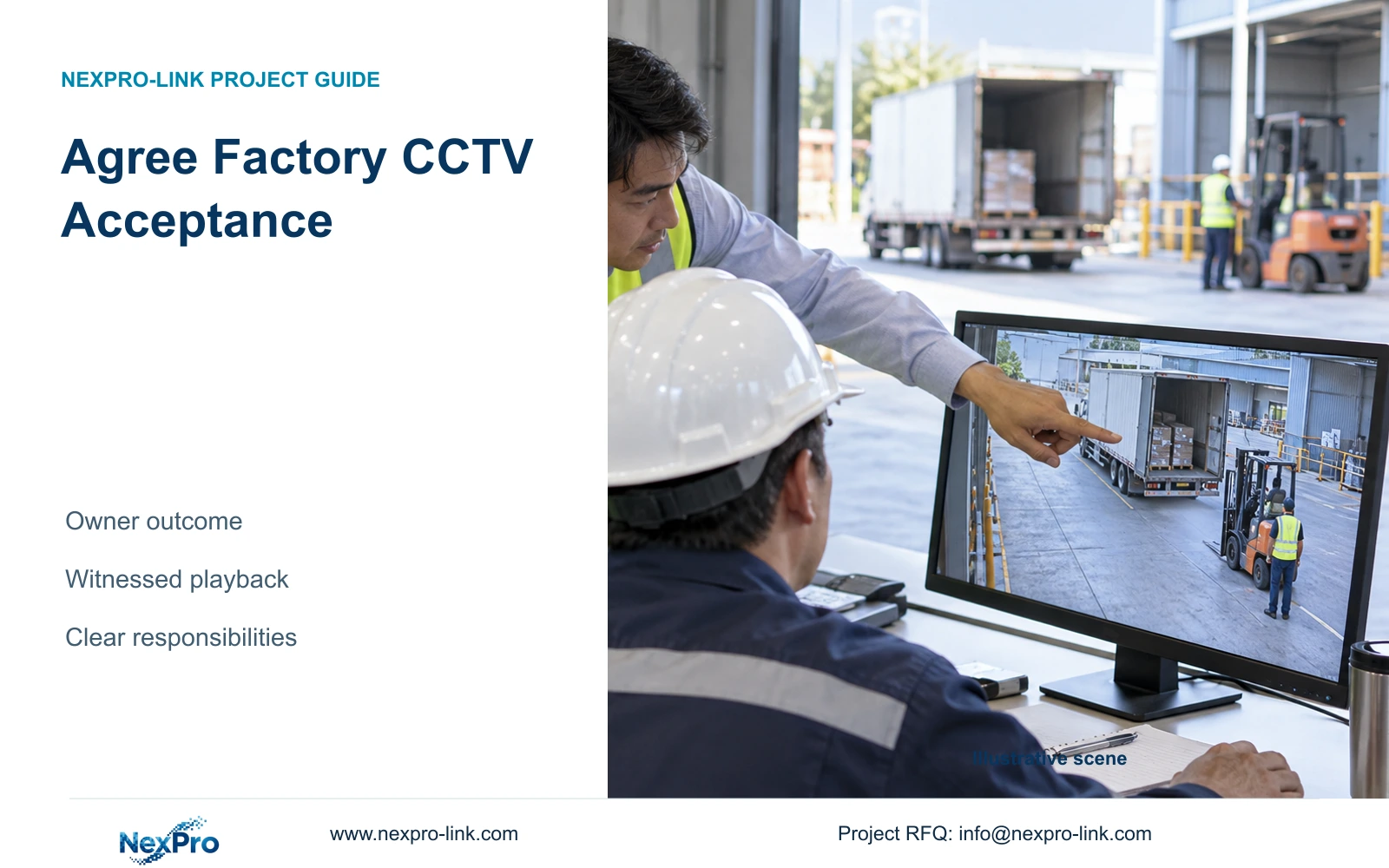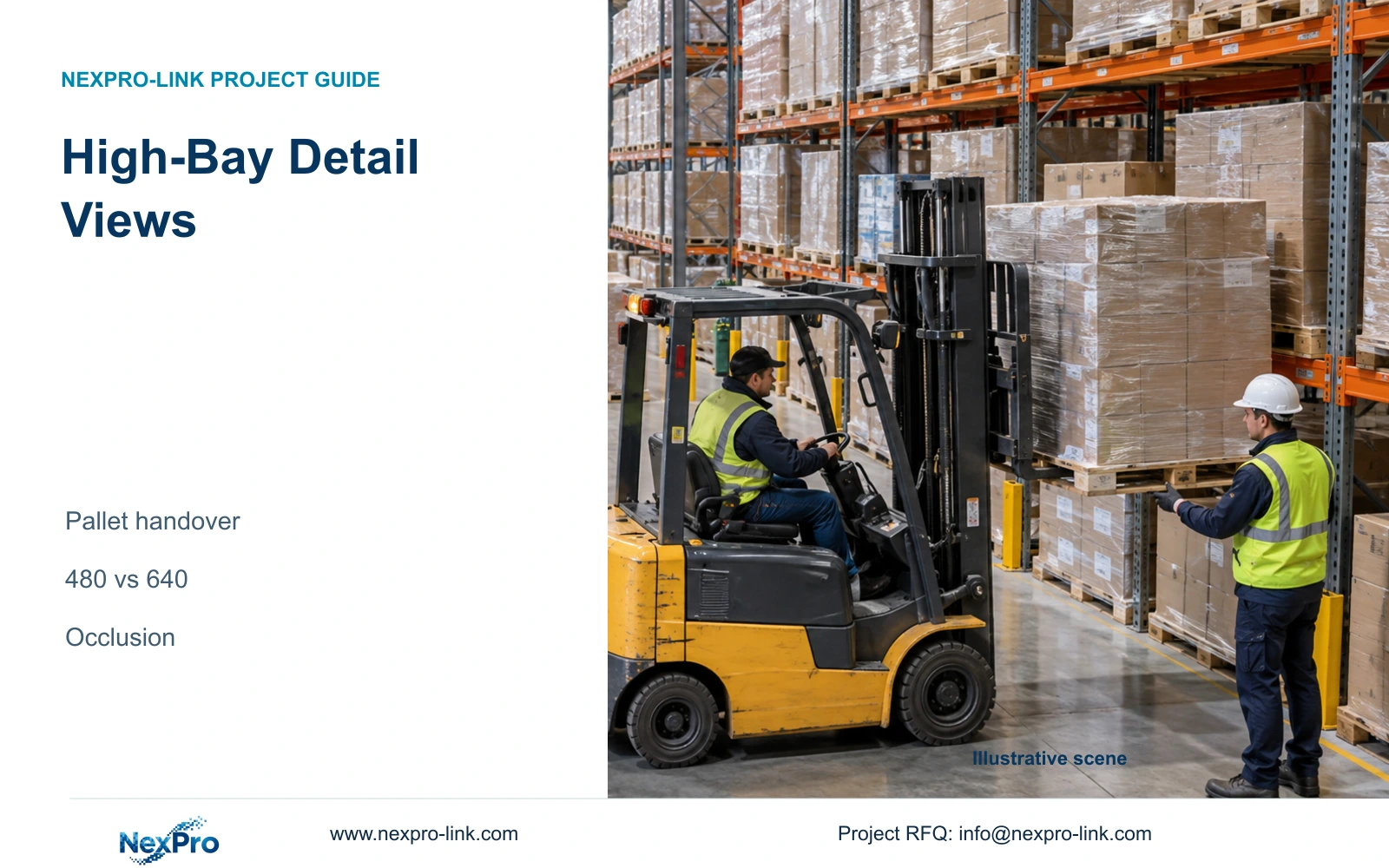
High mounting positions can show warehouse activity while missing the pallet identifier. Define the transfer plane, test occlusion and compare 480 versus 640 pixels per metre.
Section 01
Define the handover detail before choosing camera height
For a high-bay factory warehouse, place detail cameras around the actual pallet-transfer geometry and use roof-level views for movement context where useful. The required identifier must face the camera, occupy enough of the recorded image and remain visible during the handover. A high-angle panorama may show the route without resolving that detail.
Illustrative project scenario: The owner needs evidence of pallet handover, not just a view of activity from the roof. Assume pallets move between a rack aisle and a receiving or dispatch position. Their labels may sit at different heights, and a loaded forklift can obscure the lower part of the load. These are planning assumptions to test with representative goods.
Record the target's height range, face orientation, transfer width and nearest and farthest positions. Ask operations which detail resolves the business question: a shipment label, visible carton condition or the sequence of handling. Mark these requirements on a loaded-rack plan, together with cold-zone boundaries and available service-room locations. The engineer can then evaluate a view against a defined task instead of selecting mounting height from the building elevation alone.
Section 02
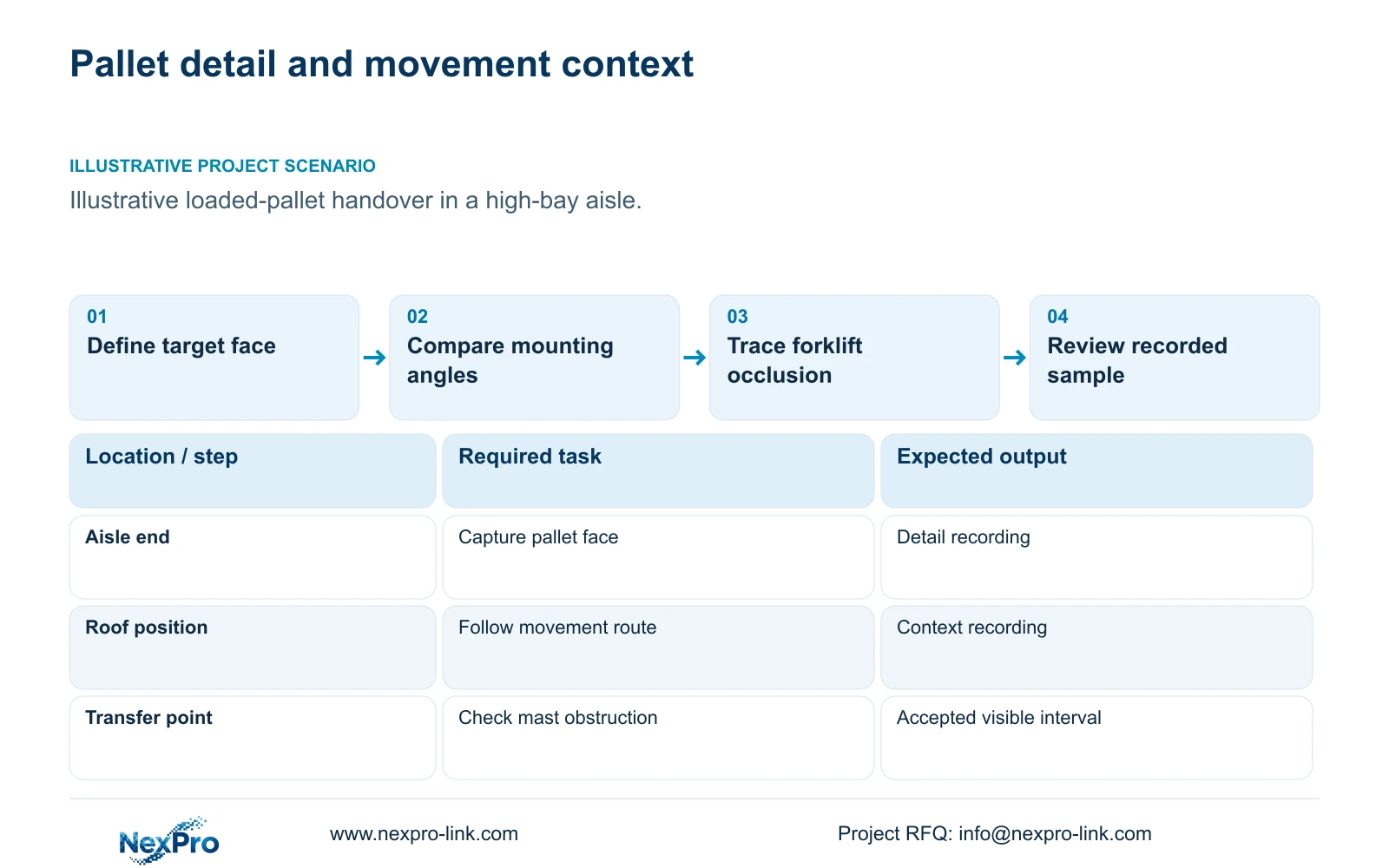
Compare aisle-end and roof views at the target
An aisle-end position can face the transfer zone more directly and allow a narrower field of view. Check whether it captures the required pallet face through the full movement, including approach and departure. A location that works only when a pallet pauses in one exact position needs that operating assumption documented and accepted.
A roof-level position can help an operator understand traffic direction, congestion or where a load moved after leaving the detail view. Evaluate it with the maximum loaded rack height, not the empty rack outline. Include overhead services, lighting and the access equipment needed to maintain the camera. Greater mounting height does not establish better visibility behind every obstruction.
Compare both options through recorded examples of the same handover, at the same operating times and with the intended compression settings. Display the roof context and aisle detail together during review, but inspect each recording at its useful image scale. A small multi-camera tile can conceal whether the source recording actually contains readable detail.
Section 03
Design around loaded forklifts and changing pallet faces
Trace the forklift approach, turning position, mast obstruction and loaded departure on the drawing. For each critical moment, identify which camera sees the relevant pallet face. Where the same obstruction blocks both proposed views, moving one camera or changing the transfer position is more useful than simply increasing resolution.
Use a representative loaded movement to decide whether a second angle is justified. The designer defines the missing part of the event; operations supplies the realistic route; the installer checks mounting and safe service access. Any additional camera should have a named task, its own route and a recording requirement. An unspecified extra overview adds cost without demonstrating that the hidden face becomes visible.
The illustrative CASE06 system separates 16 ordinary-area views from eight specialist cold-area views. Apply that separation where a high-bay aisle enters a cold chamber. Keep switches, recorder and batteries in a suitable warm room, while selecting cold-position cameras and connections independently. Moving an ordinary detail camera inside the chamber requires a fresh environmental decision, even if its lens provides a better angle.
Section 04
Calculate density from the listed output dimensions
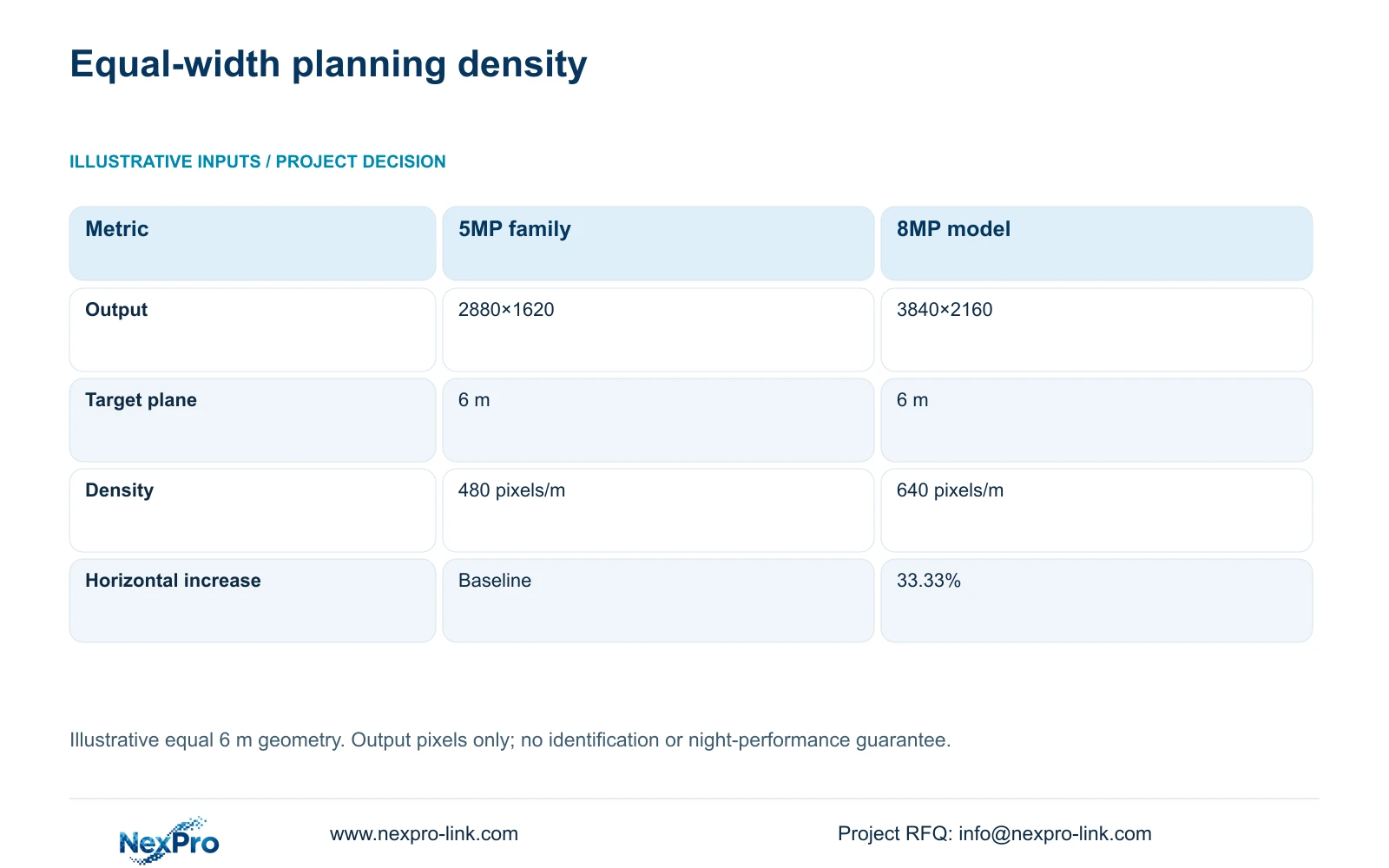
The BL2812M specification lists 2880×1620 for the 5MP-family main output and 3840×2160 for the 8MP model. Preserve those dimensions in the comparison. At an illustrative target plane 6 m wide, planning density is ppm = horizontal_pixels / 6. The resulting values are 2880 / 6 = 480 pixels per metre and 3840 / 6 = 640 pixels per metre.
Relative horizontal-density increase = (3840 / 2880 - 1) × 100 = 33.33%. The decisive difference comes from actual horizontal output width at equal geometry. The 5MP and 8MP family labels do not establish a 60% improvement in readable detail, and this arithmetic provides no comparative night-performance result.
Both bullet references list a 2.8–12 mm motorized lens, but the final target width needs confirmation for the selected model and position. Exposure, movement, focus, perspective and compression still determine usable recorded detail. Approve a sample against the real identifier rather than adopting a universal pixels-per-metre threshold that the supplied evidence does not establish.
| Metric | 5MP-family output | 8MP output |
|---|---|---|
| Listed dimensions | 2880×1620 | 3840×2160 |
| Horizontal pixels | 2,880 | 3,840 |
| Target width | 6 m | 6 m |
| Planning density | 480 pixels/m | 640 pixels/m |
Section 05
Allocate higher detail to the transfer task
Prefer a mixed view schedule: detail at the agreed handover, with overview only where it helps reconstruct movement. Select the higher-output model when a sample demonstrates useful additional detail at the required width. Retain the lower-output option where it meets acceptance, particularly for context views that do not need the same identifier detail.
Changing selected views to 8MP requires a recorder and network review. CASE06 assumes all 24 streams remain within selected supported 5MP-class recording modes, averaging 4 Mbps each for a combined 96 Mbps. Its 60-day video requirement is 62.208 TB. Those assumptions cannot be carried unchanged into an all-8MP redesign, and channel count does not establish simultaneous decoding capacity.
Compare alternative supplier packages using the same pallet faces, routes, lighting states and replay task. Include mounts, service access, additional cable drops and any specialist cold-zone equipment in the comparison. Keep required software or brand constraints where they apply. Without matched quotations and image trials, the geometry and resource schedule can support a selection method, but cannot establish a price winner.
Section 06
Make the handover test part of procurement
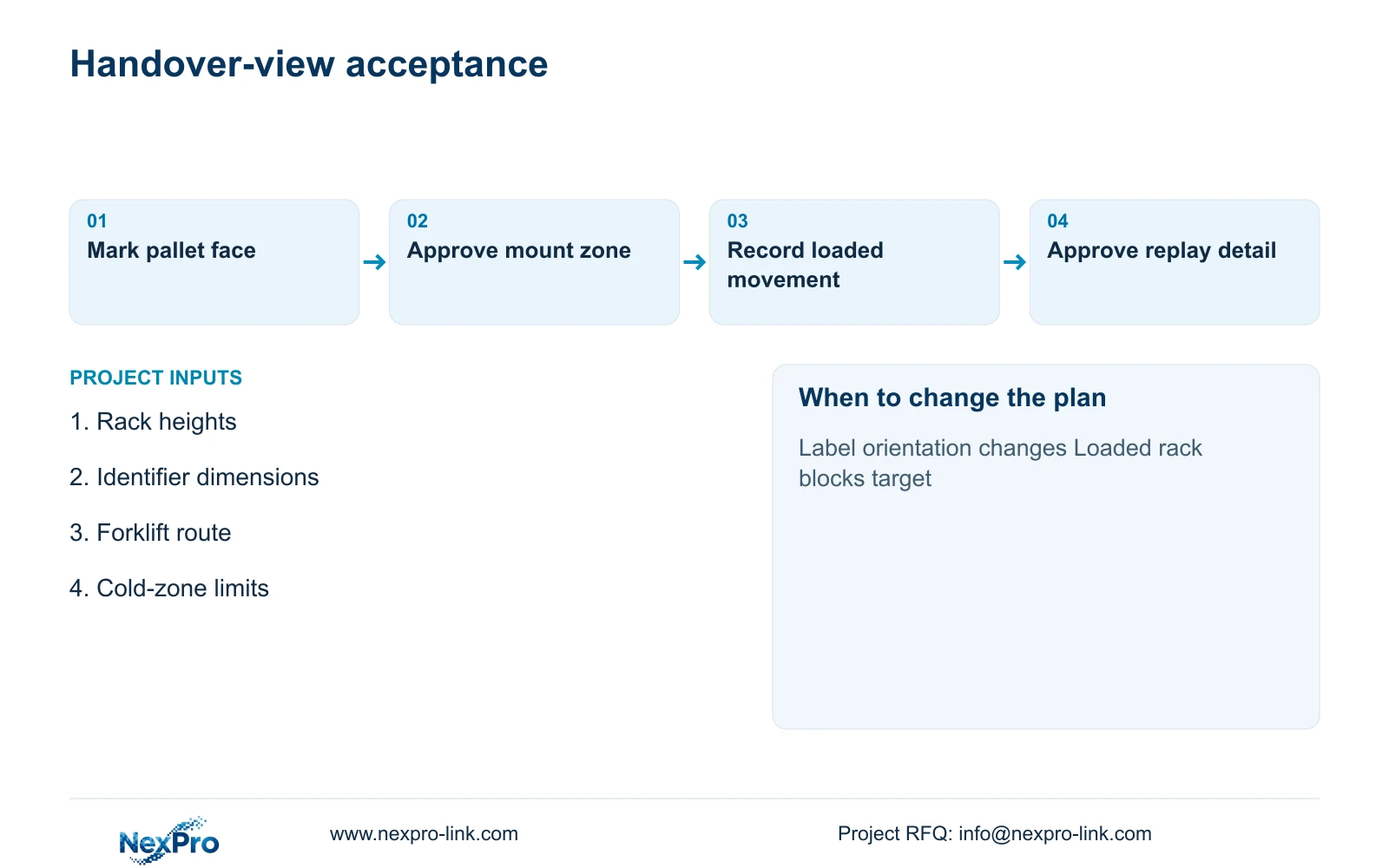
Attach a view-acceptance sheet to each critical location. It should identify the pallet face, target width, height range, route and expected obstructions, plus the recorded evidence to be reviewed. Separate installation checks from image acceptance: a working stream proves connectivity, while the moving loaded sample demonstrates whether the task is met.
Request a coordinated equipment schedule with camera role, selected output mode, mount, local access group and recorder assignment. NexPro-Link can discuss camera matching and BOQ documentation through its factory and warehouse project-supply scope. Location-based packing should distinguish aisle detail from roof overview so similar-looking units are not installed interchangeably.
Keep a service path to each mount and an accessible cabinet for the associated infrastructure. At commissioning, replay and export the sample from the intended operator station, then record any unresolved occlusion. A changed rack height, label position or forklift route should trigger a targeted view review before the owner relies on the recording for that handover.
Section 07
Buyer questions
Should every high-bay camera be 8MP? Only where the selected output improves an accepted task. An obstructed or badly angled identifier remains a geometry problem. Use representative recordings to justify upgrades at critical positions.
Can a motorized lens follow a moving pallet? The supplied lens range supports field-of-view adjustment. It does not establish pan-and-tilt tracking. Design a fixed view around the route or select a separately qualified tracking arrangement if the task requires one.
What should happen if labels face away from both cameras? Agree a visible transfer face with operations, add a justified angle or use the shipment record to establish identity. Do not approve label-reading capability from footage that never shows the label.
Section 08
Define a pallet-handover view package
Email your loaded-rack layout, pallet identifier dimensions and heights, forklift transfer route, and cold-zone boundaries to info@nexpro-link.com. NexPro-Link can discuss detail and overview roles with the corresponding equipment schedule.
Engineering references
These sources support the general planning principles. Always use the selected product's current datasheet and applicable project standards for final design.