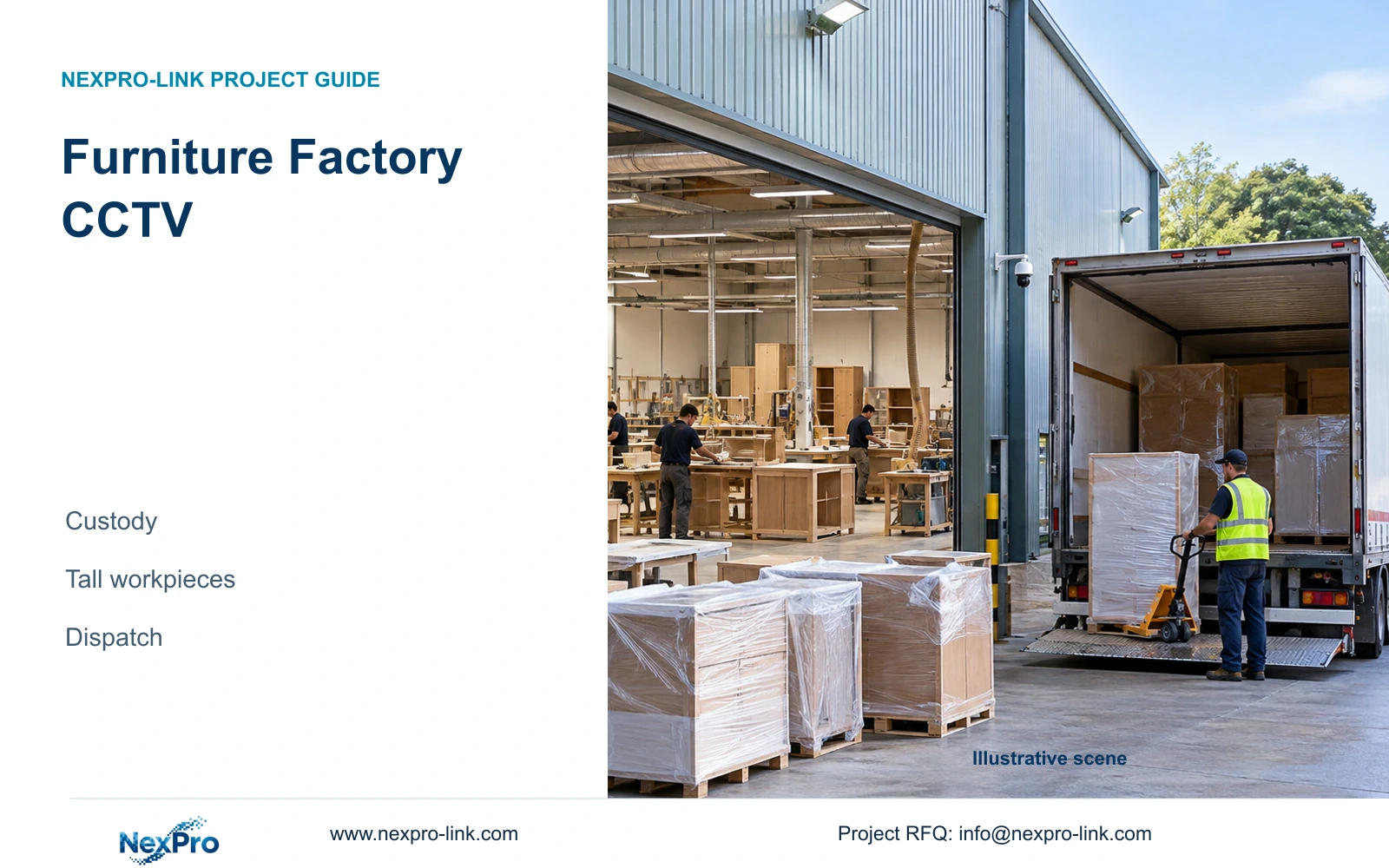
Furniture factory CCTV works best when each view follows a material handover. This guide connects stack geometry, environmental boundaries and recording scope to an RFQ-ready placement plan.
Section 01
Place cameras where material custody changes
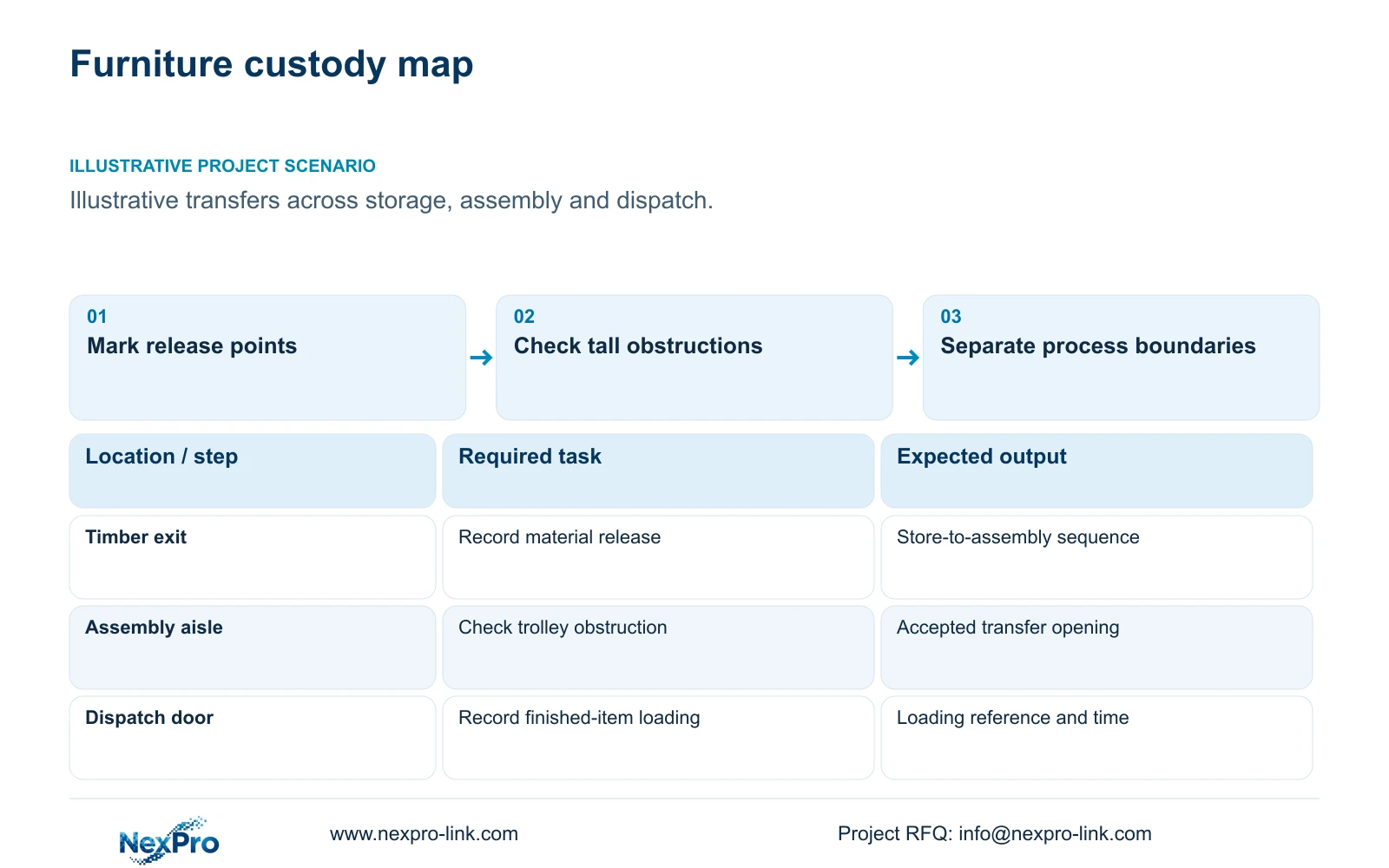
Furniture factory CCTV should follow transfers between timber storage, assembly and dispatch, with dedicated views wherever responsibility changes. Start with the event the owner needs to reconstruct: material released from a store, a workpiece delivered to assembly, or a finished item loaded for transport. Allocate ordinary cameras only to suitable locations. Sanding, extraction and finishing areas need their own environmental assessment before equipment is selected.
Illustrative project scenario: A furniture plant wants material and loading evidence across storage and assembly buildings. For planning, assume timber bundles move through a store exit, assembled furniture passes a shared transfer aisle, and finished products wait beside dispatch doors. These are hypothetical operating arrangements. The engineer should confirm them with production staff before drawing camera positions.
Create a transfer schedule showing the releasing location, receiving location, likely obstruction and record used to find the event. A warehouse issue time or dispatch reference can guide playback without assuming automatic software integration. If two teams use different door names, reconcile those names before configuring the recorder. Otherwise, usable footage can remain difficult to retrieve.
Section 02
Check tall workpieces at their maximum operating height
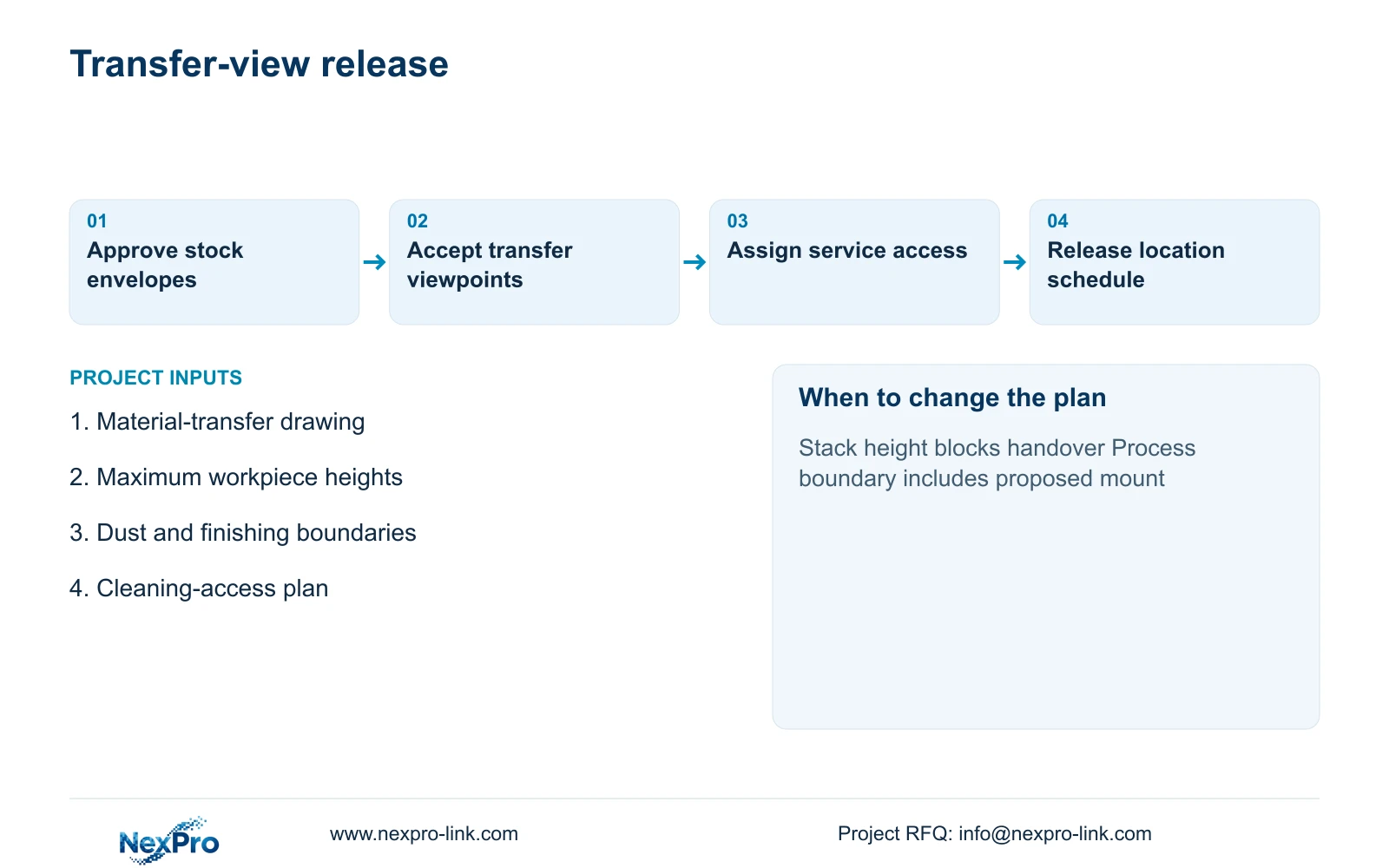
Draw the permitted storage envelope rather than the stack visible on survey day. Record maximum timber height, furniture dimensions, trolley positions and temporary staging areas. Check the sightline with those objects present. An elevated overview may show movement above a stack while missing the actual exchange at its base; a lower transfer view may capture the exchange but be blocked by the next trolley.
Use a separate handover view when the overview cannot retain the required detail throughout normal operation. Position it toward an agreed transfer opening, not across an unrestricted storage area whose contents will change. The operating team must accept any requirement to keep that opening clear. A camera plan depending on an unapproved clear aisle is an unresolved operational assumption.
The NexPro-BL2812M55-5MP-DIC-AI and NexPro-DM2812M55-5MP-DIC-AI provide ordinary-area references with 2.8–12mm motorized lenses. Their supplied 5MP-family specifications retain the listed 2880x1620 output and 25fps field. Lens adjustment can refine framing after installation, but it cannot see through furniture or establish a guaranteed identification distance. Validate the actual view using representative material movements.
Section 03
Separate process boundaries from security viewpoints
Overlay extraction equipment, dust-area information and finishing boundaries on the placement drawing. Ask the responsible process and safety designers to identify the applicable location conditions and verify current local requirements. The security designer should use that information to select or exclude positions, rather than infer a classification from the word woodworking or from the appearance of a clean workshop.
A practical planning choice is to observe the transfer outside a sanding enclosure while leaving interior process observation as a separate requirement. This preserves evidence of material entering and leaving without assigning ordinary equipment an unsupported protective role. If the external position falls within the actual classified boundary, moving outside the enclosure has not resolved equipment suitability.
For each accepted position, identify how the lens will be cleaned and the camera reached. Keep access equipment out of active handling routes where possible. Record who arranges an operational pause if service requires one. The resulting maintenance plan should address loss of visibility from deposits as well as physical replacement; CCTV does not replace extraction controls or machine guarding.
Section 04
Compare ordinary and specialist positions separately
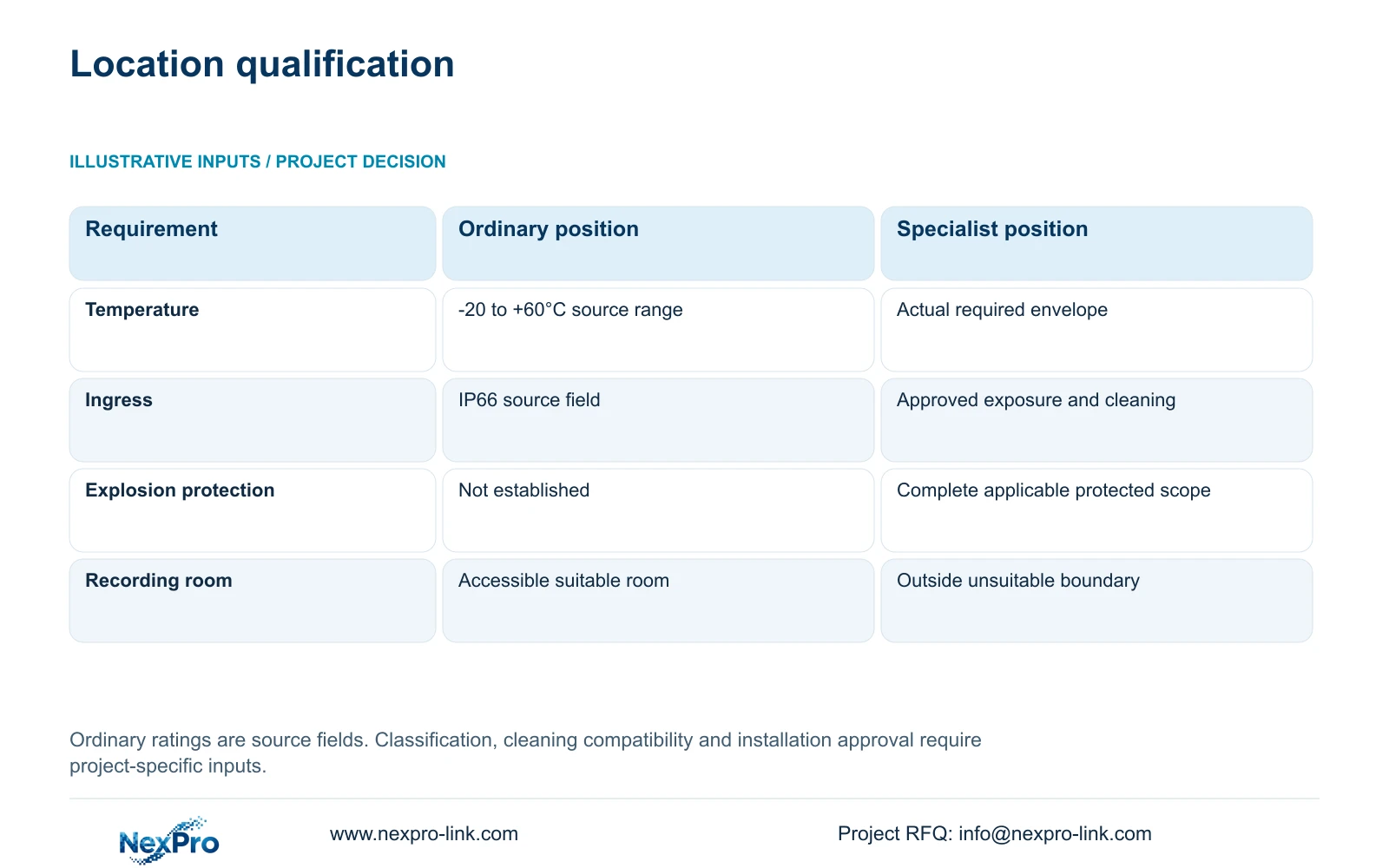
Use a conjunctive qualification method: location conditions AND complete product scope AND approved installation requirements must fit. A passing temperature field cannot compensate for an unsupported cleaning method or missing explosion-protection scope. The ordinary BL and DM references list IP66 and a temperature range of -20 to +60°C; those fields support only the corresponding documented product characteristics.
The decisive difference in the comparison is whether the proposed position fits ordinary equipment or requires a separately qualified assembly. This changes the camera, connections, service method and approval scope together. Price the timber-store transfer view as an ordinary-area task only after its location is accepted. Keep a finishing-area position separate if specialist protection remains necessary.
For suitable storage and assembly positions, match housing, mounting and lens access to the actual task. A Dome family name does not establish an IK rating. Likewise, IP66 does not establish chemical resistance, washdown compatibility or explosion protection. These distinctions prevent a visually similar camera from being offered against a materially different requirement.
| Decision | Ordinary transfer position | Specialist process position |
|---|---|---|
| Temperature | Source range: -20 to +60°C | Match actual required operating envelope |
| Cleaning | IP66 field; confirm cleaning exposure | Confirm method and material compatibility |
| Dust or finishing protection | Not established by ordinary camera PDFs | Complete applicable equipment and installation scope |
| Recorder location | Accessible suitable service room | Ordinary infrastructure outside unsuitable boundary |
| Quotation basis | Accepted transfer view and mounting | Protected assembly, interfaces and specialist services |
Section 05
Preserve the recording task when the layout changes
The preferred arrangement combines stable transfer views with enough overview footage to explain movement between buildings. Use local access switches and an approved backbone to reach the recorder; choose the recording location according to service access and the consequence of a link failure. An operator display is a client branch. A permanent display wall is unnecessary unless staff have an accepted simultaneous-viewing task.
CASE01 provides an illustrative infrastructure check, not a furniture-project quantity schedule. Its 32 ordinary cameras at an assumed average 4 Mbps produce 128 Mbps input. Video_TB = cameras × average_Mbps × 10^6 × 86400 × days / 8 / 10^12 gives 41.472 TB for 30 days. Four 16 TB disks provide a 48.64 TB recording budget using 64 × 0.95 × 0.80, already including formatting allowance and reserve.
That reference shows why adding transfer views affects more than camera price. Recheck recorder modes, storage, switch ports and power at the affected node. Obtain actual device demand before final PoE selection, and avoid counting camera power again when complete switch AC demand already includes it. Separate buildings may need separate protected power nodes; a central UPS does not automatically reach them.
Section 06
Issue a placement and maintenance schedule for quotation
Give every proposed camera a location ID, transfer purpose, environmental status and maintenance approach. Mark unresolved positions as provisional. The BOQ should distinguish ordinary supplied cameras, retained equipment, optional overview additions and specialist items assigned to another party. Include mounts, terminations and backbone interfaces against their actual locations rather than leaving them as an undefined accessory allowance.
NexPro-Link can discuss model matching, coordinated CCTV and related equipment lists, technical submittals and project packing. Its factory and warehouse project-supply scope provides an equipment coordination route; the buyer retains project approval and the local team confirms installation. Where OEM labels are requested, use the approved location IDs so cartons and equipment records follow the drawing.
Compare alternative bids against the same handover events, stock envelope, retention period and maintenance access. Preserve required platform integration or specialist protection in any substitution. A lower camera line price is not a complete comparison if the alternative omits a second transfer view, service access or the recording resources needed to retain it.
Section 07
Buyer questions
Can one assembly overview also prove the condition of every finished item? Only if the relevant surfaces remain visible at usable detail during the agreed movement. Large furniture, wrapping and trolleys can conceal condition. Specify a close handover task where needed and keep inspection records separate.
Should the camera schedule wait until every storage rack is installed? A provisional schedule can proceed using approved maximum stock envelopes and transfer routes. Hold final mounting and framing acceptance until representative obstructions can be checked, and identify which quantities remain subject to that check.
How should cleaning frequency be specified without site history? Start with an inspection-based maintenance plan and an assigned owner. Record visibility loss during initial operation, then adjust cleaning intervals to observed deposits and the approved cleaning method rather than inventing a universal interval.
Section 08
Define your furniture transfer views
Send your material-transfer drawing, maximum stock and workpiece heights, dust/finishing boundary information, and cleaning-access plan to info@nexpro-link.com to discuss a location-based equipment and maintenance scope.
Engineering references
These sources support the general planning principles. Always use the selected product's current datasheet and applicable project standards for final design.