After a charger or battery arrangement changes, link the change to camera, connector and maintenance-route IDs. Obtain the responsible engineer's updated location assessment before retaining the old equipment approval.
Section 01
Use the charging-system assessment to define camera suitability
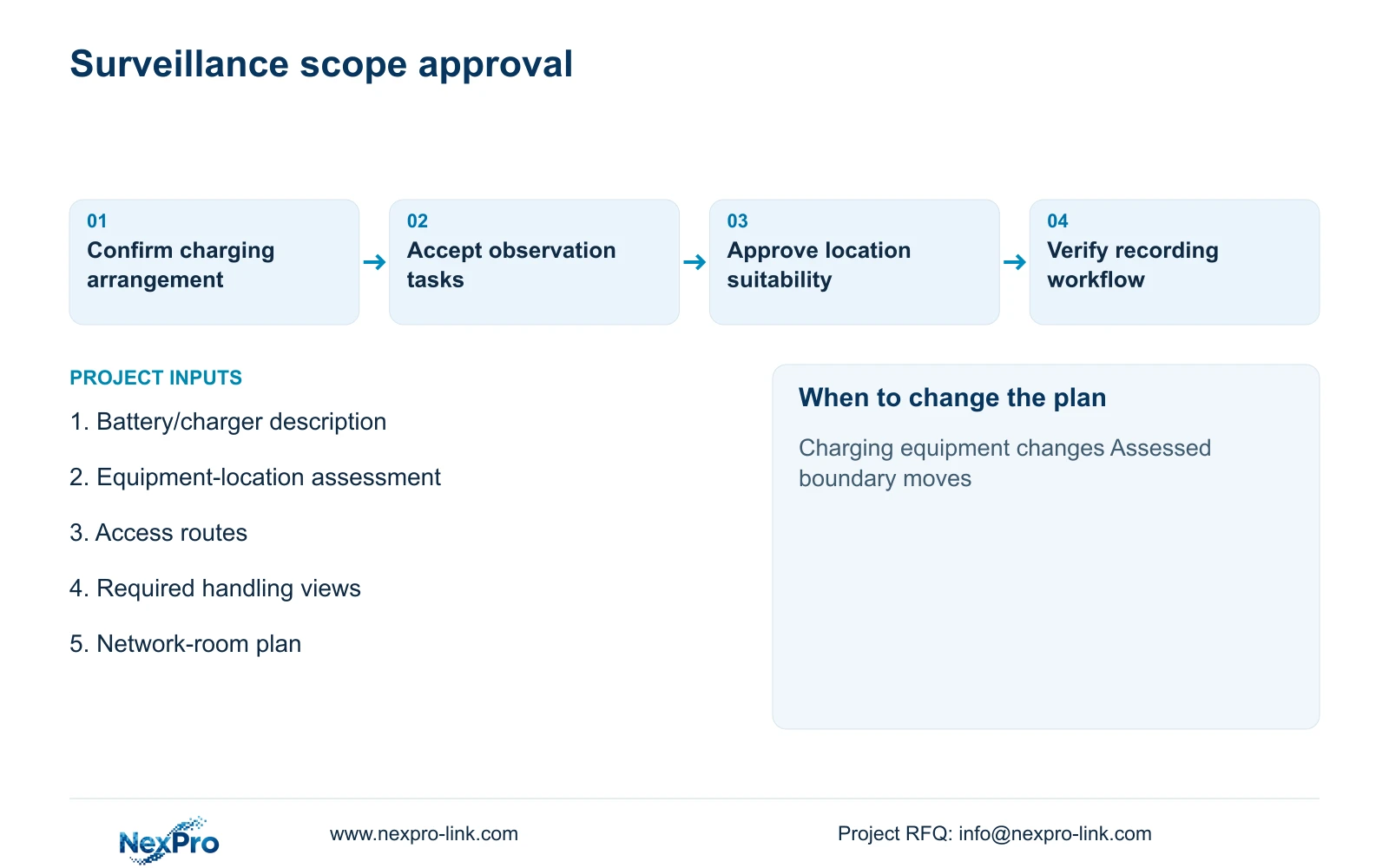
After a charger or battery arrangement changes, link the change to camera, connector and maintenance-route IDs. Obtain the responsible engineer's updated location assessment before retaining the old equipment approval. Keep unaffected entry views separate. This review does not specify charging ventilation, gas detection or protective-system settings.
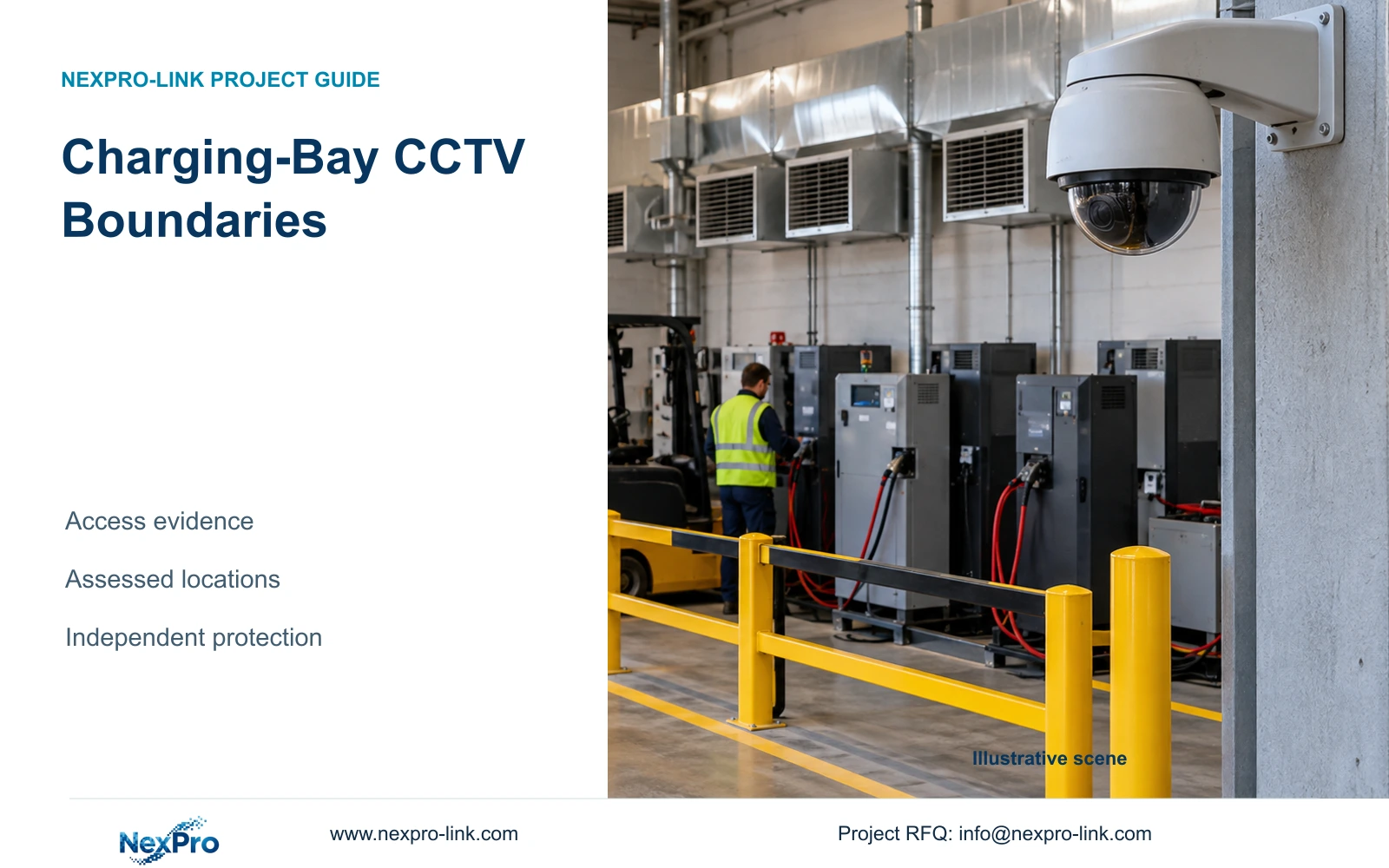
Forklift charging area CCTV should record authorised access, vehicle movement and relevant handling from positions suited to the site's assessed conditions. Obtain the actual charging-system information and location assessment before choosing equipment. General surveillance cameras do not provide ventilation interlocking, gas detection or fire protection, and their analytics should not become a protective control dependency.
Illustrative project scenario: A facility wants security footage around a battery-charging bay with its own electrical and ventilation requirements. Assume the owner needs to review entry, bay occupancy and departure. The battery type and approved equipment boundary remain inputs for the responsible engineering team, rather than facts inferred from the phrase charging area.
Request the charger and battery arrangement, equipment-location assessment, access routes and maintenance plan. Add the surrounding loaded-rack layout, cold-zone boundaries and network rooms if they affect the camera position or route. Identify who approves location suitability and who defines the surveillance task. Do not label every charging bay hazardous, or classify it as ordinary, from a generic warehouse drawing.
Section 02
Place views around approved entry and handling routes
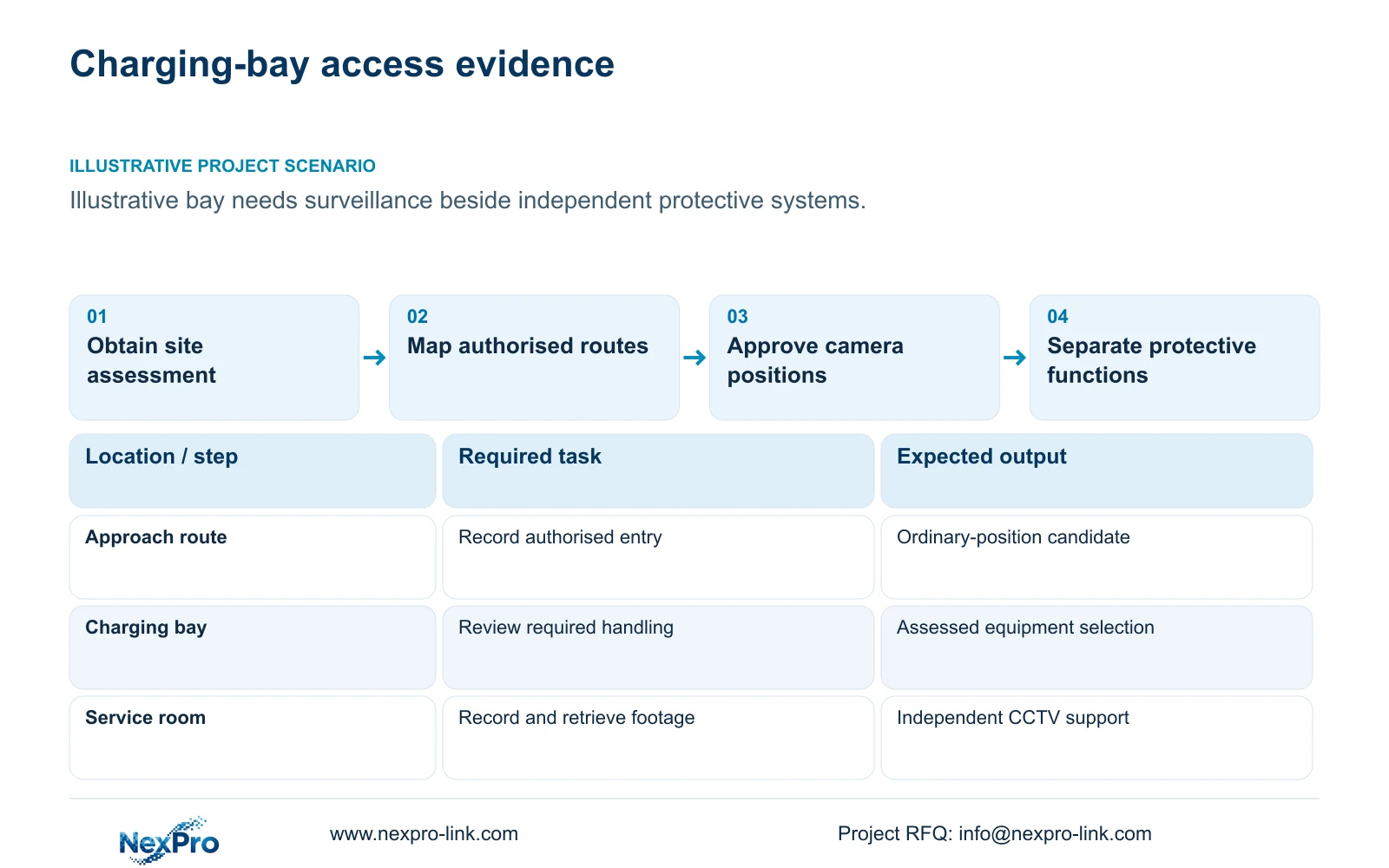
Start with the route into the charging area and the point where the vehicle occupies its assigned bay. Define whether the owner needs to identify a person, establish a forklift's movement or see a visible handling action. The selected view should capture the required target without demanding an unsupported reading distance or obscured connector detail.
Compare an ordinary-area approach view with an internal bay view. An approach camera can document arrival and departure while keeping equipment outside an unsuitable location, provided the approved position gives the required evidence. If the task includes activity hidden inside the bay, retain an appropriately qualified internal view rather than claiming the approach camera covers it.
Test with the forklift parked, its mast in the normal position and any adjacent equipment in place. Include service vehicles or temporary materials that operations permits nearby. Agree mounting and cable routes that do not obstruct the approved movement or maintenance path. Any position change across an assessed boundary needs technical review before the installer relocates the camera.
Section 03
Keep protective monitoring outside the CCTV dependency chain
Document the surveillance path as camera to access switch to recorder and authorised review client. Show protective monitoring and charging controls in their own project scope, with their own responsible designer. A loss of camera, recorder or viewing software must not be described as an accepted method of controlling ventilation or charging safety.
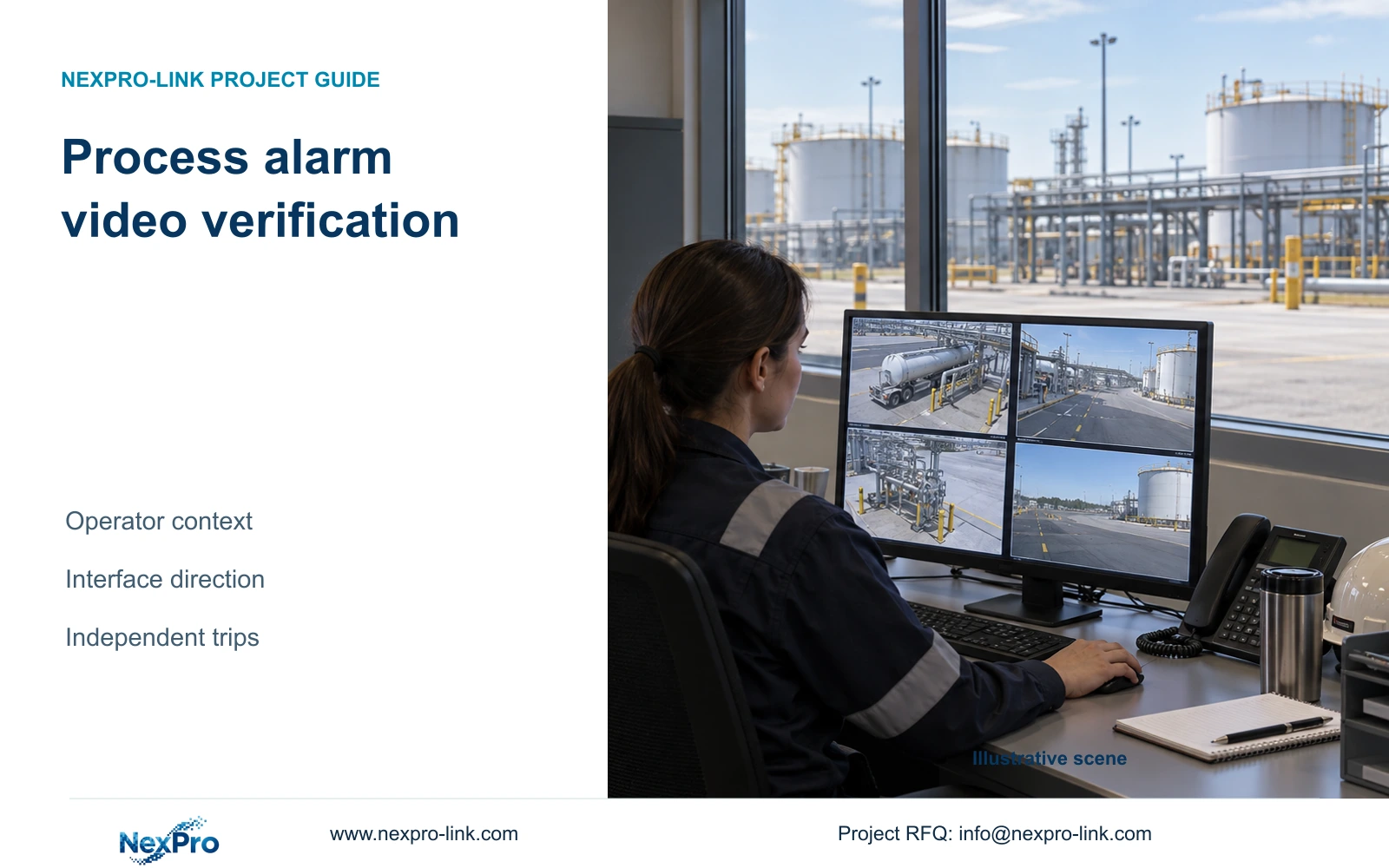
If the owner wants video associated with a protective-system event, define a separate visual-verification interface for review. Specify who supplies the event reference, how times are related and what happens when video is unavailable. The project should retain the protective action independently. Do not turn a human/vehicle notification or ordinary visible image into a gas, temperature or fire measurement.
Separate network permissions as well as equipment roles. NIST SP 800-82 Rev.3 provides an OT-security reference concerned with operational and safety constraints. Use that distinction to structure a review with the site's controls and IT teams; it does not qualify a proposed CCTV integration. Permit only the documented information path required for authorised review and leave control-system access outside the camera package unless specifically designed and approved.
Section 04
Approve locations through a complete qualification matrix
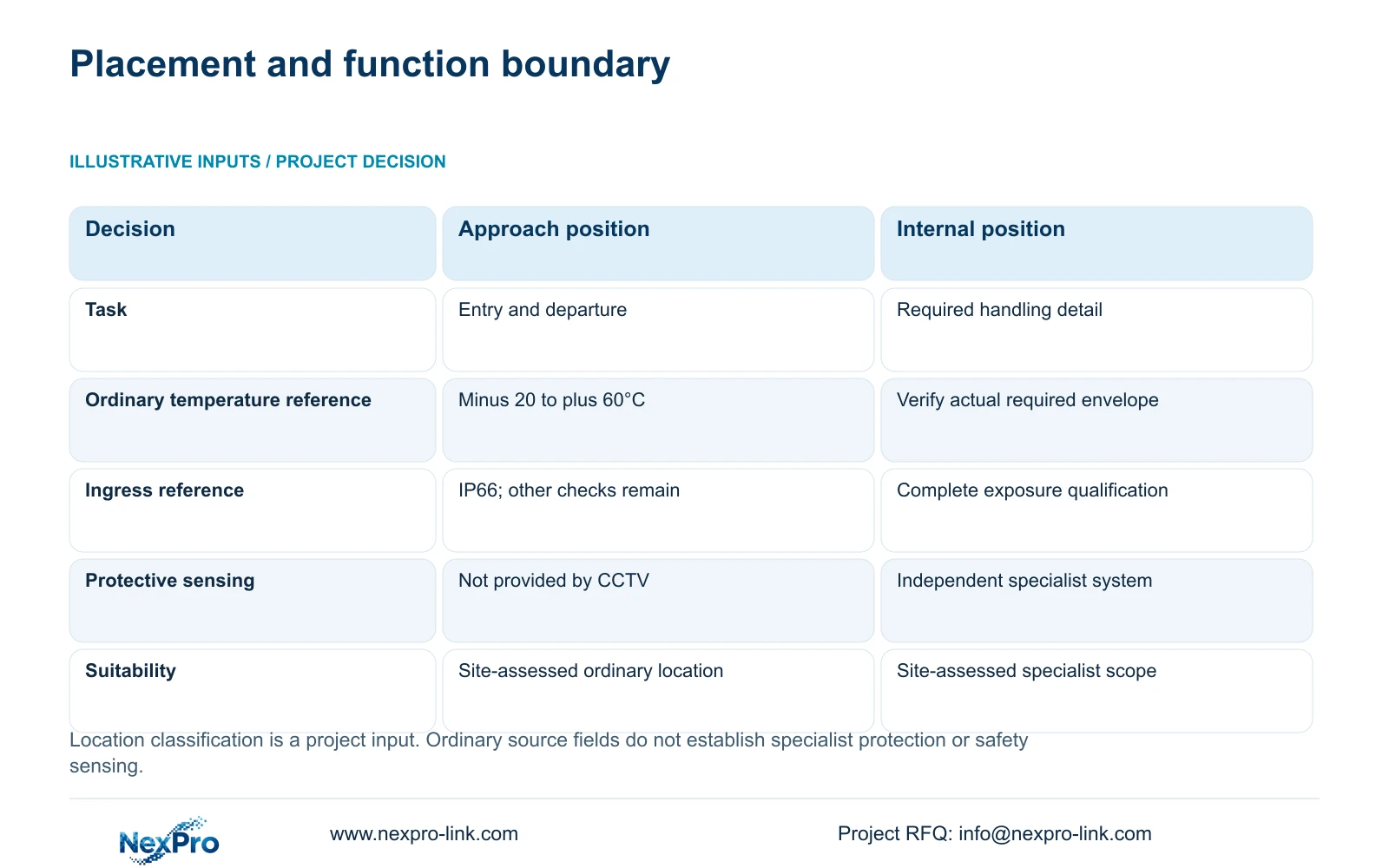
Apply the supplied qualification rule: location conditions AND complete product scope AND approved installation requirements must fit. An ordinary camera's ingress rating cannot override a missing specialist protection requirement. The table compares a suitable ordinary approach with a position that the site's assessment determines needs specialist equipment.
For an ordinary approach candidate, NexPro-BL2812M55-5MP-DIC-AI lists IP66 and minus 20 to plus 60°C, plus a 2.8–12 mm motorized lens and 2880×1620 output in its 5MP-family specification. These fields support a defined normal-area security role. They do not establish chemical resistance, washdown compatibility, explosion protection or a protective sensing function.
The decisive choice is whether the entire selected configuration meets the assessed position. A specialist camera still needs suitable connections, mounting and installation evidence for that scope. Responsible designers should verify current local requirements and any applicable classification. This matrix is a procurement boundary, not instructions for assembling a certified installation from unrelated components.
| Check | Ordinary approach view | Assessed specialist position |
|---|---|---|
| Temperature | Match listed equipment envelope | Match documented required envelope |
| Ingress and materials | IP66 alone leaves other checks open | Qualify actual exposure and materials |
| Additional protection | No specialist approval established | Applicable complete protective scope |
| Recording location | Suitable accessible service room | Keep ordinary infrastructure outside boundary |
| Observation task | Entry and departure evidence | Required internal handling evidence |
Section 05
Size surveillance support without including charger loads
Calculate the CCTV supply path separately from charger demand. List the selected camera maximum load, access-switch complete AC input, recorder, disks and required review equipment. If the switch input already includes PoE delivery, do not add the cameras a second time. The surveillance UPS quotation should state its protected circuits and exclude unrelated charging equipment unless a separate approved design includes it.
CASE06 is a cold-chain reference, not a charging-bay certification example. Its 16 ordinary views and eight specialist cold views demonstrate how to keep location-specific equipment separate while sharing recording infrastructure. The ordinary access groups assume eight devices at 12 W each; the specialist group assumes eight at 18 W each. These planning values cannot establish the demand of a charging-area specialist camera.
Retain the same separation if the charging bay belongs to a cold-chain warehouse. Record actual cold-transition conditions and specialist freezer loads independently. Keep recorder, switches and batteries in suitable accessible rooms, with working links to the assessed camera positions. A central UPS protects only equipment on its actual supplied circuits; it does not protect a remote node simply because the video reaches the same recorder.
Section 06
Release a surveillance package with explicit exclusions
Prefer ordinary-area views where they satisfy the access task and the engineering assessment permits the equipment. Retain qualified specialist positions where internal evidence is necessary. If a suitable external view cannot capture the agreed event, revise the camera scope rather than remove the event from the proposal without approval.
Compare supplier offers by the same route, recorded task, environmental boundary and services. Identify equipment supplied by the CCTV vendor, specialist items provided elsewhere, local installation work and any optional verification interface. Unknown specialist costs are unresolved inputs, not zero-cost omissions. Preserve owner-mandated platforms or protective requirements when presenting an alternative.
NexPro-Link can discuss normal-area camera matching, BOQ documentation and a coordinated factory-project equipment scope. Before release, obtain written project acceptance of the locations and responsibility split. At commissioning, demonstrate access recording, authorised replay and export, while the responsible specialists separately verify the charging and protective systems. Record a change trigger for any battery, charger, bay layout or assessed boundary revision.
Section 07
Buyer questions
Is every forklift charging bay a hazardous location? The CCTV schedule should use the site's actual engineering assessment. The charging-area label alone does not establish classification, suitable equipment or required protection.
Can CCTV be used to review a charging-system alarm? It can supply visual context through an approved review workflow. The protective-system response must remain independent, and unavailable video should be identified as unavailable rather than treated as clearance.
What changes should reopen camera suitability approval? A different battery or charger arrangement, revised ventilation or cleaning conditions, or a changed equipment boundary should trigger review by the responsible engineering team before substitutions or relocation.
Section 08
Define the charging-bay surveillance boundary
Send your charging-system description, assessed equipment-location drawing, required access/handling views, and network-room map to info@nexpro-link.com. NexPro-Link can discuss the ordinary surveillance package and clearly separated specialist interfaces.
Engineering references
These sources support the general planning principles. Always use the selected product's current datasheet and applicable project standards for final design.