Define post-alarm video review without requiring personnel to approach an uncleared battery area. Use authorized remote retrieval where the installed system supports it; preserve the relevant interval and note unavailable channels.
Section 01
Define the security evidence before assigning safety duties
Define post-alarm video review without requiring personnel to approach an uncleared battery area. Use authorized remote retrieval where the installed system supports it; preserve the relevant interval and note unavailable channels. Let the responsible safety team determine site access. Footage provides visible context, not battery condition, a cause diagnosis or permission to re-enter.
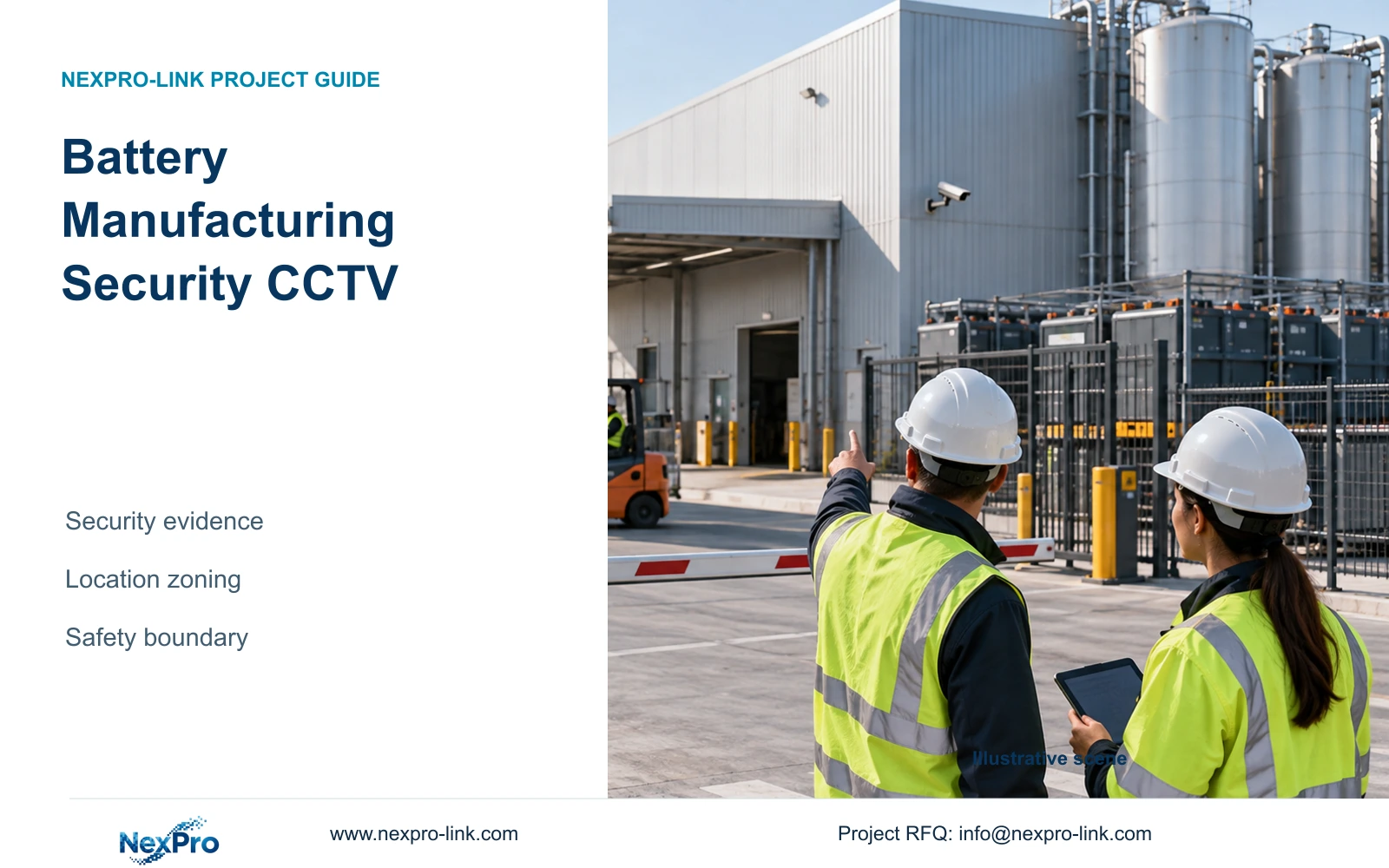
Battery manufacturing security CCTV should record access, custody and material movement in suitable locations. Thermal-runaway protection, fire detection and production safety require separately defined specialist systems. Start the camera schedule with the event an operator must review, the location where it occurs and the record used to identify it. A camera watching a storage doorway can support an access investigation; that view does not establish the condition of the batteries inside.
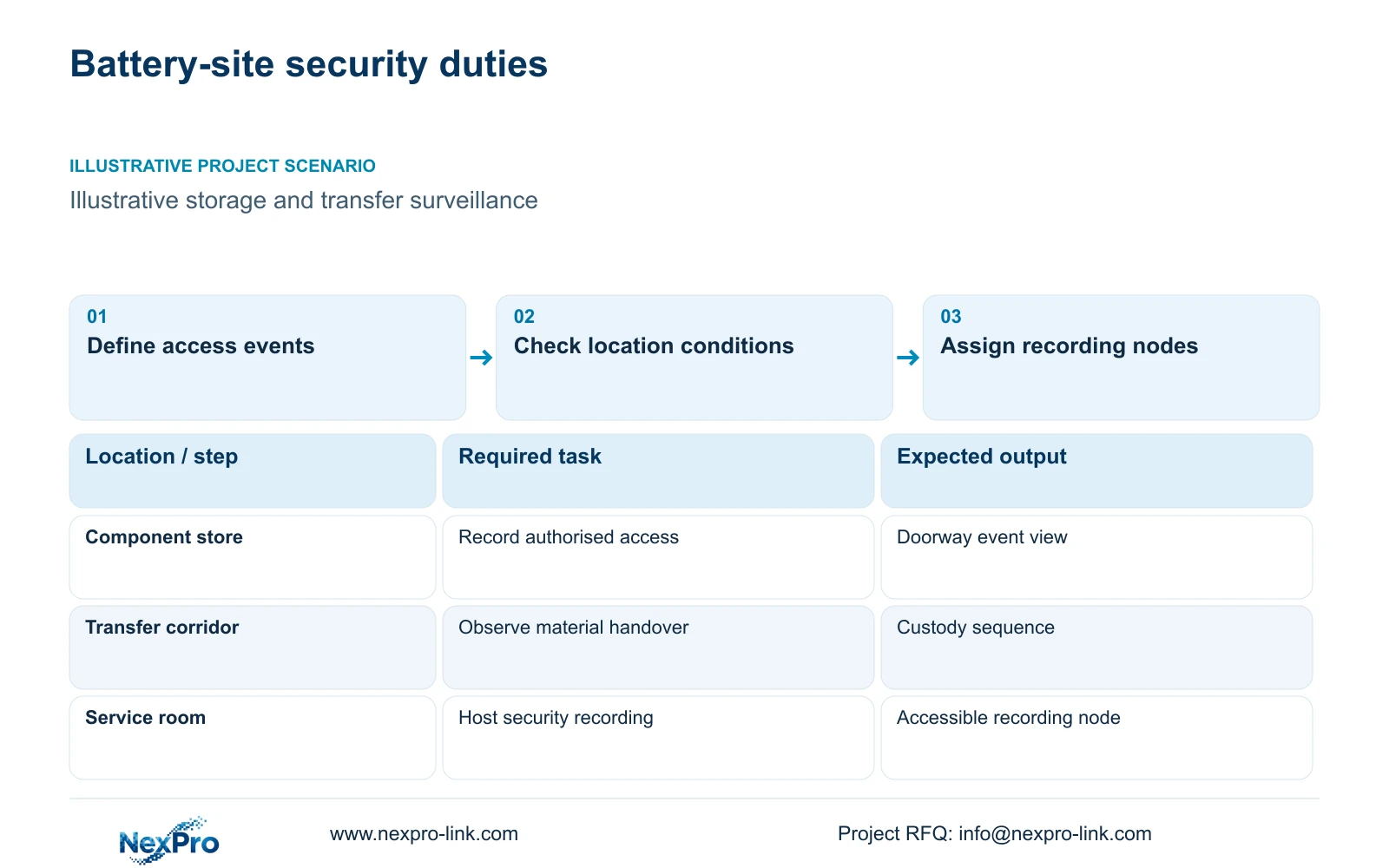
Illustrative project scenario: A battery manufacturer wants access and material-transfer footage around production and storage buildings. Assume the initial brief covers component-store entrances, transfer corridors and dispatch handovers, with safety-system responsibilities assigned elsewhere. These are planning assumptions, not a completed installation. The design engineer should mark each requested view as ordinary security, specialist-location surveillance or excluded safety duty before quantities enter the BOQ.
Give the owner an acceptance statement for each security event. For a transfer doorway, it might require visible arrival, handover and departure from an agreed viewing position. Keep temperature measurement and alarm response out of that statement unless a separately qualified package explicitly supplies them. This prevents an ordinary video demonstration from being accepted as evidence that the thermal protection design is complete.
Section 02
Qualify the mounting position and its complete route
Obtain the location-classification drawing and the operating conditions for every proposed camera position. Record temperature, cleaning method, corrosion exposure, condensation and maintenance access independently. A normal-looking corridor can share a boundary with a controlled process area; the appearance of the room cannot settle the equipment decision. Where classification remains unresolved, keep the affected line provisional rather than assigning an ordinary camera by default.
Assess the bracket, connections, cable route and service location as part of the same position. Moving the camera outside a restricted area may preserve the doorway view, but it can change the angle, mounting distance and cable path. The engineer should compare that external position with a specialist internal position against the same observation task. If the external view loses the handover, it is not an equivalent scope reduction.
The qualification rule is conjunctive: location conditions AND complete product scope AND approved installation requirements must fit. One passing field cannot override another. The responsible local team must verify applicable requirements for the actual site; an archived jurisdiction-specific reference does not establish current obligations elsewhere.
Section 03
Keep recording equipment accessible and outside unsuitable areas
Locate recorders, switches and batteries in service spaces suited to their operating, charging and maintenance conditions. Draw the data path from camera to local access switch and recorder, then show authorised viewing as a separate branch. Draw the protected electrical circuits independently. A central viewing connection does not mean a central UPS supplies the distant camera or its local switch.
CASE05 provides an illustrative infrastructure reference from solar-module manufacturing: three buildings, each with 32 cameras and local recording. Its distributed arrangement can inform a battery-site discussion, but its 96 ordinary positions do not determine battery-factory quantities or environmental suitability. Adopt the separation of nodes only after matching actual storage buildings, transfer routes and service access.
For outage planning, list the camera supply, complete switch AC input, recorder, disks and necessary link equipment at each node. Do not add camera demand again when it is already included in the switch input. The safety-system supply remains outside this security load schedule. Also identify which local recording continues if the backbone fails and which remote review functions become unavailable.
Section 04
Choose ordinary or specialist equipment by location
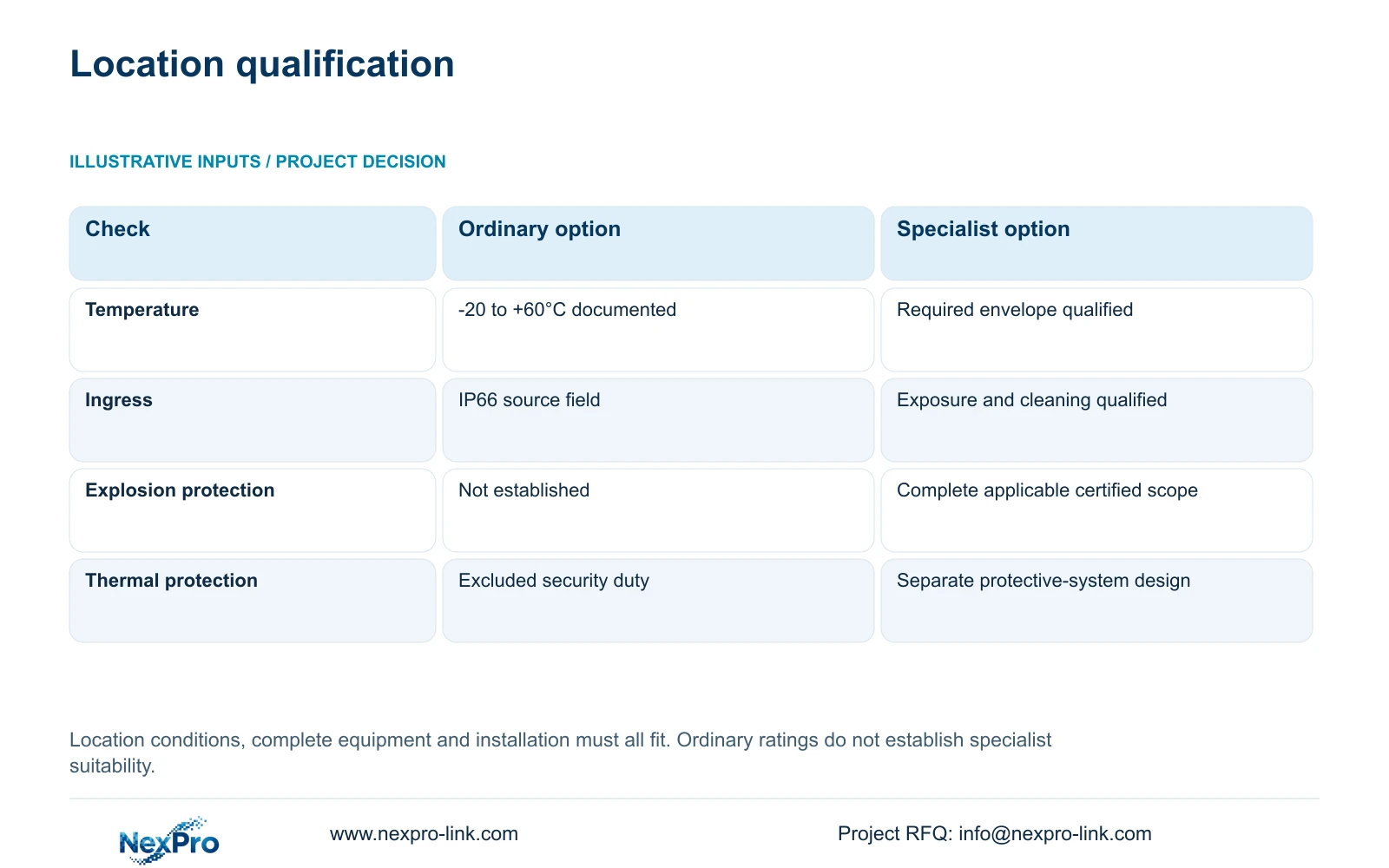
The BL2812M and DM2812M ordinary camera references list IP66 and an operating temperature field of -20 to +60°C. These fields support an initial comparison for suitable security locations. They do not establish chemical resistance, cleaning compatibility or explosion protection. The following matrix turns those limits into purchasing choices for the illustrative battery plant.
The decisive difference is the required duty and environmental qualification. An ordinary camera at an approved transfer corridor may provide the requested security view. A position requiring specialist protection needs the applicable complete equipment and installation scope, even if both proposals offer similar video resolution. Keep that specialist line visible when comparing prices.
For an ordinary detail view, NexPro-BL2812M55-5MP-DIC-AI lists a 2.8-12mm motorized lens, PoE and a 5MP-family output including 2880x1620 at 25fps. Use that documented output in the camera schedule. Confirm the actual view through recorded samples; neither the family label nor motorized focusing establishes battery-condition detection.
| Decision | Ordinary-location option | Specialist-location option |
|---|---|---|
| Temperature | Compare with documented -20 to +60°C | Specify the required operating envelope |
| Cleaning and exposure | IP66 plus separately checked materials | Qualify cleaning, corrosion and condensation |
| Classified position | Protection not established by ordinary PDF | Applicable complete certified scope |
| Recording equipment | Accessible suitable service room | Keep ordinary infrastructure outside unsuitable areas |
| Thermal safety duty | Excluded from security camera acceptance | Separate validated protective-system design |
Section 05
Recommend a security package with explicit exclusions
The preferred basis is ordinary-area CCTV for approved access and transfer tasks, with specialist surveillance and thermal protection retained as separate scopes. This preserves useful operational evidence without transferring safety responsibility to the security supplier. The owner should approve the event schedule, while the engineer resolves location suitability and the quantity surveyor keeps exclusions and provisional items identifiable.
Change the recommendation if the only usable view lies inside a specialist area, if an existing platform requires a specific interface, or if the owner needs a function absent from the proposed package. A qualified incumbent system may need to remain in place. Compare alternatives by the accepted event, operating conditions, retention and integration workflow, including local services rather than camera prices alone.
A display wall is optional for this decision. A review screen may meet the access-investigation task without continuous multi-window monitoring. If operators require simultaneous views, define the display and decoding workload separately. Additional viewing equipment must not silently change the recording stream or consume backup capacity reserved for essential security nodes.
Section 06
Release an evidence package with named responsibilities
The supply schedule should distinguish new ordinary cameras, retained specialist systems, optional displays and local installation work. Attach the approved view description to each camera ID. Record who confirms environmental suitability, who installs the cable route and who accepts playback and export. A specialist system excluded from the equipment quotation should still have a named project owner so it cannot disappear between contracts.
NexPro-Link's factory project and BOQ support scopes provide a route for discussing model matching, technical submittals and coordinated equipment supply. For this project, preparation should focus on camera identities, node allocation and packing labels that match the approved drawings. OEM packaging can be considered after technical configuration is fixed; branding does not alter environmental qualification.
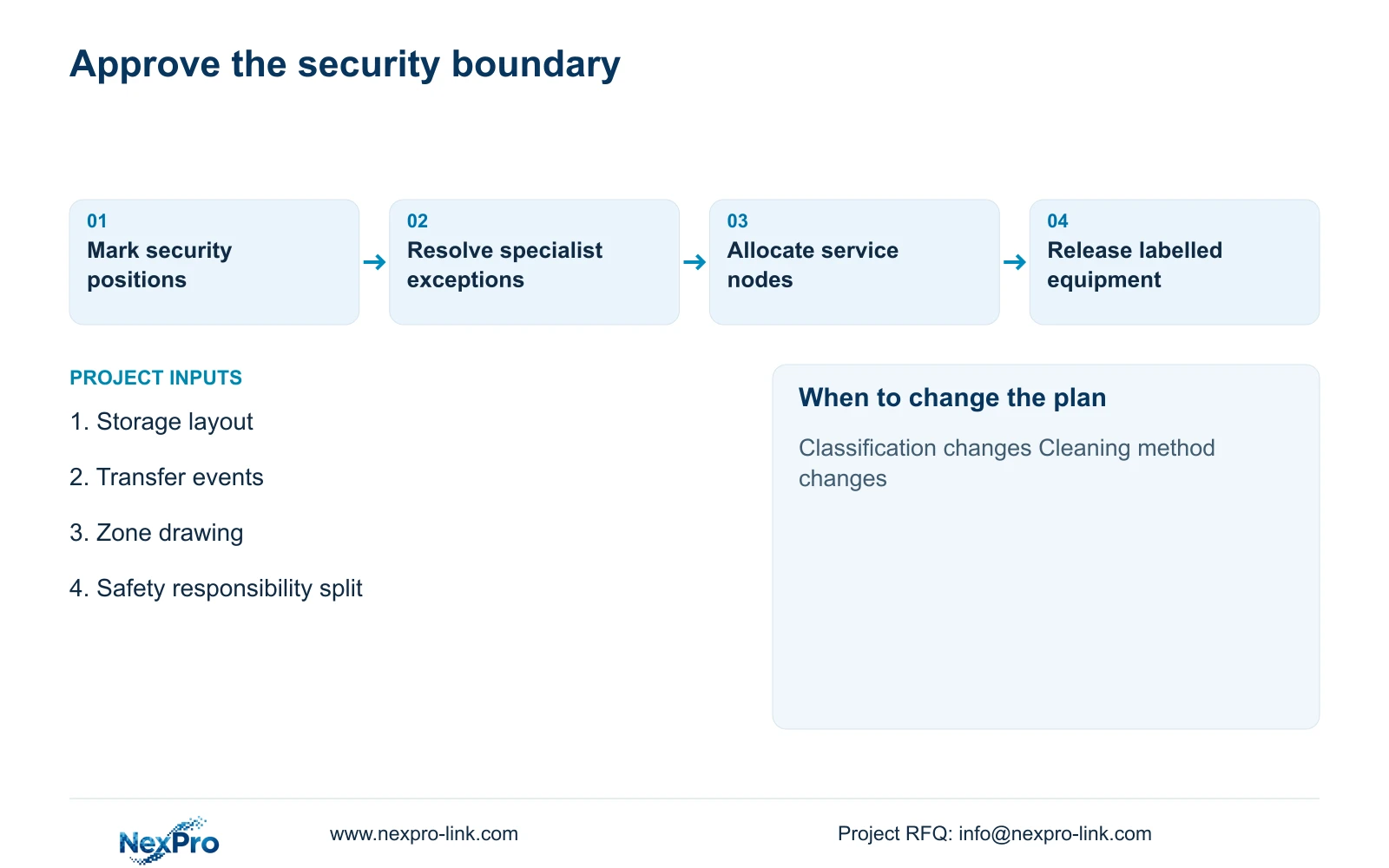
Before shipment, reconcile the ordinary-area list against the latest zone drawing. A changed storage process or cleaning procedure can invalidate a previously suitable position. Hold only the affected selection for resolution, while retaining approved work elsewhere. The handover result should be an operational evidence package with specialist safety duties expressly excluded and their separate responsibilities recorded.
Section 07
Buyer questions
Can we quote ordinary areas before every specialist position is resolved? Yes. Issue the approved ordinary-area schedule separately and identify unresolved specialist positions as provisional or excluded lines. Do not let their omission imply that the full factory scope has been satisfied.
Does moving a camera outside a classified area settle the design? It creates a candidate position. The responsible team must still check the mounting location, connections, route and recorded view. A safer service position that loses the required event may need a different design.
Should a competitor's thermal camera be compared with an ordinary security camera? Only for a genuinely shared surveillance task. Any required temperature or protective-system duty must remain separately specified and qualified; matching resolution does not make the systems equivalent.
Section 08
Define your battery-site security boundary
Send your storage and transfer layout, location-classification information, required security events, and safety-system responsibility split to info@nexpro-link.com to discuss the appropriate equipment and documentation scope.
Engineering references
These sources support the general planning principles. Always use the selected product's current datasheet and applicable project standards for final design.