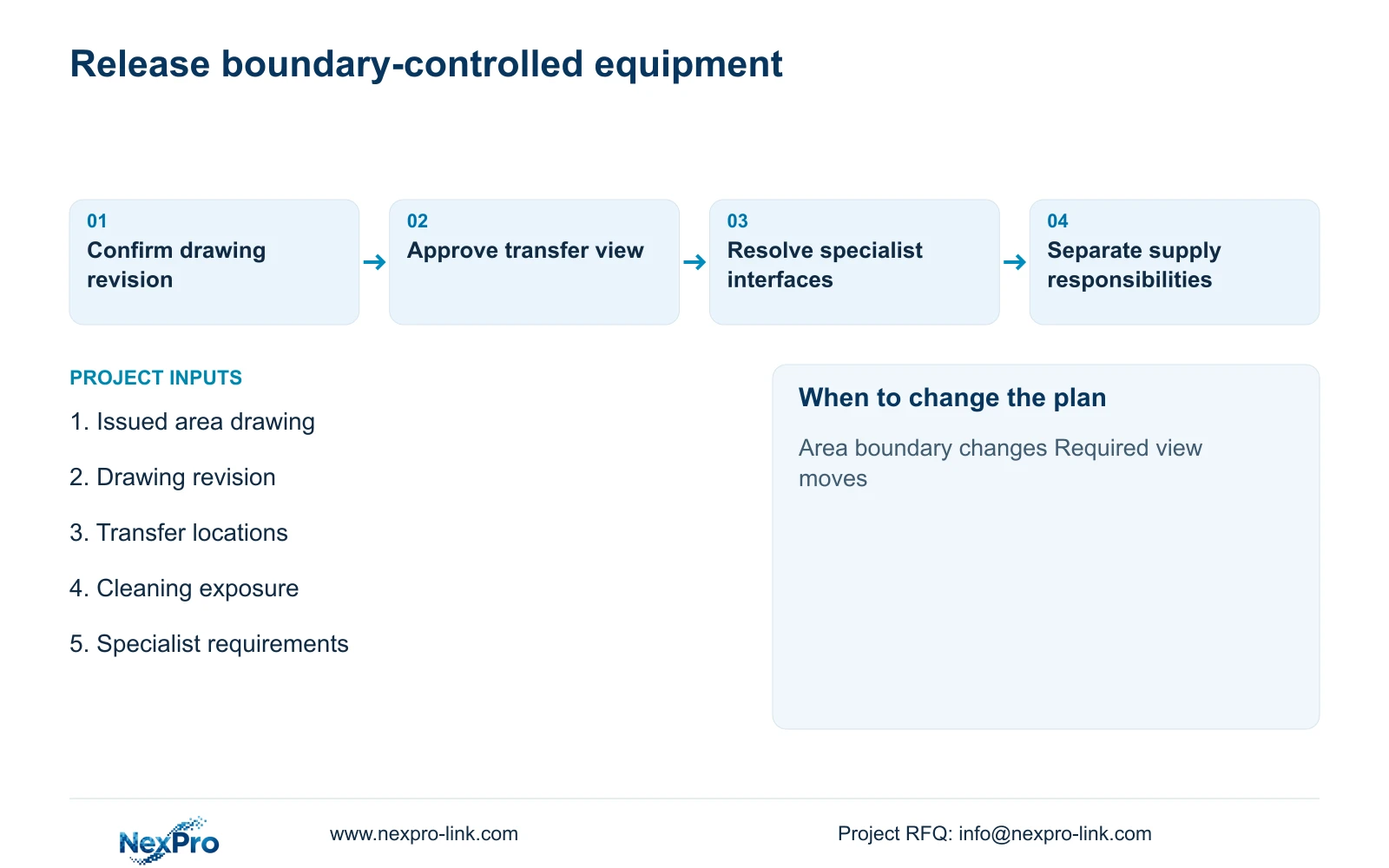
Carry the issued solvent-area drawing revision into camera lines, installation routes and packing labels. A boundary change must reopen affected equipment before the installer uses an earlier allocation.
Section 01
Use the issued area drawing to locate equipment
For flexible-packaging CCTV, treat the issued area-drawing revision as a release input for affected cameras, connections and routes. When the boundary changes, identify which allocation and cartons rely on the earlier revision before releasing installation. Hold those items for the qualified team's review, while keeping separately accepted dispatch work traceable. The result is a revision-controlled release list; it does not classify the solvent area or turn ordinary equipment into an approved protective assembly.
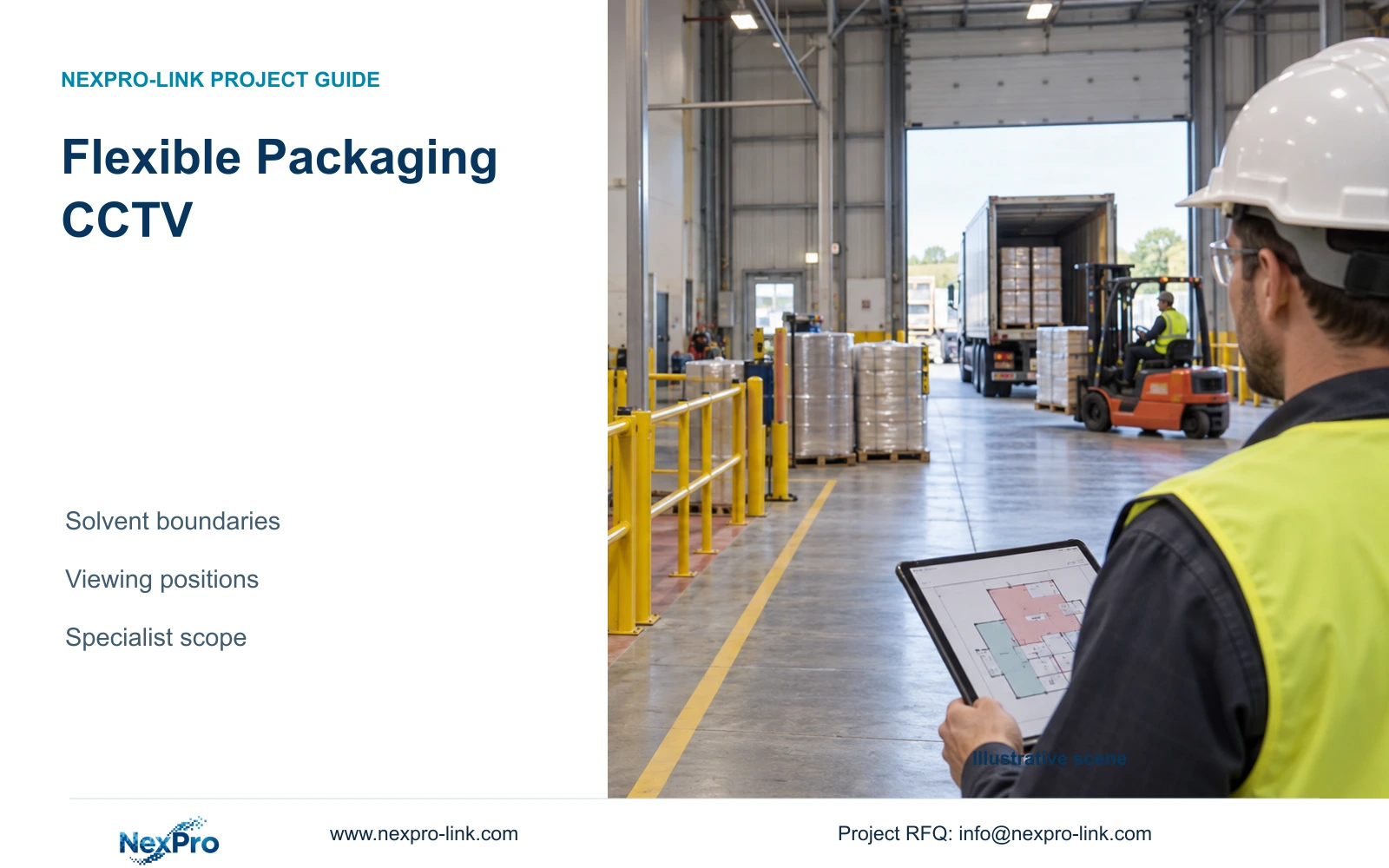
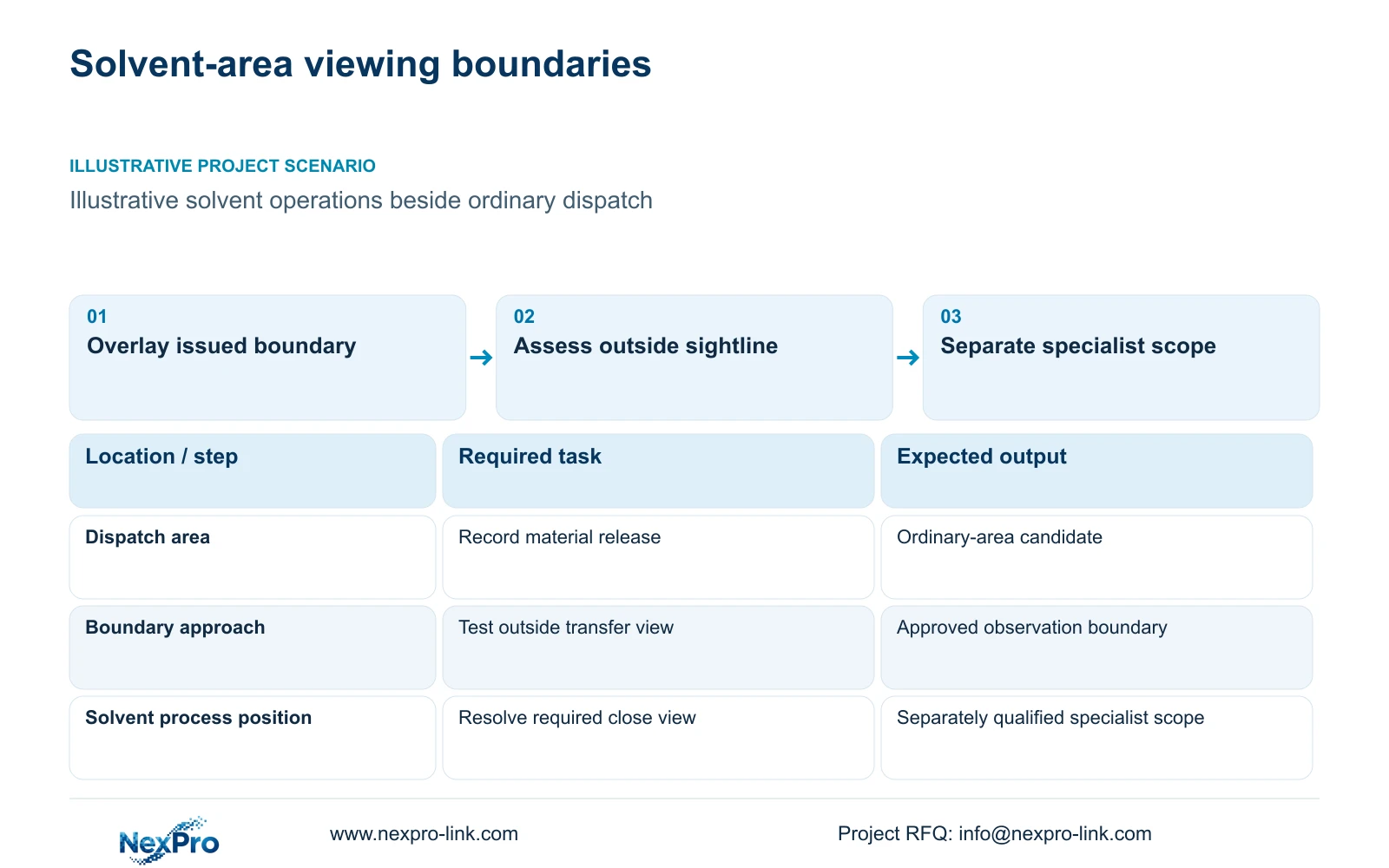
Illustrative project scenario: A packaging site includes solvent-related operations and normal dispatch areas. Assume the owner wants security records of material movement between those areas, not process-safety detection. The engineer overlays proposed views on the issued area drawing and marks positions needing further assessment. No zone dimensions or classification are supplied here. The resulting schedule must preserve those unknowns rather than invent a boundary from the room name or place an ordinary camera inside it provisionally.
Section 02
Compare an outside view with a specialist position
First examine whether the custody event can be recorded from an assessed ordinary location outside the unsuitable area. Check the actual target plane, intervening machinery, doorway position and maintenance access. An outside view may preserve useful transfer evidence without moving the camera into the process area. It is acceptable only if the owner approves the resulting observation boundary and recorded detail.
If that position misses the required event, retain a specialist-camera line with exact location conditions and complete equipment requirements. The ordinary BL2812M55 and DM2812M55 sources list IP66, -20 to +60°C and 2880×1620 output with a 2.8–12mm motorized lens. These fields can support suitable ordinary dispatch or approach views; they establish no explosion protection or solvent compatibility. Do not infer that a narrower lens setting resolves a blocked view or that an added enclosure qualifies the ordinary camera. The camera position and all relevant connections still need review.
Section 03
Keep surveillance separate from protective systems
State the security purpose in the interface schedule: recording authorised movement, reviewing a transfer or observing an approach. Keep gas detection, ventilation control, fire protection and safety interlocks under their responsible specialist teams. An operator watching CCTV does not turn the video system into a protective device, and an image classification feature does not establish detection of a hazardous process state.
Give the local qualified design team responsibility for area requirements and current local compliance verification. The supplied archived OSHA reference is a US-specific research context, not a worldwide rule or project approval. This article makes no fresh legal requirement from it. Procurement should request the applicable approved equipment and installation documentation for the actual destination. Where an interface to a safety-related system is proposed, describe it as a separate unresolved design item rather than promising that an ordinary recorder or camera can supply the required safety function.
Section 04
Compare complete qualification instead of enclosure labels
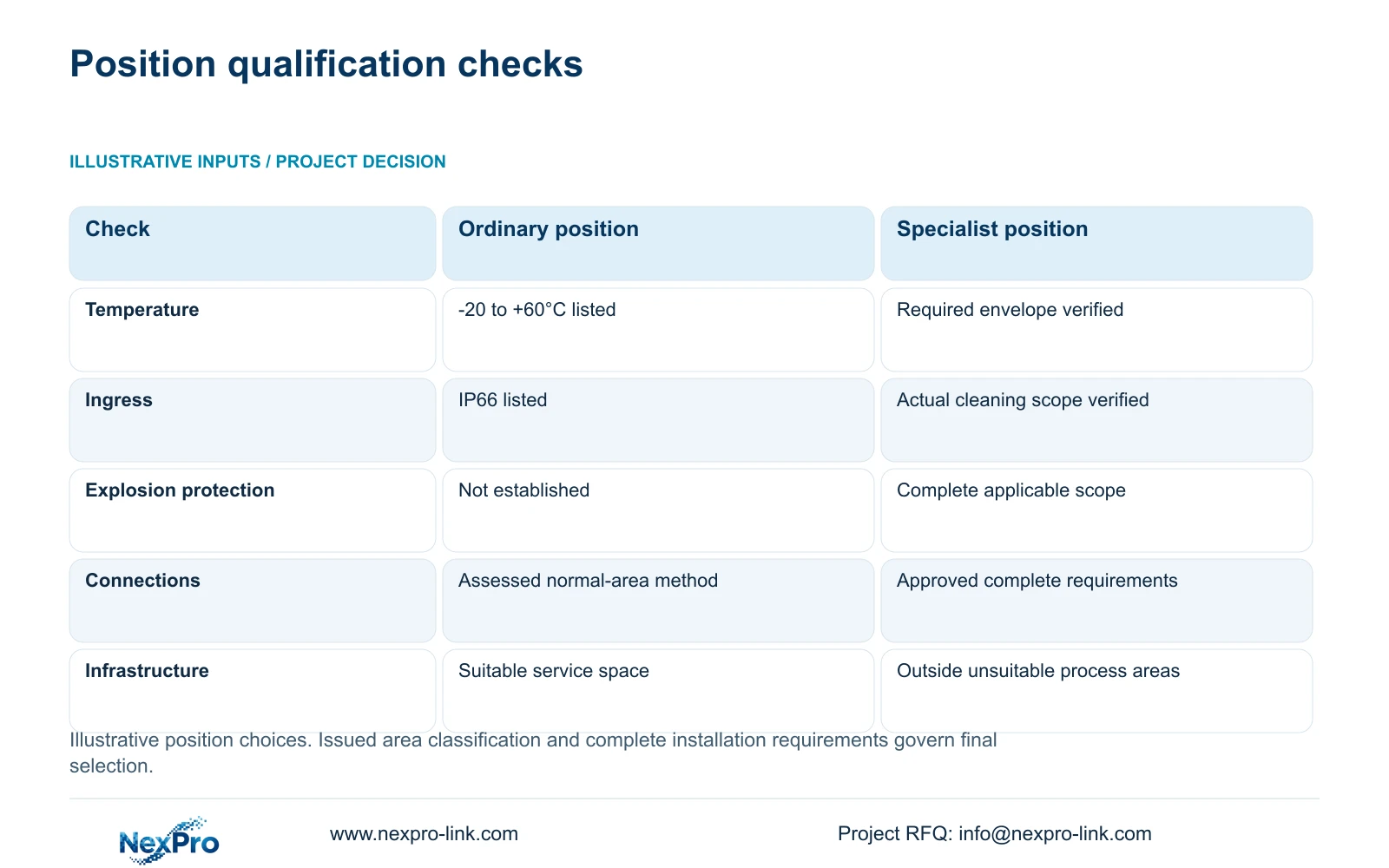
Use the supplied conjunctive method: location conditions AND complete product scope AND approved installation requirements must fit. An acceptable ingress field does not override an unknown hazard scope, and a temperature rating does not establish cleaning or corrosion resistance. Apply the checks to the proposed ordinary dispatch view and each specialist solvent-area position. Keep the camera, connection components and installation requirements visible as one reviewed scope.
The decisive difference in the matrix is the evidence needed to release each position. Ordinary product documents can support assessed normal-area candidates; specialist positions require their complete applicable configuration. Keep recorders, normal switches and batteries in suitable accessible service spaces, with field connections designed by the responsible team. This is a purchasing method rather than instructions for constructing protective assemblies. If any necessary qualification remains unresolved, retain the view as a separately priced or pending scope instead of substituting an ordinary device to close the equipment list.
| Check | Ordinary dispatch candidate | Specialist solvent-area position |
|---|---|---|
| Temperature | Source range -20 to +60°C | Verify required operating envelope |
| Ingress and cleaning | IP66 field only | Verify cleaning and material compatibility |
| Explosion protection | Not established by ordinary PDF | Complete applicable qualified scope |
| Connections | Normal-area method subject to design | Approved complete connection requirements |
| Infrastructure | Suitable accessible service space | Ordinary equipment outside unsuitable areas |
Section 05
Retain specialist scope in every supplier comparison
Recommend ordinary cameras at confirmed suitable dispatch and approach positions, with specialist equipment retained wherever the required view cannot be achieved otherwise. Reopen the position decision when the area drawing changes, the transfer plane moves or new process equipment blocks the accepted sightline. Changing the location may alter specialist quantity, but only after the viewing task and environmental boundary have been reapproved.
CASE01 is an illustrative ordinary-area baseline containing 32 cameras and zero specialist cameras. Its assumed camera power, cable routes and supported stream modes cannot qualify a solvent-area installation. Use its modular organization to separate camera, recording, PoE, backbone and power responsibilities, then replace inputs for actual specialist front ends. Verify the selected stream's recording and retrieval behaviour before combining systems. Compare brand proposals with the same required protective and local-service scope; an ordinary package cannot be presented as a cheaper equivalent by omitting the specialist positions.
Section 06
Carry the boundary revision into installation release
Attach the area drawing revision to each affected camera line and show supplied ordinary equipment, retained specialist equipment, pending specialist positions and local installation responsibilities separately. Include the approved observation boundary, proposed cable route and service access. A change to any of these should be traceable to a revised line, not hidden in a general camera substitution. Keep unrelated printing inspection and production-control requirements outside security acceptance.
NexPro-Link's factory-project and BOQ support can coordinate ordinary-area model matching, recording equipment and relevant technical documents. It does not convert the general supply package into a specialist installation approval. Before procurement release, the owner's qualified team should resolve location requirements and identify the party providing each specialist assembly and connection. At handover, accept ordinary views using recorded transfers and accept specialist scope through its applicable project process. Packing labels and location schedules should retain the boundary revision so equipment intended for dispatch is not confused with equipment for a restricted process position.
Trace the change from the drawing to each view ID, supplied assembly and installation instruction. Mark a retained ordinary dispatch camera separately from a pending specialist front end so a location label cannot be interpreted as approval to mount it in the process area. If a revised outside view misses the required transfer, retain the observation gap for the owner rather than removing specialist scope solely to reduce price. Preserve the previous decision in the change record without using it as the current work instruction.
| Condition / stage | Required input | Decision and evidence |
|---|---|---|
| Drawing revision changes | Affected mount, connection and cable-route IDs | Suspend only the affected allocation for qualified review |
| Equipment already prepared | Carton/view label and its prior revision | Reconcile the label with the current accepted destination |
| Outside view replaces process view | Recorded transfer and lost interior scope | Obtain owner acceptance before removing the specialist line |
Section 07
Buyer questions
Is a camera outside the area automatically acceptable? No. Its actual mounting and connection conditions must be suitable, and its recorded view must meet the transfer task. The outside position is an option to assess, not automatic approval.
Can the supplier classify the area from photographs? Photographs can help explain the view, but they do not replace the issued classification and qualified project assessment. Keep the missing area information explicit in the enquiry.
Should a specialist camera force replacement of the whole CCTV system? Not necessarily. Check its exact data and power interfaces and demonstrate recording and retrieval. Retain compatible ordinary infrastructure where its location and operating scope remain suitable.
Section 08
Scope the views around solvent-area boundaries
Send the issued area drawing and revision, required transfer-view locations, environmental and cleaning information, and specialist equipment requirements to info@nexpro-link.com for an ordinary-area supply discussion with clearly separated specialist scope.
Engineering references
These sources support the general planning principles. Always use the selected product's current datasheet and applicable project standards for final design.