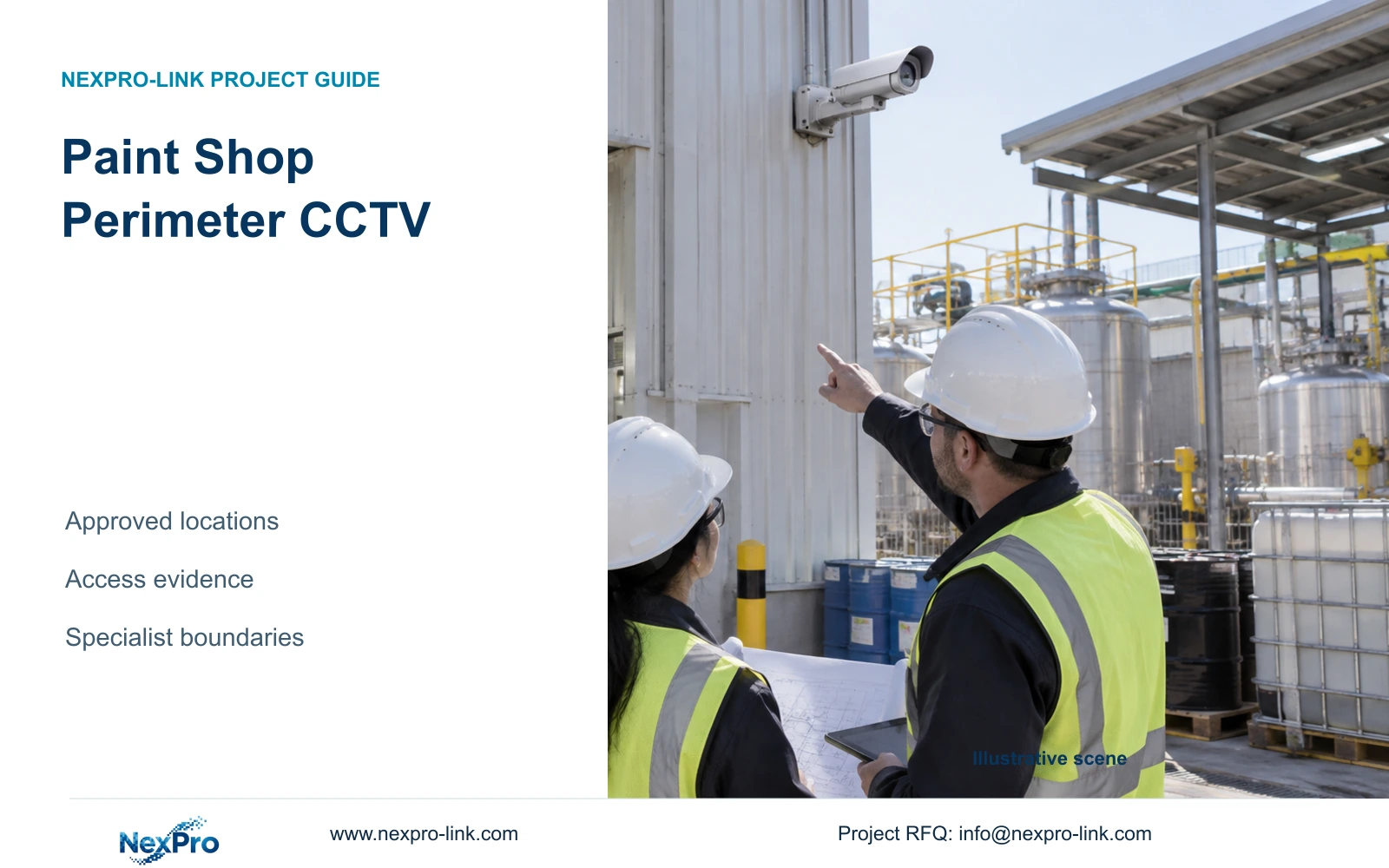
Define paint-shop entry recording from approved mounting locations, with ordinary infrastructure outside unsuitable areas and specialist equipment listed separately.
Section 01
Use the issued classification drawing to gate selection
Paint shop perimeter CCTV should use suitable non-classified mounting locations for ordinary cameras, or a separately qualified specialist product and installation where the task requires equipment within a classified location. Begin with the issued area-classification drawing. Combining an ordinary camera with a generic enclosure does not establish a certified system.
Illustrative project scenario: A body-painting building needs entry evidence around solvent-handling areas. Assume the owner has appointed responsible specialists to issue location information and wants to review personnel and material access. The proposed CCTV arrangement remains a planning example; no boundary, protective configuration or installation has been approved here.
Overlay camera coordinates, connection points and service equipment on the relevant drawing revision. Ask the responsible designer to identify which proposed locations are suitable and which need specialist scope. Keep unresolved positions out of an unconditional model selection. The perimeter task should state what access evidence is needed, while paint-process supervision, fire protection and safety interlocks remain separate systems.
Section 02
Prove the entry task from a suitable observation position
Review access from a suitable position before proposing equipment closer to the solvent-handling area. Map the authorized doorway, approach route and material exchange, then check whether doors, vehicles or temporary stock conceal the required event. Observing from outside a boundary is useful only if the accepted access task remains visible.
Record mounting distance, target width, doorway lighting and operating shifts. An ordinary camera can be considered where its complete environmental scope fits. NexPro-BL2812M55-5MP-DIC-AI lists IP66, -20 to +60°C and a 2.8–12mm motorized lens, with a listed 2880×1620 output in its 5MP-family source. None of these fields establishes explosion protection.
If an exterior angle cannot capture the required access detail, document the missing result and refer the position for specialist design. Do not quietly move a prepared ordinary unit inside the classified boundary during site alignment. The location decision and the image decision must both be satisfied before the buyer accepts the view.
Section 03
Keep specialist equipment and interfaces as separate priced lines
A specialist line should identify the required protective scope, complete product configuration, connections, supporting accessories and installation responsibility. Retain existing approved equipment where appropriate. Avoid a BOQ description that says only hazardous-area camera while leaving the protection basis and installation interfaces unstated.
AXIS P1468-XLE is an official specialist reference with stated Zone2/22 and Division2 application scopes. Its relevance depends on the complete applicable documentation and the site's requirements; it is not a reference for every hazardous location. An ordinary NexPro-Link camera is not an equivalent replacement for that protective scope.
Keep the recorder, switches and batteries in suitable accessible service space where feasible. The supplied CASE01 illustrates ordinary security recording with local protected nodes, but it contains no specialist positions and cannot establish a paint-shop installation design. A specialist stream can join an approved recording workflow only after its actual format, firmware and client requirements are confirmed. Record that integration separately from the protective equipment approval.
Section 04
Require location, product and installation scope to agree
Use the qualification rule as an AND decision: actual location conditions AND complete product scope AND approved installation requirements must fit. Temperature, ingress, cleaning and protective scope are separate checks. One acceptable field cannot compensate for another that remains unsuitable or unknown.
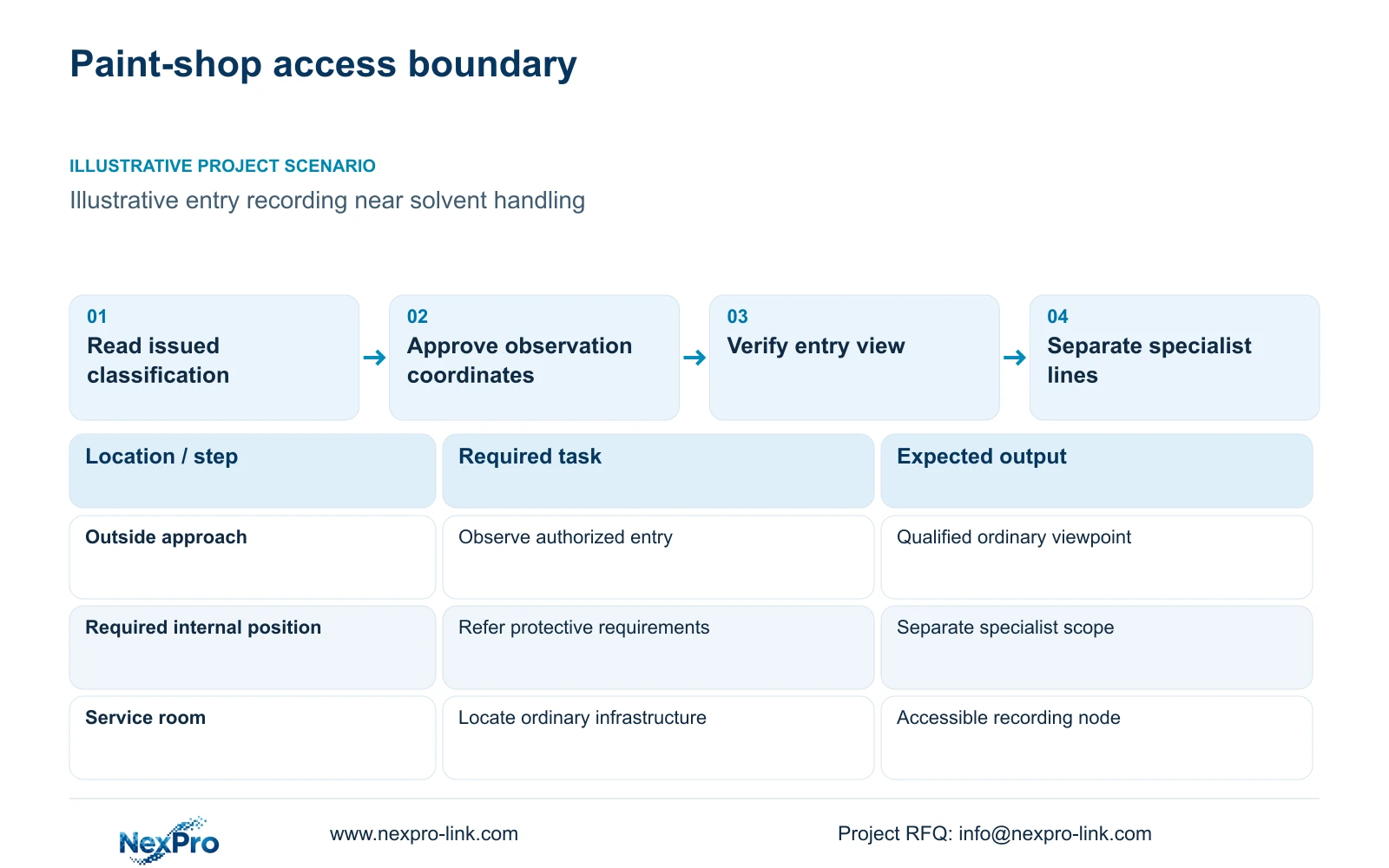
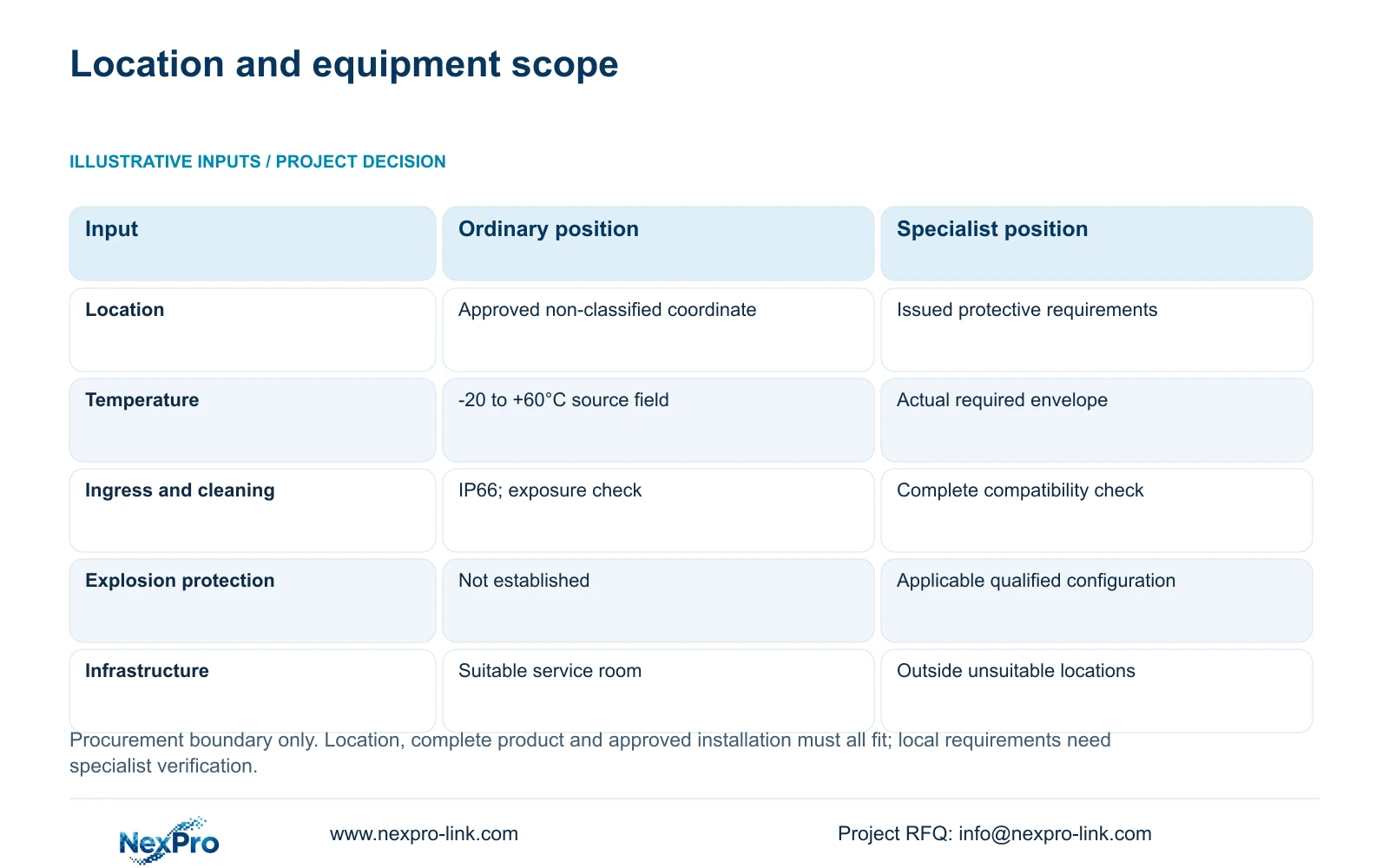
The table applies that rule to the illustrative access task. A suitable outside approach may support ordinary coverage after environmental checks. A required internal view retains specialist scope. The decisive distinction is not image resolution or enclosure material; it is the evidence that the complete selected arrangement fits the location and installation requirements.
IP66 does not establish explosion protection, chemical resistance or compatibility with a site's cleaning methods. The supplied OSHA 1910.307 reference is a US-specific hazardous-location source, not a worldwide code or a fresh determination for this project. Responsible local specialists must verify current requirements and approval scope. This article provides procurement boundaries, not instructions for constructing or wiring a certified assembly.
| Decision input | Suitable ordinary position | Required specialist position |
|---|---|---|
| Location evidence | Approved non-classified coordinate | Issued classification requirements |
| Temperature | Check -20 to +60°C source field | Required complete operating envelope |
| Ingress and cleaning | IP66 field; verify exposure | Verify materials and cleaning compatibility |
| Protective scope | Explosion protection not established | Applicable complete qualified configuration |
| Recording infrastructure | Suitable accessible service room | Keep ordinary equipment outside unsuitable areas |
Section 05
Compare access outcomes without downgrading protection
Recommend ordinary approach views where the responsible team confirms suitable locations and recorded trials demonstrate the entry task. Retain a separate specialist line when the required evidence cannot be captured from those positions. This gives the owner an intelligible security package while preserving the protective scope that the location requires.
Normalize quotations against the same access task and boundary. An external overview and a qualified internal camera are different deliverables even if both show the doorway. Price specialist equipment, approved accessories, installation, commissioning and maintenance responsibilities separately. Without that normalization, an equipment total can hide missing work rather than demonstrate a commercial advantage.
Revisit selection when the classification drawing, solvent-handling arrangement, cleaning method or camera position changes. A proposed move can affect the cable route and connections as well as the camera. Preserve existing owner-platform functions where required and verify the alternative recording workflow. Neither a general PoE label nor basic video compatibility establishes specialist suitability or every event and search function.
Section 06
Tie procurement release to approved coordinates and revisions
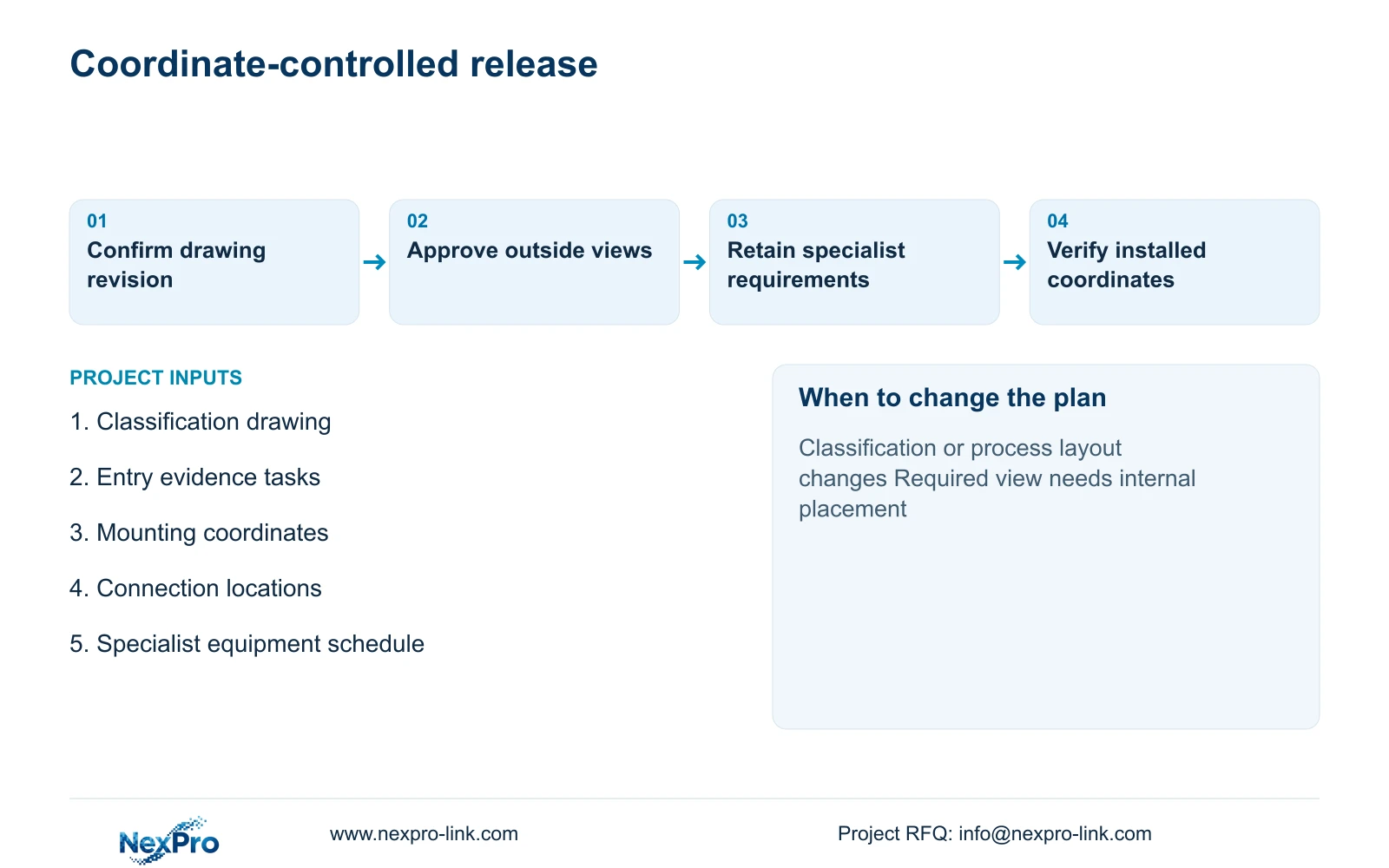
Prepare a view schedule containing task ID, drawing revision, approved coordinate, environmental inputs and supplied or retained status. Maintain a separate process-interface list for any access-system or production-system connection. Show which specialist approvals remain open and who is responsible for them, so an ordinary equipment shipment cannot be mistaken for approval of the entire paint-shop system.
NexPro-Link's BOQ and tender support can coordinate ordinary camera model matching, technical submissions and quotation deviations. Project labels and packing can identify the approved outside-access views. Specialist selection, local electrical work and protective-system acceptance must remain with the appointed parties and their agreed scope.
At commissioning, check the installed coordinate against the approved drawing before image alignment. Then demonstrate authorized-entry playback and export with representative door and vehicle states. Preserve the accepted view and maintenance access records. If the required result is missing, return to the location decision instead of adjusting the installation across an unapproved boundary.
Section 07
Buyer questions
Can the CCTV supplier decide the hazardous boundary from photographs? Photographs can explain sightlines and access, but they do not replace the responsible specialist's issued classification information. Use approved location documents to select and release equipment.
Is AXIS P1468-XLE a suitable reference for every paint-shop zone? No. The supplied reference concerns stated Zone2/22 and Division2 scopes. Match the complete applicable documentation to the actual location requirements rather than extend those scopes to other zones.
Can we order ordinary outside cameras while specialist positions remain unresolved? A phased release is possible when outside coordinates, environmental conditions and required views are approved. Keep unresolved specialist lines and recording interfaces visible, with dependencies and responsibilities explicitly stated.
Section 08
Define the paint-shop access package
Send the relevant issued classification drawing, required entry-view tasks, proposed mounting and connection locations, and specialist-versus-retained equipment schedule to info@nexpro-link.com for a clearly bounded security equipment discussion.
Engineering references
These sources support the general planning principles. Always use the selected product's current datasheet and applicable project standards for final design.