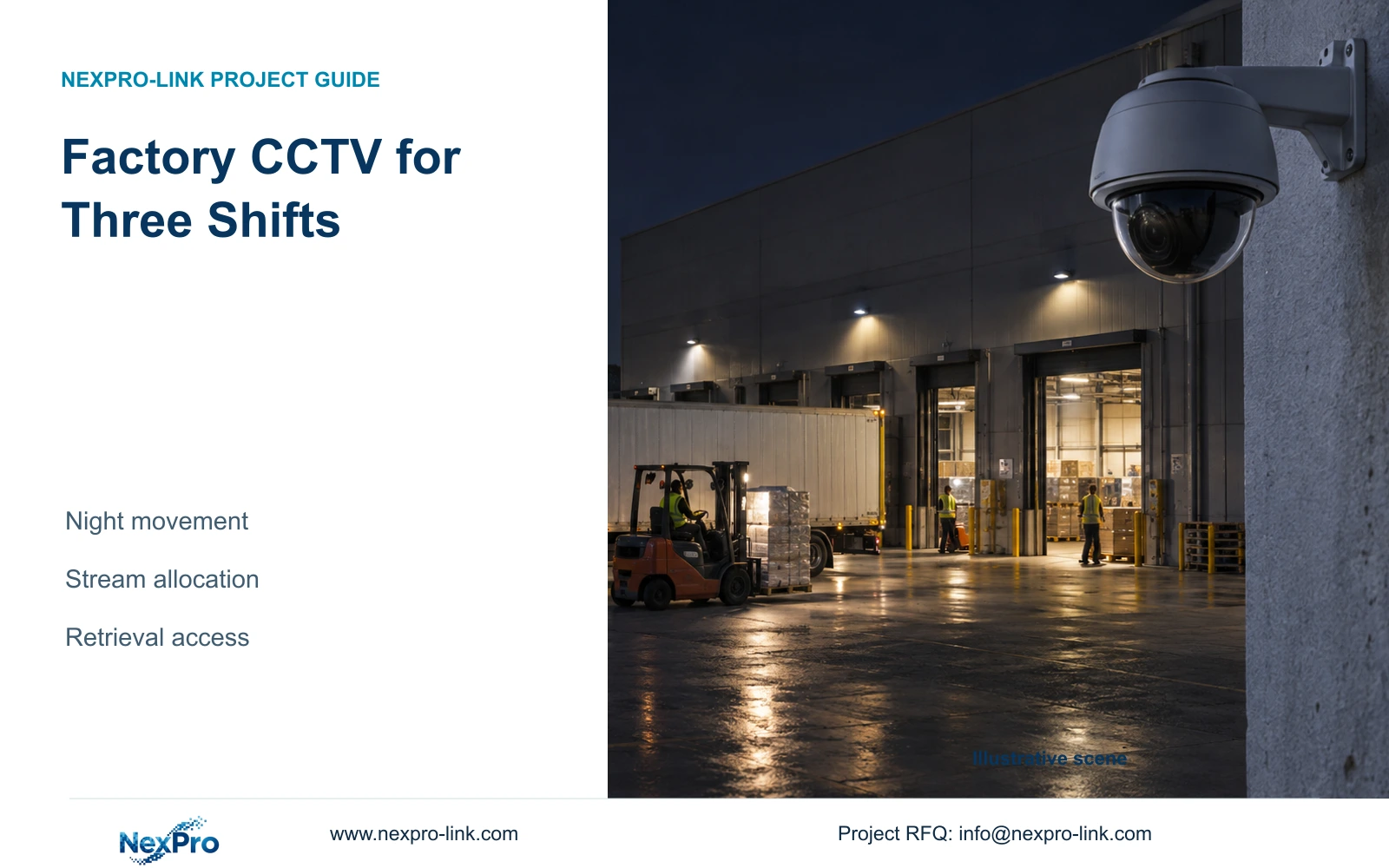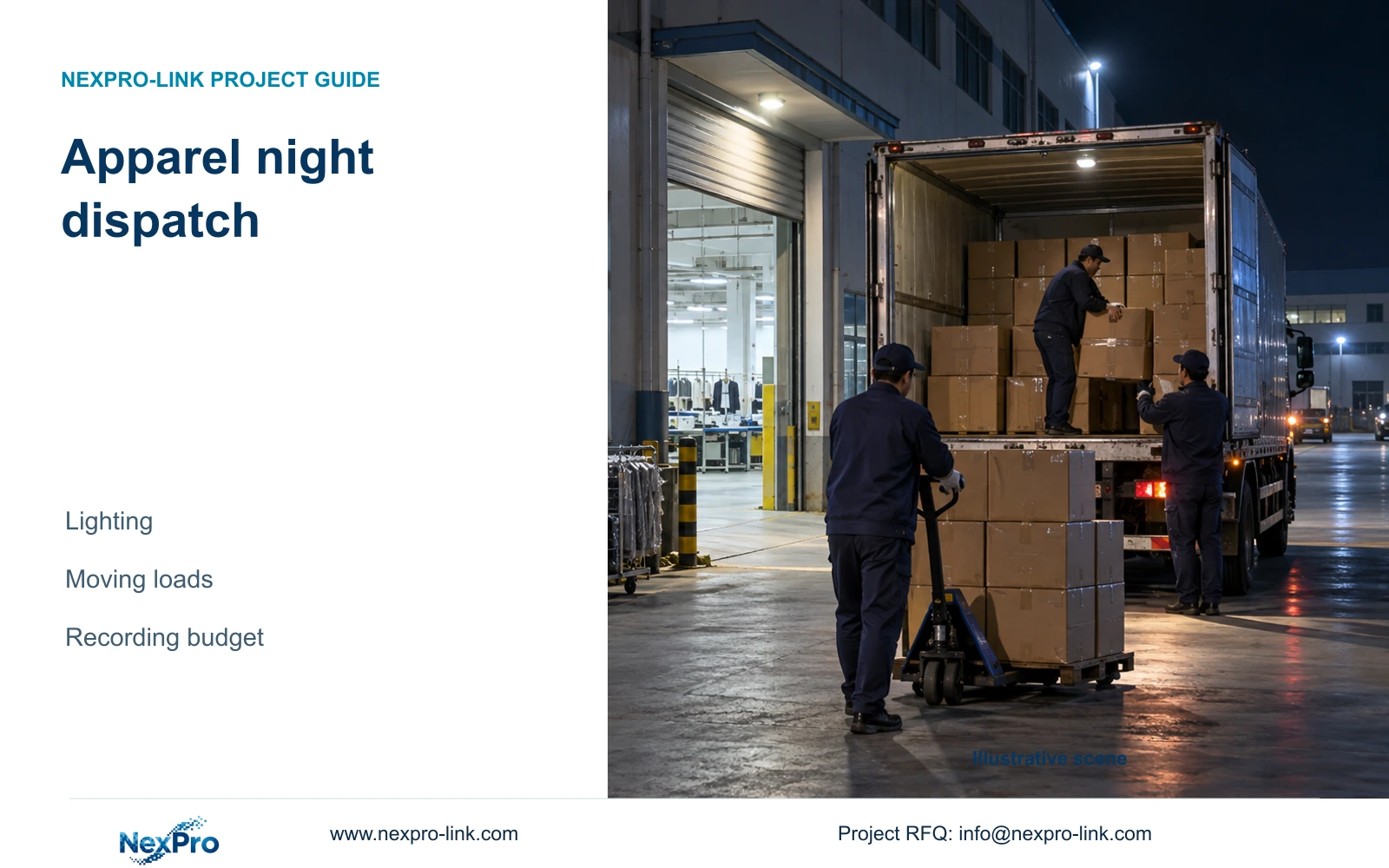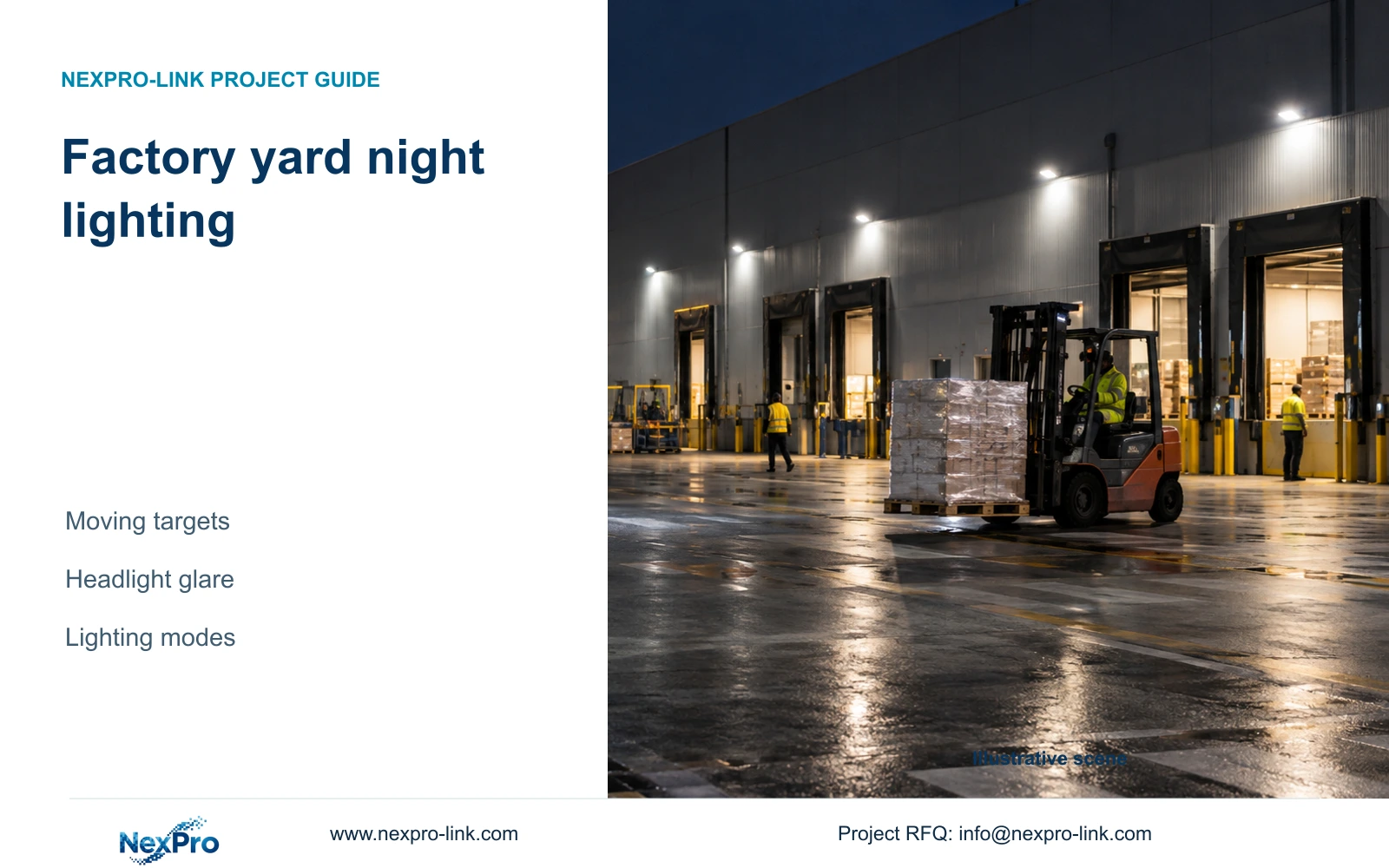
Factory yard lighting should preserve useful moving-target evidence without introducing unwanted visible light into vehicle routes. Compare exposure, glare and lighting transitions before approving dual-light cameras.
Section 01
Reserve colour evidence for the tasks that need it
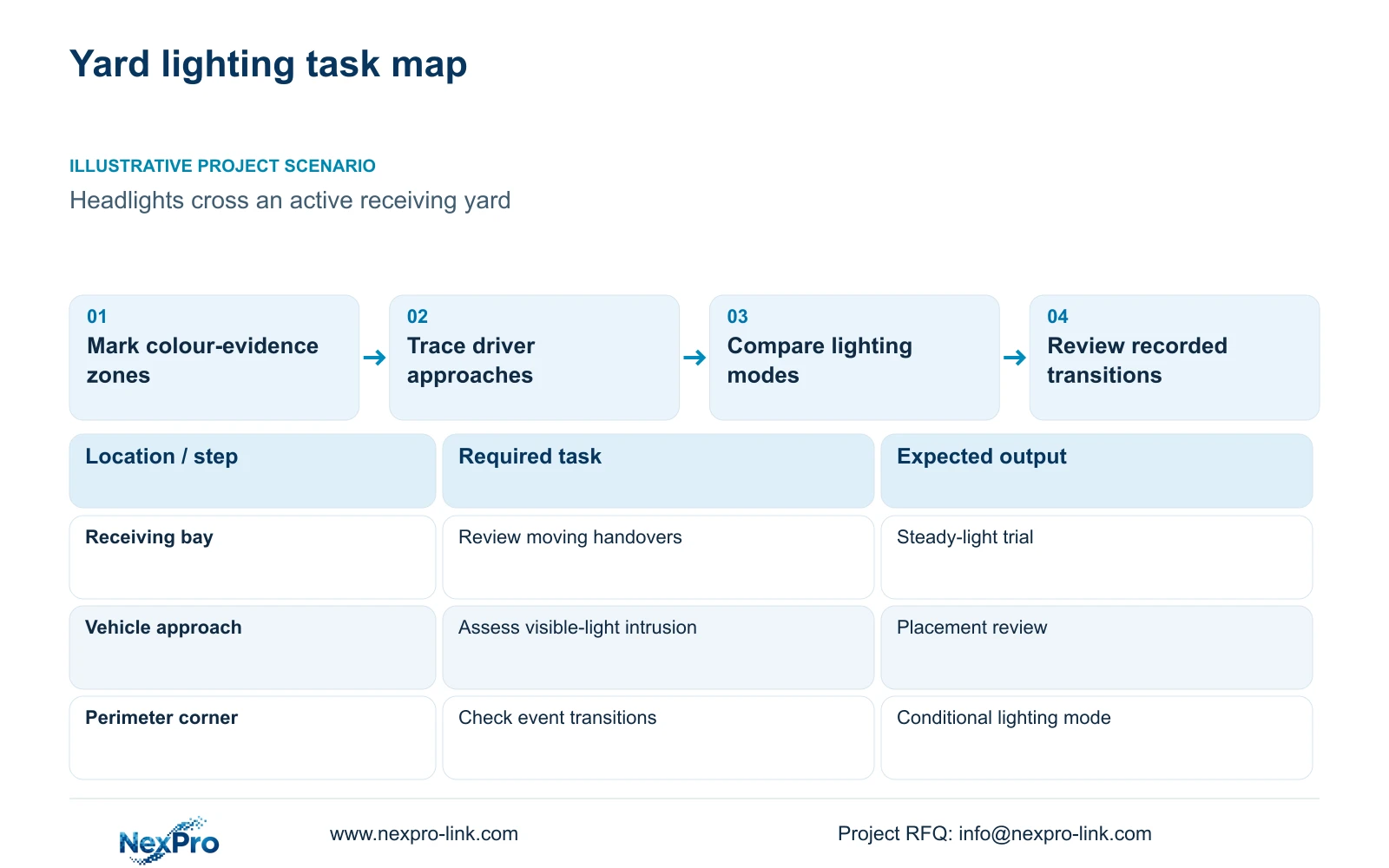
For factory yard night lighting, choose the lighting mode at each observation point from the evidence task and nearby traffic conditions. Use steady illumination where continuous colour evidence is important and the lighting arrangement is acceptable to operations. Consider event-triggered visible light only after testing its timing and effect on drivers. A dual-light label does not establish usable images of moving targets.
Illustrative project scenario: Vehicle headlights and added visible camera lighting affect an active loading yard. Assume trucks approach a receiving bay, staff cross a marked pedestrian route and operators need to review handovers. Within the supplied CASE08 industrial-park reference, each building retains its own 32-camera recording node. No night trial or driver assessment has been performed for this hypothetical situation.
Define what colour contributes at each location. A receiving view might need to distinguish carton markings or clothing, while a distant yard overview may primarily establish movement and sequence. Record the required target area and operating hours beside each view. Keep plate recognition and barrier safety outside the ordinary overview task, with their own equipment and acceptance criteria.
Section 02
Review the camera view and the driver's approach together
Survey the yard from both the proposed camera position and the vehicle approach. Mark headlight directions, turning movements, reflective trailers, wet surfaces and existing luminaires on the plan. Record the night conditions under which evidence is required. A stationary empty-yard image cannot represent a truck turning towards the camera or a pedestrian passing through its illuminated foreground.
Prepare a night trial covering approach, turn, stop and departure. Compare recorded clips with headlights facing towards and away from the camera, then inspect the required subject area during each transition. Ask the local operations team to assess whether added visible light is intrusive from the cab and pedestrian route. This assessment should inform placement and lighting direction before settings are frozen.
If the proposed mounting position directs visible light towards an approaching driver, first review the position or the use of separately designed yard lighting. Preserve the camera's evidence task when changing the angle; a less intrusive position can also lose the handover view. Let the lighting contractor address luminaire selection and aiming, while the CCTV team demonstrates the resulting recorded image.
Section 03
Select steady or event lighting by zone
At a continuously active receiving bay, begin by testing the existing steady lighting with the intended camera settings. If it provides acceptable colour evidence, additional camera illumination may be unnecessary. Where the image fails, compare an adjusted yard-lighting arrangement with supported camera lighting modes. Include the electrical work and maintenance access when pricing either option.
For a less frequently occupied perimeter corner, event lighting may be worth evaluating if visible illumination is acceptable there. Check the exact model and firmware for available controls rather than assuming every dual-light camera offers the same trigger behaviour. The trial must show the subject before activation, during the transition and after it leaves. Delayed colour footage may miss the event detail the buyer actually needs.
NexPro-BL2812M55-5MP-DIC-AI is a relevant ordinary-area candidate: its source specification lists dual light, a 2.8–12mm motorized lens and 25fps@5MP, with listed main output including 2880×1620. These are selection fields, not a demonstrated night result. Verify mode controls and moving-target footage on the proposed unit. Human and vehicle classification does not establish plate identification or safe barrier operation.
Section 04
Use exposure time to test the moving-target requirement
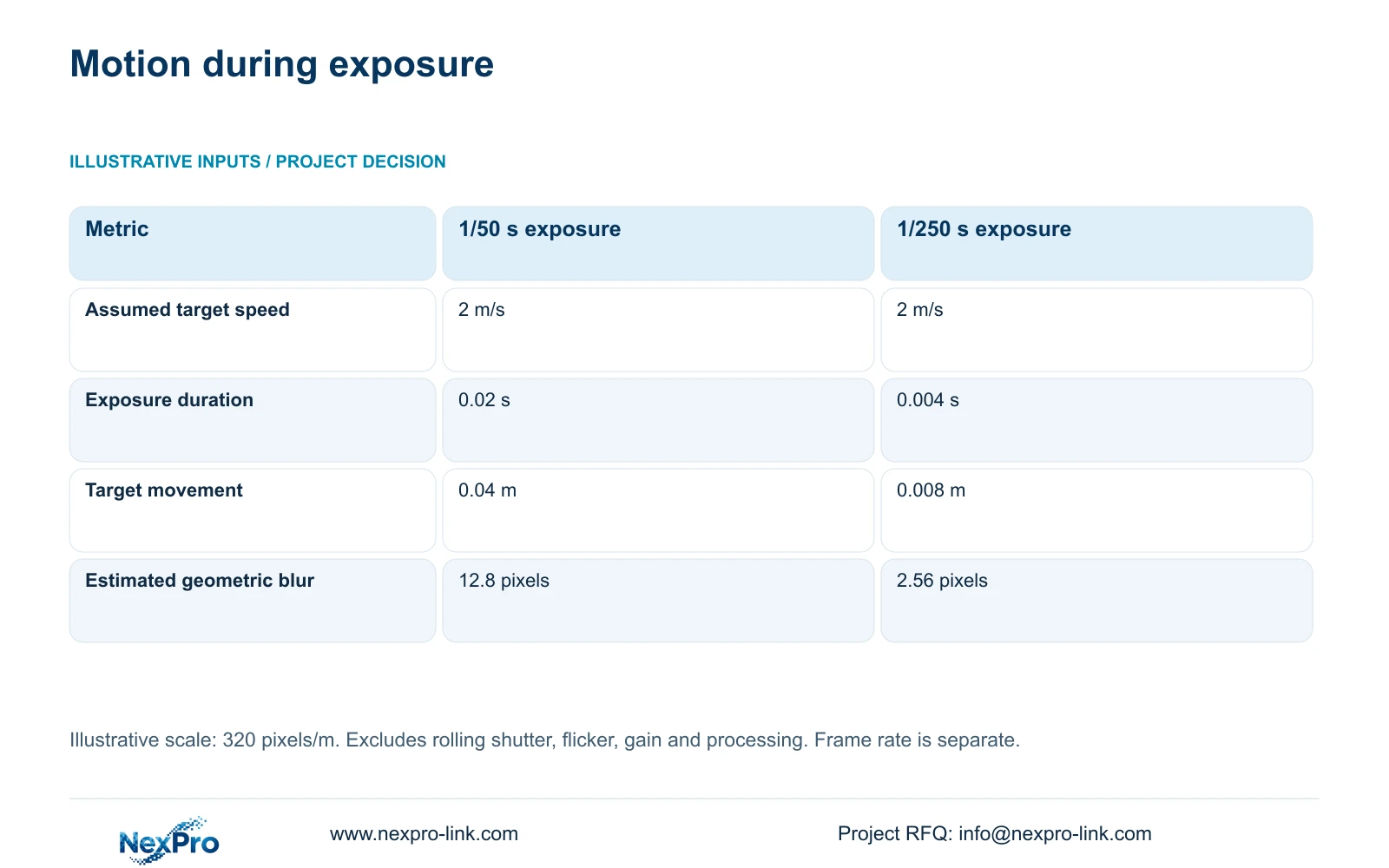
The supplied illustrative calculation assumes a target speed of 2 m/s and an image scale of 320 pixels/m. Compare exposures of 1/50 s and 1/250 s, equal to 0.02 s and 0.004 s. Use movement_m = speed_m_s × exposure_s, then estimated_blur_px = movement_m × pixels_per_m. Frame rate remains a separate setting.
At 1/50 s, movement is 2 × 0.02 = 0.04 m and the geometric blur estimate is 0.04 × 320 = 12.8 pixels. At 1/250 s, movement is 2 × 0.004 = 0.008 m, giving 0.008 × 320 = 2.56 pixels. The shorter exposure reduces this estimate fivefold under the same assumed speed and scale. Increasing fps alone does not produce that reduction.
The decisive trade-off is the light available during the shorter exposure. Test whether the required subject remains usable without unacceptable gain or processing effects, rather than compensating automatically with brighter visible camera light. This simple estimate excludes rolling shutter, lighting flicker, gain and image processing. It is neither a sensor test nor a promised identification result, and the 2 m/s assumption is not a yard traffic-speed recommendation.
| Metric | Option A | Option B |
|---|---|---|
| Assumed target speed | 2 m/s | 2 m/s |
| Exposure | 1/50 s = 0.02 s | 1/250 s = 0.004 s |
| Movement during exposure | 0.04 m | 0.008 m |
| Geometric blur estimate | 12.8 pixels | 2.56 pixels |
Section 05
Carry accepted lighting settings into recording and power budgets
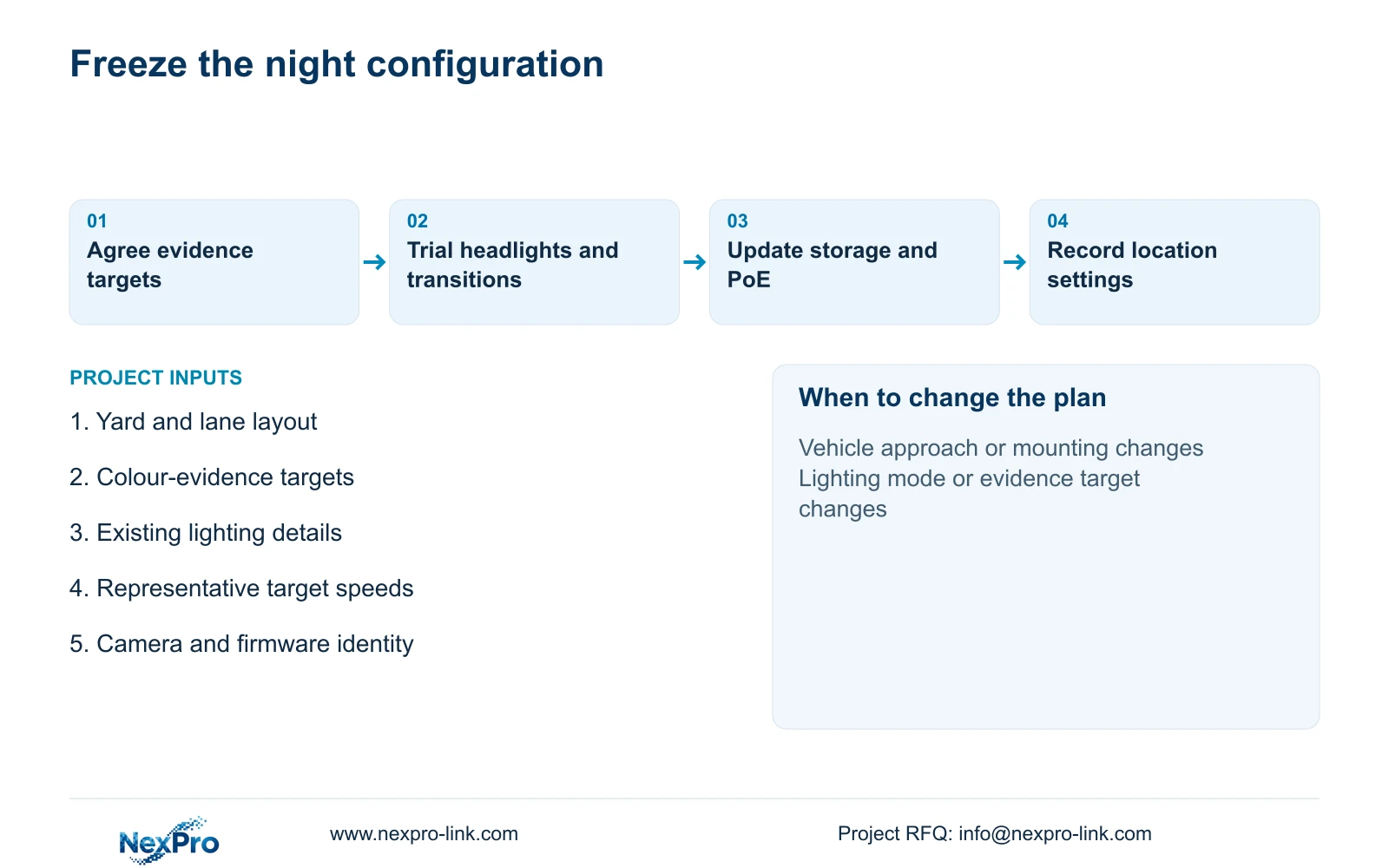
Recommend a zone-based configuration: retain acceptable steady yard lighting at active handover points, use supported camera illumination where the trial justifies it, and keep event lighting conditional on transition and traffic assessment. Change the configuration when vehicle approaches, mounting positions or evidence needs change. Avoid applying one exposure and lighting preset to every yard camera merely to simplify the order.
CASE08 assumes 32 cameras per node, 4 Mbps average bitrate, continuous recording and 30 days. Its illustrative formula is video_TB = cameras × average_Mbps × 10^6 × 86400 × days / 8 / 10^12, yielding 41.472 TB per node. Four 16 TB drives provide 64 TB raw; the planning budget is 64 × 0.95 × 0.80 = 48.64 TB. Compare 41.472 TB directly with 48.64 TB, which already includes formatting and reserve allowances.
Measure the accepted night stream before retaining that bitrate assumption. Also replace CASE08's assumed 12 W camera demand with the selected unit's documented maximum demand for the intended features. Eight assumed cameras give 96 W device-side demand and a 133.3333 W PSE budget target under the case's delivery and utilisation factors. The supplied camera source does not establish peak watts, so this remains a procurement requirement to resolve.
Section 06
Buy a repeatable night configuration with clear site responsibilities
Write the acceptance schedule around recorded events: the agreed handover target remains useful during vehicle movement, headlight changes and supported lighting transitions. Identify who approves the evidence and who assesses traffic impact. Include playback and export in the demonstration, because an attractive live preview does not establish that operators can retrieve the relevant sequence later.
Record the approved model, firmware, lens position, exposure policy and lighting mode by location. Identify which settings can be prepared before shipment and which require site adjustment. Keep existing luminaires, new electrical work and camera supply as separate scope lines. Protect the local camera-power and recording path where outage recording is required; independently supplied yard lights need their own power-continuity decision.
NexPro-Link can discuss model matching, technical submittals and location-labelled project packing from that accepted schedule. Compare any alternative proposal using the same target area, movement conditions, lighting arrangement and recording workflow. Retain required integrations and local services in the comparison. Request actual sample evidence and matching quotations before drawing conclusions about night performance or package value.
Section 07
Buyer questions
Can event lighting be accepted from a daytime demonstration? A daytime demonstration can verify controls, but it cannot resolve the yard's night evidence requirement. Request recorded night sequences showing activation, moving subjects and headlight changes, then confirm the proposed configuration at the actual location.
Does colour footage prove the colour of every object? Avoid making that assumption. Review the specific marking or object under the accepted illumination and recorded settings. If accurate colour is essential to a business decision, define a suitable verification method rather than relying on general yard footage alone.
Can one sample camera qualify the entire yard order? It can qualify a repeatable model and settings combination for comparable views. Different approach angles, target scales, lighting or mounting positions require additional checks. Group locations by those conditions and document the exceptions before volume preparation.
Section 08
Prepare a yard night-trial scope
Send your yard and lane layout, required colour-evidence targets, existing night-lighting details, and representative target speeds to info@nexpro-link.com to discuss camera candidates and a location-specific trial schedule.
Engineering references
These sources support the general planning principles. Always use the selected product's current datasheet and applicable project standards for final design.
- Axis Communications: Troubleshooting Image Quality
- Axis Communications: IR in Surveillance (July 2026; general imaging principles, not NexPro-Link mode specifications)
- User BL2812M series product specification
- NexPro-Link Factory & Warehouse project supply
- NexPro-Link BOQ & Tender Support
- NexPro-NVR4449-4K