Night-time CCTV comparisons often mix sensor performance, visible lighting and switching behavior into a single full-color claim. Compare the proposed Seetong-compatible dual-light camera with the exact Hikvision and Dahua variants instead. Specify whether the task needs continuous color, event-triggered light or discreet infrared monitoring, then evaluate the complete camera and recording workflow.
Section 01
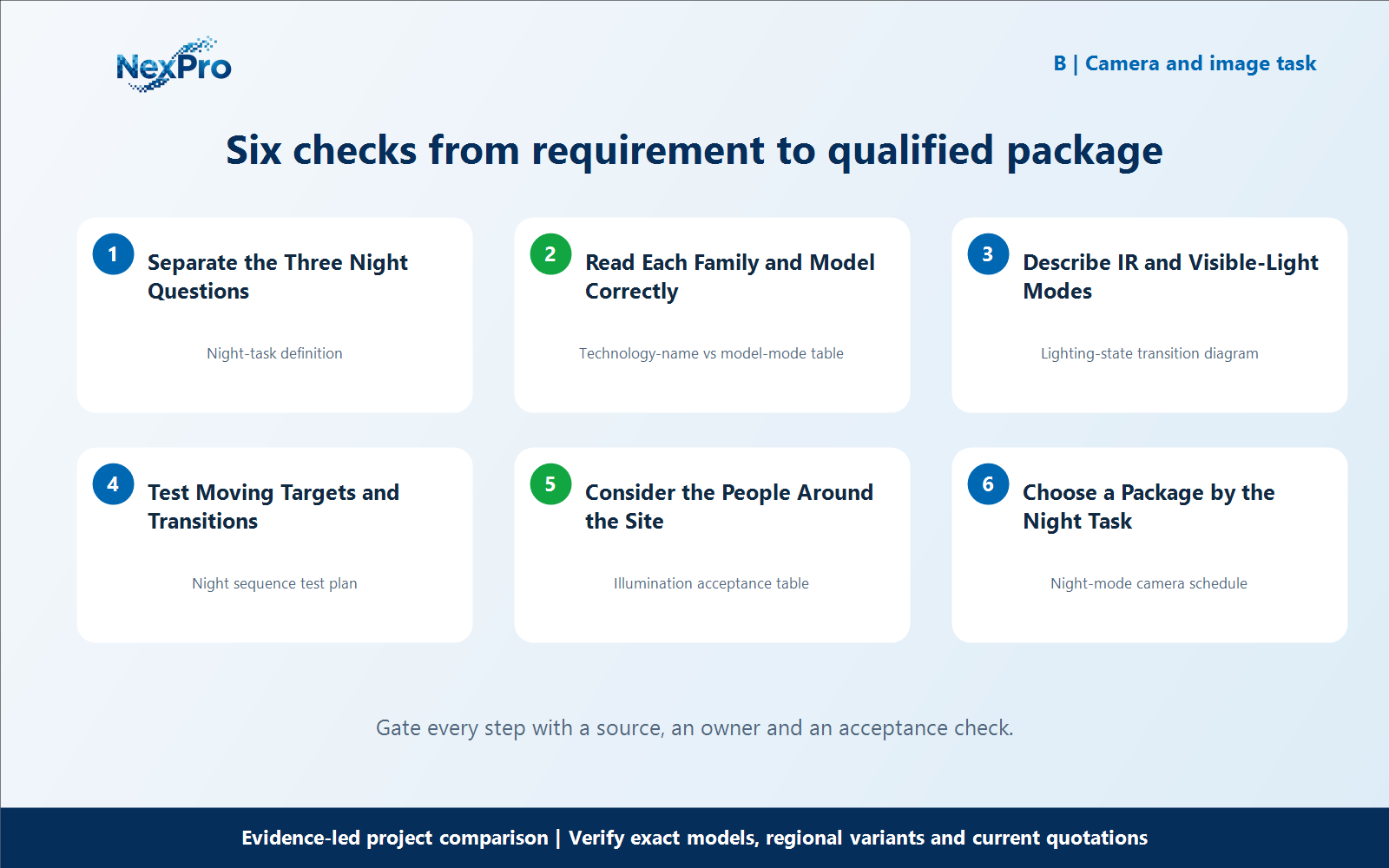
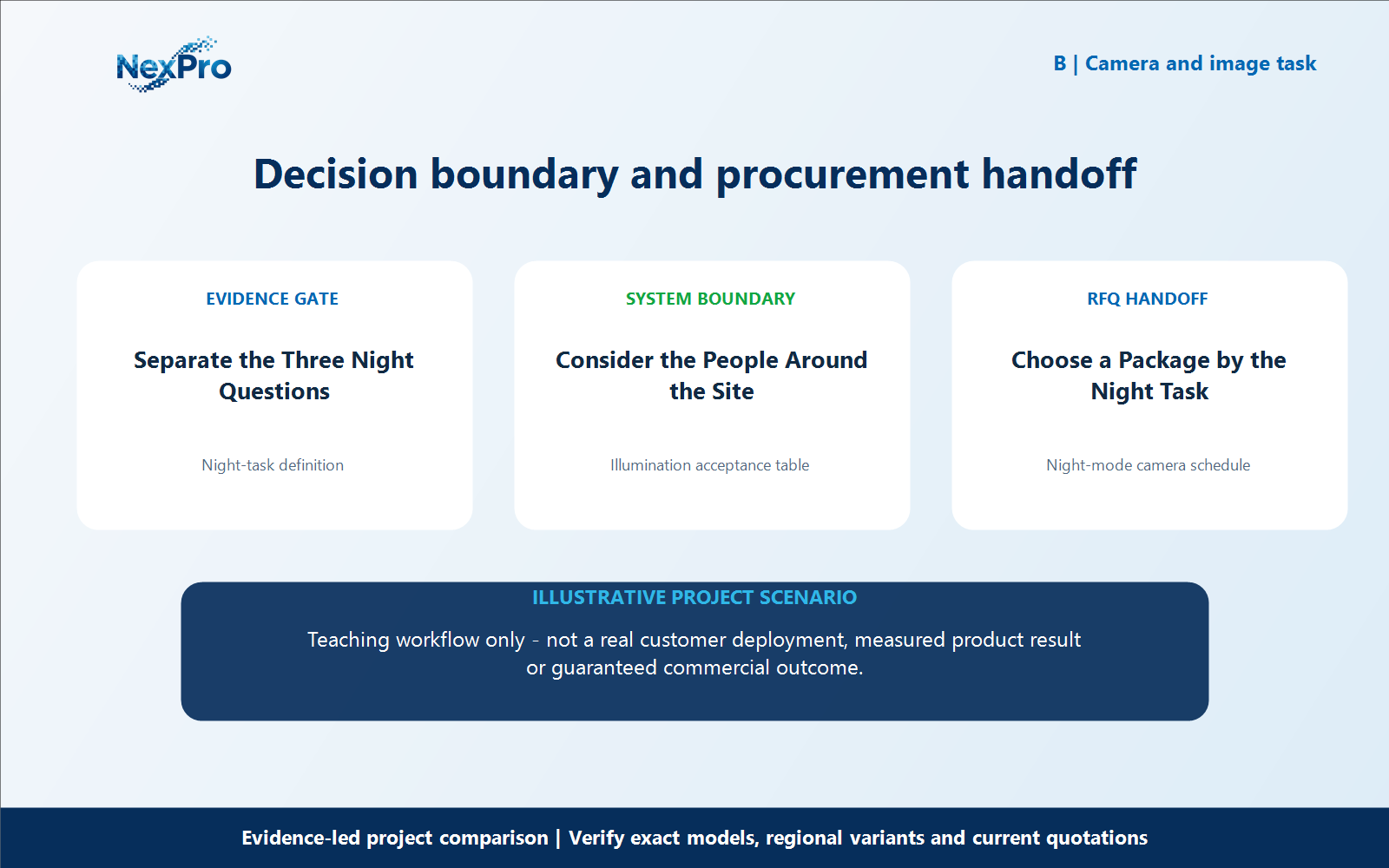
Separate the Three Night Questions
Night-time CCTV comparisons often mix sensor performance, visible lighting and switching behavior into a single full-color claim. Compare the proposed Seetong-compatible dual-light camera with the exact Hikvision and Dahua variants instead. Specify whether the task needs continuous color, event-triggered light or discreet infrared monitoring, then evaluate the complete camera and recording workflow. What should be separated in a night-vision comparison? Separate the amount of available light, the image information required and the permitted illumination behavior. Color detail, moving-target sharpness and low visible-light disturbance are different objectives. Naming the objective prevents a broad full-color label from replacing a useful scene-specific comparison.
For separate the three night questions, build a working record around Night-task definition. For Seetong dual light vs Hikvision ColorVu, record the current project condition, candidate response, evidence source and unresolved boundary before comparing offers.
Review Night-task definition separately from the downstream workflow. This prevents one attractive specification from deciding the complete Seetong dual light vs Hikvision ColorVu question without considering recording, installation, operation and support consequences.
Carry the Night-task definition record into the RFQ, BOQ review or pilot checklist. For Seetong dual light vs Hikvision ColorVu, keep product capability, project assumptions and supplier responsibility beside the separate the three night questions decision; site measurements, network policy, installation safety and acceptance remain project inputs unless the signed scope says otherwise.
- Record night-task definition with a named source, owner or acceptance check; do not leave it as an unqualified brochure phrase.
Section 02
Read Each Family and Model Correctly
Is ColorVu the same thing as dual-light switching? Do not assume that from the family name. Read the selected Hikvision model and its lighting options. Compare its documented operation with the proposed NexPro-Link dual-light model and the selected Dahua Smart Dual Light model, keeping sensor capability and illumination control as separate fields.
For read each family and model correctly, build a working record around Technology-name vs model-mode table. For Seetong dual light vs Hikvision ColorVu, record the current project condition, candidate response, evidence source and unresolved boundary before comparing offers.
Review Technology-name vs model-mode table separately from the downstream workflow. This prevents one attractive specification from deciding the complete Seetong dual light vs Hikvision ColorVu question without considering recording, installation, operation and support consequences.
Carry the Technology-name vs model-mode table record into the RFQ, BOQ review or pilot checklist. For Seetong dual light vs Hikvision ColorVu, keep product capability, project assumptions and supplier responsibility beside the read each family and model correctly decision; site measurements, network policy, installation safety and acceptance remain project inputs unless the signed scope says otherwise.
- Record technology-name vs model-mode table with a named source, owner or acceptance check; do not leave it as an unqualified brochure phrase.
Section 03
Describe IR and Visible-Light Modes
What can event-triggered visible light add? Where the device supports it, visible light can be activated around a detected event to capture color information while using another mode at other times. The useful result depends on detection timing, illumination reach and the camera settings. Verify the transition on the actual target path.
For describe ir and visible-light modes, build a working record around Lighting-state transition diagram. For Seetong dual light vs Hikvision ColorVu, record the current project condition, candidate response, evidence source and unresolved boundary before comparing offers.
Review Lighting-state transition diagram separately from the downstream workflow. This prevents one attractive specification from deciding the complete Seetong dual light vs Hikvision ColorVu question without considering recording, installation, operation and support consequences.
Carry the Lighting-state transition diagram record into the RFQ, BOQ review or pilot checklist. For Seetong dual light vs Hikvision ColorVu, keep product capability, project assumptions and supplier responsibility beside the describe ir and visible-light modes decision; site measurements, network policy, installation safety and acceptance remain project inputs unless the signed scope says otherwise.
- Record lighting-state transition diagram with a named source, owner or acceptance check; do not leave it as an unqualified brochure phrase.
| Comparison factor | Object or condition | Evidence-led action | Do not infer |
|---|---|---|---|
| Continuous color | Check light and exposure | Choose a suitable exact model | Not synonymous with every dual-light mode |
| Event color | Check detection and transition | Inspect the recorded sequence | Do not infer guaranteed identification |
| IR operation | Check target and reflections | Assess actual moving detail | No color assumption |
| Value | Match illumination by position | Price power and setup | No universal brand winner |
Section 04
Test Moving Targets and Transitions
Why is a static bright night image insufficient? A static image does not reveal blur, triggering delay or the frames captured while lighting changes. Walk or drive the intended path at a representative speed and inspect the recorded sequence. Use comparable objectives and document the settings; do not manufacture results from edited promotional pictures.
For test moving targets and transitions, build a working record around Night sequence test plan. For Seetong dual light vs Hikvision ColorVu, record the current project condition, candidate response, evidence source and unresolved boundary before comparing offers.
Review Night sequence test plan separately from the downstream workflow. This prevents one attractive specification from deciding the complete Seetong dual light vs Hikvision ColorVu question without considering recording, installation, operation and support consequences.
Carry the Night sequence test plan record into the RFQ, BOQ review or pilot checklist. For Seetong dual light vs Hikvision ColorVu, keep product capability, project assumptions and supplier responsibility beside the test moving targets and transitions decision; site measurements, network policy, installation safety and acceptance remain project inputs unless the signed scope says otherwise.
- Record night sequence test plan with a named source, owner or acceptance check; do not leave it as an unqualified brochure phrase.
Section 05
Consider the People Around the Site
When can constant visible lighting be a poor choice? When the customer’s operating requirements limit disturbance, glare or visible illumination near neighboring spaces. Discuss the real site constraints and lighting design rather than assuming darkness is always preferred. Evaluate whether the selected mode supports the required evidence without creating an unacceptable operating condition.
For consider the people around the site, build a working record around Illumination acceptance table. For Seetong dual light vs Hikvision ColorVu, record the current project condition, candidate response, evidence source and unresolved boundary before comparing offers.
Review Illumination acceptance table separately from the downstream workflow. This prevents one attractive specification from deciding the complete Seetong dual light vs Hikvision ColorVu question without considering recording, installation, operation and support consequences.
Carry the Illumination acceptance table record into the RFQ, BOQ review or pilot checklist. For Seetong dual light vs Hikvision ColorVu, keep product capability, project assumptions and supplier responsibility beside the consider the people around the site decision; site measurements, network policy, installation safety and acceptance remain project inputs unless the signed scope says otherwise.
- Record illumination acceptance table with a named source, owner or acceptance check; do not leave it as an unqualified brochure phrase.
Section 06
Choose a Package by the Night Task
How can dual light support a value-focused Seetong package? Use it at positions where the documented lighting behavior solves the agreed task, then include the required power, settings and commissioning in the package. Retain another camera type where continuous color or different illumination is necessary. Cost-effectiveness comes from the appropriate mix, not a universal night-vision winner.
For choose a package by the night task, build a working record around Night-mode camera schedule. For Seetong dual light vs Hikvision ColorVu, record the current project condition, candidate response, evidence source and unresolved boundary before comparing offers.
Review Night-mode camera schedule separately from the downstream workflow. This prevents one attractive specification from deciding the complete Seetong dual light vs Hikvision ColorVu question without considering recording, installation, operation and support consequences.
Carry the Night-mode camera schedule record into the RFQ, BOQ review or pilot checklist. For Seetong dual light vs Hikvision ColorVu, keep product capability, project assumptions and supplier responsibility beside the choose a package by the night task decision; site measurements, network policy, installation safety and acceptance remain project inputs unless the signed scope says otherwise.
What should the buyer include in an RFQ for Seetong dual light vs Hikvision ColorVu? Provide the camera schedule, required workflows, candidate equipment lists, mandatory brand or integration constraints, and the evidence still needed for choose a package by the night task. Keep access credentials out of the inquiry. For Seetong dual light vs Hikvision ColorVu, this defines the next comparison; it does not promise identical performance, fixed savings or automatic approval.
- Record night-mode camera schedule with a named source, owner or acceptance check; do not leave it as an unqualified brochure phrase.
Engineering references
These sources support the general planning principles. Always use the selected product's current datasheet and applicable project standards for final design.