Rehearse retrieval using a known transaction, recording each system's timestamp and the observed movement sequence. Retain any offset with its check date and source.
Section 01
Keep weight measurements separate from video context
Rehearse retrieval using a known transaction, recording each system's timestamp and the observed movement sequence. Retain any offset with its check date and source. If clocks or timestamp meanings change, widen the search and repeat the mapping; an earlier offset must not silently govern later incident requests.
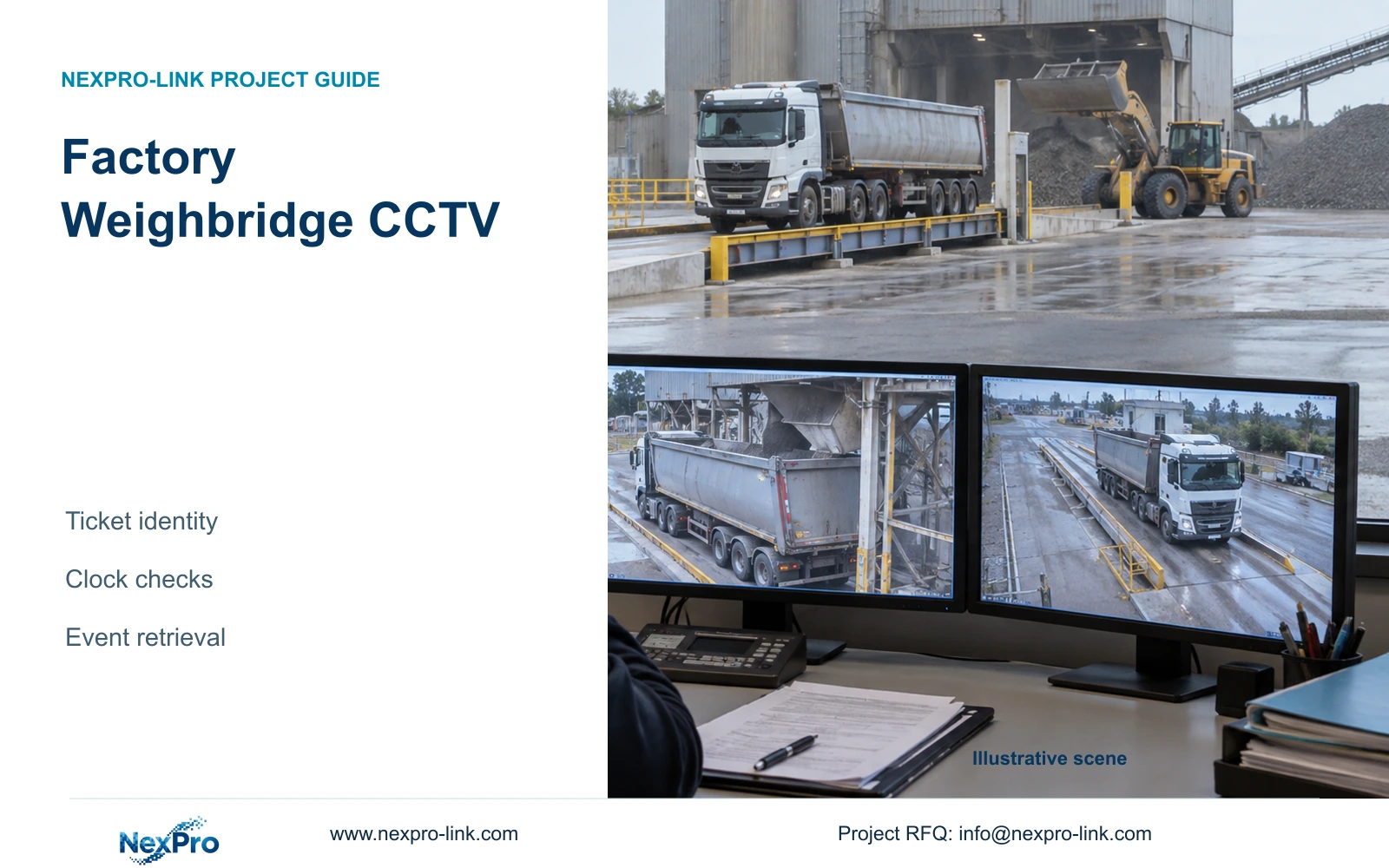
Align factory weighbridge CCTV with scale records through transaction identifiers and checked event times. The weighing system remains the source for weight; CCTV supplies context about the vehicle, its position and the surrounding sequence. A camera image of a display is not a substitute for the original weighing record, and a recorded truck does not by itself establish which ticket belongs to it.
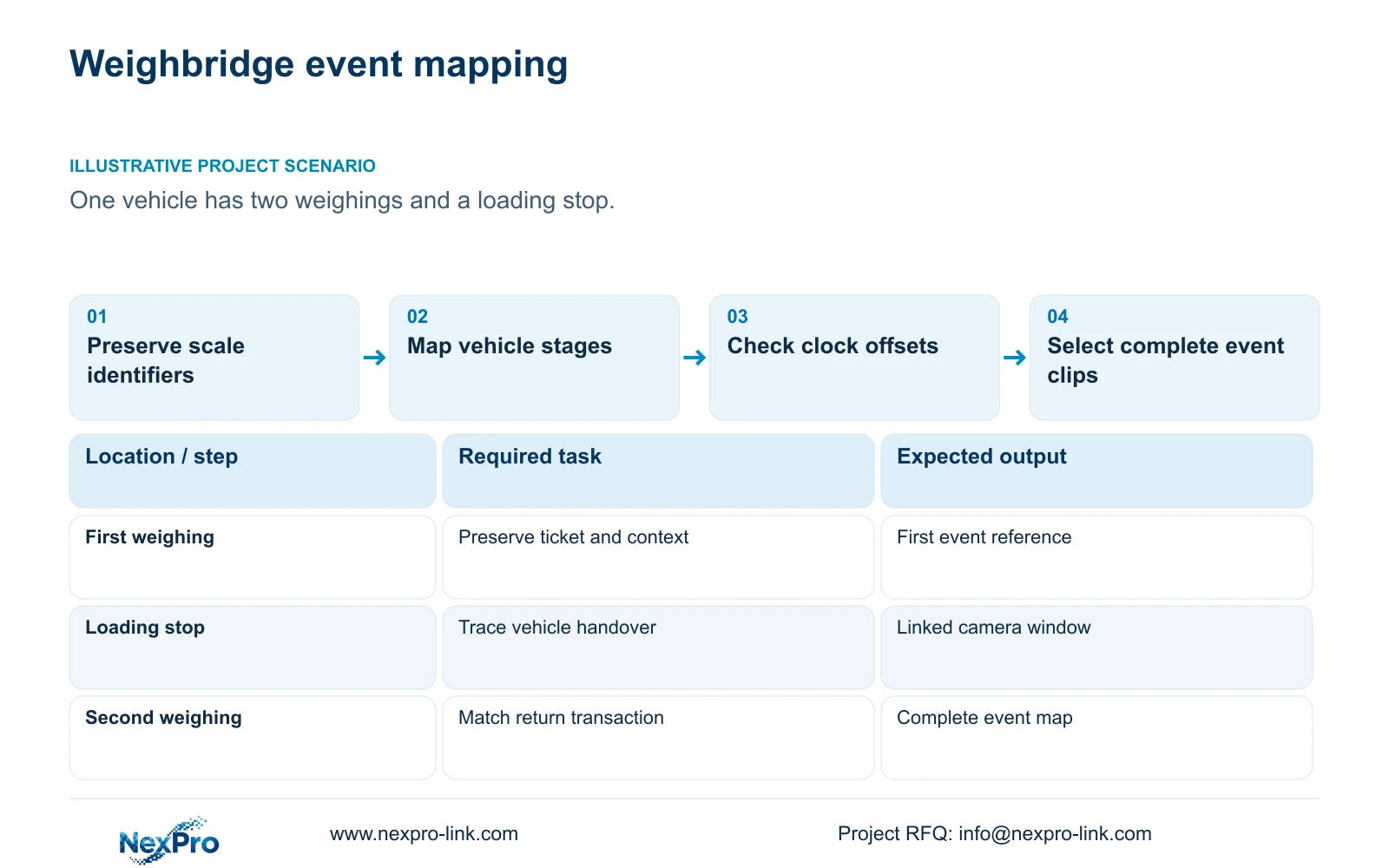
Illustrative project scenario: The operator must investigate a vehicle transaction involving two weighings and a loading stop. Assume the vehicle enters, is weighed, visits a loading area and returns for a second weighing before departure. The proposed investigation needs to connect those stages without treating every nearby vehicle as part of the same transaction. This is a hypothetical workflow rather than a completed case.
Map the arrival, scale approach, platform, loading stop and exit. Assign each required camera a contextual question, such as whether the same vehicle returned or whether another truck obstructed the view. Plate reading, general overview and barrier safety retain separate device and interface requirements. Ordinary vehicle classification is not evidence of a searchable plate record.
Section 02
Use a transaction identity that survives both weighings
Ask the scale-system owner which identifier connects the first weighing, loading movement and second weighing. It may be an existing transaction number or an approved relationship between two ticket records. Preserve the source identifiers even if an investigation worksheet groups them under one review reference. A registration number alone can be ambiguous when the same vehicle makes repeated visits.
Create an event map containing the transaction reference, vehicle reference, weighing record identifiers, stage timestamps, camera names and recording nodes. The scale administrator owns the measurement records; the security team owns permitted video retrieval. Start with a controlled manual mapping if the source systems provide no qualified integration. Price automatic metadata transfer as separate work, including the supported interface and failure handling.
For planning, use a clearly labelled dummy transaction to walk through the entire route. Confirm that staff can distinguish its two weighings from another vehicle's event and find the loading stop. If the route branches or the loading location changes, update the camera mapping rather than preserving an obsolete fixed search template.
Section 03
Check clock alignment at the systems that create records
Record the time source, time zone and clock settings for the scale application, cameras, recorders and any plate system used in the investigation. Where supported and approved, configure a consistent time source. Verify the actual displayed and recorded times against an agreed reference event. Do not assume two systems are aligned because their screens show the same hour.
Keep observed offsets in the investigation method and allow an appropriate search window around uncertain timestamps. The owner should approve the permitted discrepancy for the retrieval task rather than borrowing an unsupported universal tolerance. Recheck after replacement, firmware changes, time-setting changes or recovery from an outage. Preserve the original records when noting a discrepancy instead of silently rewriting their event times.
CASE08's four independent recording nodes show why the map needs a node identifier as well as a camera name. Shared fibre does not create shared export permission. An investigator may need authorised clips from more than one node, with each clip tied to its original camera and event window. Verify playback and export at the actual client used by staff.
Section 04
Calculate the selected payload before exporting
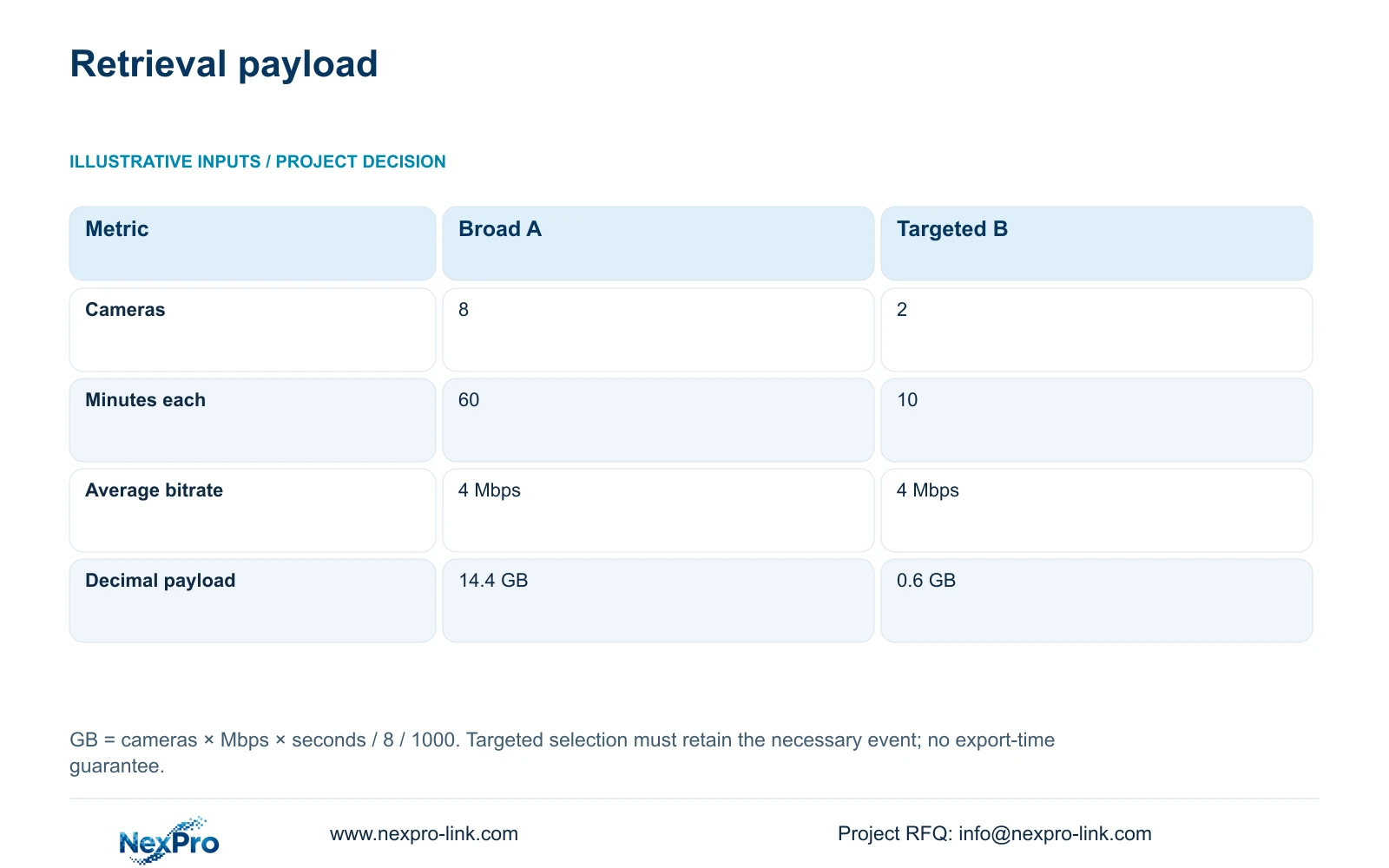
The illustrative broad request selects eight cameras for 60 minutes each at an average 4 Mbps. The targeted request selects two relevant cameras for 10 minutes each at the same average bitrate. Using decimal GB, the formula is GB = cameras × Mbps × seconds / 8 / 1000. The broad selection is 8 × 4 × 3600 / 8 / 1000 = 14.4 GB; the targeted selection is 2 × 4 × 600 / 8 / 1000 = 0.6 GB.
The decisive difference comes from selecting fewer camera-minutes, not changing the quality of the source recordings. An approved time-and-camera map can reduce unrelated material in the review or export. The 0.6 GB option is suitable only if those selected windows retain the complete event needed for the investigation.
For the supplied two-weighing and loading-stop scenario, two cameras and 10 minutes each may cover only a specific question within the transaction. If the loading stop or second weighing falls outside those windows, expand the request. The calculation does not guarantee export duration, staff-time savings or legal evidence status. Actual files may include variable bitrate, audio or container overhead beyond this average video payload estimate.
| Metric | Option A: broad | Option B: targeted |
|---|---|---|
| Selected cameras | 8 | 2 |
| Minutes per camera | 60 | 10 |
| Average video bitrate | 4 Mbps | 4 Mbps |
| Estimated decimal payload | 14.4 GB | 0.6 GB |
Section 05
Design retrieval around the complete event path
Prefer a transaction-linked retrieval method that preserves the original scale records and the necessary video context. Use targeted exports when camera assignments and clocks are reliable. Widen the initial review when a timestamp is uncertain, a vehicle changes route or an obstruction hides a stage. The owner should approve the retained event boundary before staff reduce the export to convenient clips.
The NexPro-BL2812M55-5MP-DIC-AI offers a relevant ordinary-area camera reference with listed 2880×1620 output and a 2.8–12mm motorized lens. Frame the scale approach or loading boundary for its contextual task. Its specification does not establish weight measurement, guaranteed plate recognition or an automatic scale integration. Camera and weighing-system responsibilities remain distinct even when they share a project drawing.
CASE08's illustrative local storage method can support the retention check: each 32-camera node requires 41.472 TB for 30 days at 4 Mbps continuous recording, against a 48.64 TB budget already adjusted for formatting and reserve. Align the actual video retention with the period in which staff may need to review scale transactions. Record custody, access and any archive copies separately from circular recording capacity.
Section 06
Specify the retrieval demonstration and handover record
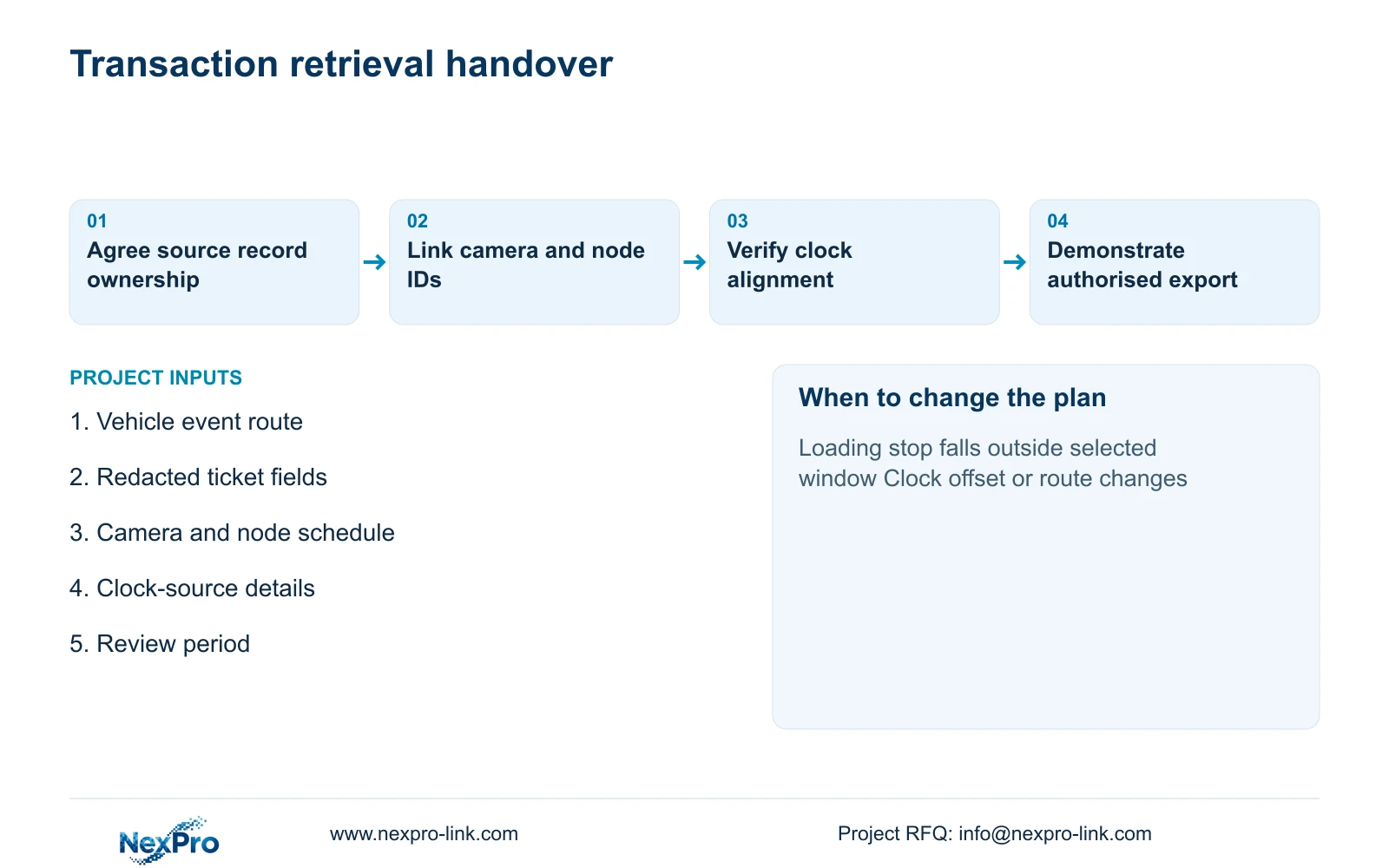
Require a demonstration using a permitted sample transaction with both weighings and the loading stop. Staff should retrieve the original scale references, identify the correct camera windows and export the required clips through an authorised account. Check that the receiving reviewer can open the files and understand their camera, node and time references. This tests the investigation workflow rather than only the live image.
The equipment schedule should identify new and retained cameras, recorder assignments, local network routes, power protection and any integration work. Protect relevant camera switches and recorders where outage continuity is required, without assuming the scale itself is covered by the CCTV UPS. Keep measurement-network access under the scale-system owner's approved boundary.
NexPro-Link can discuss model matching, coordinated CCTV equipment and technical documentation through its project and BOQ support. Packing labels can follow the scale-approach, loading and exit identifiers. The scale vendor remains responsible for measurement records and any approved scale interface, while local installation and final workflow acceptance are assigned explicitly.
Section 07
Buyer questions
Is a plate number enough to link two weighing tickets? It can help, but repeated visits or multiple transactions may make it ambiguous. Preserve the weighing-system transaction or ticket relationship and use plate information as an associated vehicle reference.
Can the project start without automatic scale-to-video integration? Yes. A controlled identifier-and-time worksheet can support retrieval if staff can access the source records and clocks are checked. Automatic integration should be separately specified and demonstrated.
Should targeted exports replace continuous retention? No. Export selection answers a particular review request. The underlying recording and retention plan should continue to preserve the agreed evidence until its approved retention boundary.
Section 08
Build a weighbridge retrieval scope
Send the vehicle event route, a redacted sample ticket structure, camera and clock-system details, and required review period to info@nexpro-link.com for a CCTV equipment and retrieval-workflow discussion.
Engineering references
These sources support the general planning principles. Always use the selected product's current datasheet and applicable project standards for final design.