For a visit with return weighing, map each scale event to its actual time and direction before selecting footage. Keep the two records under the same documented visit reference only when the scale workflow establishes that relationship.
Section 01
Use the weighing record as the measurement source
For a visit with return weighing, map each scale event to its actual time and direction before selecting footage. Keep the two records under the same documented visit reference only when the scale workflow establishes that relationship. Review intervening yard movement and report an unexplained gap; images cannot reconstruct missing scale measurements or material composition.
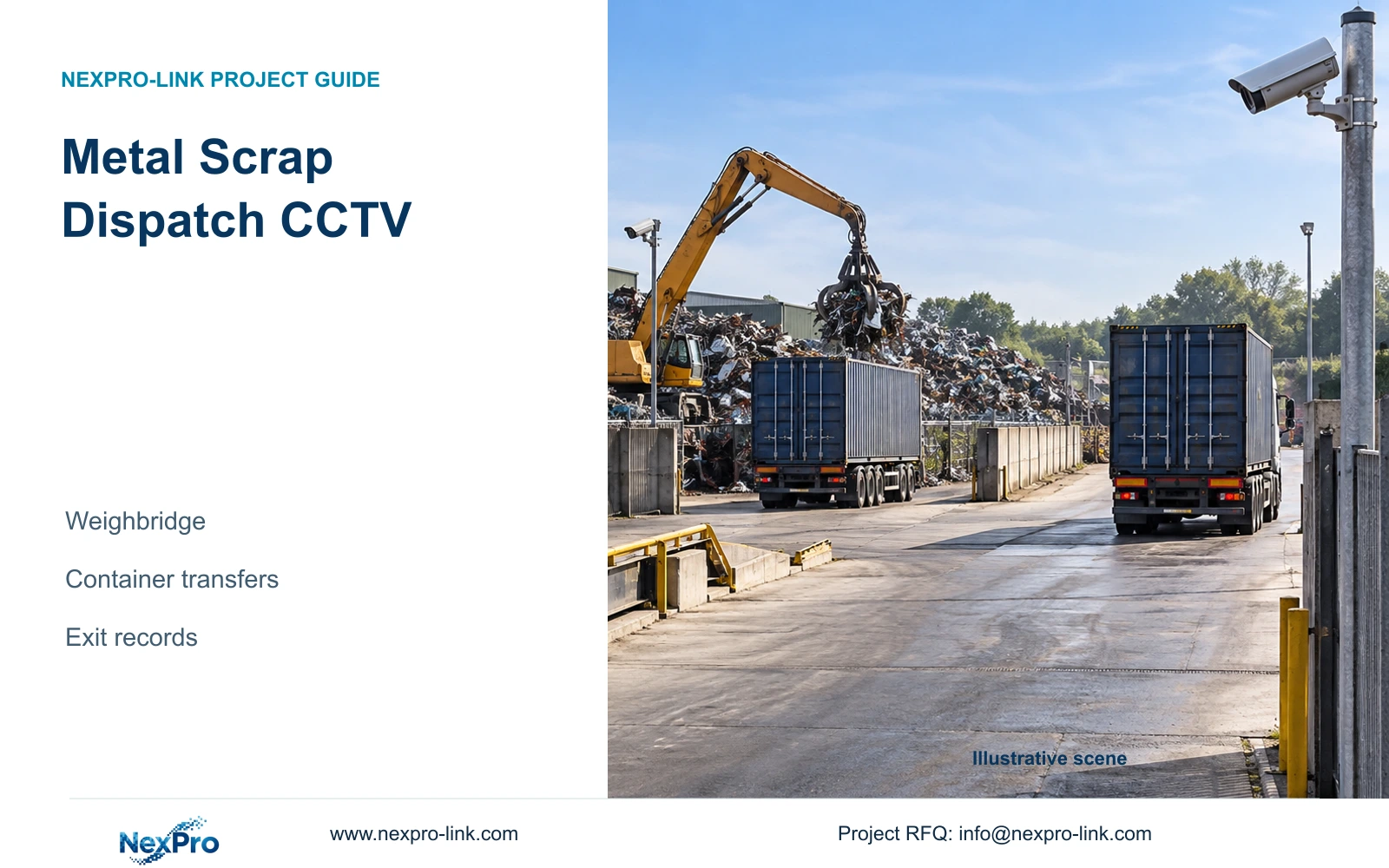
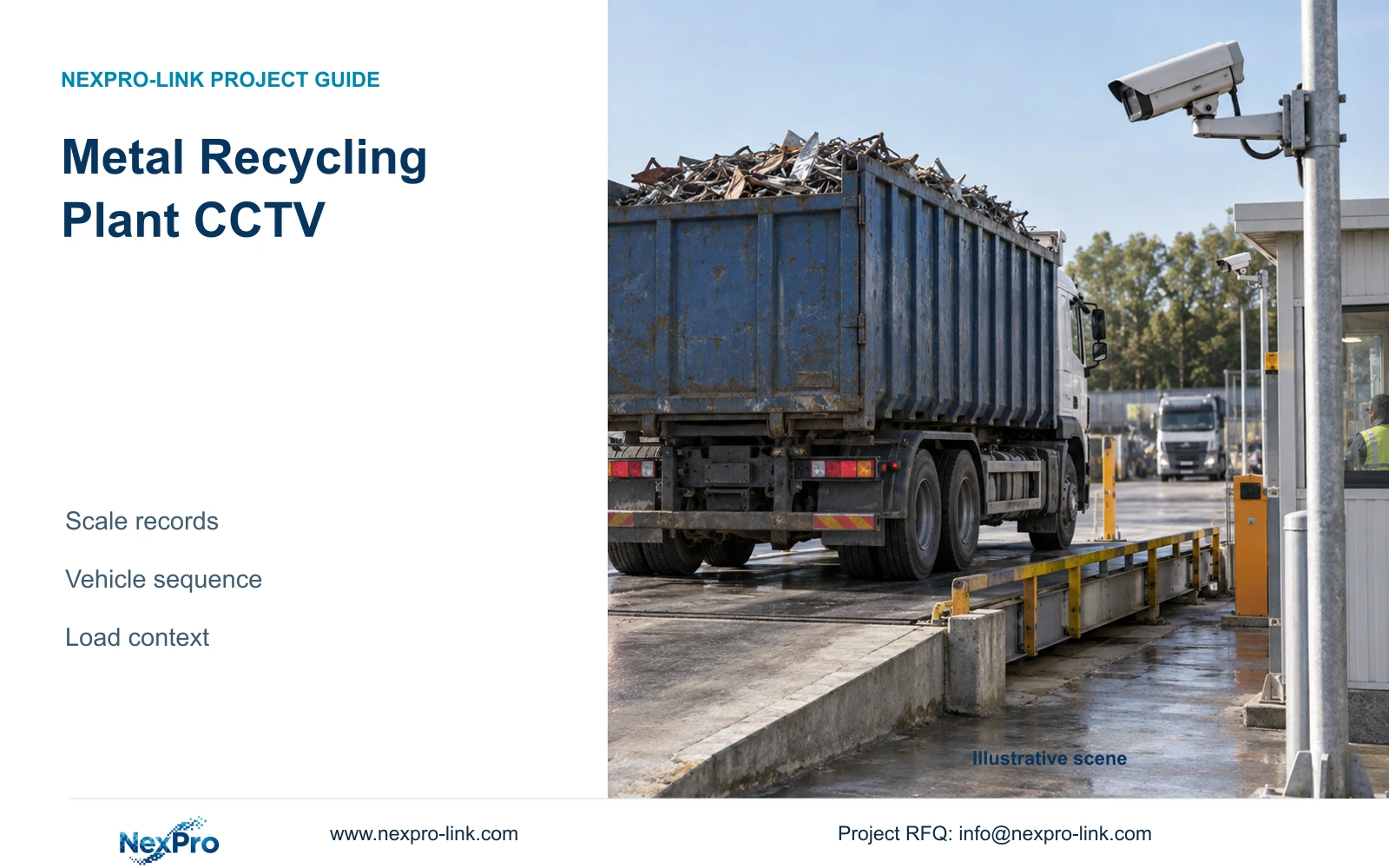
Metal recycling plant CCTV should use the scale record for weight and video for the vehicle's visible sequence. Coordinate the record's timestamp with camera and recorder time, then map it to the relevant views. Ordinary footage should not be used to derive weight or material composition. The quantity surveyor should price record-linked review separately from any scale-system integration.
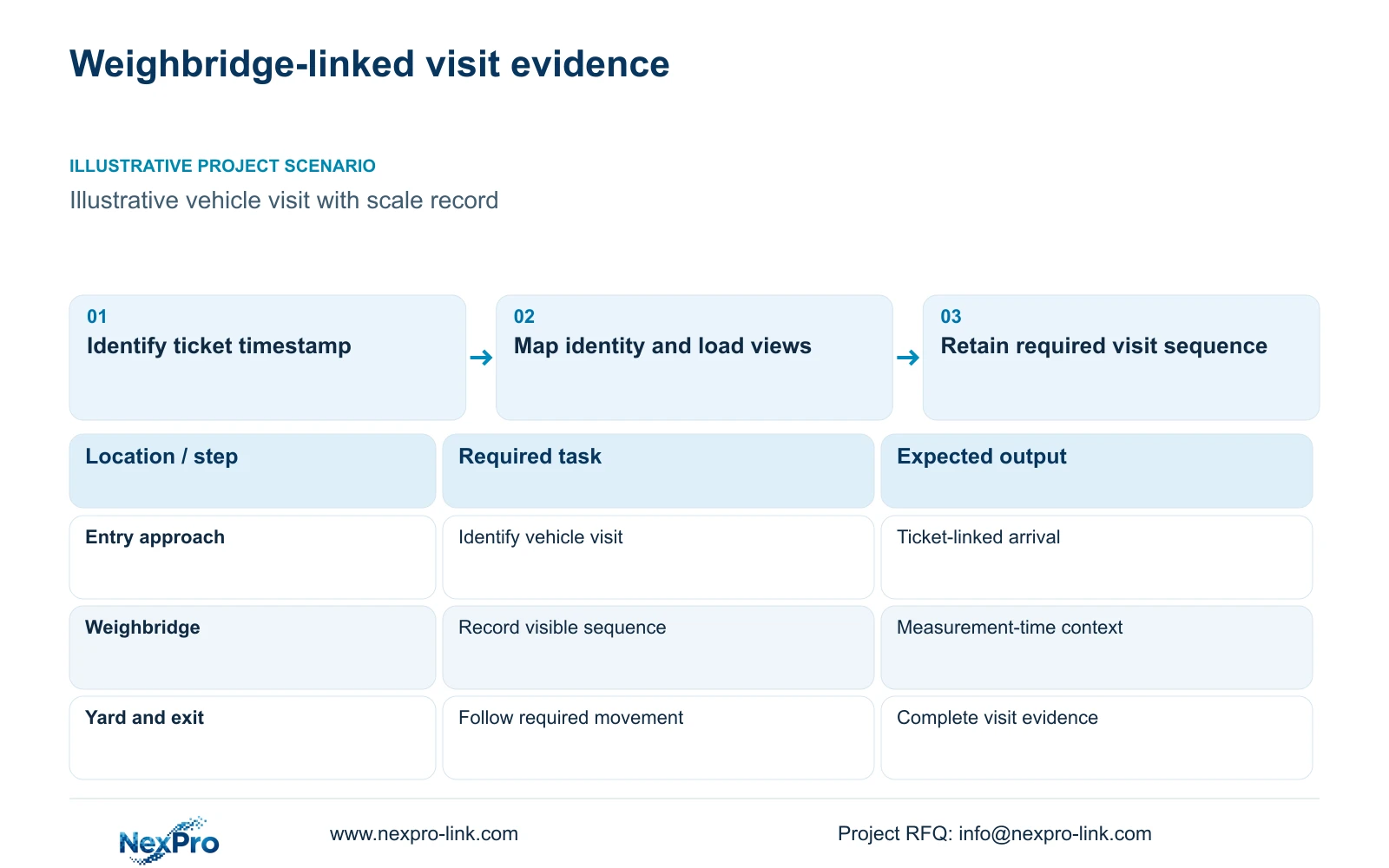
Illustrative project scenario: A recycling yard needs to correlate a vehicle visit with an external weighing record. Assume the visit includes arrival, weighing, yard movement and departure, with weighing records retained by the scale operator. The surveillance task is to explain which vehicle and visible load followed that sequence, not to verify the scale's measurement from images.
Confirm which event the scale timestamp represents. It may refer to a captured measurement or a later record action, so its meaning must be documented before setting a search window. Record timezone, clock source and any known offset. Give the reviewer a visit or ticket reference that remains useful if the same vehicle makes several trips.
Section 02
Separate vehicle identity from visible load context
A plate-oriented view and a material overview solve different tasks. The first may help identify the vehicle under a demonstrated scene condition; the second explains load presence and movement. A camera aimed to see the vehicle body may not retain the plate clearly, while a narrow plate image may omit the load and its surrounding sequence.
NexPro-BL2812M55-5MP-DIC-AI lists human and vehicle classification, a 2.8-12mm motorized lens and a 5MP-family output including 2880x1620 at 25fps. Vehicle classification is not plate identification. If automatic plate recognition is required, define a separately qualified system and lane task. Do not add ANPR performance to an ordinary camera quotation.
Check vehicle stopping positions, travel direction, lighting and obstruction from trailers or machinery. Use representative recorded movement for acceptance. Visible load context can help explain a visit, but hidden material remains outside the view. The scale and controlled intake records should retain responsibility for measurement and declared material information.
Section 03
Retain the route between weighing and departure
Map the visit as a sequence of observation points rather than a single weighbridge picture. Identify the entry approach, scale position, unloading or loading area and exit. If a truck leaves the weighbridge view before the relevant handover, the review package must include the downstream camera. Record the accepted camera mapping against the visit reference.
CASE05 supplies an illustrative distributed recording reference from a solar-module campus with three 32-camera nodes. That arrangement can inform separate gate and yard recording groups, but it does not establish metal-yard quantities. Local recording can preserve a group's footage when a viewing backbone is unavailable, provided its own camera, switch and recorder dependencies remain powered.
The supplied case uses 30 days of continuous recording at an assumed 4Mbps per camera. Retention at a recycling yard should follow its actual review period and approved requirements. Keep long-term retention distinct from a selected visit export. Provide suitable service rooms for ordinary recorders and batteries, and qualify exposed yard camera positions independently.
Section 04
Narrow the export only after confirming the complete visit
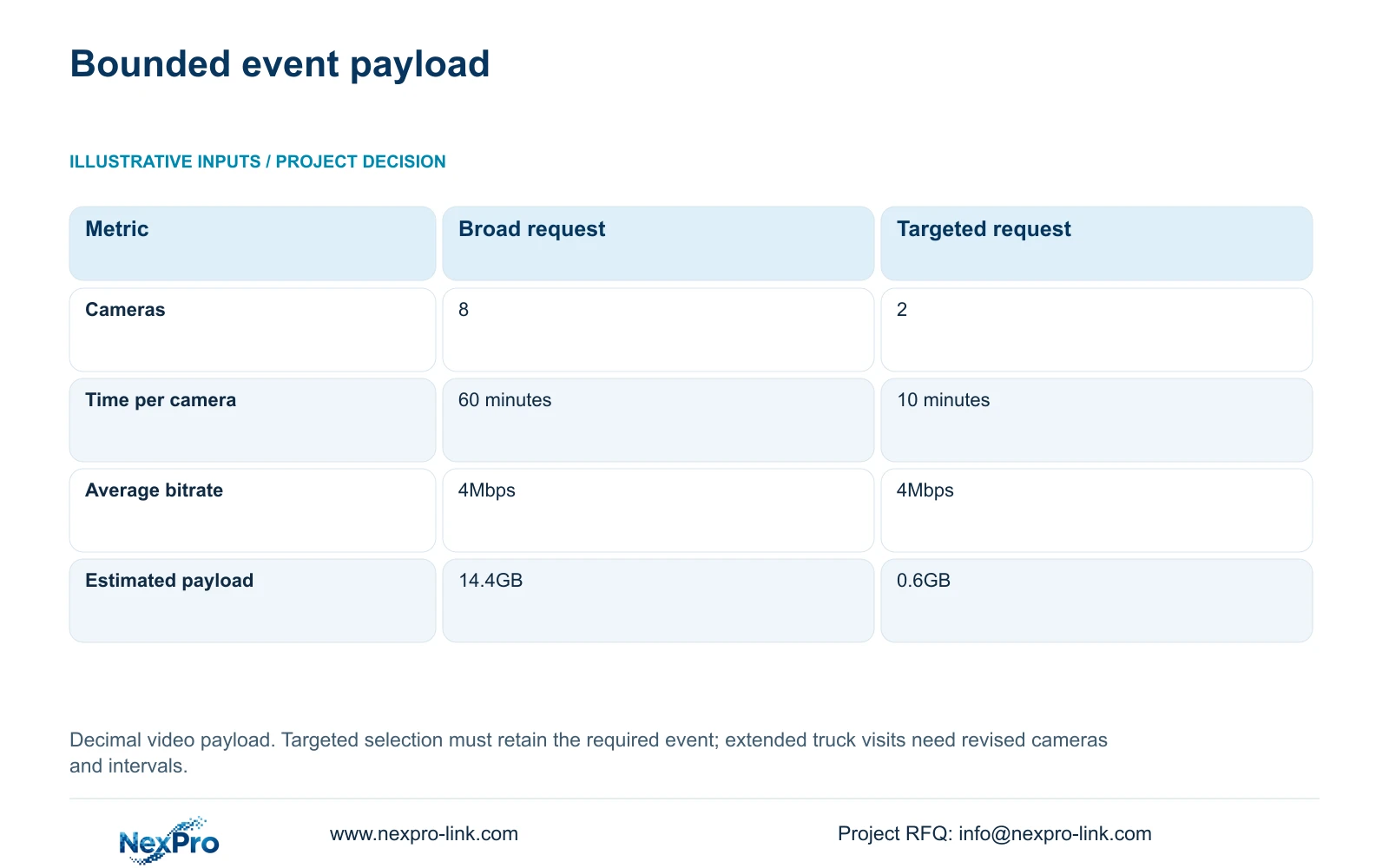
The illustrative broad selection includes eight cameras for 60 minutes each at an average 4Mbps. The targeted selection includes two relevant cameras for 10 minutes each at 4Mbps. Using decimal GB, GB = cameras × Mbps × seconds / 8 / 1000. Option A is 8 × 4 × 3600 / 8 / 1000 = 14.4GB. Option B is 2 × 4 × 600 / 8 / 1000 = 0.6GB.
The smaller selection can be appropriate for a bounded weighbridge event, but it is not automatically a complete vehicle visit. If the review includes unloading, a return weighing or departure later in the visit, add the necessary views and time. The decisive difference is an approved camera-and-time mapping that removes irrelevant material while retaining the required sequence.
These figures estimate average video payload only. They do not guarantee export duration, reviewer effort or legal evidence status. Record the visit reference, selected cameras and intervals alongside the export. Preserve the distinction between what the scale measured, what the intake system recorded and what the images visibly show.
| Metric | Broad request | Targeted request |
|---|---|---|
| Selected cameras | 8 | 2 |
| Minutes per camera | 60 | 10 |
| Average bitrate | 4Mbps | 4Mbps |
| Estimated decimal payload | 14.4GB | 0.6GB |
| Use condition | Uncertain event route or time | Complete required event verified |
Section 05
Recommend ticket-linked review with separate measurement duties
Use a controlled ticket-to-camera mapping as the baseline when the external scale record provides a dependable visit and time reference. This can support manual review without assuming a native scale-to-recorder connection. Retain the scale operator's measurement records, while the security reviewer handles the visible route and custody questions.
Add integration when the owner defines a workflow that manual lookup cannot adequately meet. State the exact record fields, supported interfaces, access permissions and commissioning demonstration. A video connection alone does not establish automatic ticket association. A separately specified plate system may also be needed if the owner requires automated vehicle identity.
Compare suppliers using the same accepted visit sequence, lighting conditions, retention and export task. Include camera mounts, network nodes, time coordination and local commissioning. A lower camera price is not a complete alternative if it omits a necessary downstream view or measurement-system interface. No matched quotes or field trials are supplied here to establish an overall winner.
Section 06
Make ticket mapping part of the commissioning package
Issue a schedule tying observation points to camera IDs and recorder nodes. Mark scale records as retained, ordinary surveillance as supplied and automatic plate recognition or integration as separately specified options. Assign responsibility for timestamp meaning, clock configuration, route visibility and authorised export. The operator should know who updates the mapping after a lane or unloading area changes.
NexPro-Link's BOQ support scope can help align models, technical documents and quotation deviations. Its factory project scope supports discussion of coordinated equipment packages. Preparation should keep gate, weighbridge and yard labels consistent through packing and configuration records, while actual alignment and environmental approval remain with the site team.
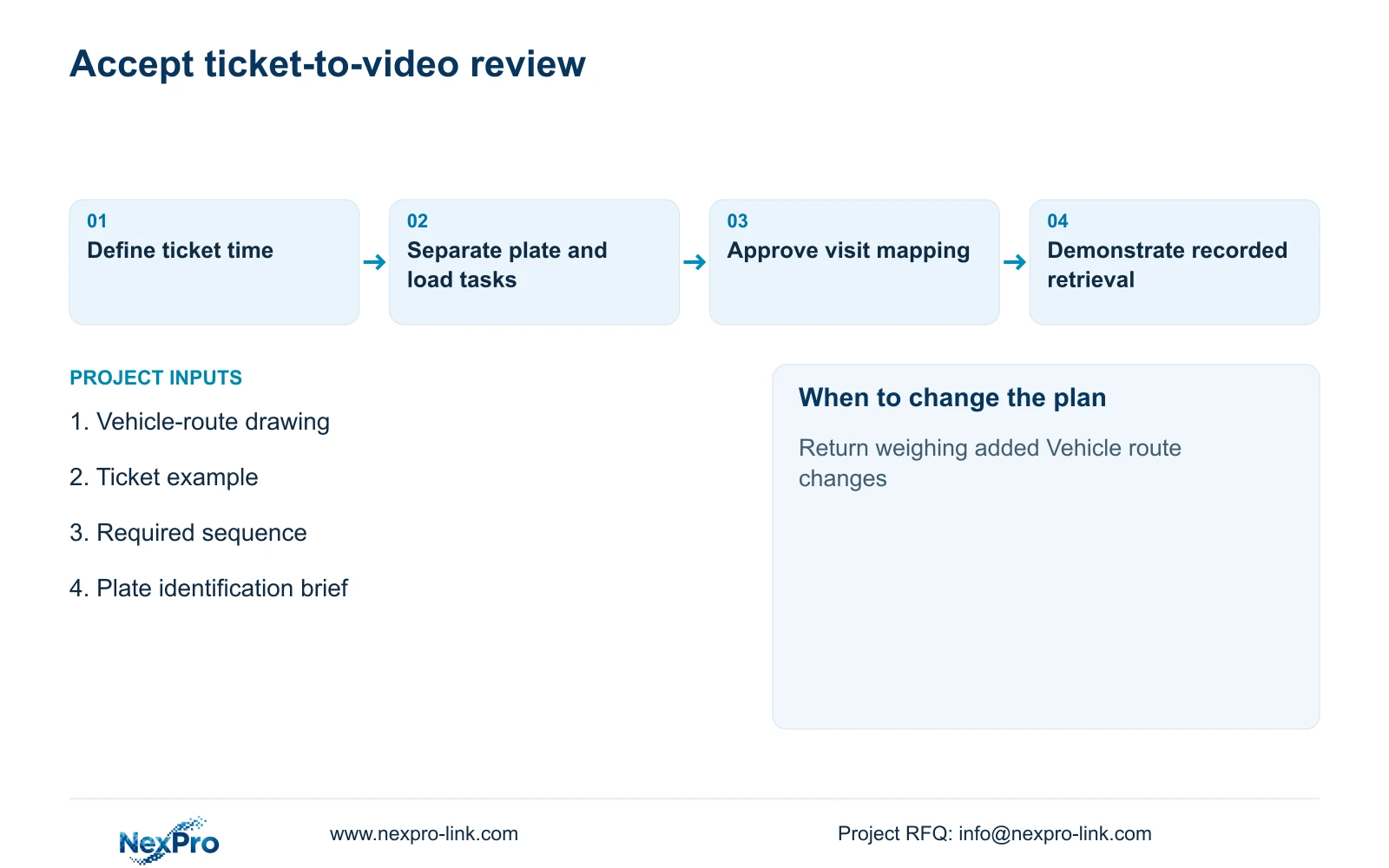
Commission with a representative visit reference, then retrieve recorded arrival, the relevant weighing context and every additional movement required by the brief. Check an extended visit as well as a simple passage. Recalculate storage, selected payload and affected network traffic when the event scope changes. Acceptance should explicitly exclude weight determination, composition analysis and scale certification from ordinary CCTV.
Section 07
Buyer questions
Can the two-camera, ten-minute option cover every truck visit? No. It is an illustrative bounded-event selection. Visits involving waiting, unloading or return weighing may need more cameras and longer intervals to preserve the required sequence.
Do we need automatic scale integration to start? A controlled manual ticket-and-time mapping may meet the initial task. Add integration only with defined fields, supported interfaces and an acceptance demonstration.
What if one vehicle makes several visits in a shift? Use a visit or ticket reference together with the timestamp and route. Vehicle identity alone is insufficient to distinguish repeated trips reliably.
Section 08
Specify weighbridge-linked video review
Send the weighbridge and vehicle-route layout, a redacted ticket example with timestamp meaning, the required visit sequence, and any plate-identification requirement to info@nexpro-link.com for a scoped proposal discussion.
Engineering references
These sources support the general planning principles. Always use the selected product's current datasheet and applicable project standards for final design.