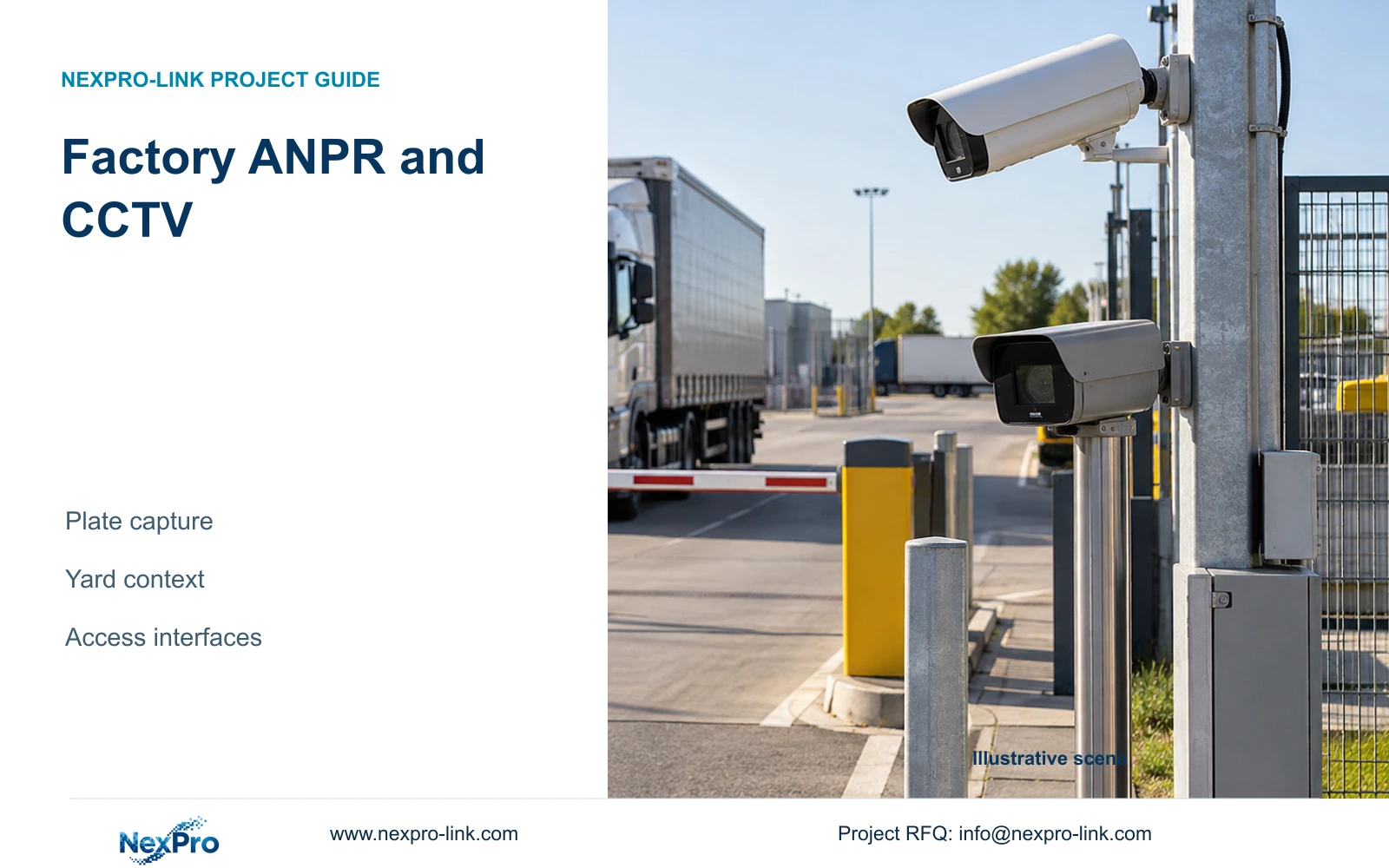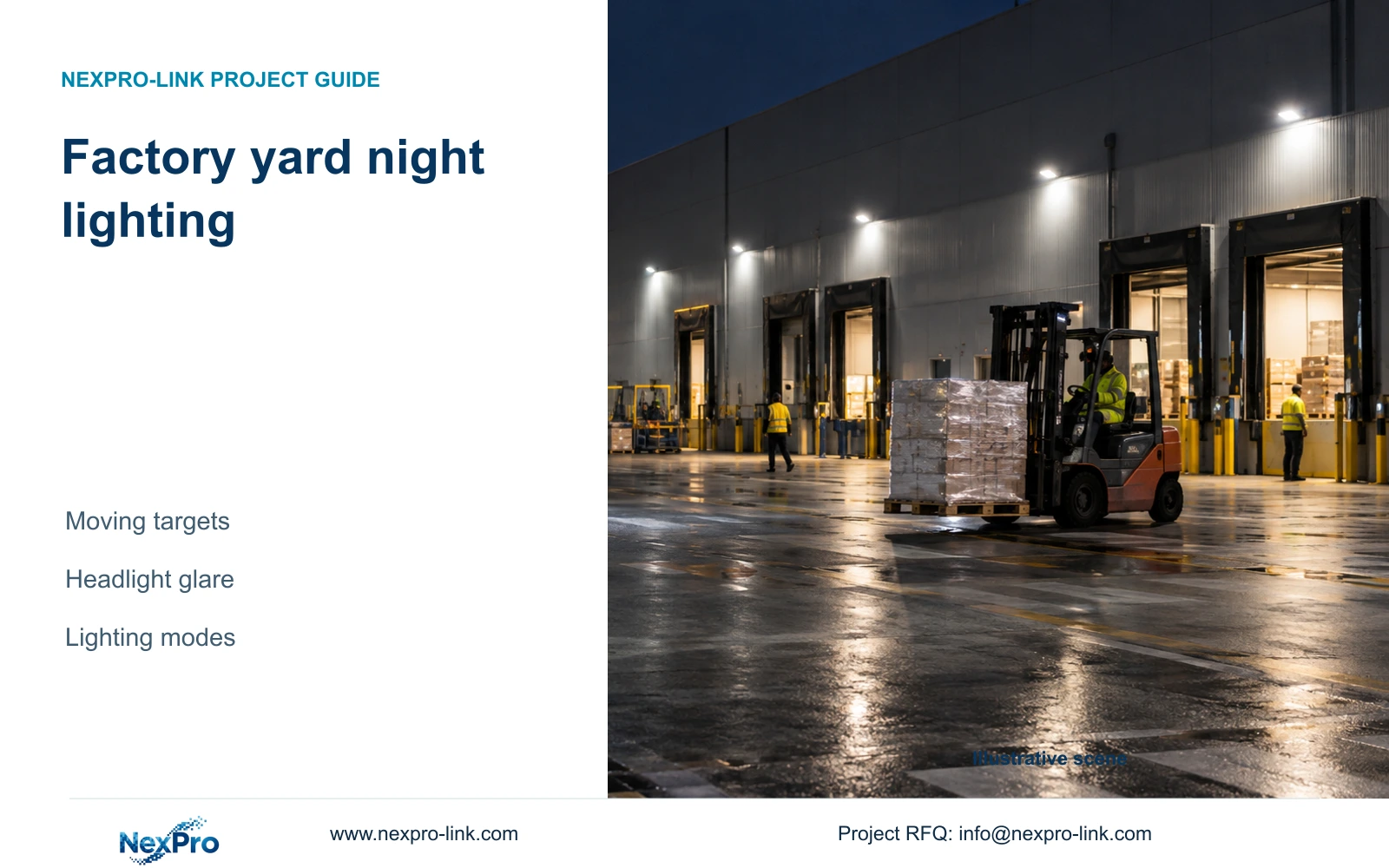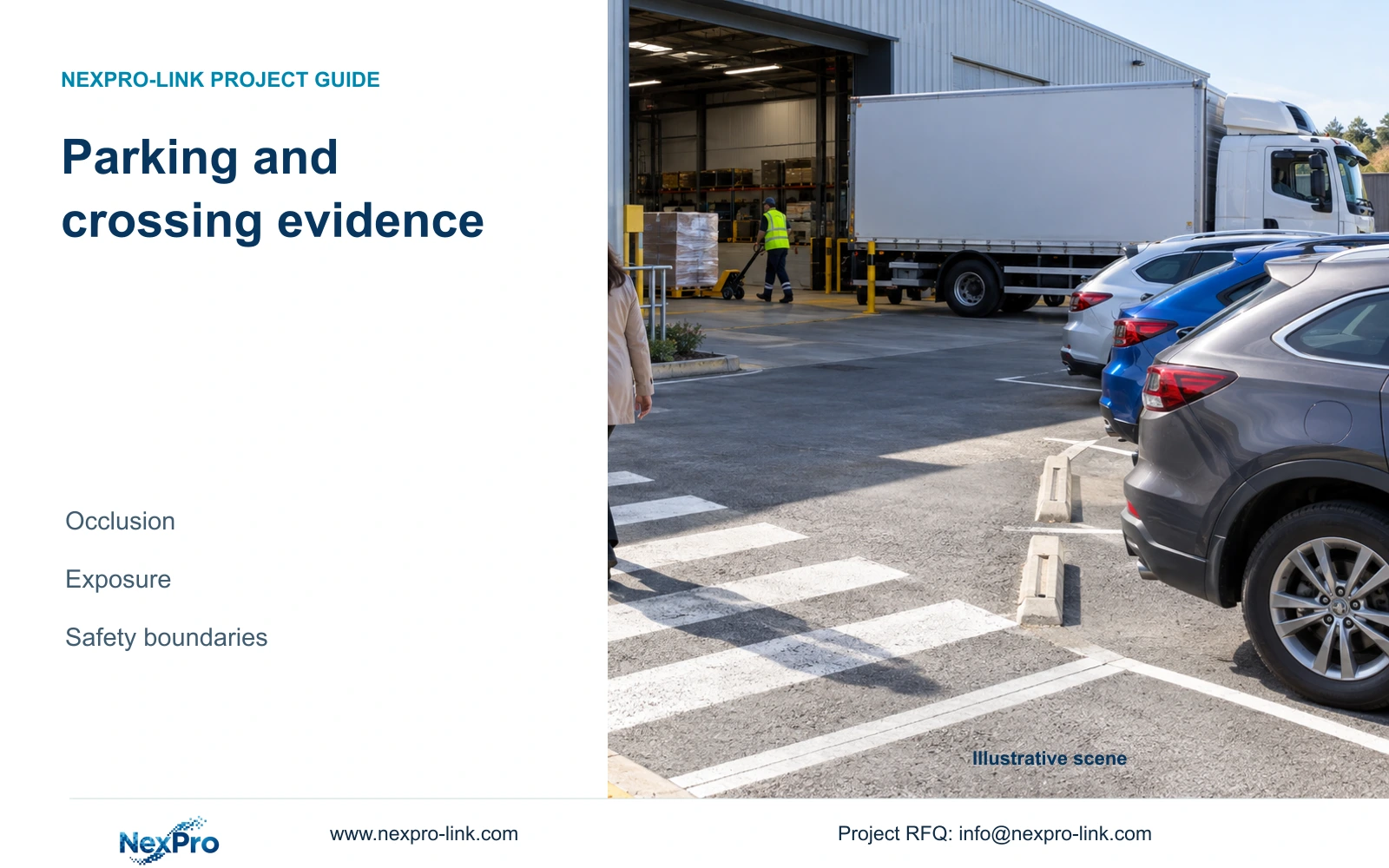
Factory parking cameras need to preserve the approach, crossing and departure sequence despite parked vehicles. Exposure, lighting and clearly assigned safety responsibilities determine whether that evidence is useful.
Section 01
Define the crossing sequence the recording must preserve
For factory visitor parking and pedestrian crossings, choose CCTV views that preserve how people and vehicles approach, meet and leave the crossing. Keep pedestrian segregation, signs and any certified collision-prevention systems under their own design and operating responsibilities. A camera schedule should describe the events available for later review, without assigning ordinary security cameras the task of preventing a collision.
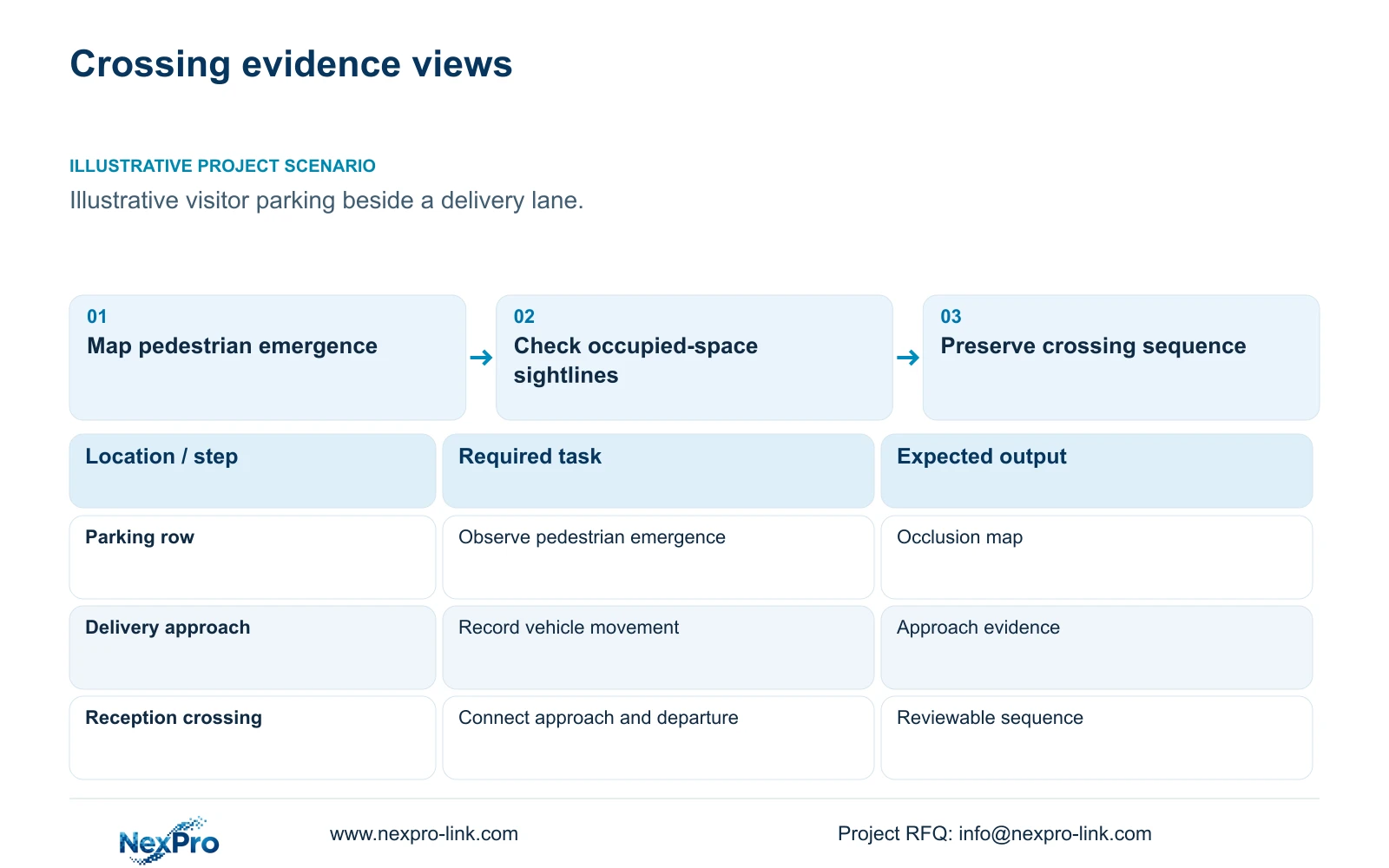
Illustrative project scenario: The site has shared visitor parking and crossings near a delivery lane. Assume visitors walk from parked cars toward reception while delivery vehicles pass the crossing. These are planning assumptions, not a reported customer installation. The engineer needs to identify where pedestrians first become visible, which vehicle approaches matter and whether reception staff or guards will retrieve recordings.
Mark those movements on the internal-route drawing and connect the destination to the door schedule. Specify a usable sequence: pedestrian emergence, vehicle approach, crossing occupancy and departure. Assign each view to the appropriate recording authority, especially where the parking area serves several occupiers. The owner can then approve an evidence task rather than an unsupported promise that a single wide camera will show every relevant detail.
Section 02
Check visibility with the parking spaces occupied
Evaluate the crossing with representative vehicles in the spaces that can obstruct it. A clear view of an empty parking area says little about a pedestrian stepping out beside a van. On the proposed plan, trace the camera sightline to both crossing approaches, then repeat the check with plausible parked-vehicle heights and a delivery vehicle in the lane. Record the obstructed segments rather than averaging them into a general coverage claim.
An elevated overview may establish traffic direction and the broad sequence. If parked vehicles hide the point where pedestrians emerge, add or reposition a view from the opposite side, subject to mounting access and the actual geometry. Narrowing a lens cannot recover an event behind an opaque vehicle. Moving the camera can also change cable length, maintenance access and the area of unrelated activity captured.
The NexPro-BL2812M55-5MP-DIC-AI is a normal-area candidate with a 2.8–12mm motorized lens, PoE and IP66. Its supplied specification identifies the 5MP family, 25fps@5MP and listed main output including 2880×1620. Use those fields to propose a view for testing. They do not establish recognition distance, maximum power or a collision-prevention capability. Final framing should be assessed at the crossing, including occupied spaces and actual nighttime lighting.
Section 03
Assign traffic controls and CCTV separate responsibilities
Build an interface schedule before combining equipment into one quotation. In this scenario, the CCTV integrator supplies the agreed recording views, while the site traffic-design team owns the crossing layout and physical controls. The owner decides who may review footage. If an existing barrier or access-control system remains, identify its contractor and retain its approved operating behavior unless a separately authorized change is specified.
A proposed event link needs a precise purpose, such as helping an operator locate video around an access event. Record the source, timestamp handling, receiving software and responsible party, then demonstrate the workflow. Equipment arriving in the same shipment does not establish software integration or life-safety control. Security video should also remain separate from production-control access unless the project explicitly defines and approves an interface.
| Item | Required task | Supply status | Responsible party |
|---|---|---|---|
| Crossing cameras | Record approaches and crossing occupancy | Supplied | CCTV integrator |
| Segregation and signs | Define pedestrian and vehicle routes | Installer-provided | Site traffic-design team |
| Existing barrier | Retain approved vehicle-access operation | Retained | Barrier contractor |
| Event-to-video link | Locate footage from an agreed event | Optional | Named integration contractor |
| Shared recorder and rack | Provide allocated recording and network resources | Retained or supplied after survey | Owner's security-system administrator |
Section 04
Select exposure using movement and available light
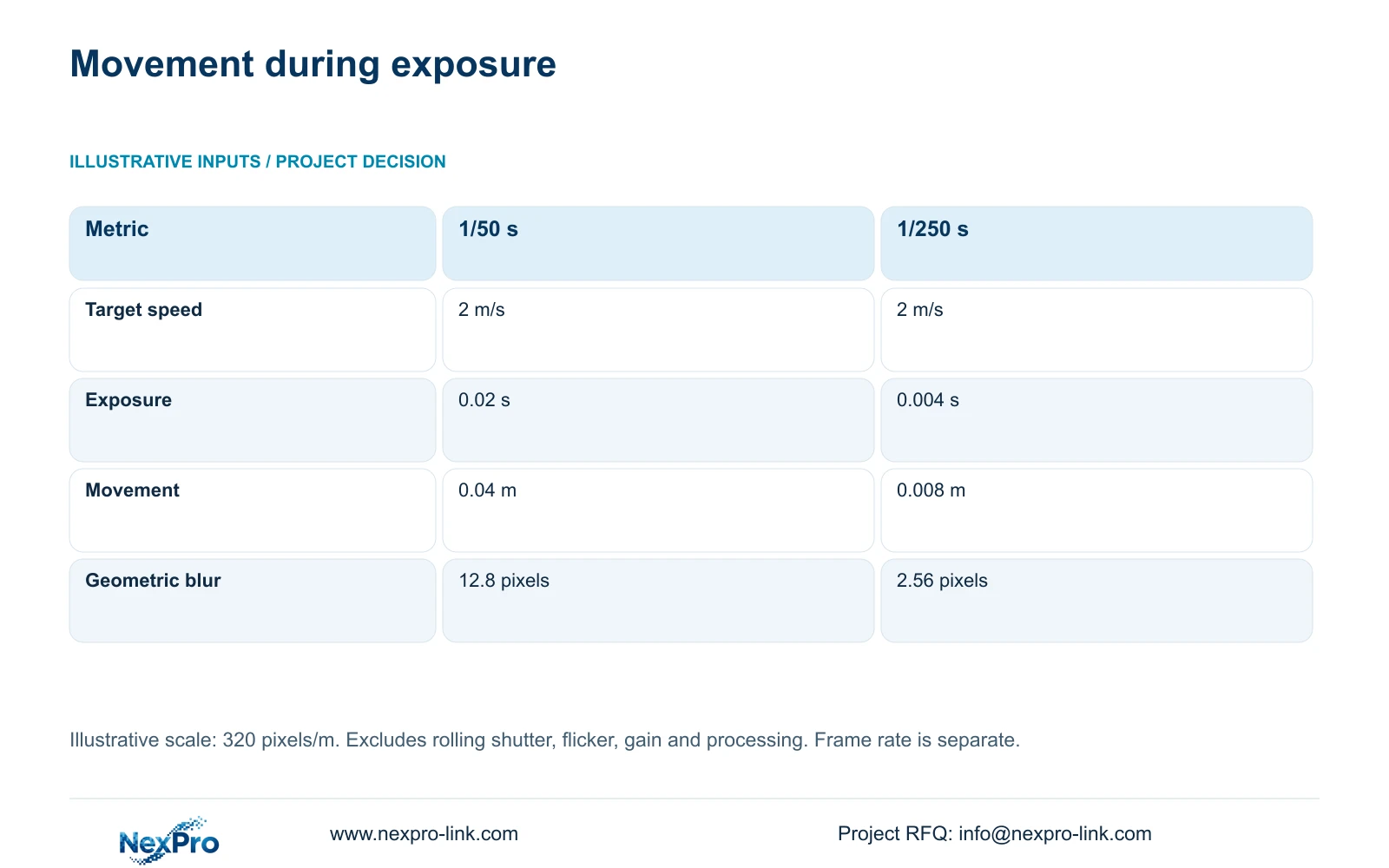
The supplied illustrative calculation assumes a target speed of 2 m/s and an image scale of 320 pixels/m. Compare exposures of 1/50 s and 1/250 s, equivalent to 0.02 s and 0.004 s. The formulas are movement_m = speed_m_s × exposure_s and estimated_blur_px = movement_m × pixels_per_m. The results describe movement during one exposure, independently of frame rate.
At 1/50 s, movement is 2 × 0.02 = 0.04 m, producing an estimated 0.04 × 320 = 12.8 pixels of geometric blur. At 1/250 s, movement is 0.008 m and estimated blur is 2.56 pixels. That difference supports testing a shorter exposure where moving detail matters. Increasing fps alone does not create the shorter exposure used in this comparison.
Test the shorter exposure under the actual lighting conditions because available light, gain and processing affect the recorded result. The calculation excludes rolling shutter, lighting flicker and sensor behavior; it is neither a product test nor a safety rating. Resolve occlusion first. Even an exposure that produces acceptable moving detail cannot record the portion of a pedestrian hidden behind a parked van.
| Metric | Option A | Option B |
|---|---|---|
| Assumed target speed | 2 m/s | 2 m/s |
| Exposure | 1/50 s = 0.02 s | 1/250 s = 0.004 s |
| Movement during exposure | 0.04 m | 0.008 m |
| Geometric blur estimate | 12.8 pixels | 2.56 pixels |
Section 05
Protect the evidence path before adding display equipment
Use an overview as the baseline, adding a complementary crossing view where the occupied-parking check identifies a missing event segment. Include mounts, nighttime image assessment and retrieval demonstration in both offers. Compare another supplier's proposal against those same tasks and services. A higher camera resolution or a lower equipment quotation does not resolve a missing sightline or an omitted installation activity.
CASE08 provides an illustrative infrastructure reference with four independent 32-camera nodes. Each node assumes 4 Mbps per camera and 30 days of continuous recording, giving 128 Mbps input and 41.472 TB of video. Four 16 TB disks provide 64 TB raw capacity and a recording budget of 64 × 0.95 × 0.80 = 48.64 TB. The reserve is already included. If crossing cameras are added beyond an agreed node schedule, recalculate that node rather than borrowing unused storage from another.
The referenced NexPro-NVR4449-4K has 320 Mbps input and four SATA bays, but channel count does not establish simultaneous decoding or RAID. Preserve the camera-to-switch-to-recorder path and its actual power dependencies. Account for switch AC input without counting its PoE camera load twice. A retrieval monitor may suit this task; an optional LCD wall adds display and power requirements without removing parked-vehicle occlusion. Backup duration requires the selected UPS and battery configuration, not a load-energy figure alone.
Section 06
Release a view schedule with observable acceptance checks
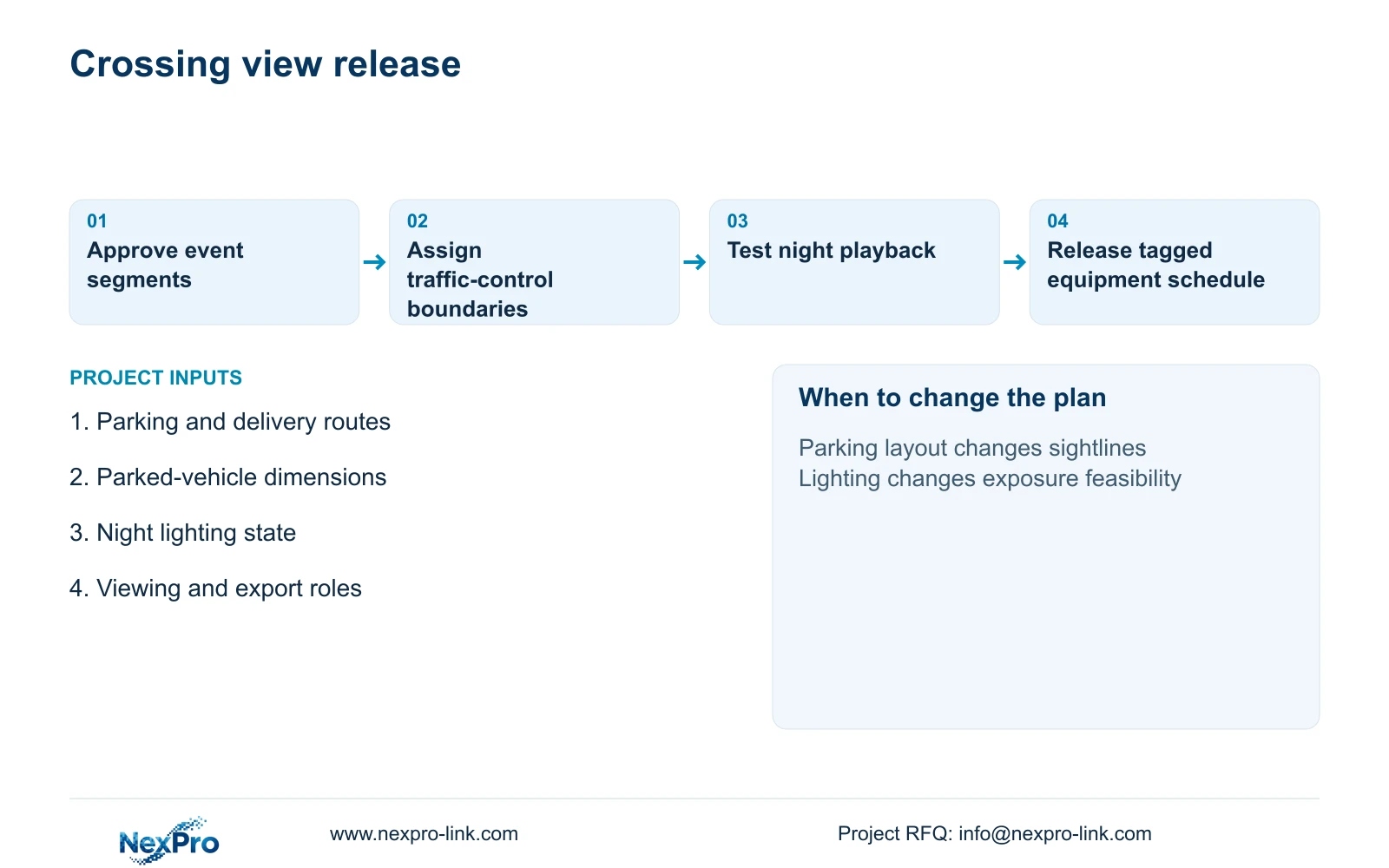
Give each crossing camera a location tag, required event segment and approved mounting position. Record the trial conditions: occupied parking spaces, delivery movement, pedestrian direction and nighttime lighting state. Acceptance should include playback and export of the agreed sequence. Keep credentials and private device identifiers outside public drawings and packaging artwork.
Allocate retained recording capacity, network ports and cabinet resources explicitly. Measure individual cable routes and distinguish permanent links from patch cords; a changed viewpoint may require a different route or backbone connection. NexPro-Link can discuss model matching, BOQ support, relevant technical documents and location-labelled project packing. Local installation, traffic-control design and any specialist integration remain assigned project scopes. Reopen the view assessment when parking arrangements, delivery routes or lighting change, rather than substituting a camera while retaining obsolete acceptance conditions.
Section 07
Buyer questions
Should the parking package include number-plate identification? Only if the owner needs that separate task. Human/vehicle classification does not establish plate identification. Define the lane, target vehicle behavior and identification workflow before adding an ANPR requirement to the parking evidence package.
Can an existing camera be retained for the overview? Yes, if its recorded view preserves the required sequence under occupied-parking and nighttime conditions. Confirm retrieval, export, mounting condition and its actual recorder connection before deducting a replacement from the quotation.
Does this article prescribe a retention period for parking footage? No. The 30-day figure belongs to CASE08's illustrative storage boundary. The owner should set the actual period with the relevant advisers and verify applicable local requirements before procurement.
Section 08
Request a crossing evidence package
Send the parking and delivery-route plan, representative parked-vehicle dimensions, nighttime lighting information and proposed viewing roles to info@nexpro-link.com. NexPro-Link can discuss the camera schedule and shared recording allocation for your crossing evidence task.
Engineering references
These sources support the general planning principles. Always use the selected product's current datasheet and applicable project standards for final design.