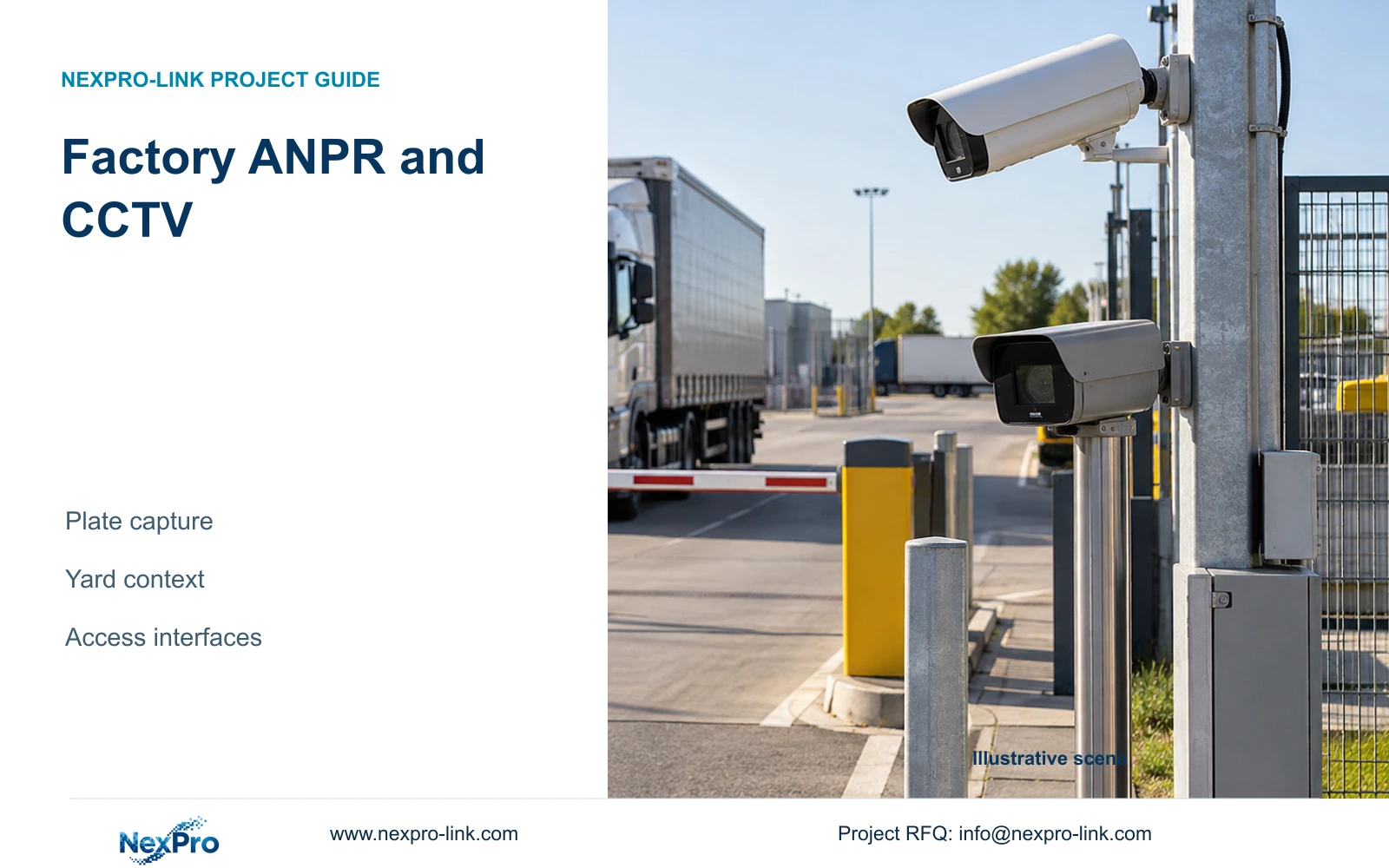
Factory gate design needs distinct plate-reading and overview roles. Specify vehicle behaviour, preserve context and verify the complete access and recording workflow.
Section 01
Specify the plate-reading task before choosing a camera
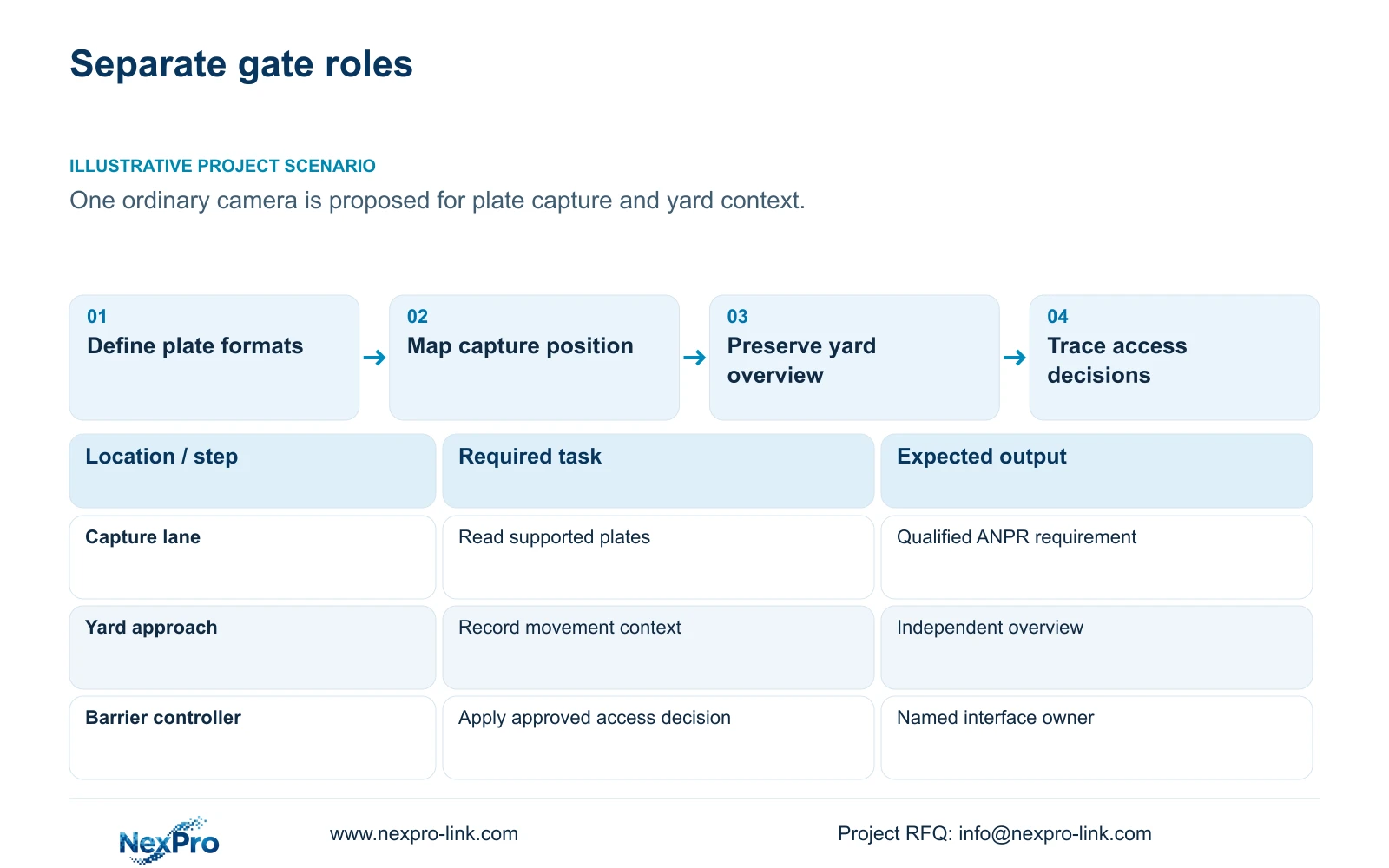
Factory ANPR and CCTV should have separately defined roles. Specify the plate country or format, vehicle direction, stopping behaviour and capture position for the ANPR task, while preserving an independent yard overview. Human or vehicle classification on an ordinary security camera does not establish number-plate recognition, supported plate formats or a working barrier-control interface.
Illustrative project scenario: The gate proposal tries to use one ordinary vehicle-detection camera for all plate and yard tasks. Assume, for planning, that delivery vehicles pause near a guard checkpoint while other vehicles may proceed after authorisation. The engineer must confirm whether every vehicle stops at the same position and whether front or rear plates are available. These assumptions describe a proposed workflow, not a successful client installation.
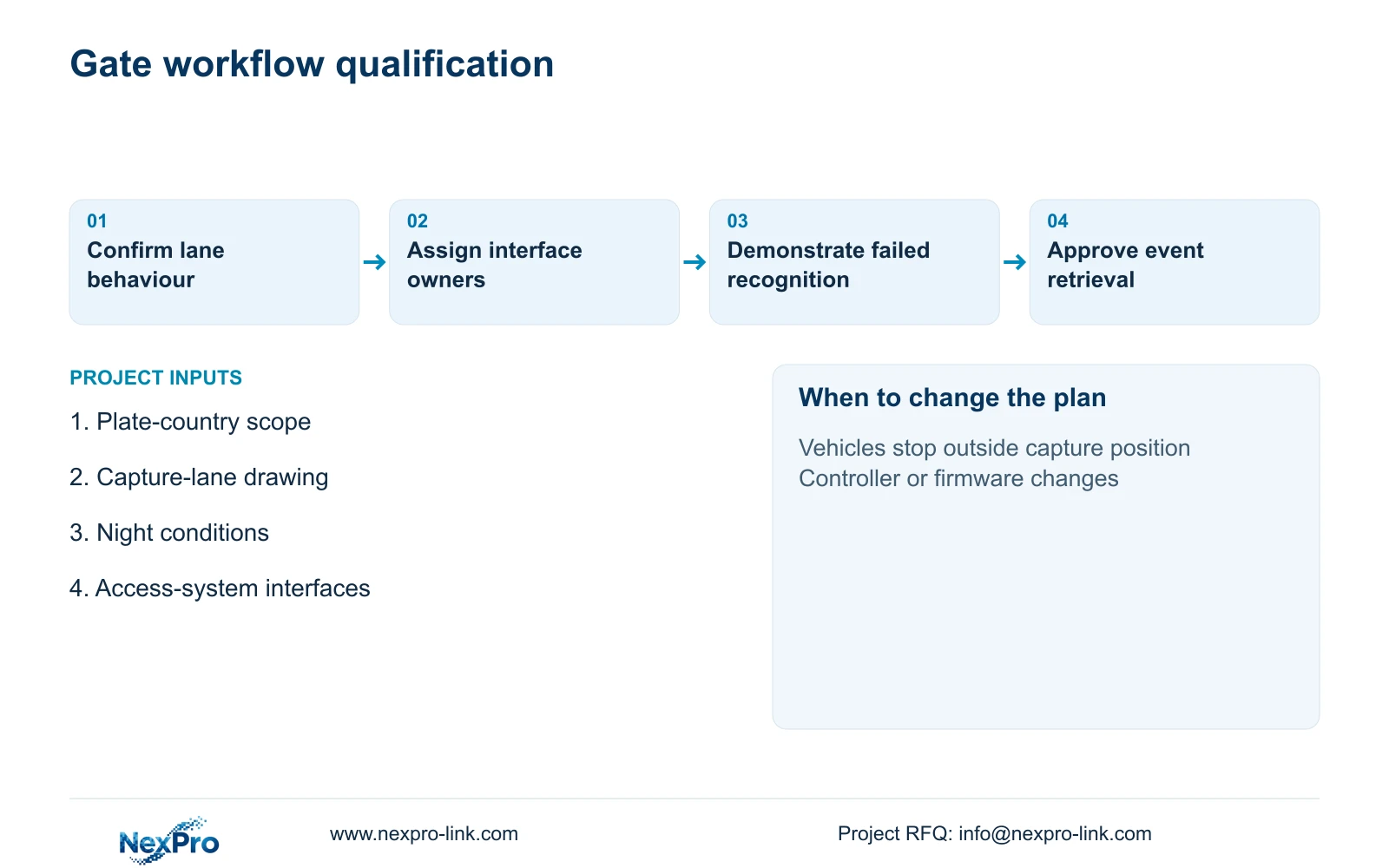
Record lane width, capture distance, camera height, vehicle path and night conditions on the gate drawing. Ask the owner whether the objective is searchable plate history, manual checking or automatic access authorisation. Each objective changes the software, exception handling and acceptance demonstration needed alongside the camera.
Section 02
Keep movement context outside the plate frame
An overview should show where the vehicle came from, its position relative to the checkpoint and relevant activity around it. A plate-focused frame may exclude a pedestrian beside the truck, another vehicle entering the lane or the loading yard beyond the barrier. Specify that context directly rather than expecting one narrow capture image to answer every later investigation question.
For a reasonable baseline, retain a fixed overview and specify a dedicated plate-reading role where searchable plates are required. Change the overview position if queued trucks block the approach or obscure the barrier area. At night, review headlights, available lighting and moving vehicles in recorded footage. A clear stationary daytime plate does not demonstrate the complete intended capture task.
The NexPro-BL2812M55-5MP-DIC-AI and NexPro-BL2812M88-8MP-DIC-AI are ordinary overview candidates with listed 2.8–12mm motorized lenses. Their source outputs support the comparison below. Neither model should be assigned an ANPR capability from human or vehicle classification alone; a plate-reading offer needs its own exact device and workflow evidence.
Section 03
Trace recognition, authorisation and recording separately
Draw two related paths. The video path runs from the camera through the local network to a recorder and authorised viewing client. The access path runs from a recognised or manually entered identity through an access decision to the barrier controller. State which component owns each decision and which supplier must demonstrate it. Receiving video at an NVR does not prove that plate metadata, search or access events are also supported.
Use an interface schedule identifying the ANPR supplier, access-system owner, CCTV supplier and local gate contractor. The dedicated plate device can be retained if its integration is already approved, while ordinary overview cameras are supplied separately. Keep barrier safety functions under the gate system's defined responsibility. A plate match must not be treated as proof that the vehicle path is safe for movement.
ONVIF's profile framework makes exact device, client and firmware applicability relevant to interoperability checks. Test the required video, event and search functions individually. Include a rejected plate, an unreadable plate and loss of the link in the demonstration, with the owner approving how the guard handles each exception.
Section 04
Compare source outputs at the same scene width
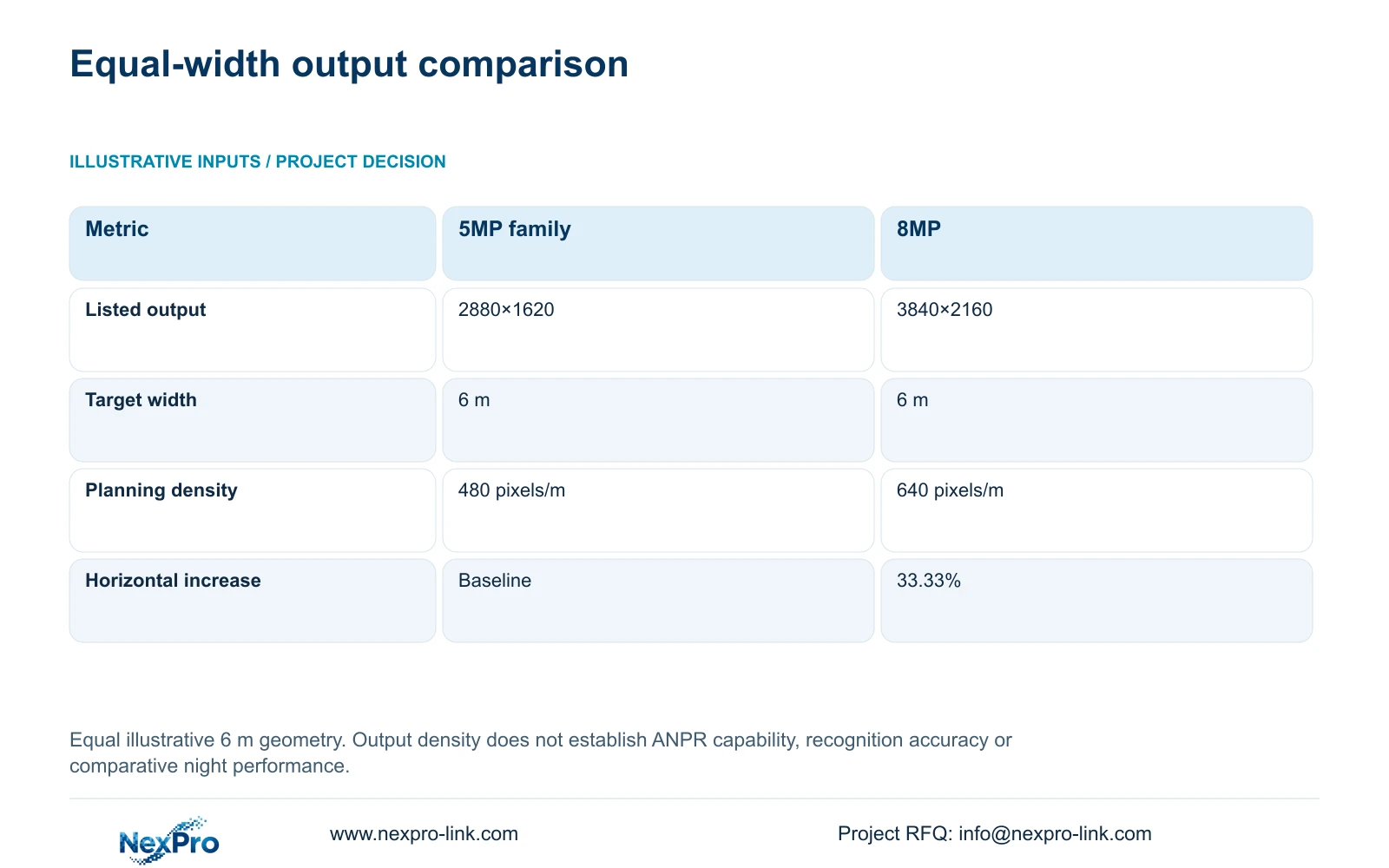
The supplied 5MP-family source lists 2880×1620 output; the 8MP source lists 3840×2160. At an illustrative 6 m target-plane width, planning density is ppm = horizontal_pixels / 6. The resulting values are 480 pixels/m and 640 pixels/m. The relative increase is (3840 / 2880 - 1) × 100 = 33.33%. Preserve the listed dimensions rather than substituting another assumed 5MP format.
This arithmetic helps compare overview detail under equal geometry. It does not establish a plate-reading capability or a 60% detail improvement from the 5MP and 8MP labels. Exposure, vehicle movement, lighting, lens geometry and compression require separate acceptance data. The comparison also does not establish comparative night performance.
If the 6 m overview still fails the required visual detail check, consider a narrower dedicated detail view or a different mounting position. Do not remove the broad context merely because the higher-output candidate has more horizontal pixels. Price the accepted overview and the qualified ANPR role separately so a resolution upgrade does not hide an unresolved software dependency.
| Metric | Option A: 5MP family | Option B: 8MP |
|---|---|---|
| Listed output | 2880×1620 | 3840×2160 |
| Horizontal pixels | 2,880 | 3,840 |
| Target width | 6 m | 6 m |
| Planning density | 480 pixels/m | 640 pixels/m |
| Horizontal-density increase | Baseline | 33.33% |
Section 05
Retain approved gate functions while sizing video nodes
Prefer a dedicated, qualified plate workflow plus independent overview where both tasks are required. A manually operated gate may instead need readable context and a guard procedure without automatic plate authorisation. Retain an existing mandatory platform when its integration or operational role is essential. Compare NexPro-Link and other proposals against these same tasks, including licences, interfaces, installation and support.
CASE08 offers a useful architectural boundary: four independent 32-camera recording nodes maintain separate ownership and access roles despite a shared backbone. A gate package should likewise identify who may view footage or export vehicle records. Its ordinary 5MP-class stream assumption does not establish compatibility for a specialist ANPR camera or an all-8MP replacement.
Obtain actual average recording bitrates and maximum device demand before adding a plate device to the node budget. Check input modes, storage, PoE class and local backup together. If a specialist device needs separate power, include that supply in the protected path. Keep the guard's live display separate from recording, and verify that the chosen client can retrieve the relevant incident.
Section 06
Release the order against a gate workflow demonstration
The procurement schedule should identify the capture lane, ordinary overview, plate device, controller interface, recording destination and operator client. For each line, state whether it is supplied, retained or provided by another contractor. Require the ANPR offer to name the supported plate scope and software version. Specify any integration work as a deliverable rather than assuming it is included with the camera.
Demonstrate a complete vehicle event: arrival, capture, access decision, passage and subsequent retrieval. Confirm that the overview and plate record refer to the same event, and test what the operator sees when recognition fails. Outdoor link routes, fibre endpoints and local power supplies should appear on the same dependency drawing, with maintenance access included in the installation scope.
NexPro-Link's factory project and BOQ support can help coordinate ordinary CCTV selection, technical documentation and equipment packing around the approved gate roles. Any specialist plate device and access integration remain explicitly qualified. This gives the buyer a clear basis for comparing the complete package without claiming a universal mixed-brand workflow.
Section 07
Buyer questions
Can an existing plate camera remain when the overview system changes? Yes, if its required access and recording interfaces remain supported. Treat its firmware, metadata path and operating permissions as retained dependencies, then test the revised overview and retrieval workflow.
Must every factory gate use automatic plate authorisation? No. A staffed gate may use manual identity checking. Buy automatic authorisation only when the owner defines the access policy, exception procedure and required integration.
What should a supplier demonstrate beyond a readable plate image? The supported plate formats, moving and stopped vehicle behaviour, searchable record, associated overview and response to failed recognition. Barrier integration needs a separate operational demonstration.
Section 08
Define your gate package
Send plate-country requirements, lane geometry and stopping behaviour, night conditions, and existing access-system interfaces to info@nexpro-link.com for a separated ANPR and CCTV supply discussion.
Engineering references
These sources support the general planning principles. Always use the selected product's current datasheet and applicable project standards for final design.