A factory UPS acceptance test must follow the actual camera-to-recording power path, with operational evidence that goes beyond timing an energised UPS.
Section 01
Define the operational path covered by the outage test
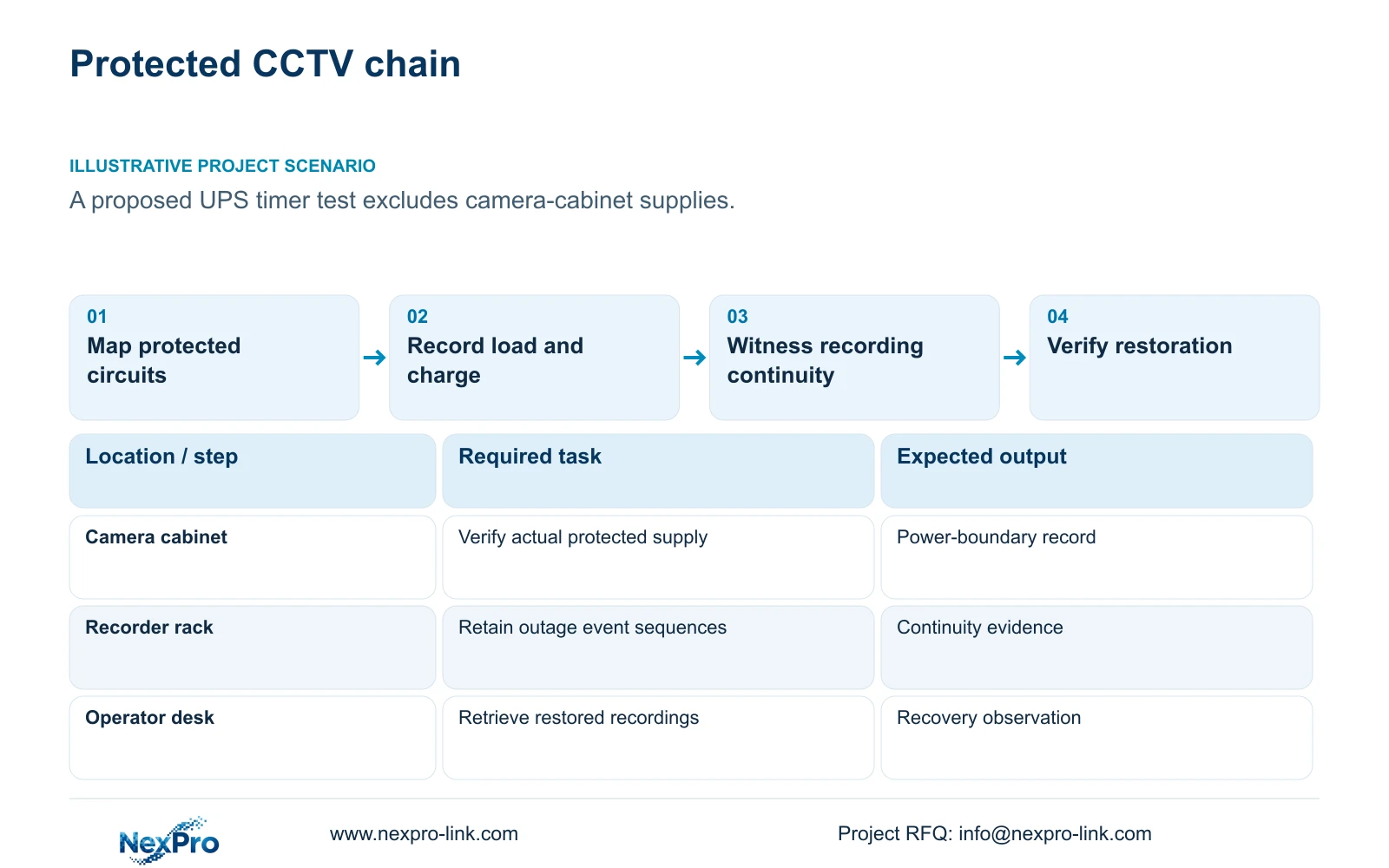
Factory UPS acceptance should verify the complete required CCTV service through a safe, authorised electrical test. Establish which cameras, switches, links, recorder and viewing functions are within the protected path. Report demonstrated recording continuity for that boundary; elapsed UPS-on time alone does not establish all-camera runtime.
Illustrative project scenario: An acceptance plan proposes timing the UPS while disconnected camera cabinets use other supplies. The hypothetical CASE01 CNC package provides the reference arrangement: 32 ordinary cameras, four PoE groups and local recording. Assume the project manager discovers that the proposed test does not reproduce the installed power dependencies.
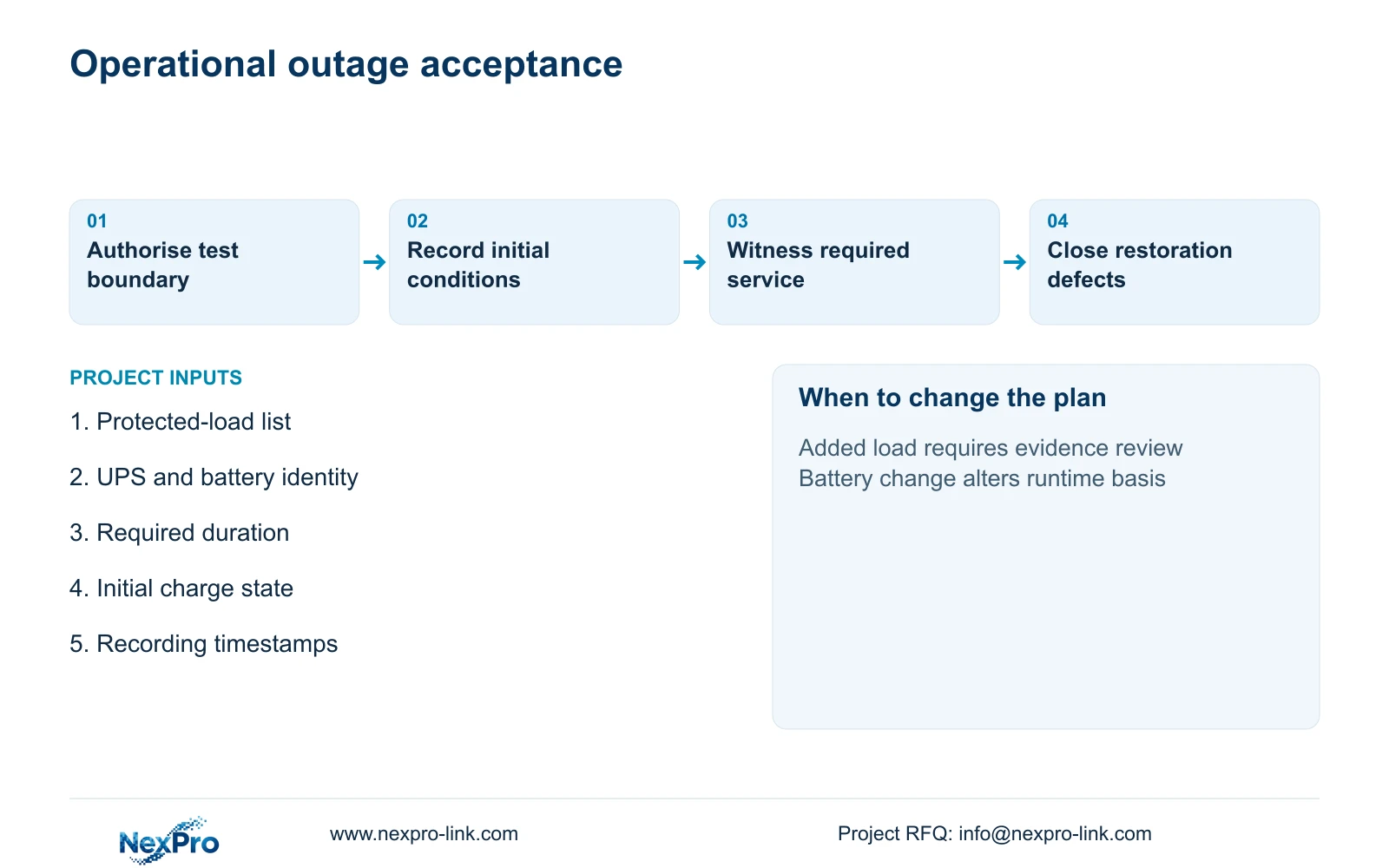
Have the responsible electrical personnel define the permitted test method, affected circuits, abort conditions and restoration plan. This article does not prescribe switching or disconnection steps. The CCTV team should map service dependencies and witness recording behaviour, while the authorised electrical team controls the supply test. Exclude production and specialist systems unless separately approved.
Section 02
Record actual load and battery conditions
Before testing, identify the exact UPS and supported battery configuration, initial charge state, relevant alarms and environmental conditions. Record the protected AC load under the required camera operating modes. Include switches, recorder disks and necessary link equipment. Keep optional displays separate if the outage objective does not require them.
W and VA are separate capacity constraints, while runtime depends on the selected UPS, battery and load. The supplied NexPro-Link rack series references are SP1KR(S) at 1kVA/900W, SP2KR(S) at 2kVA/1800W and SP3KR(S) at 3kVA/2700W. These ratings identify capacity candidates and do not establish minutes of operation or a shared battery capacity.
CASE01's recording-priority option assumes 682.7407W, including complete switch AC inputs and its specified recorder, disks and operating equipment. The separate duration illustration below uses 650W. Do not substitute one load for the other without recalculation. Likewise, do not add camera watts again where they are already included in switch AC demand.
Section 03
Verify recording throughout the event and restoration
Agree observable CCTV events before, during and after the authorised supply transition. Use project point identities and consistent timestamps. The witness should check required views and later retrieve their recorded sequences. A lit recorder front panel or live display is useful status information but cannot establish that each camera's video reached storage.
Inspect whether any camera, switch or link failed before the UPS reached the agreed endpoint. Record loss and recovery times against the affected service. If one cabinet remains powered by a separate supply, identify that dependency in the result. Its apparent continuity cannot be attributed to the UPS under test.
After restoration, verify recording resumes or continues as required, disk status remains appropriate and the operator can retrieve the test interval. Record alarms and unresolved gaps. If a function recovers only after an unplanned intervention, retain that fact for defect closure instead of reporting automatic recovery. The owner needs a service result that matches the stated operational objective.
Section 04
Compare duration requests without promising battery runtime
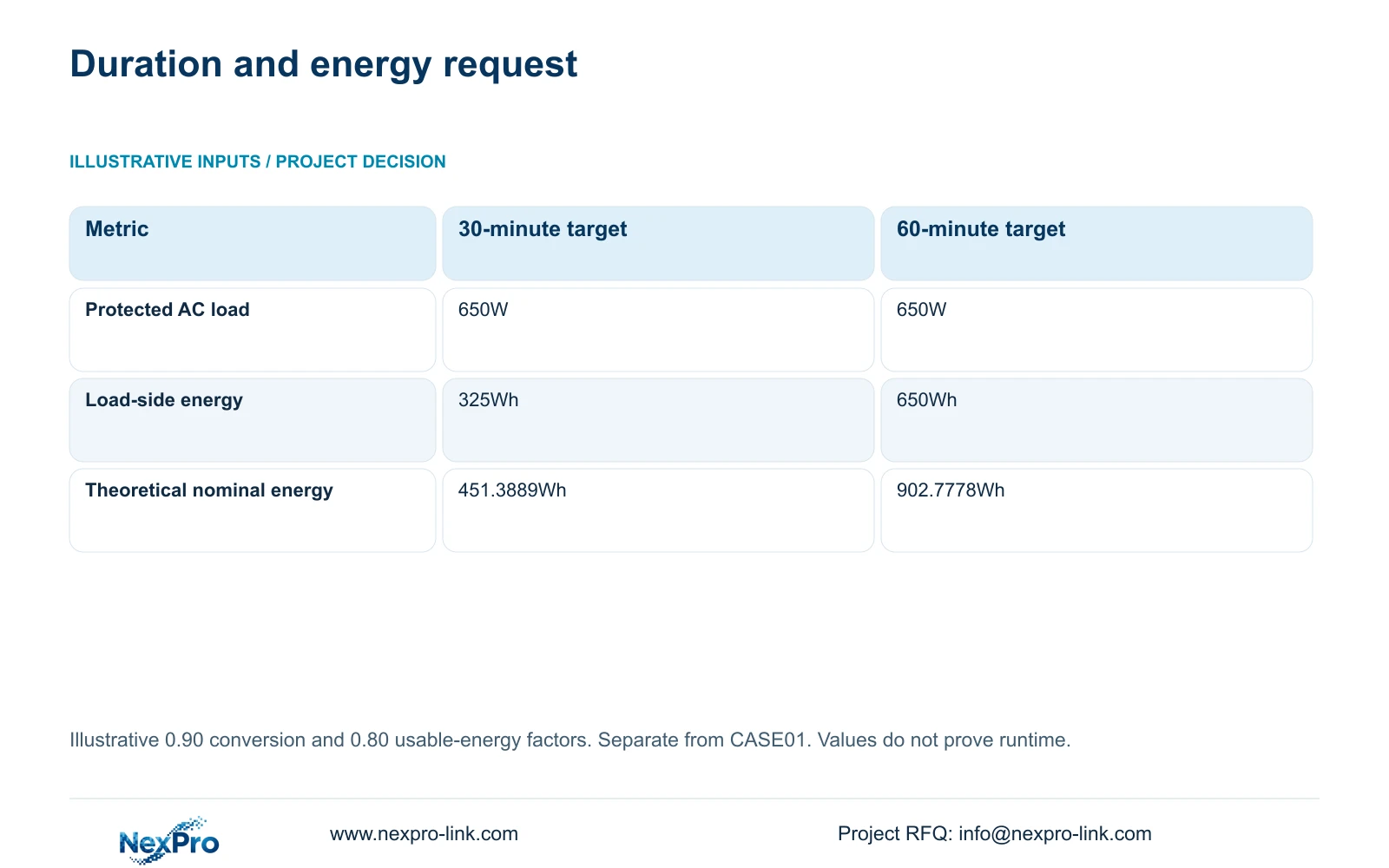
The supplied duration illustration assumes a constant protected AC load of 650W and compares 30 minutes with 60 minutes. It applies a battery-to-load conversion factor of 0.90 and usable stored-energy fraction of 0.80. Both factors are teaching assumptions, not a measured efficiency curve or the usable capacity of a selected battery.
Load_Wh = P_W × minutes / 60. For 30 minutes, 650 × 30 / 60 = 325Wh; for 60 minutes, the requirement is 650Wh. Nominal_battery_Wh = load_Wh / (0.90 × 0.80), giving 451.3889Wh and 902.7778Wh respectively.
The longer target doubles the theoretical energy request at the same load, but neither result proves actual runtime. Request a compatible manufacturer-supported battery system and applicable runtime curve. Temperature, ageing, discharge rate, BMS limits, UPS self-consumption, initial charge and recharge conditions still affect the proposed configuration and acceptance basis.
| Metric | Option A | Option B |
|---|---|---|
| Protected AC load | 650W | 650W |
| Target duration | 30 minutes | 60 minutes |
| Load-side energy | 325Wh | 650Wh |
| Theoretical nominal battery energy | 451.3889Wh | 902.7778Wh |
Section 05
Select the test endpoint from the owner's service objective
Recommend a test that demonstrates the required operational duration through the complete protected path under agreed conditions. The owner should explain what the interval is intended to achieve: continued recording, an authorised handover to another supply or a supported controlled stopping point. That objective determines the necessary loads and evidence.
A 30-minute target may be appropriate for one operating plan, while another requires 60 minutes. The choice cannot be made from camera count or UPS kVA alone. If an essential remote switch is outside the protected boundary, increasing central battery energy will not solve that dependency. Correct the power scope before debating a longer central runtime.
Keep the recording-priority and display-supported options separate. CASE01's optional wall adds load without changing the underlying recording task. If the owner requires live visibility during the outage, include the complete viewing chain and revise capacity and runtime requests. If it does not, document that the display is excluded rather than describing its loss as a recording failure.
Section 06
Issue an acceptance record that another team can interpret
The test report should identify the protected-load revision, UPS and battery identities, initial conditions, authorised method reference, observed duration and recording evidence. Include exclusions and any interventions. A future maintenance team should be able to tell whether the result covers the present arrangement or an earlier, smaller load.
Close defects through targeted retests. A missed remote supply needs its corrected path witnessed; a recording gap needs its original service task repeated. The operator handover should explain relevant alarms, escalation contacts and the approved response when the service cannot meet its target. It should not encourage staff to improvise electrical tests.
NexPro-Link can discuss the rack UPS capacity references and coordinated factory security equipment scope. The procurement documents should request the exact supported battery arrangement and evidence for the selected load and duration. Local electrical approval and safe testing remain with the appointed responsible personnel, and applicable installation requirements must be verified for the project location.
Section 07
Buyer questions
Can a load-bank result prove all-camera recording duration? It can provide evidence for a defined electrical load test. It does not by itself demonstrate installed camera, network and recorder continuity; those operational dependencies require their own evidence.
Must the acceptance test discharge the battery completely? The agreed objective and manufacturer-supported procedure should determine the endpoint. Use authorised abort and restoration conditions rather than assuming full discharge is necessary.
What invalidates an earlier runtime acceptance record? Changes to protected loads, batteries, distribution or required operating modes can change its applicability. Review the changed boundary and obtain updated evidence where needed.
Section 08
Define the protected CCTV service
Send your protected-load list, required outage duration, proposed UPS and battery configuration, and authorised acceptance conditions to info@nexpro-link.com. NexPro-Link can discuss the supply basis and evidence request for that specific chain.
Engineering references
These sources support the general planning principles. Always use the selected product's current datasheet and applicable project standards for final design.