
Separate self-tests, trend checks and authorized capacity tests, and stop short of live battery work or protection bypasses.
Section 01
Define the Test Question
Separate self-tests, trend checks and authorized capacity tests, and stop short of live battery work or protection bypasses.
The first decision is what the test is meant to establish. Three objectives are common, and each produces its own method, observation and limit.
A pass label on its own is weak evidence. The record matters more: what was checked, under which load, at which temperature, and on which date. The most common planning error is presenting a self-test pass as proof that the complete battery arrangement meets every required runtime condition. It does not.
| Decision area | Project question | Required output |
|---|---|---|
| Define the Test Question | What should a battery test establish? | Test map: objective / method scope / observation / limitation |
| Check the Supported Procedure | Can one generic discharge procedure apply to every UPS? | Procedure record: configuration / supported test / authorized team / constraints |
| Assess Service Exposure | Why consider service impact before a test? | Service table: load / available reserve / alternate / permitted state |
Section 02
Check the Supported Procedure
One generic discharge procedure cannot serve every UPS. Battery chemistry, configuration, system design and service conditions all differ. On the NexPro-Link catalog, the rack-mounted online series NX-UP-RM-001 lists internal VRLA batteries, while NX-UP-RM-002 lists a built-in LiFePO4 pack. Those two chemistries age and discharge differently, so a procedure written for one cannot be copied onto the other.
Use the selected equipment's supported procedure through the responsible team. For a project-specific decision, record configuration, supported test, authorized team and constraints.
The configuration line uses a real catalog entry. It is not a selection for every site. NX-UP-RM-001 is the series, C2KR(S) is the configuration rated 2,000 VA and 1,800 W, and the published battery field is internal VRLA. A different configuration carries a different supported test.
Section 03
Assess Service Exposure
A test can change the available reserve or the operating state, even when it is scheduled and run by an authorized team. Before a window is booked, define the protected service, the alternate arrangement and the permitted state.
A scheduled test is not risk-free. The risk sits in the reduced reserve, the recharge time and any fault the test uncovers, and it has to be owned by the person who authorizes the window.
- Confirm the answer to: Why consider service impact before a test?
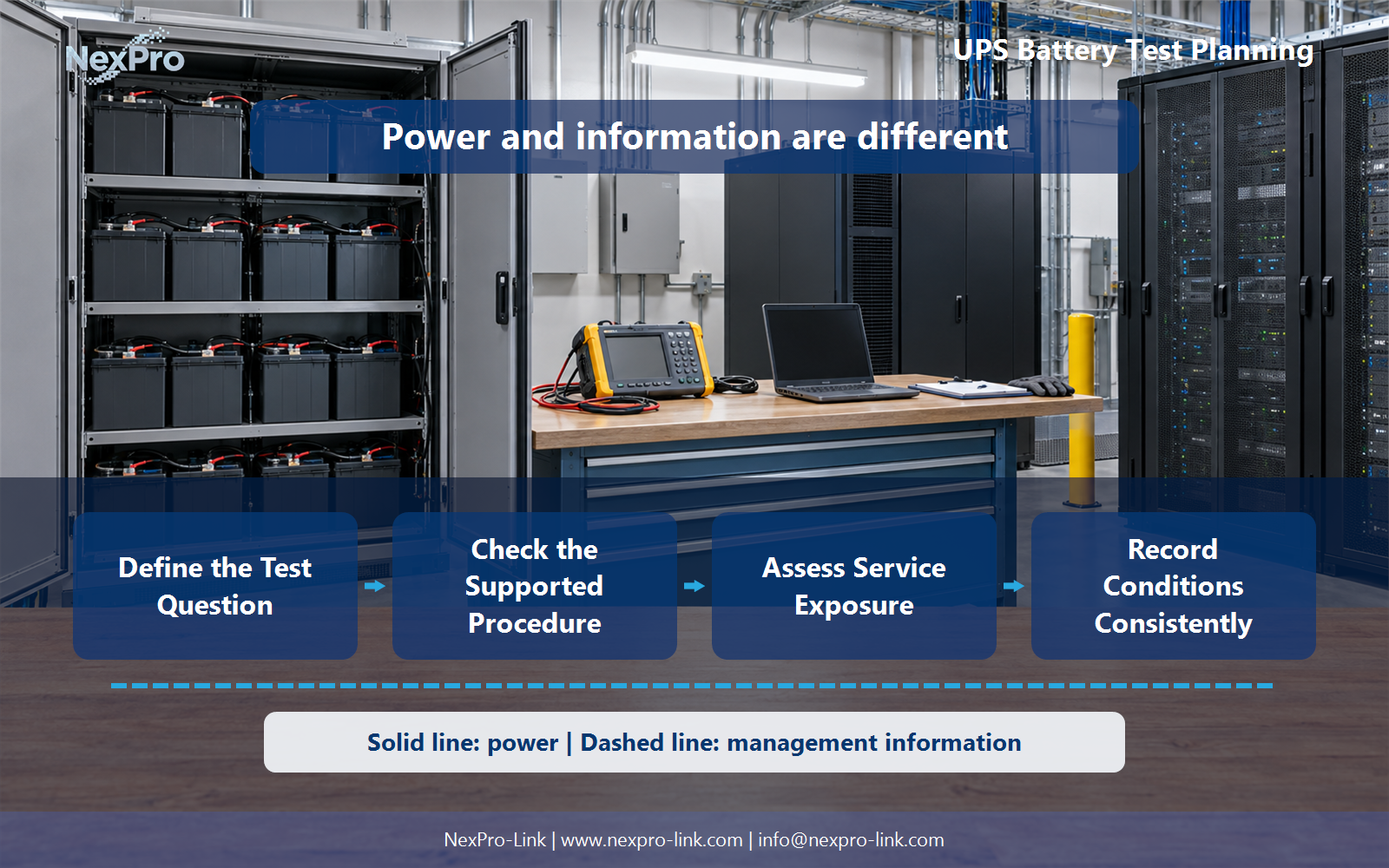
- Draw electrical power as a solid path and management information as a separate dashed path.
- Keep external services and specialist approvals outside the UPS equipment claim.
Section 04
Record Conditions Consistently
Records are useful when two dates can be compared. That needs the same fields each time: the actual load, the relevant battery and room conditions, the configuration and the observed events within the test scope.
An isolated pass label cannot be compared with next year's reading. One condition also says little about another: a reading at 24 C under a 480 W load says little about behavior at 32 C under a 600 W load.
Section 05
Restore Readiness After Testing
Finishing the observation period is not the same as restoring backup capability. The system returns to readiness only when the normal source is stable, the alarms are clear and the reserve has recovered through the supported process.
Assign one person to confirm each line. If the alarm clears but the reserve has not recharged, the backup capability is still below its intended level.
Section 06
Use Results for Planning
A test result feeds planning through the observed scope and the equipment guidance. One test cannot predict remaining life for every future condition, and a life-expectancy number should not be built from a single reading.
NexPro-Link can discuss replacement or backup equipment requirements based on the actual configuration. The useful inputs are the battery configuration, the service objective and the authorized test conditions, together with the records that show the trend.
Engineering references
These sources support the general planning principles. Always use the selected product's current datasheet and applicable project standards for final design.