The drill records source state, load service and recovery, so a generator start is not counted as a completed business recovery.
Section 01
Define the Drill Objective
The drill records source state, load service and recovery, so a generator start is not counted as a completed business recovery.
Start by naming three things: the source event you are simulating, the service you need to protect, and the restoration outcome you will accept. Write them down before anyone touches a switch. A delayed generator transfer is a different test from a full utility outage, and a recording system has different acceptance than a lighting circuit.
The generator start and the UPS bridge sit inside that objective, and they do not finish it. If the transfer passes while the business function stays down, the test has not answered its own question. Keep the scope realistic and approved for the operations affected.
The success basis is the line most teams leave out. It names what "recovered" means for this test, so the observer knows when to stop and the supplier knows what the equipment must protect.
| Decision area | Project question | Required output |
|---|---|---|
| Define the Drill Objective | What should an integrated drill demonstrate? | Objective table: event / protected service / observation / success basis |
| Budget the Full Transition | Which transition steps should be represented? | Timeline: detect / start / stable / transfer / fallback / reserve |
| Assign Authority and Stop Conditions | Who controls a live integrated test? | Control sheet: authority / scope / safeguards / stop condition / owner |
Section 02
Budget the Full Transition
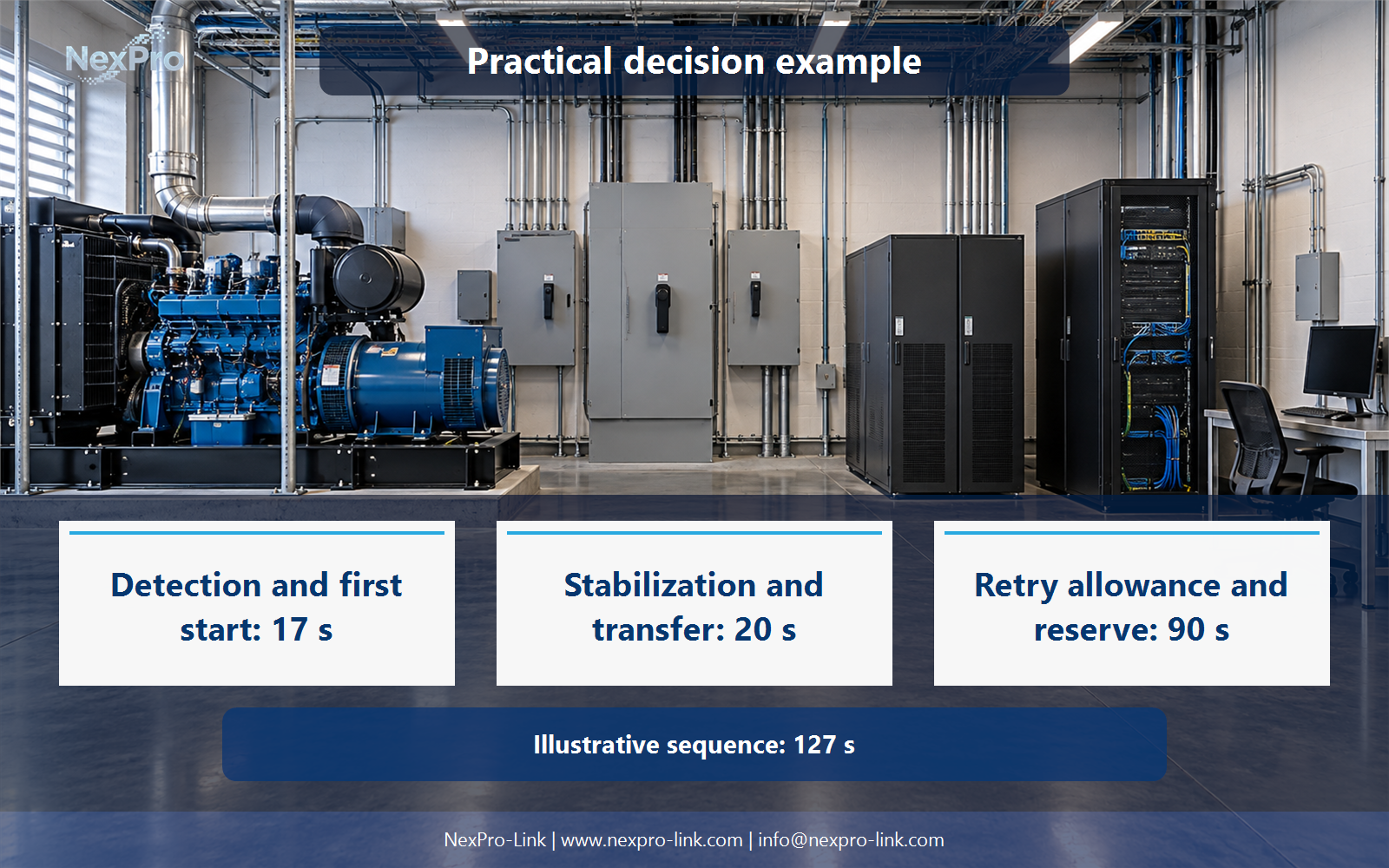
Include detection, source start, stabilization, transfer and any approved retry or fallback condition. Use the site's actual plan rather than a fixed fifteen-second number. The UPS interval has to support the required sequence at the defined load.
The rows total 127 seconds. At a teaching load of 3,000 W, the load-side energy is 3,000 x 127 / 3,600, or 105.83 Wh. Both figures are teaching inputs, not measured product performance. Engine start is one step in the list. Real programs may overlap steps or fail differently, and this example is not a hospital, rail or regulatory requirement. A watt-hour figure also does not by itself size a battery string.
The reserve row matters because one clean transfer can flatter a plan that would fail on the second attempt. If the first start misses, the retry allowance and the reserve have to hold the load while the sequence runs again. Budget the full transition, including what happens when the first attempt does not land.
Section 03
Assign Authority and Stop Conditions
A live integrated test needs a named owner. The responsible facilities and operational teams define the authorization, the safeguards and the stop conditions before the switch is operated. Critical and safety-related loads keep their own approved protections and procedures. This article does not describe a bypass or a hazardous switching action.
The stop condition is a decision made in advance, not a judgment made mid-test. When the transfer misses its window, the team halts and returns to the approved state instead of improvising. Recording authority and the stop condition on one sheet keeps the equipment inputs and the intended service outcome aligned.
- Confirm the answer to: Who controls a live integrated test?
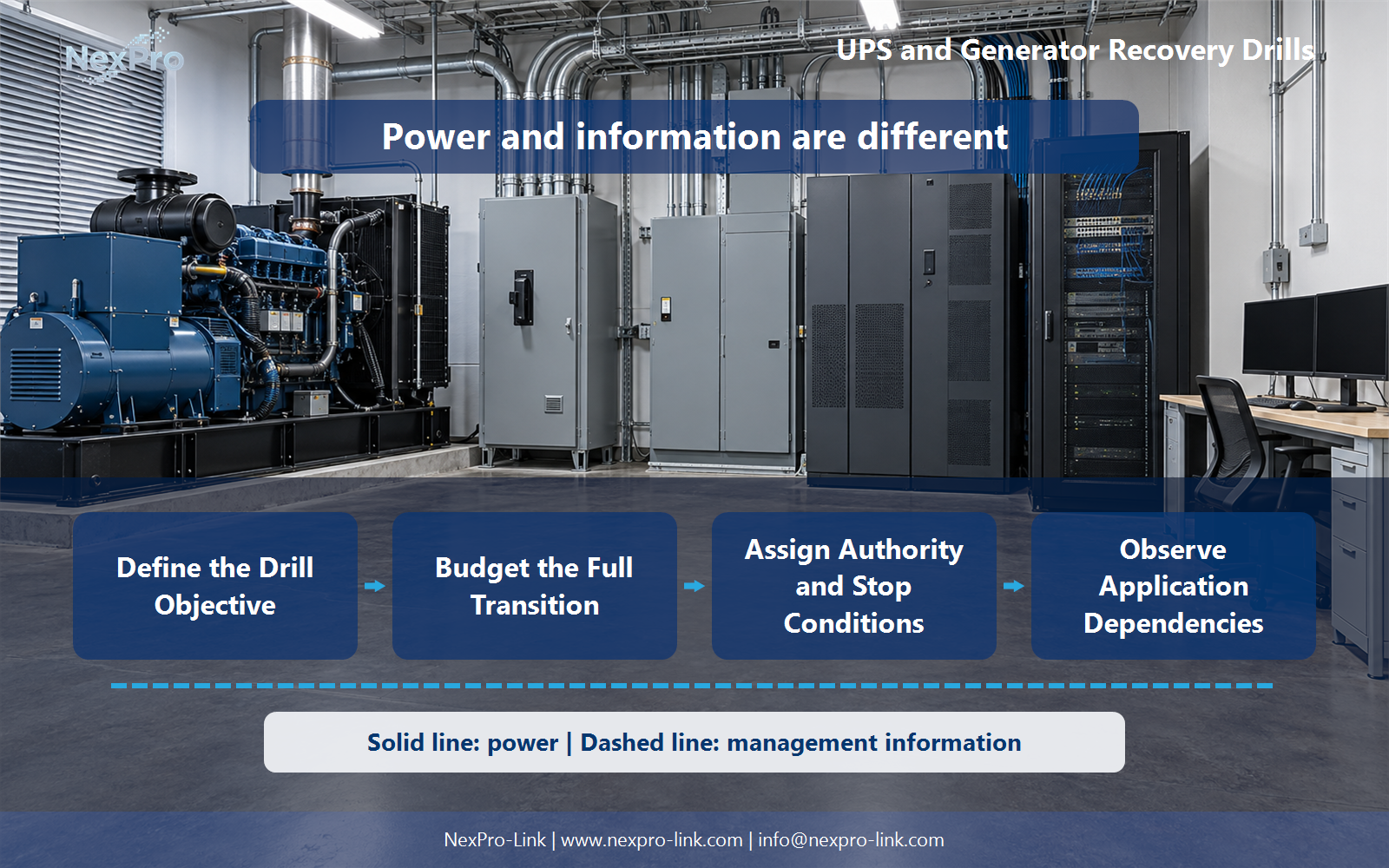
- Draw electrical power as a solid path and management information as a separate dashed path.
- Keep external services and specialist approvals outside the UPS equipment claim.
Section 04
Observe Application Dependencies
A service can fail even when the electrical transfer succeeds. Network, timing and application dependencies sit behind the plug. Record the user-visible functions and the relevant device states, so electrical performance and service continuity stay separate.
!Functional diagram connecting define the drill objective with assign authority and stop conditions, using separate power and information paths
Power delivery and management information are different paths. A generator that shows "running" on its panel has not confirmed that the NVR is still writing files. The observation map records both, without letting one stand in for the other.
Section 05
Confirm Recharge and Return State
The drill is complete when the approved source, equipment and service return conditions are confirmed, including the required reserve recovery. Finishing the transfer event is often not enough. Assign someone to own any unresolved alarms, configuration changes or reduced backup readiness.
Battery recovery deserves its own line. A UPS can be online again while its reserve is still low and climbing. Until recharge and its checks finish, the site is running with less protection than the design assumes.
Section 06
Turn Findings into Scope Changes
Describe the observed condition, the affected boundary and the required change. Do not stretch a single drill into a claim of universal uninterrupted operation. NexPro-Link can discuss the equipment and interface requirements that follow from that scope.
A finding like this changes the equipment scope. The camera already has power; the question is which branch supplies it and whether that branch stays up during the transfer.
Engineering references
These sources support the general planning principles. Always use the selected product's current datasheet and applicable project standards for final design.