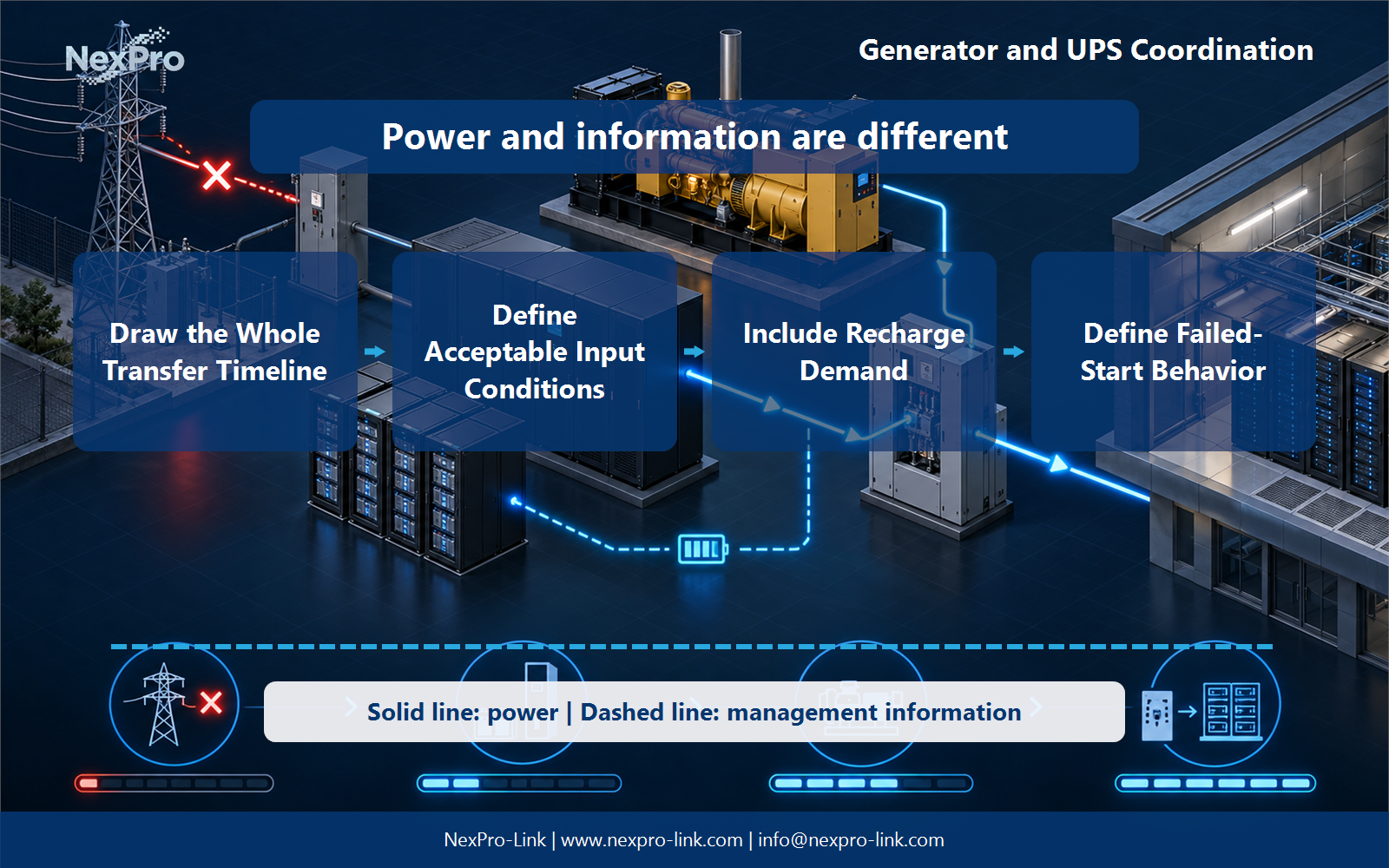
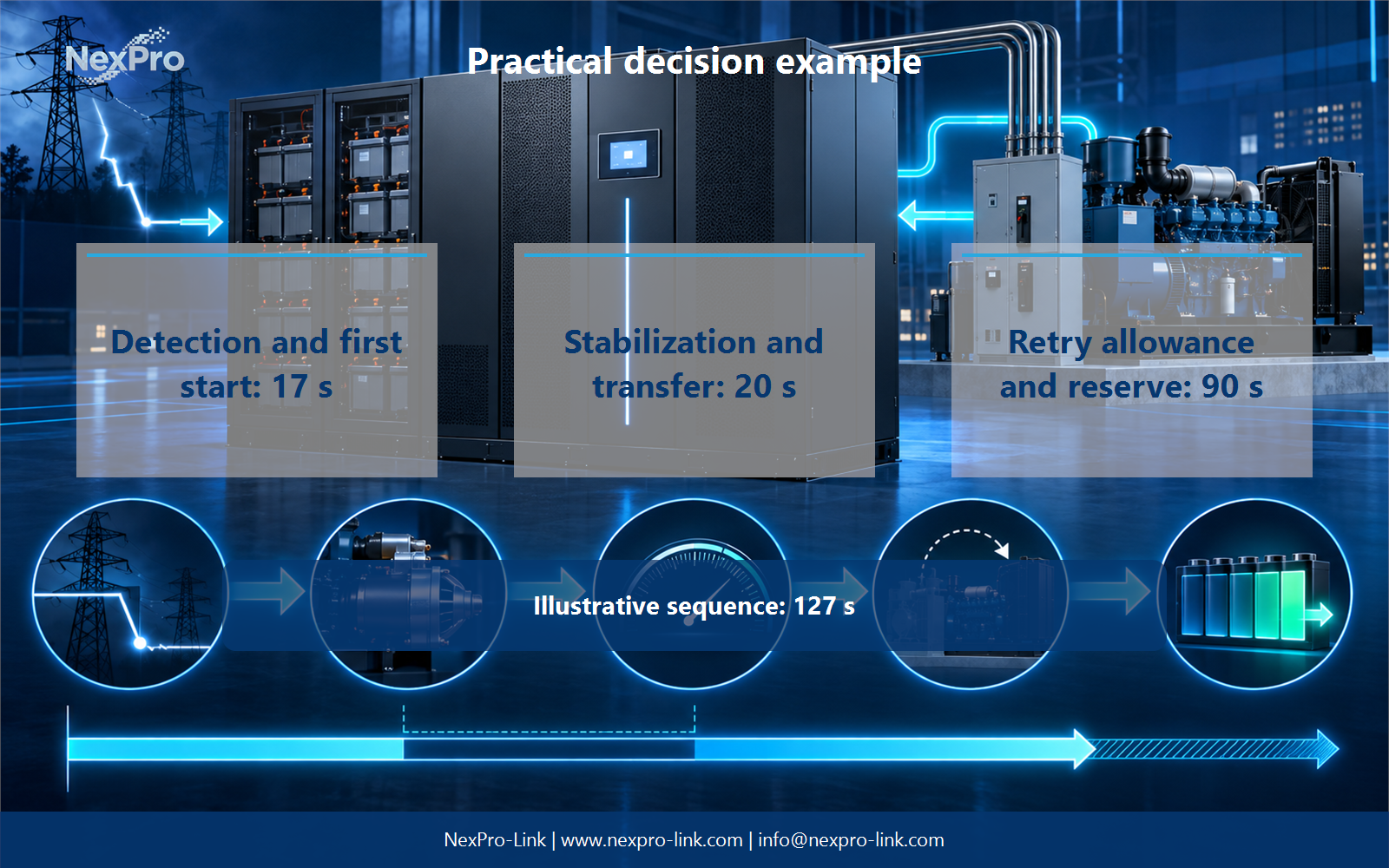
The bridge must cover detection, start, stabilization, transfer and failed-start retry, not only the 15 second nominal start time.
Section 01
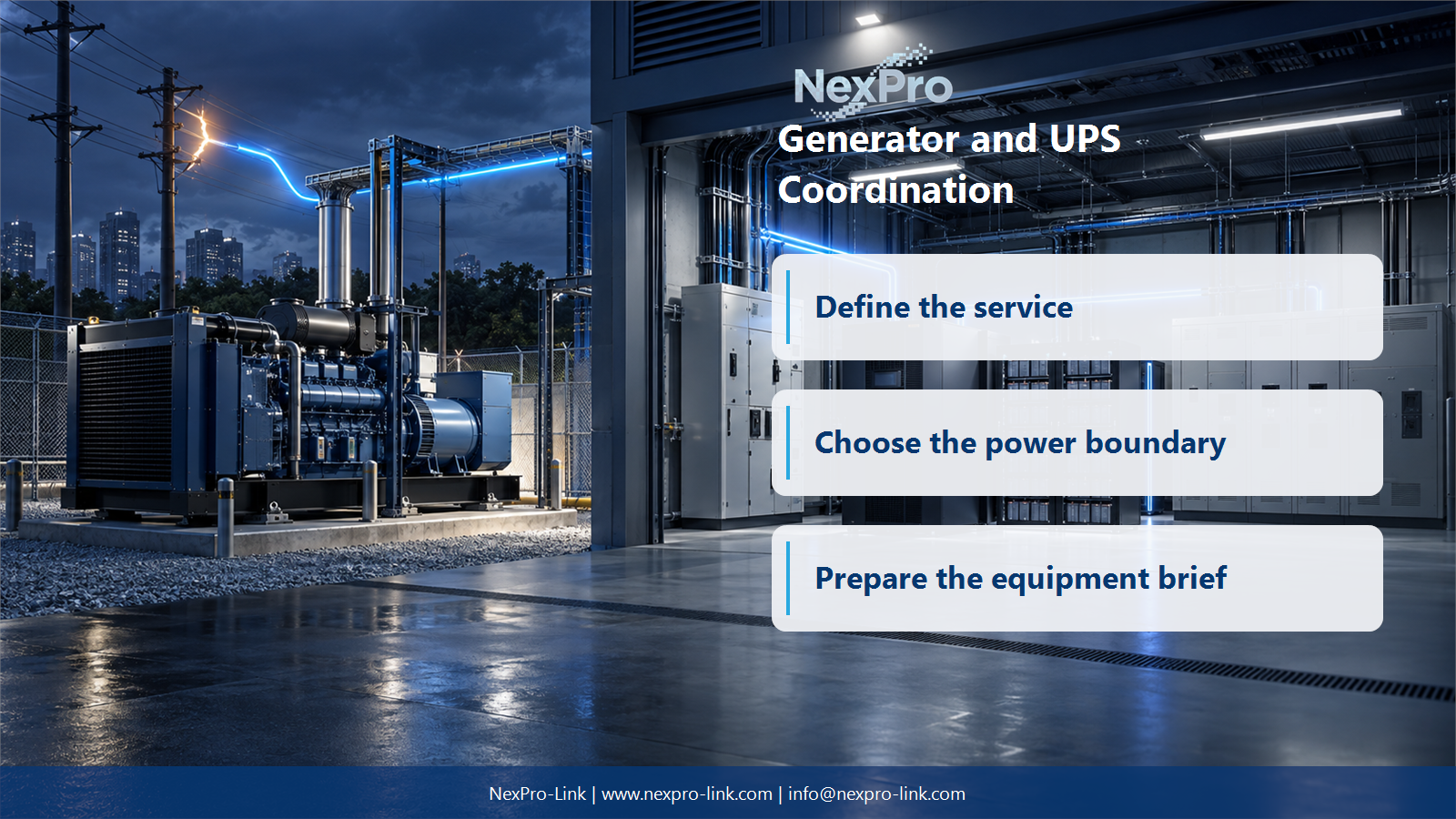
Draw the Whole Transfer Timeline
Is generator start time the whole UPS bridge interval? For Generator room and infrastructure managers, the answer must stay inside the project boundary: No. Include outage detection, start attempts, stabilization, transfer acceptance and any approved retry behavior. The battery objective should cover the actual sequence with stated reserve. For a project-specific decision, record detection, start, stable, transfer and reserve in the timeline. This keeps the equipment inputs and intended service outcome aligned. The next step is timeline: detection / start / stable / transfer / reserve, using generator transfer sequence and protected-load recovery objective.
| Decision area | Project question | Required output |
|---|---|---|
| Draw the Whole Transfer Timeline | Is generator start time the whole UPS bridge interval? | Approved service objective |
| Define Acceptable Input Conditions | What determines whether the UPS accepts generator supply? | Defined load and dependency boundary |
| Include Recharge Demand | Why consider battery charging after transfer? | Reviewed power-path decision |
Section 02
Define Acceptable Input Conditions
Use the UPS input limits and the generator's behavior under the expected load and operating sequence. Voltage and frequency conditions matter alongside the nominal rating. A generic claim of generator compatibility does not describe every combination or transient state.
Keep the load list, operating state and supporting dependencies in the same schedule. This makes omissions visible before runtime or capacity is discussed.
- Confirm the answer to: What determines whether the UPS accepts generator supply?
- Separate measured demand, nameplate limits and committed growth.
- Identify the owner of each external service or approval.
Section 03
Include Recharge Demand and Define Failed-Start Behavior
The generator may supply both protected loads and UPS charging demand after the outage. Check how charging is controlled and how the combination affects the source. Do not infer the required generator rating from UPS kVA using a universal multiplier.
The site needs a finite fallback based on remaining energy and the protected service's requirements. Define when to stop new work, shut down or escalate. The UPS should support this plan rather than simply wait until the battery is exhausted.
Draw power delivery as a solid path and management information as a separate dashed path. That distinction prevents an alarm or software command from being mistaken for an electrical protection function.
Section 04
Plan Integrated Testing
Use an authorized integrated test plan with qualified personnel, clear operating states and restoration criteria. Observe the actual source acceptance and load response. For a project-specific decision, record state, source, UPS mode, load response and stop condition in the test record. This keeps the equipment inputs and intended service outcome aligned.
Assign the action, acknowledgement, timeout and escalation owner before commissioning. The useful battery interval is the time needed for this approved sequence plus reserve, not an arbitrary marketing duration.
Section 05
Request a Coordinated Package
Share the engineered supply sequence, load, interface requirements and desired bridge duration. NexPro-Link can discuss UPS configuration and available controls within the supply scope. Generator sizing and site integration remain separately defined rather than implied by the UPS quotation.
For the article's practical example, the stated teaching inputs are: Detection and first start: 17 s. Stabilization and transfer: 20 s. Retry allowance and reserve: 90 s. Illustrative sequence: 127 s. Treat these figures as planning assumptions, then replace them with measured or manufacturer-supported project data.
Engineering references
These sources support the general planning principles. Always use the selected product's current datasheet and applicable project standards for final design.