Backup time covers real start stabilization, load acceptance and failed-start fallback; 15 seconds is not a universal hospital value.
Section 01
Define the Source Sequence
Backup time covers real start stabilization, load acceptance and failed-start fallback; 15 seconds is not a universal hospital value.
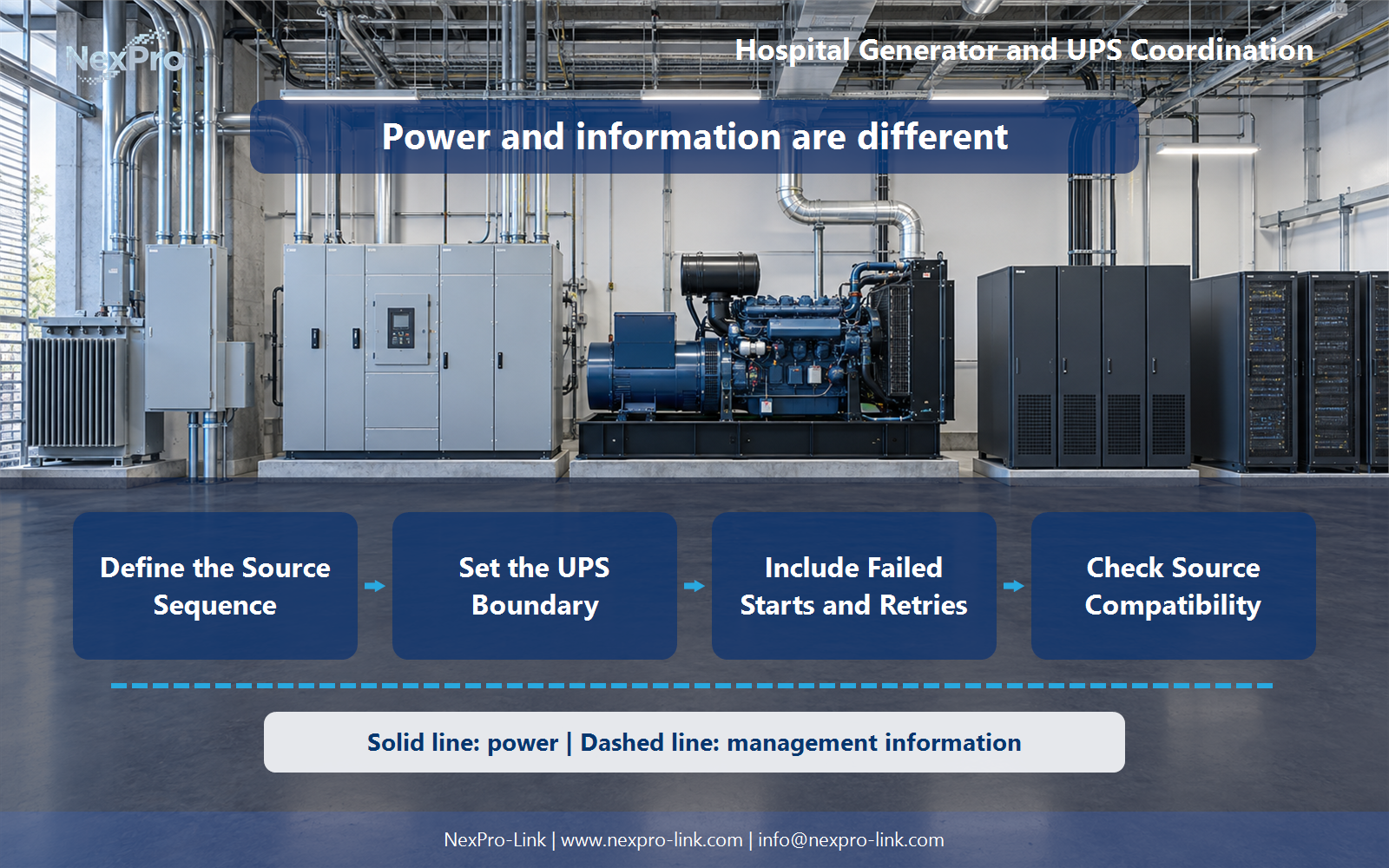
Start with the approved sequence, not with a stopwatch. The plan shows what happens from source loss through generator readiness, transfer and restored support. It names who controls each step and which status signal confirms it. Two things run in parallel here. A power path moves energy from the selected source through the UPS or backup system to the included load. A separate management information path reports status, alarms and confirmation. Keeping the two apart stops a monitoring signal from being drawn as if it were a power connection.
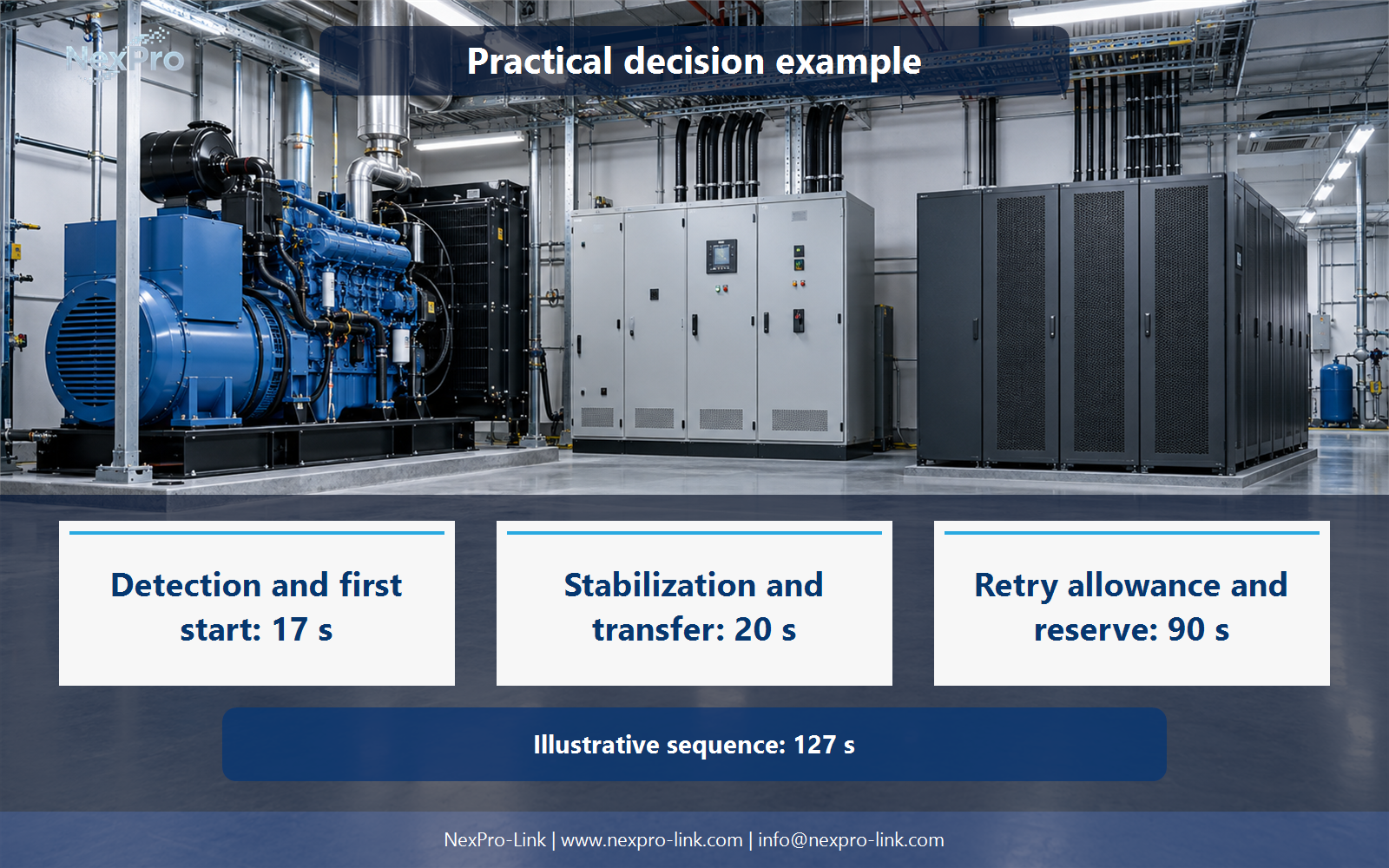
The sequence below is a filled teaching example. The numbers are illustrative assumptions, not measured values and not a hospital-wide requirement.
The five elements readers usually ask about are all present here: detection, start, stabilization, transfer and confirmation. Transfer and confirmation share the five-second allowance in this example. The point is that 15 seconds is one line in a five-part sequence, not the whole answer. A plan that reports only engine start has skipped detection, stabilization and confirmation.
| Decision area | Project question | Required output |
|---|---|---|
| Define the Source Sequence | What should the transition plan show? | Timeline: detection / start / stabilize / transfer / confirmation |
| Set the UPS Boundary | Which loads should the UPS bridge? | Group table: function / supply / transition objective / owner |
| Include Failed Starts and Retries | Why include more than the successful-start case? | Scenario budget: success / delay / retry / fallback / reserve |
Section 02
Set the UPS Boundary
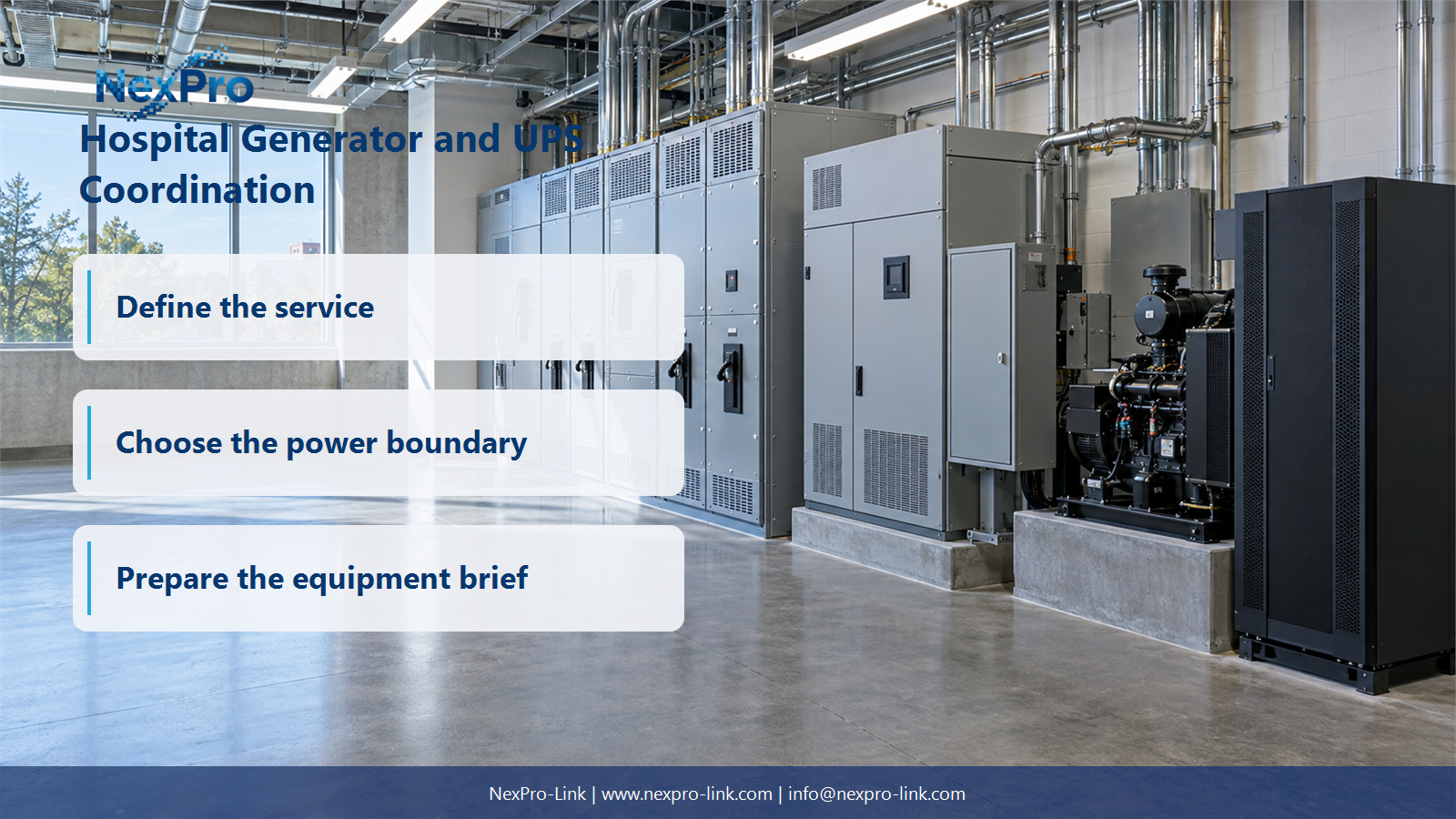
The UPS does not need to bridge every load. The hospital's approved load classification decides which groups stay powered, which groups get an orderly shutdown and which groups simply wait for the generator. Recording function, supply, transition objective and owner keeps the equipment inputs lined up with the service the hospital actually wants to protect.
For a non-clinical IT room, a filled group table could look like this.
General lighting, non-essential cooling and other loads that can tolerate the outage sit outside the UPS boundary and come back when the generator stabilizes. The boundary is a supply decision, not a list of every device in the room. A clinical area would be classified separately by the hospital and is outside this worked example.
Section 03
Include Failed Starts and Retries
A plan that models only the successful start has no answer for the cold morning when the generator cranks and does not fire. The resilience objective should state which cases the bridge must cover: an unsuccessful start, delayed stabilization or another event the hospital has defined. Budget those cases, and only those cases.
The fallback line is not a fixed number. It follows from the hospital's stop objective, not from a battery nameplate. A fixed battery interval does not cover every possible generator failure, and the plan should not promise that it does. The same logic applies after a scope change: update the group table, find the input or objective that changed, and rework the retry decision from the current transition requirements.
- Confirm the answer to: Why include more than the successful-start case?
- Draw electrical power as a solid path and management information as a separate dashed path.
- Keep external services and specialist approvals outside the UPS equipment claim.
Section 04
Check Source Compatibility
When the generator accepts the load, it carries more than the IT rack. The UPS now draws power to run the load and to recharge its batteries. Other generator-fed equipment adds its own demand. Matching nominal kVA ratings is not enough to confirm stable operation across every state, so the team checks the combined demand line by line.
The UPS input window and any start ramp come from the selected model's documentation. Acceptance and recovery are planned together, because the recharge current appears at the same time as the running load. That combined demand is what the generator has to accept, not the nominal kVA figure printed on each cabinet.
[Figure 02: hospital-generator-and-ups-coordination-define-the-complete-transition-02.webp] Caption: The functional relationships behind hospital generator UPS transition sequence; power delivery and management information are shown separately. Alt: Functional diagram connecting define the source sequence with include failed starts and retries, using separate power and information paths.
Section 05
Coordinate Authorized Drills
Integrated testing is planned by the responsible hospital teams. They define the permitted scope, the safeguards and what gets observed. The drill records source behavior, the supported service and restoration under the authorized procedure. A successful engine start is a step, not proof that the service recovered.
The record belongs to the teams that run the exercise. NexPro-Link supplies equipment and project information within its scope; it does not direct the clinical or safety procedure.
Section 06
Prepare the Coordination Brief
The brief turns the six decisions into an equipment discussion. It carries the approved sequence, the load groups, the electrical interfaces and the coordination requirements. NexPro-Link can respond to that brief within its supply scope, for example by mapping it against the NX-UP-HF-001 tower and NX-UP-RM-001 rack-mounted online UPS series or the NX-UP-RM-002 lithium rack series where the project calls for that form factor.
Final clinical power-system design and acceptance stay with the responsible project teams. The brief is a working input for a load schedule, BOQ or supplier discussion, not a substitute for that design.
Engineering references
These sources support the general planning principles. Always use the selected product's current datasheet and applicable project standards for final design.