Battery replacement in a bank UPS is often planned as a calendar task. The batteries get old, a window opens, a technician swaps them. The questions that matter sit ahead of the swap.
Section 01
Identify the Service Boundary
What should be established before replacing batteries? For Bank facility and maintenance managers, the answer must stay inside the project boundary: Record the exact UPS, battery arrangement, supported service procedure and protected load. Determine whether the work affects reserve, monitoring or output. For a project-specific decision, record UPS, battery, service procedure and load in the asset table. This keeps the equipment inputs and intended service outcome aligned. The next step is asset table: UPS / battery / service procedure / load, using UPS and battery configuration, maintenance procedure and permitted service window.
Battery replacement in a bank UPS is often planned as a calendar task. The batteries get old, a window opens, a technician swaps them. The questions that matter sit ahead of the swap. What exactly is protected, what does the unit keep supplying while the battery is out, and who confirms the outcome once the covers go back on. A parts list answers none of those.
| Decision area | Project question | Required output |
|---|---|---|
| Identify the Service Boundary | What should be established before replacing batteries? | Approved service objective |
| Separate Age from Condition | Is a calendar age enough to decide replacement? | Defined load and dependency boundary |
| Check the Maintenance State | Can the load remain protected during battery replacement? | Reviewed power-path decision |
Section 02
Separate Age from Condition
Age is one planning input, alongside temperature history, operating duty, alarms and applicable service guidance. A generic three-to-five-year range is not a prediction for every battery chemistry or installation. Use a condition-informed service plan with explicit assumptions.
Keep the load list, operating state and supporting dependencies in the same schedule. This makes omissions visible before runtime or capacity is discussed.
- Confirm the answer to: Is a calendar age enough to decide replacement?
- Separate measured demand, nameplate limits and committed growth.
- Identify the owner of each external service or approval.
Section 03
Check the Maintenance State and Plan an Authorized Window
It depends on the supported configuration and remaining power and energy paths. A unit may keep supplying the load while temporarily losing battery reserve. State the distinction between remaining energized and retaining the original continuity objective.
Coordinate application activity, alternate supplies, trained personnel, access and restoration time. Define what conditions stop the work. A plan should account for the reduced-protection period rather than assuming a replaceable module makes the activity operationally invisible.
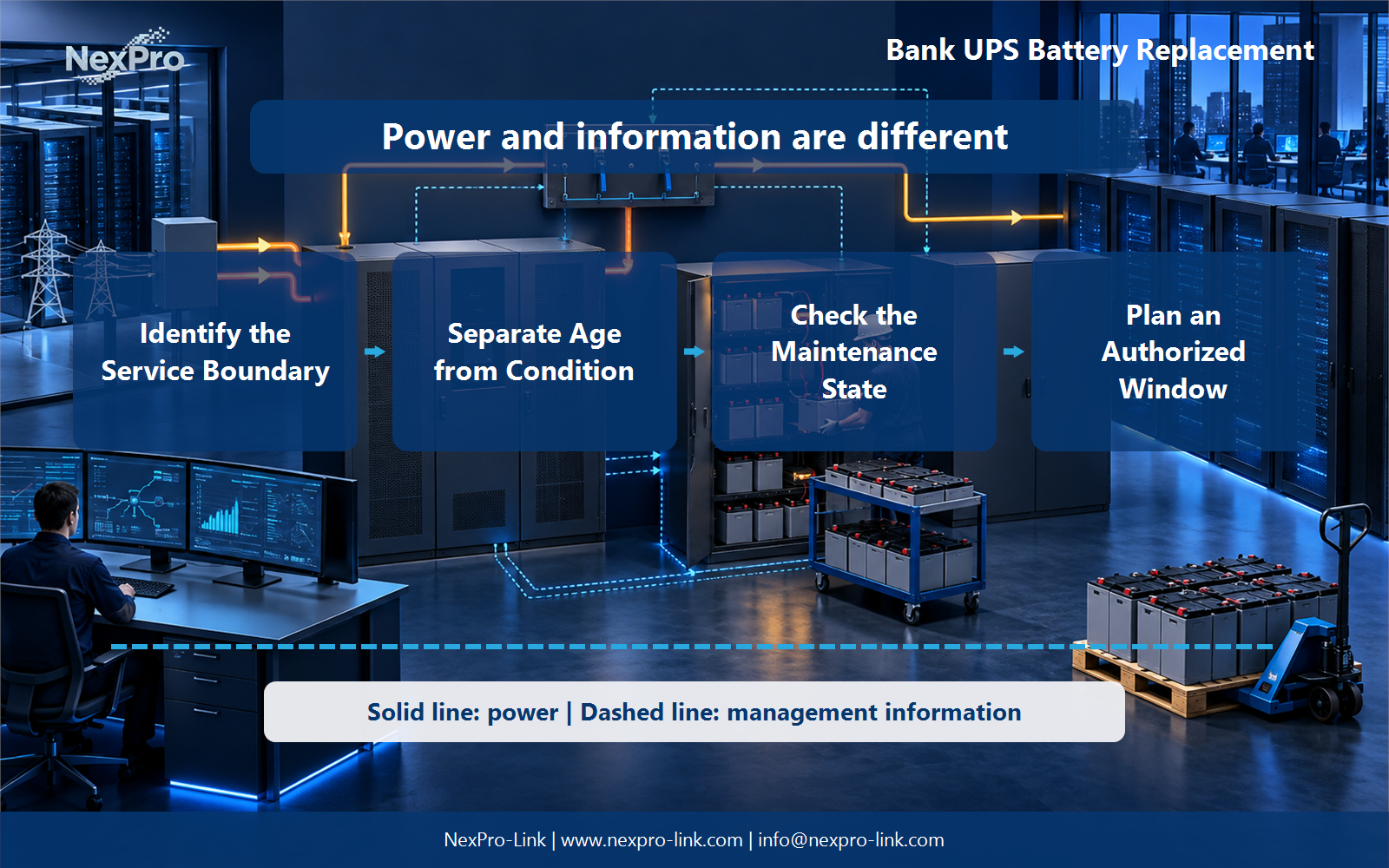
Draw power delivery as a solid path and management information as a separate dashed path. That distinction prevents an alarm or software command from being mistaken for an electrical protection function.
Section 04
Verify Restoration of the Objective
Use the manufacturer's required checks and the site's authorized acceptance process to establish correct configuration, alarms and readiness. Record any recharge or follow-up needed before the original runtime objective is restored. A successful physical swap is not the whole service result.
Assign the action, acknowledgement, timeout and escalation owner before commissioning. The useful battery interval is the time needed for this approved sequence plus reserve, not an arbitrary marketing duration.
Section 05
Define Supply and Service Responsibilities
Provide the exact configuration and requested battery or replacement scope, including interface and dimensional requirements. NexPro-Link can discuss applicable equipment options. On-site maintenance, hazardous work and uninterrupted-service commitments must be separately defined rather than assumed in a parts quotation.
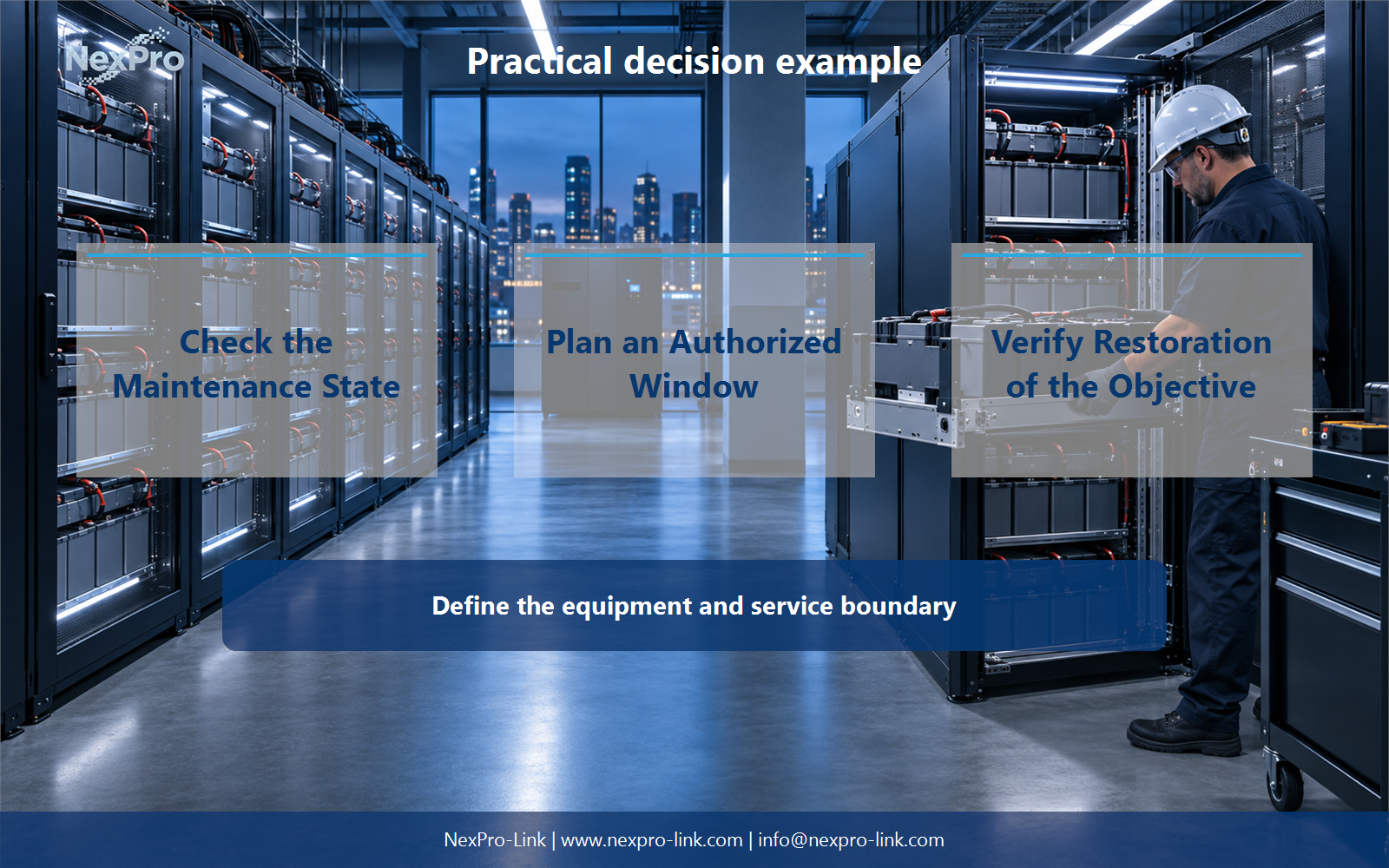
For the article's practical example, the stated teaching inputs are: Check the Maintenance State. Plan an Authorized Window. Verify Restoration of the Objective. Define the equipment and service boundary. Treat these figures as planning assumptions, then replace them with measured or manufacturer-supported project data.
Engineering references
These sources support the general planning principles. Always use the selected product's current datasheet and applicable project standards for final design.