Group loads by business-continuity time and equipment dependency instead of sizing the whole branch to one capacity and runtime target.
Section 01
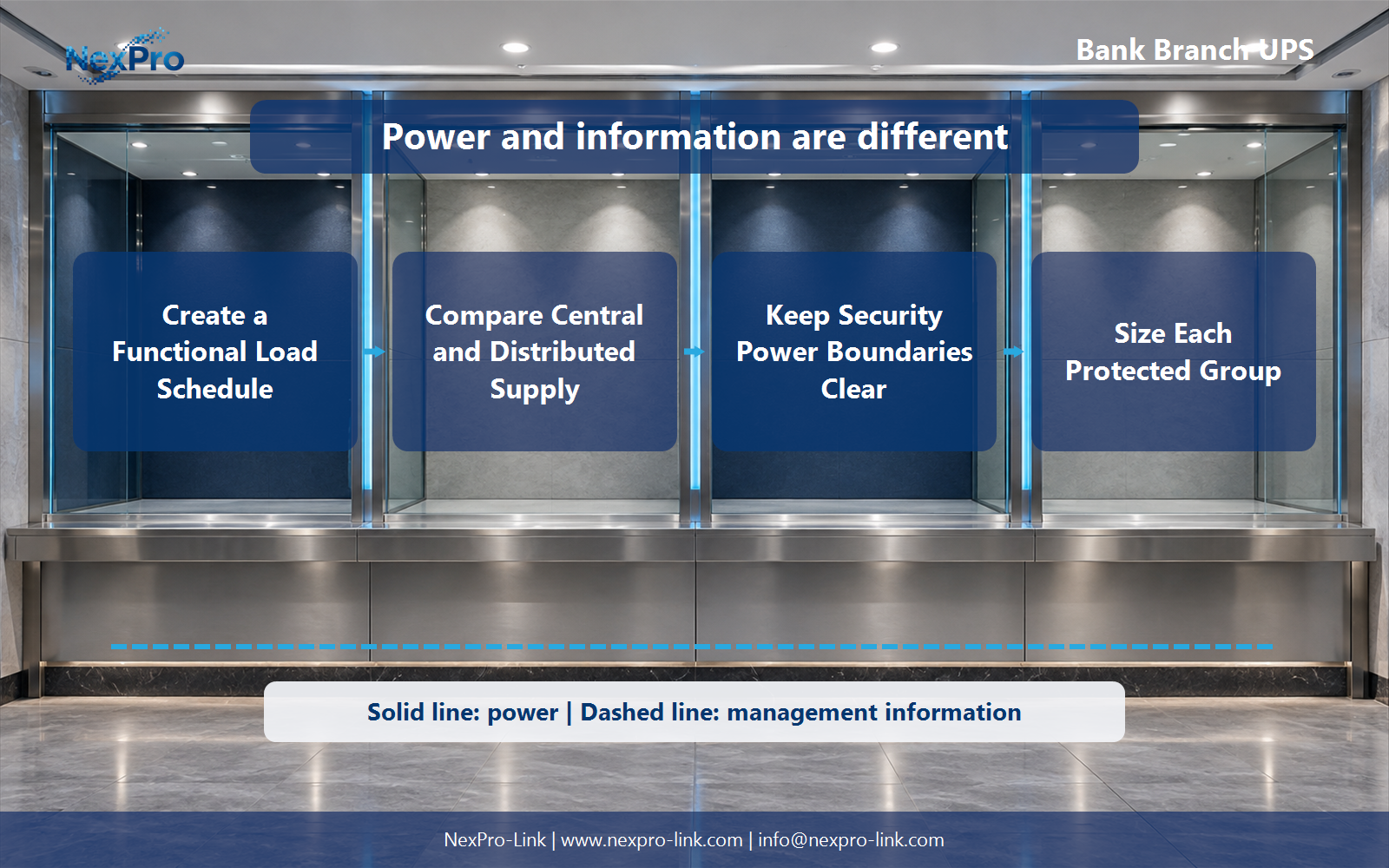
Build a functional load schedule
Which branch loads should be listed separately? For bank infrastructure and security leads, the answer must stay inside the project boundary: Separate teller equipment, local IT, ATM, recording, access systems and discretionary presentation loads. Their operating patterns and outage objectives differ. A functional list makes the protected scope clearer than a total floor-area estimate or a single branch category rating. The next step is schedule: group / function / demand / duration objective, using branch floor plan, load groups and outage priorities.
group loads by business-continuity time and equipment dependency instead of sizing the whole branch to one capacity and runtime target
A branch should begin with service groups rather than one total for every plug point. Teller equipment, local network, ATM, recording, access control and presentation displays can have different operating patterns and different outage objectives. The schedule should show which devices make each service usable, including the small shared items that are easy to overlook.
Grouping by function also gives the project team a way to make deliberate operating choices. An essential banking service can remain powered while nonessential display loads are released, provided the agreed operating plan permits it. This distinction is more useful than a floor-area estimate or a single generic branch rating.
| Group | Included function | Illustrative demand | Outage objective |
|---|---|---|---|
| Essential service | Teller terminals, local application access and required networking | 200 W | Remain available for the planned short-outage procedure |
| Security continuity | Recording or access-control equipment within the approved security boundary | 200 W | Continue according to the security design and local operating rules |
| Extended service | Additional displays and customer-facing devices | 180 W | Continue only when the operating plan calls for the full group |
| Auxiliary | Nonessential local equipment | 120 W | May be excluded when preserving the essential group |
Section 02
Compare central and distributed supply on the branch layout
A central UPS can consolidate equipment in one managed point and feed defined downstream groups. Local UPS units can isolate services where cable routes, local access or maintenance exposure make separation more practical. The suitable arrangement depends on the actual panel locations, branch routing and the service boundary, not on a generic label such as bank branch.
The comparison should include what happens when one unit is serviced, one circuit is unavailable or one cabinet is inaccessible. It should also name who can observe alarms and replace batteries. A design that appears compact on a diagram may be difficult to maintain during business hours if the UPS is placed behind a restricted service counter or inside a security-controlled enclosure.
| Question | Central arrangement | Distributed arrangement |
|---|---|---|
| Cable and panel route | One defined upstream point with downstream distribution | Shorter local feeds to individual service domains |
| Maintenance exposure | One unit can affect several groups | A local unit affects a smaller group but increases unit count |
| Monitoring path | Can be concentrated when the network path is protected | Needs a consistent approach across each local installation |
Section 03
Keep security power boundaries clear
Security-related loads require their own named power boundary. Do not assume that a camera recorder, access controller or ATM-associated device should share a teller-workstation outlet. The approved security and electrical design should identify the supply, circuit ownership, maintenance responsibility and required service state for each protected function.
This boundary also prevents hidden dependencies. If a recording function depends on a switch, a router and storage, each item must appear in the group record. The proposed UPS can then be assessed against the actual retained service rather than a simplified description such as security load.
Section 04
Size the service state before choosing a UPS
Add the nominated equipment in each service state using consistent watts and VA. The branch team should keep the essential state and the full-service state as separate calculations. A customer display or auxiliary device may remain in the full-service total while being intentionally absent from the short-outage essential group.
The figures below are teaching inputs for the group structure shown above. They are not measured branch loads or a runtime commitment for any UPS. Final selection also needs the actual equipment input data, target utilization, power factor and the proposed battery configuration.
| Operating state | Protected demand | 15-minute load energy | Project use |
|---|---|---|---|
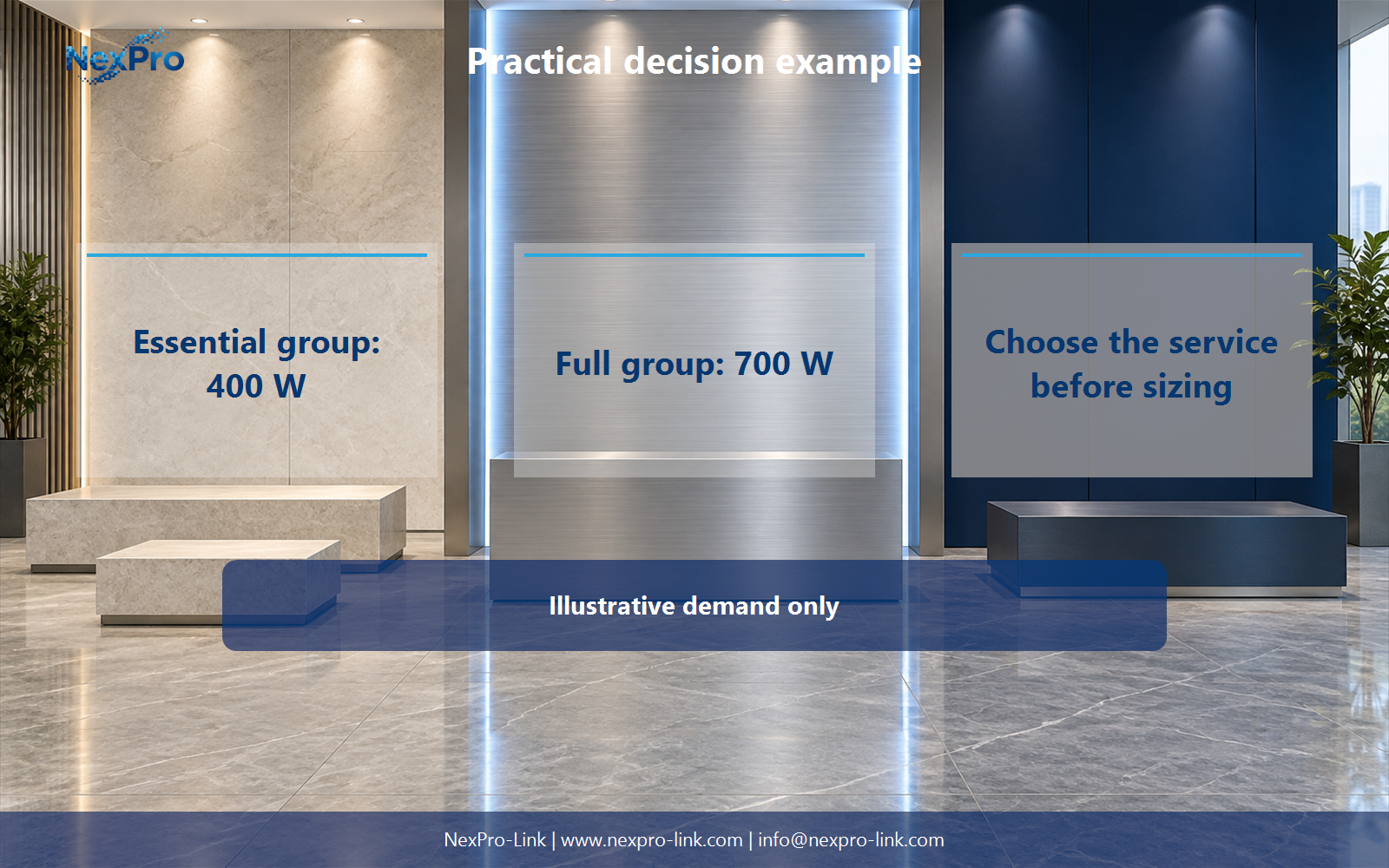
| Essential group | 400 W | 100 Wh | Maintain selected banking and security functions during the agreed response interval |
| Full service group | 700 W | 175 Wh | Keep additional displays and auxiliary functions while the operating plan requires them |
| Equipment comparison | Check W and VA separately | Battery output follows the selected configuration | Use the defined state to request comparable proposals |
Section 05
Set a recovery order for the branch
Recovery should restore prerequisites before dependent services. Local network availability, required applications and approved security functions may need confirmation before customer-facing devices return to use. The order should assign an owner to each confirmation instead of assuming that energizing every outlet recreates a working branch.
Record the recovery plan with the power design. A team can then see whether the same network segment that reports UPS status is also needed for a service confirmation, or whether a security function requires separate checks. This makes the post-outage procedure testable without turning the UPS itself into an application-control claim.
Section 06
Use the groups to compare two branch arrangements
An illustrative branch might place the essential teller and network group with the required security loads on a central protected distribution point, while the optional customer-display group has a separate local backup decision. Another site might choose small local UPS units where cable routing and service access make a central arrangement impractical. Both approaches need the same group schedule and responsibility record.
The decision belongs to the combined electrical, security and operations team because the protected services cross those boundaries. The useful output is a clear equipment boundary, not a generic promise that any UPS arrangement protects every branch activity.
Section 07
Turn the grouped design into a coordinated BOQ
A coordinated branch request lists each service group, its nominated UPS boundary, battery objective, distribution interface and work that stays with the local contractor or branch system owner. Include floor plan references, access restrictions and any monitoring interface expected from the supplied equipment.
Share the branch floor plan, load groups and outage priorities with NexPro-Link to discuss the UPS equipment, interfaces and supply scope for the project. The resulting quotation can then distinguish supply items from electrical installation, bank software and local approvals.
Section 08
FAQ: bank branch UPS load groups
Which loads should be listed separately? Start with teller equipment, local IT, ATM, recording, access systems and discretionary presentation loads. Then add shared switches, routers and storage that keep those functions usable.
Can security loads share teller outlets? Only when the approved security and electrical design establishes that arrangement. The security function, circuit, owner and maintenance responsibility should remain visible in the project record.
How should branch UPS capacity be calculated? Add the nominated loads for each operating state, check watts and VA, then apply the stated headroom policy. A full branch total does not replace the essential-service calculation.
What belongs in the quote request? Include the groups, their distribution boundaries, battery objectives, monitoring requirements and local work. This lets procurement compare complete and clearly bounded offers.
Engineering references
These sources support the general planning principles. Always use the selected product's current datasheet and applicable project standards for final design.