Budget comparisons rest on the same essential services and project requirements; 10 kVA is not set as the starting size for every small branch.
Section 01
Define Essential Service
How should a small institution start UPS planning? List the customer, security and records services that must continue or stop cleanly. Identify their actual equipment dependencies and assign objectives. This avoids using branch size or a generic capacity number as a substitute for a protected-load definition. Local bank and credit union IT can use that boundary to build the service table: function / equipment / objective / owner and prepare essential-service list, project requirements and budget assumptions before selection.
Budget comparisons rest on the same essential services and project requirements; 10 kVA is not set as the starting size for every small branch.
The working question is simple: How should a small institution start UPS planning? Record the answer as a service requirement before comparing UPS ratings or battery options.
| Decision area | Project question | Required output |
|---|---|---|
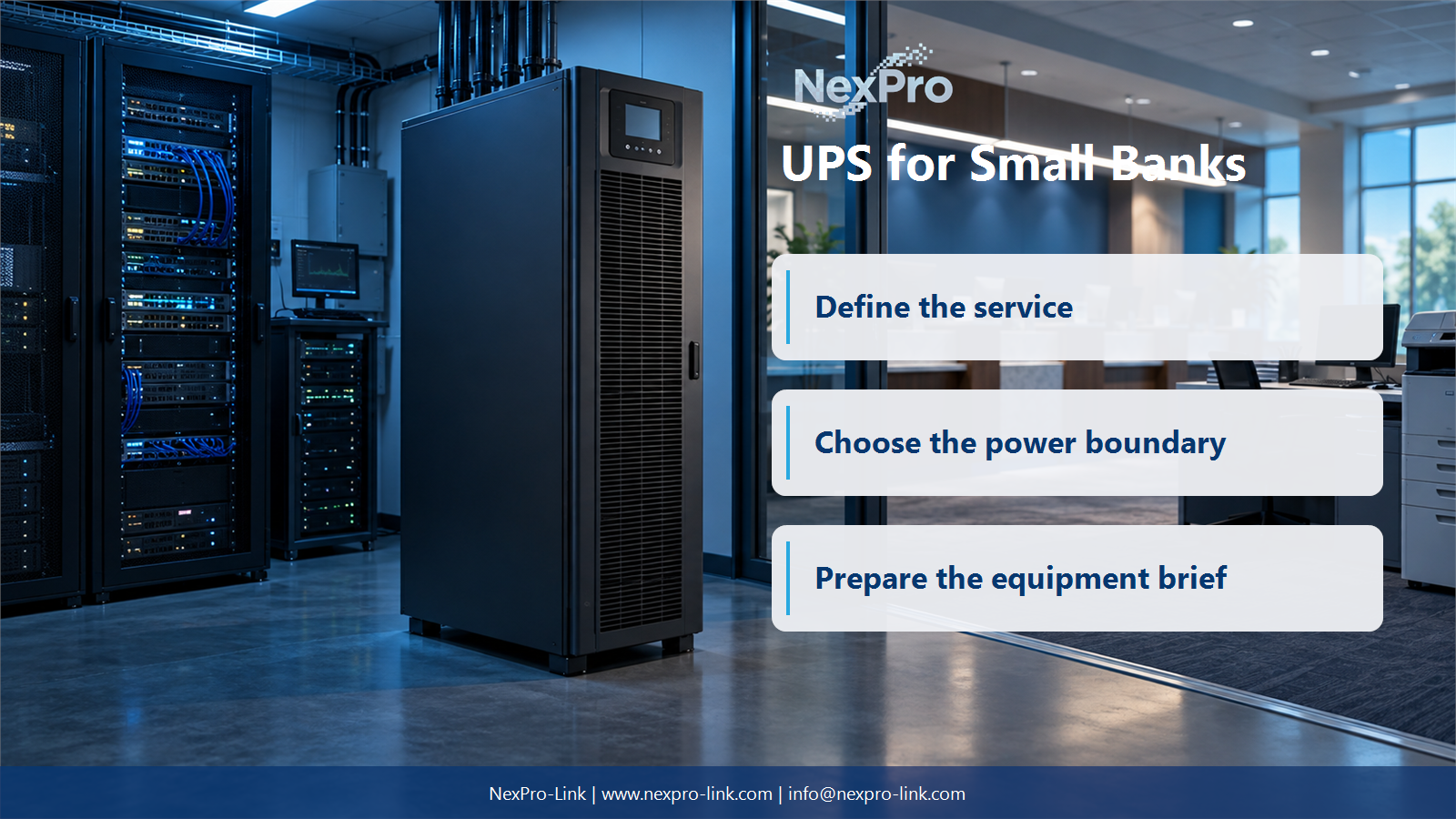
| Define Essential Service | How should a small institution start UPS planning? | Approved service objective |
| Keep Requirements Explicit | Can budget justify omitting required power functions? | Defined load and dependency boundary |
| Size from Demand | Is ten kVA a standard starting size for every small bank? | Reviewed power-path decision |
Section 02
Keep Requirements Explicit
Required project and applicable safety functions should be stated before comparing cost. Distinguish mandatory needs from optional convenience features. This helps procurement reduce scope intelligently without claiming that any economical UPS package automatically meets every financial institution's obligations.
Keep the load list, operating state and supporting dependencies in the same schedule. This makes omissions visible before runtime or capacity is discussed.
- Confirm the answer to: Can budget justify omitting required power functions?
- Separate measured demand, nameplate limits and committed growth.
- Identify the owner of each external service or approval.
Section 03
Size from Demand and Use Remote Management Selectively
No. Calculate the included devices, their operating states and the required output headroom before choosing a capacity. A smaller or larger UPS may fit the project. Battery duration, management interfaces and installation limits also need separate treatment; a ten-kVA label does not establish suitability for a financial institution.
No. It can improve visibility and escalation, but batteries, connections and faults may still need qualified local attention. Define which alarms are useful and who responds. This creates a realistic management option rather than a claim of maintenance-free operation.
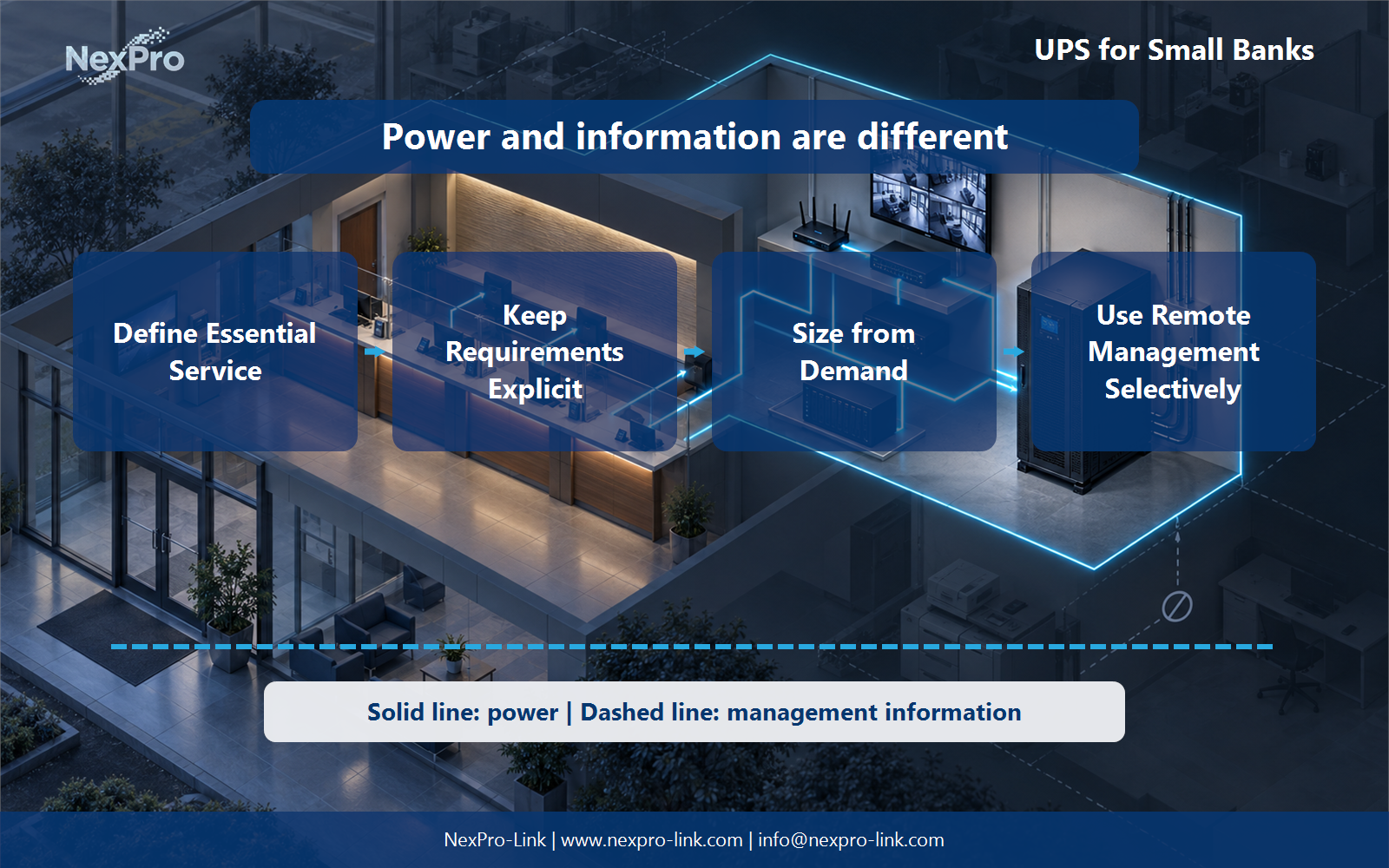
Draw power delivery as a solid path and management information as a separate dashed path. That distinction prevents an alarm or software command from being mistaken for an electrical protection function.
Section 04
Compare Lifecycle Scope
Compare equivalent protected loads, battery objectives, management and support terms. Identify installation and replacement costs separately. Avoid selecting only by initial price or adding invented failure costs as certain expenses; use clearly labeled scenarios for disruption risk.
Assign the action, acknowledgement, timeout and escalation owner before commissioning. The useful battery interval is the time needed for this approved sequence plus reserve, not an arbitrary marketing duration.
Section 05
Build a Repeatable Branch Brief
Share a standard branch load package, runtime objective and local interface requirements, with exceptions marked. NexPro-Link can discuss equipment options on that basis. Keep final compliance and operational acceptance with the institution's approved process rather than infer approval from a product family's name.
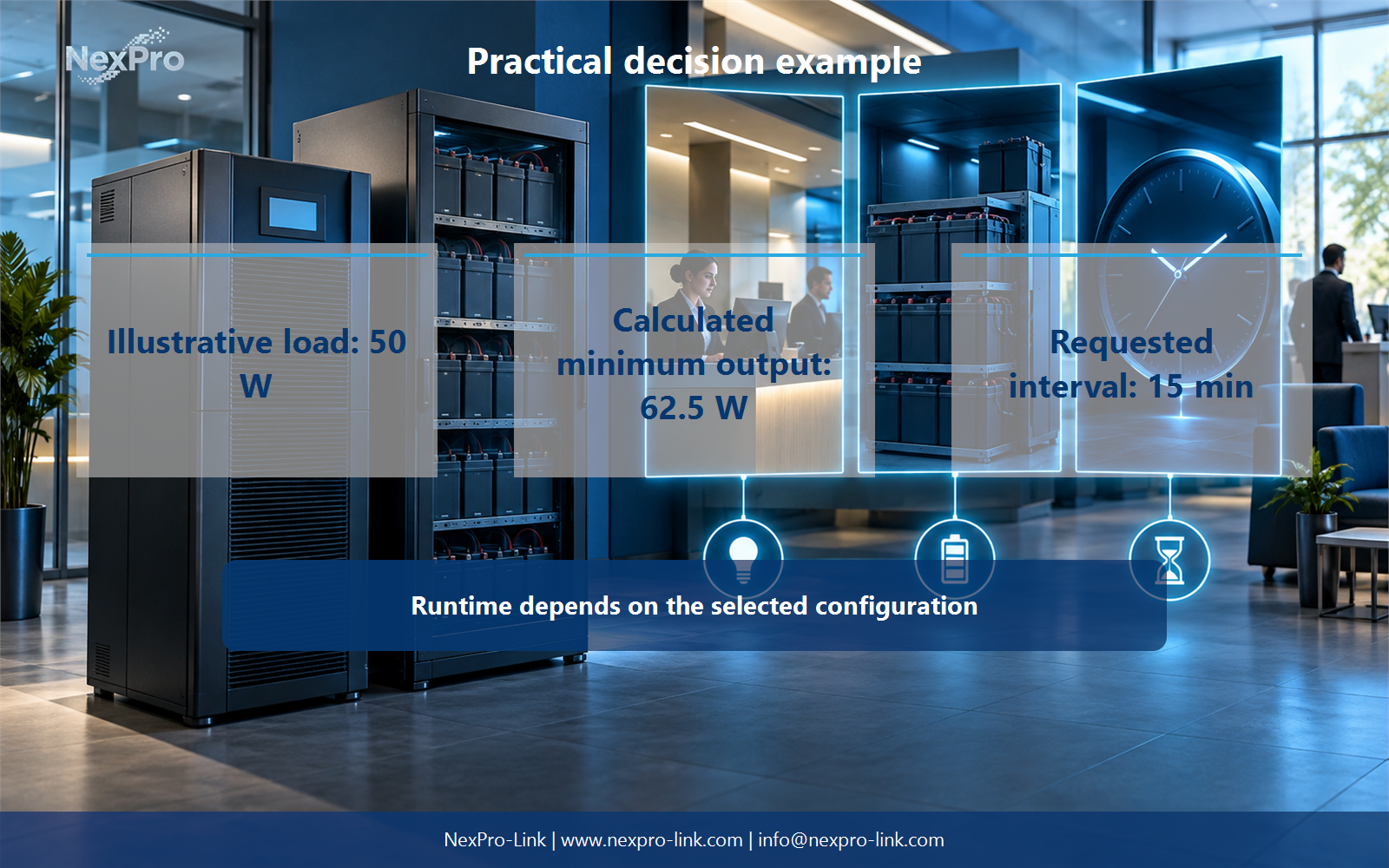
For the article's practical example, the stated teaching inputs are: Illustrative load: 50 W. Calculated minimum output: 62.5 W. Requested interval: 15 min. Runtime depends on the selected configuration. Treat these figures as planning assumptions, then replace them with measured or manufacturer-supported project data.
Engineering references
These sources support the general planning principles. Always use the selected product's current datasheet and applicable project standards for final design.