Define an adequate configuration from the minimum workable service and remote-maintenance conditions, without unlimited upgrades or a one-size cutoff.
Section 01
Define the minimum working branch
Define an adequate configuration from the minimum workable service and remote-maintenance conditions, without unlimited upgrades or a one-size cutoff.
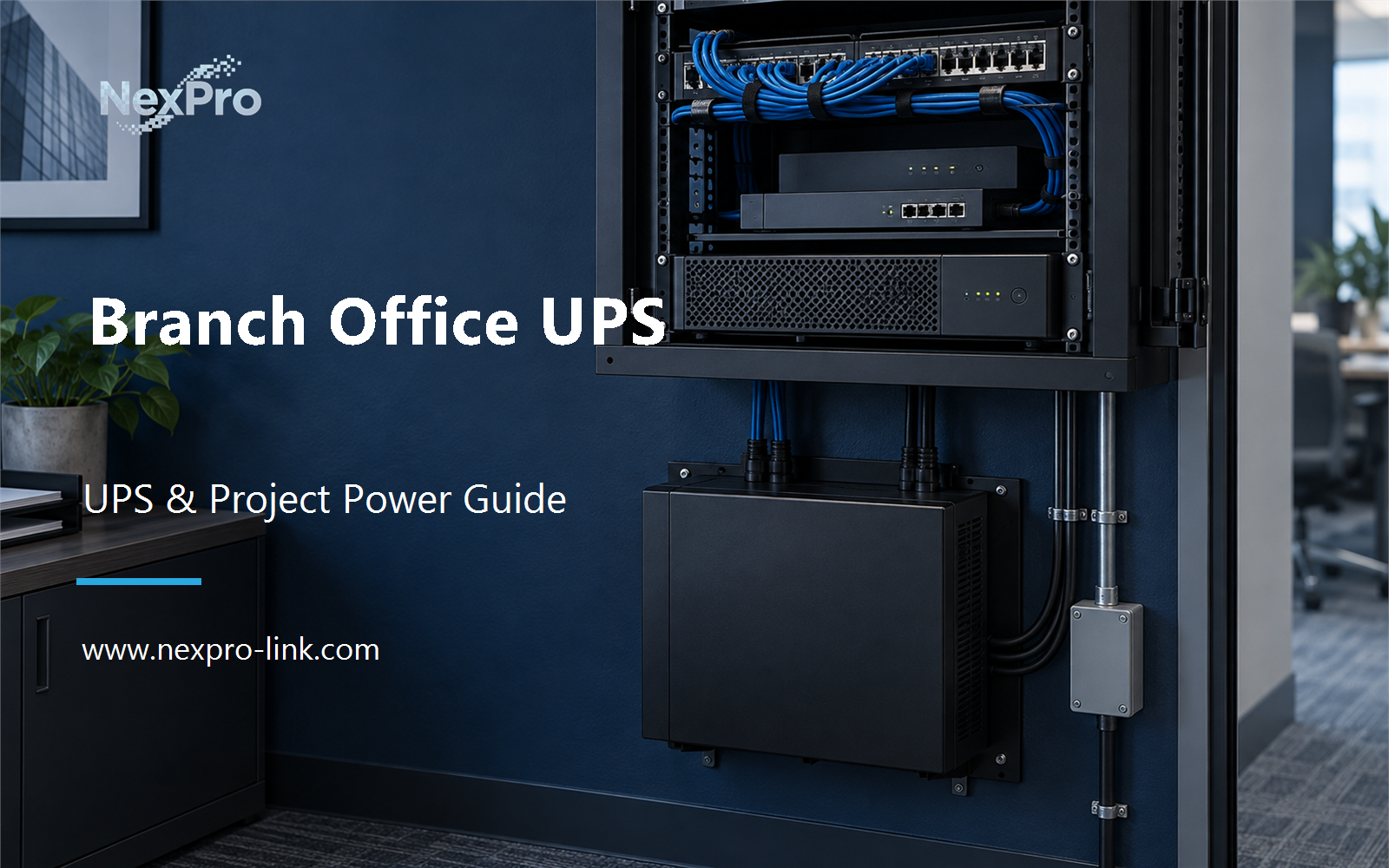
List the few local services needed to communicate, authenticate, secure the office and close active work. The minimum group may be a router, small switch and access controller rather than every workstation and printer in the branch.
Decide what happens when wide-area service is unavailable. A UPS can keep local equipment powered, but it cannot restore a failed carrier or cloud application.
| Load | Priority question | Likely treatment |
|---|---|---|
| Router and firewall | Does local or remote communication depend on it? | Protect when useful |
| Access controller | What is the approved outage behavior? | Protect to the defined objective |
| Selected workstation | Is an orderly close required? | Short save window |
| Printer and convenience loads | Do they improve the minimum service? | Usually exclude |
Section 02
Check real demand and local supply
Measure watts and VA for the intended group during representative activity. Compare the load's transfer and waveform tolerance with the local supply history and the candidate UPS topology.
A larger UPS is not automatically a better upgrade. It may add battery cost, heat and service burden without improving the branch's useful operating state.
- Exclude loads that cannot support the stated branch objective.
- Keep carrier and cloud availability outside the UPS claim.
- Confirm outlet labeling and physical placement before standardizing the kit.
Section 03
Plan unattended behavior
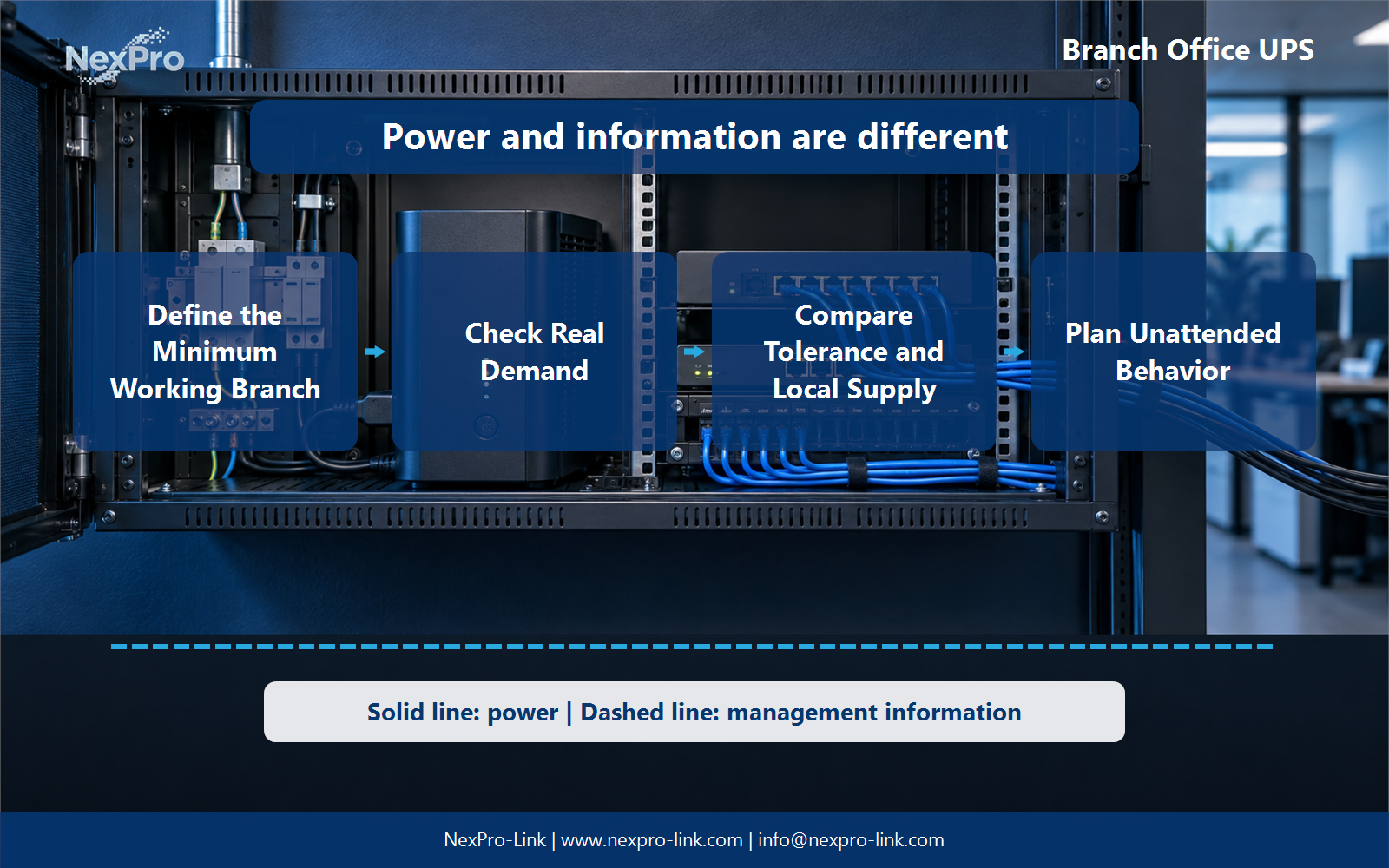
Many branches are empty overnight. Define who receives alarms, when a device shuts down and whether it restarts automatically after stable supply returns. The router and switch supporting management must stay available for as long as the plan requires them.
Test the sequence without relying on a person at the site. A branch package should recover predictably even when the first operator arrives hours later.
Section 04
Standardize the request without overbuilding
A repeatable branch kit should define approved load classes, outlet count, monitoring, battery service method, labels and a short acceptance test. Keep optional modules separate for branches with genuine additional needs.
The stopping point is reached when the protected group supports the defined branch outcome with a reasonable reserve. Extra nonessential loads should not enter the standard package simply because spare sockets exist.
Section 05
Calculate a small branch example
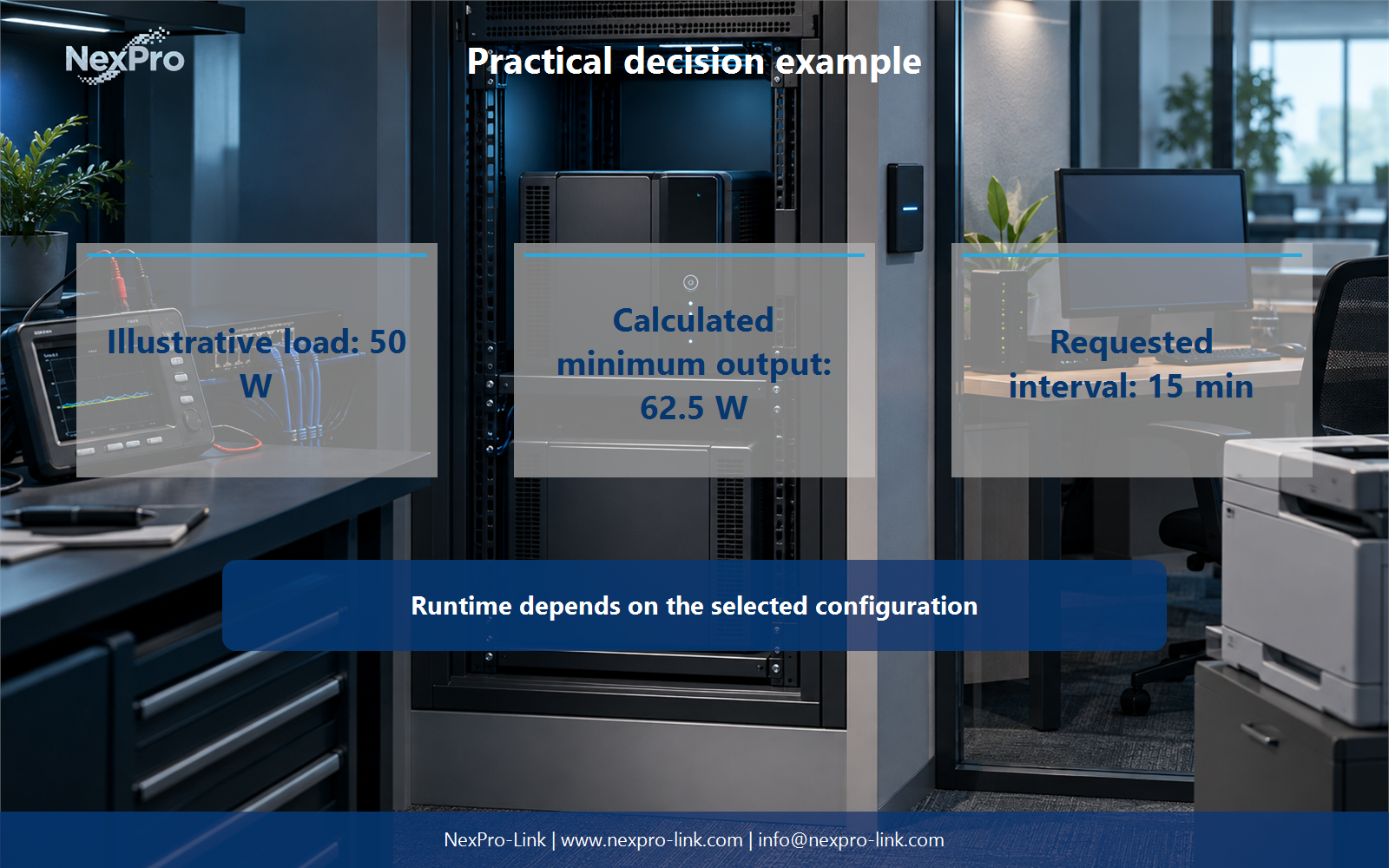
An illustrative router, switch and controller use 25 W, 15 W and 10 W, for 50 W total. At 0.90 power factor, the load is 55.56 VA. Applying an 80 percent operating ceiling gives a minimum of 62.5 W and 69.44 VA.
A 15-minute idealized energy need is 12.5 Wh before inverter loss, battery limits, aging and reserve. Select runtime from the offered configuration rather than treating this energy figure as a battery specification.
Share the branch's essential devices, outage-response plan, site voltage and support constraints so the proposed package matches its practical stopping point.
Engineering references
These sources support the general planning principles. Always use the selected product's current datasheet and applicable project standards for final design.