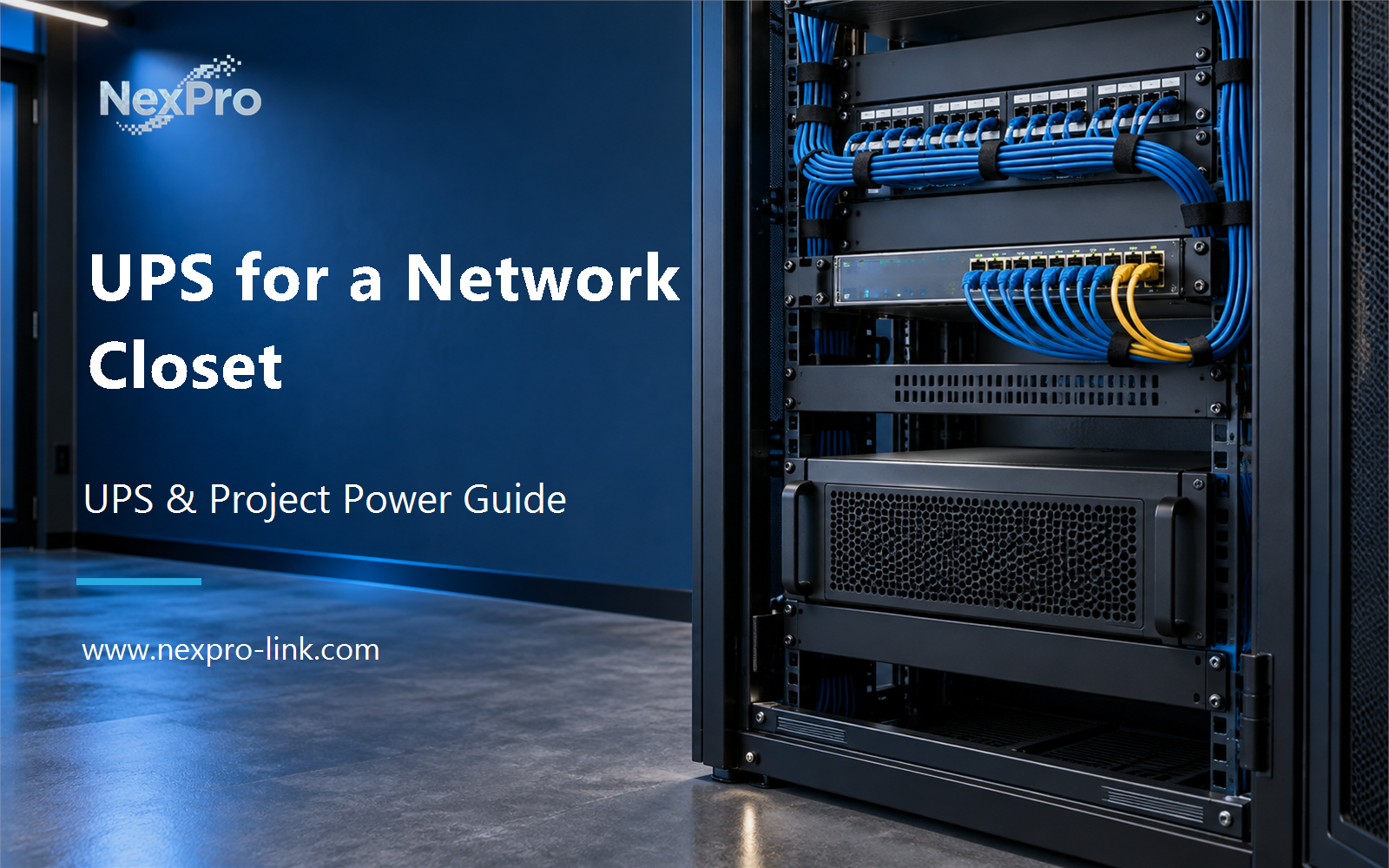
Choose the UPS from the dependency scope and actual PoE load; a low switch count does not mean low risk or low power. Plan the project from the switch inventory, PoE load and required upstream dependencies.
Section 01
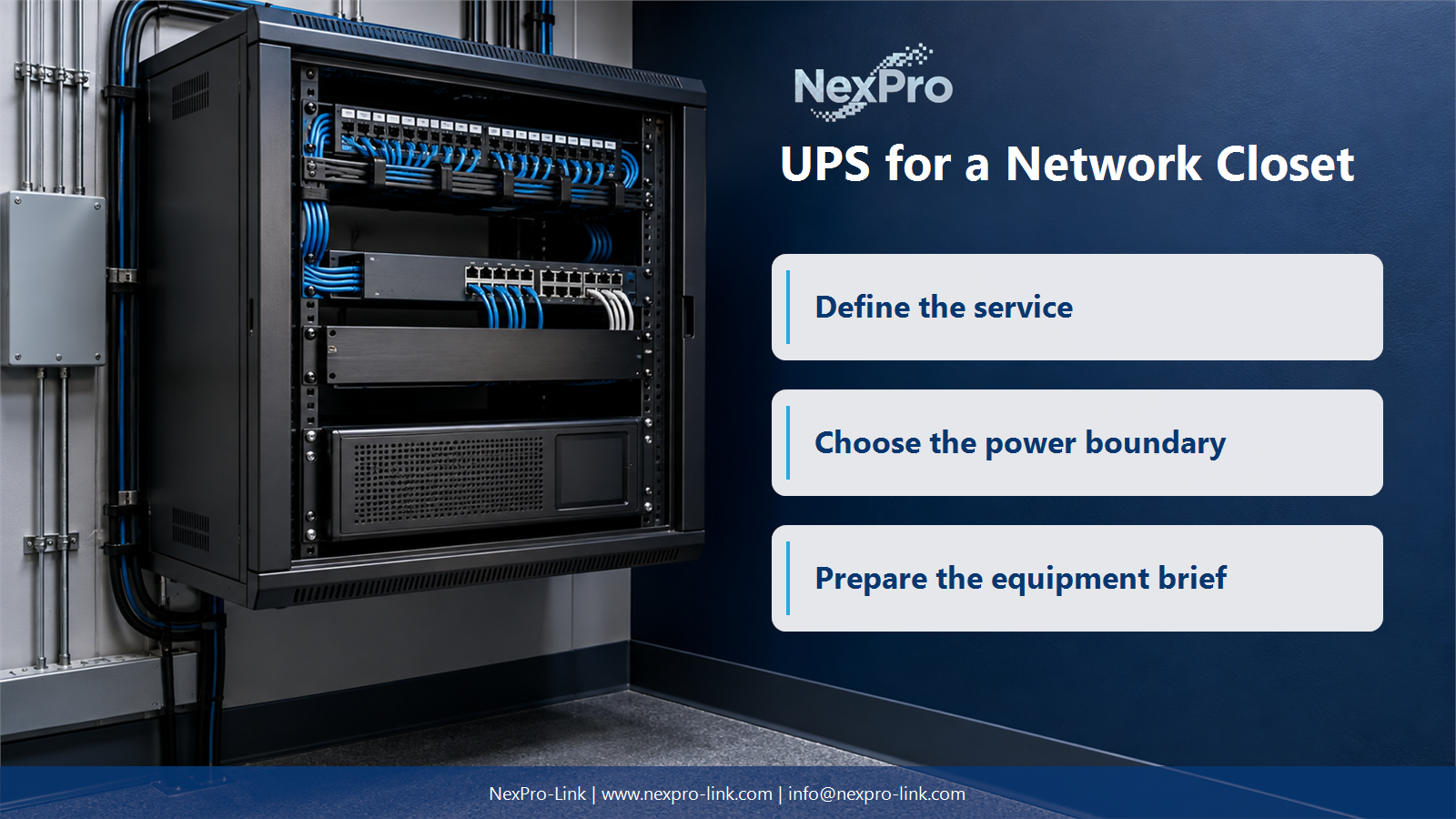
Map the closet's service area
Choose the UPS from the dependency scope and actual PoE load; a low switch count does not mean low risk or low power.
Start with what fails when this closet loses power. List the switches, wireless access points, cameras, phones, access-control devices and uplinks served from the cabinet. The business impact comes from that service map, not from the rack height of the switch.
Mark any shared dependency outside the closet. A protected access switch cannot preserve service if the upstream router, fiber converter or local controller is on an unprotected circuit.
| Load | Include once | Project evidence |
|---|---|---|
| PoE switch | AC input including PoE conversion | Measured or current technical data |
| Non-PoE switch | AC input | Representative traffic state |
| Router or media converter | Local input demand | Dependency map |
| PoE endpoints | Do not add again after switch input | Port and power-class schedule |
Section 02
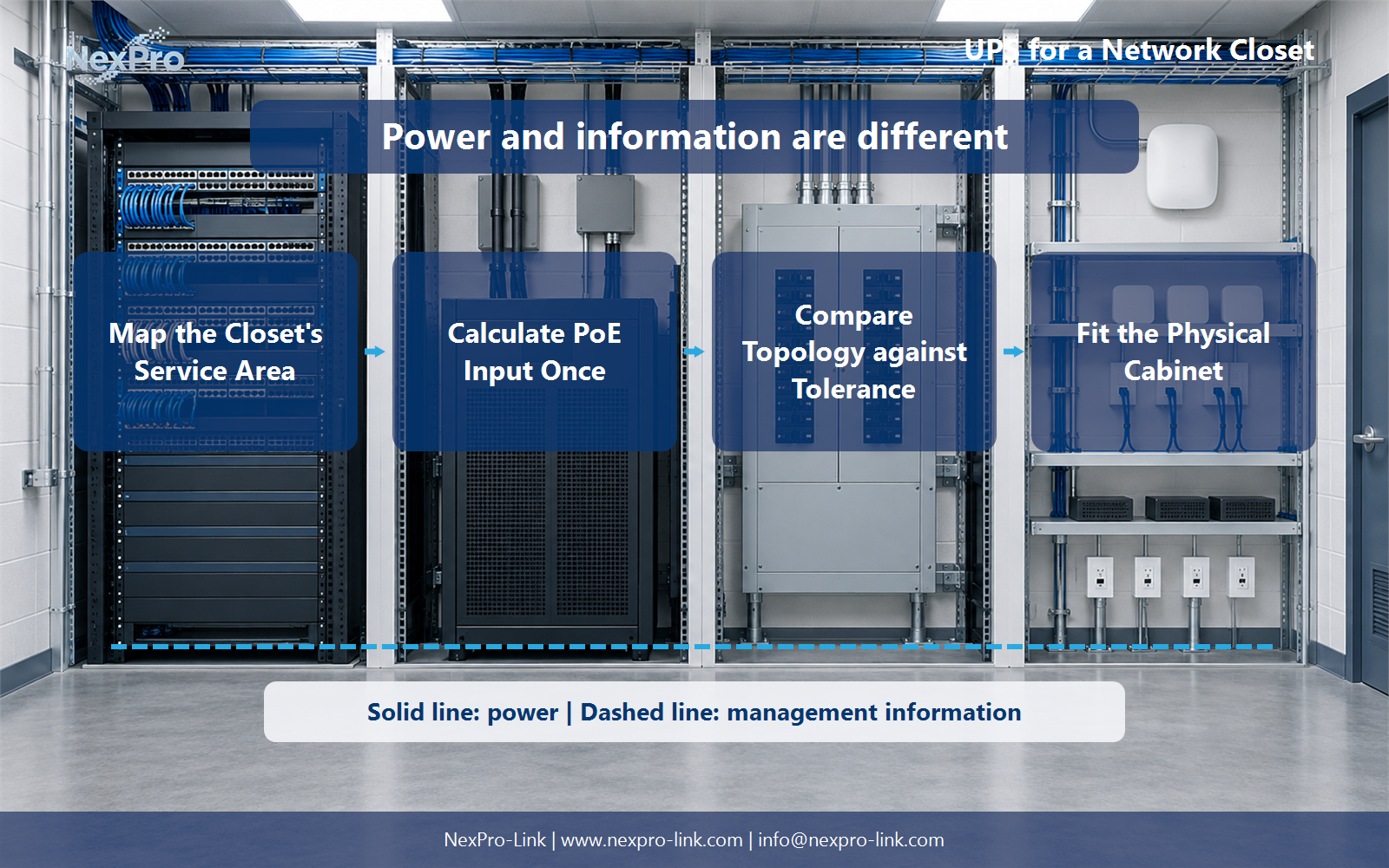
Count PoE power at the switch input once
PoE endpoint watts are useful for planning the switch budget, but the UPS sees the switch's AC input. Estimate endpoint demand, account for conversion loss and add the switch's own consumption. Do not add the endpoint watts again after using the resulting AC input.
Measure a representative condition where possible. Camera heaters, access points and phone loads can vary, so the port schedule should identify the expected active and peak states.
- Keep endpoint DC demand and switch AC input in different columns.
- Include redundant power supplies according to their actual sharing behavior.
- Reserve capacity for approved ports, not every possible future device by default.
Section 03
Compare topology against tolerance and cabinet fit
A line-interactive UPS can suit tolerant network equipment on a stable supply, while an online UPS may be selected where continuous conditioning or stricter interruption performance is required. Check the actual switch power supplies, battery-mode waveform and transfer behavior.
Then verify rack depth, rail support, rear cable bend, ventilation, battery access and floor or wall loading. A technically adequate unit that blocks the cabinet door or cannot be serviced is not an acceptable closet design.
Section 04
Buyer questions for UPS for a Network Closet: Topology, PoE Load and Cabinet Fit
For Network engineers, these six checks separate network closet UPS service impact decisions from assumptions that belong to the wider project.
| Buyer question | Practical answer | Project output |
|---|---|---|
| Why can a small network closet require careful backup planning? | It may supply several floors or critical endpoints despite containing few switches. Identify the service area and essential uplinks first. This connects the backup objective to actual dependencies without asserting that every distribution closet automatically requires the same UPS topology. | Service map: floor / endpoint group / switch / uplink |
| How should PoE camera or phone power be counted? | When using the switch's total AC input, the powered-device demand is already represented. When estimating from components, add switch overhead and conversion losses to the PoE output. Do not add both methods together, as that would count endpoint power twice. | Load worksheet: method / chassis / PoE output / losses |
| Is online UPS always mandatory for network switches? | No universal mandate follows from this source. Compare the switch power supply, permitted interruption, local supply quality and service impact. Explain when online operation is justified and when a compatible alternative may meet the documented objective without claiming it is suitable everywhere. | Selection table: tolerance / disturbance / mode / objective |
| Does a rack-compatible UPS always fit the closet? | Check usable rack depth, weight support, airflow, plug clearance and service access as well as U height. A mechanically unsuitable unit can undermine an otherwise sound electrical choice. For a project-specific decision, record U, depth, load, rear clearance and service in the fit table. This keeps the equipment inputs and intended service outcome aligned. | Fit table: U / depth / load / rear clearance / service |
| Can a closet report its outage when its uplink is down? | Only if a working communication path remains. Map the management route and decide what local action is needed when remote visibility disappears. Monitoring should not be assumed independent merely because the UPS includes a network card. | Alert path: card / switch / uplink / recipient / fallback |
| What belongs in the equipment request? | List protected switches, PoE demand, runtime objective, rack limits and outlets. NexPro-Link can discuss rack UPS, PDU and related equipment on that basis. Distinguish backed-up endpoints from ordinary loads and identify the client-side configuration work. | Closet BOQ: UPS / battery / PDU / cabling / management |
Section 05
Keep management available and define the closet package
The UPS network card and the switch carrying its alerts may depend on the same battery. Keep that path powered long enough for alarms and any orderly actions, but do not confuse management traffic with the power path.
The supply package should state UPS topology, rack or tower format, battery arrangement, PDU, monitoring interface, environmental limits and installation responsibilities. Include outlet labeling so later additions do not silently consume the reserve.
Section 06
Calculate one illustrative PoE closet
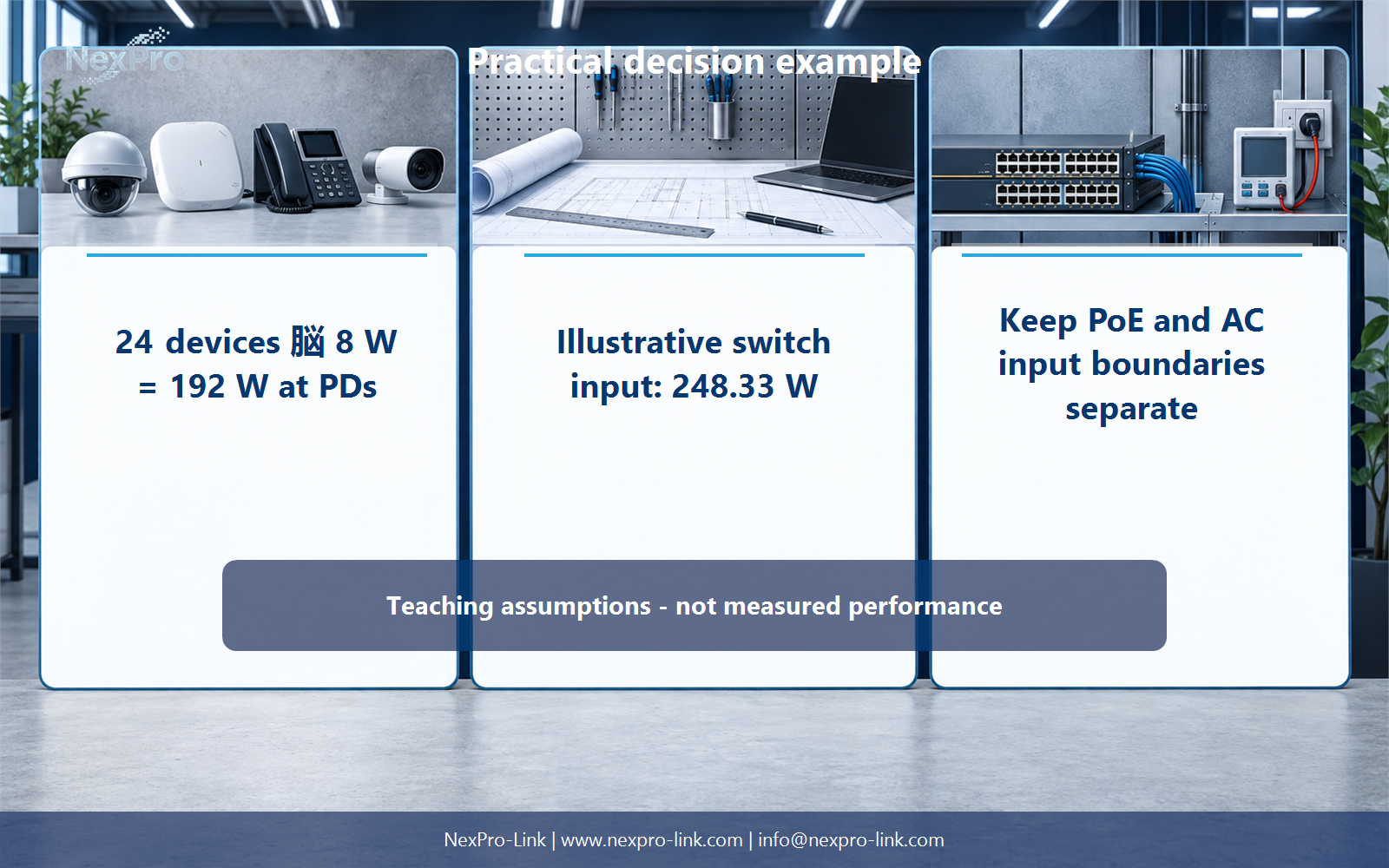
For 24 devices at 8 W each, the endpoint demand is 192 W. At 90 percent conversion efficiency, that becomes 213.33 W at the switch input; adding 35 W for the switch gives 248.33 W. A 30-minute idealized energy requirement is 124.17 Wh before battery, inverter and aging allowances.
Use 248.33 W as the illustrative UPS load contribution for this switch, not 248.33 W plus the 192 W endpoints. Runtime must still come from the offered UPS and battery configuration at the complete measured closet load.
Engineering references
These sources support the general planning principles. Always use the selected product's current datasheet and applicable project standards for final design.