
Backup for a core router has to keep three things working together: the routing function, the interfaces that carry traffic, and the management path the operations team uses to see and control the node.
Section 01
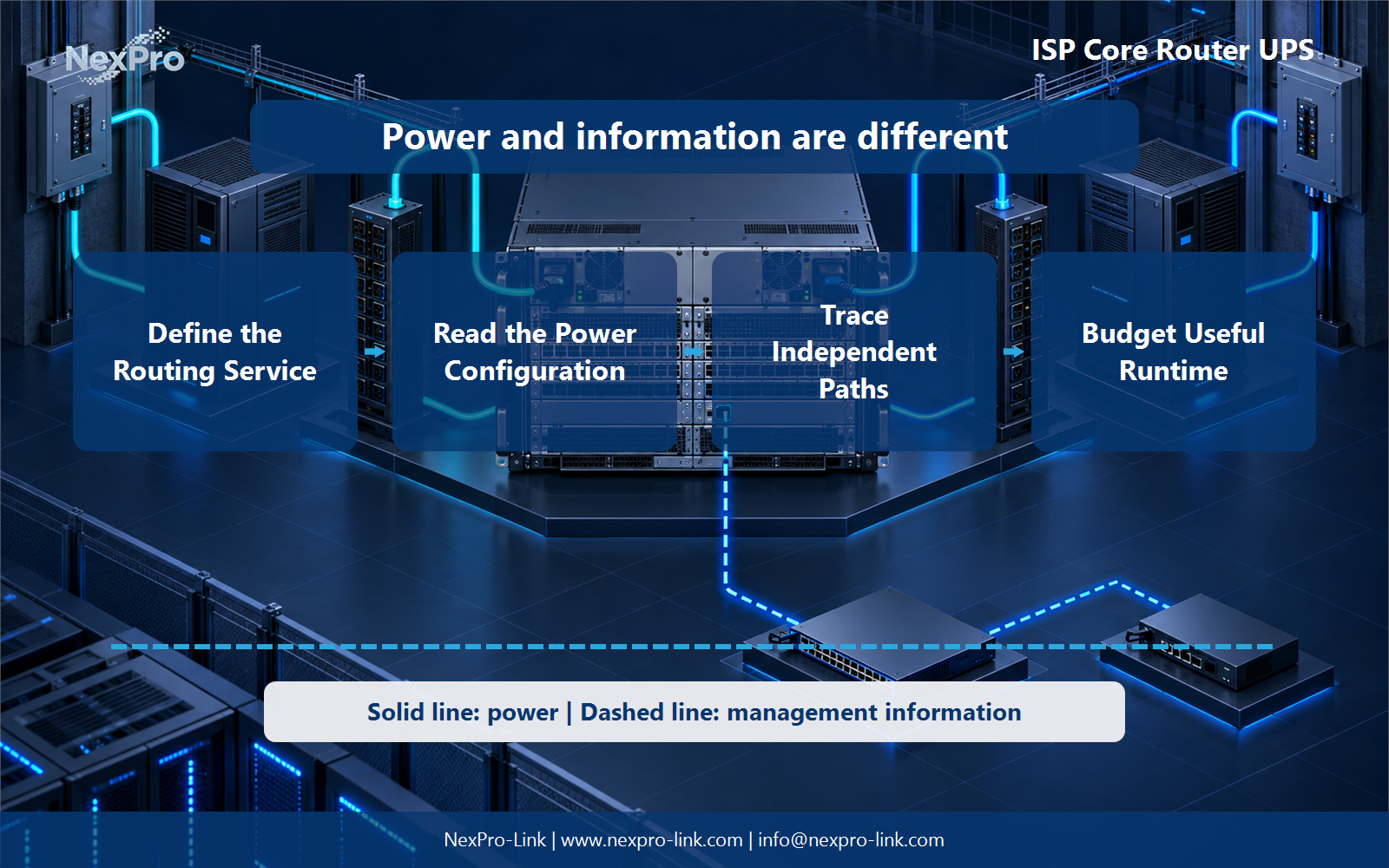
Define the Routing Service
Backup for a core router has to keep three things working together: the routing function, the interfaces that carry traffic, and the management path the operations team uses to see and control the node. A chassis that stays powered while its upstream optics or its out-of-band access drops has not really been preserved. Power is useful only when the traffic and the visibility survive with it.
Define the routing function, essential interfaces and management access needed during a source failure. Include dependent switches or optical equipment where required. A powered chassis does not preserve service if the adjacent communication path is unavailable.
The working question is simple: What should router backup actually preserve? Record the answer as a service requirement before comparing UPS ratings or battery options.
| Decision area | Project question | Required output |
|---|---|---|
| Define the Routing Service | What should router backup actually preserve? | Approved service objective |
| Read the Power Configuration | Does the sum of PSU nameplates equal running demand? | Defined load and dependency boundary |
| Trace Independent Paths | How should dual power feeds be represented? | Reviewed power-path decision |

Section 02
Read the Power Configuration
Not necessarily. Power supplies may be redundant, and their ratings describe supported capacity rather than normal consumption. Use operating and failure-state demand from the actual equipment configuration, including populated interface cards and planned expansion.
Keep the load list, operating state and supporting dependencies in the same schedule. This makes omissions visible before runtime or capacity is discussed.
- Confirm the answer to: Does the sum of PSU nameplates equal running demand?
- Separate measured demand, nameplate limits and committed growth.
- Identify the owner of each external service or approval.
Section 03
Trace Independent Paths and Budget Useful Runtime
Trace each feed through the distribution and UPS to its upstream source. Identify shared breakers, controls or rooms where relevant. Two labeled feeds should not be called independent solely because they terminate at different router sockets.
Not when service must continue through generator start or network rerouting. Define the intended outage response and its duration. Include reserve and the power needed by the management path, then compare the objective with the selected configuration.
Draw power delivery as a solid path and management information as a separate dashed path. That distinction prevents an alarm or software command from being mistaken for an electrical protection function.
Section 04
Coordinate NOC Monitoring
Map UPS events to service impact and a responsible responder. Distinguish a single-source warning from imminent loss of routing. Keep event timestamps and communication dependencies clear so power alarms can be correlated with network observations.
Assign the action, acknowledgement, timeout and escalation owner before commissioning. The useful battery interval is the time needed for this approved sequence plus reserve, not an arbitrary marketing duration.
Section 05
Create a Router-Level RFQ
Send chassis configuration, demand states, feeds, interfaces and runtime objectives. NexPro-Link can discuss equipment against this schedule. Avoid substituting a general high-reliability label or an invented business-loss figure for the actual service requirements.
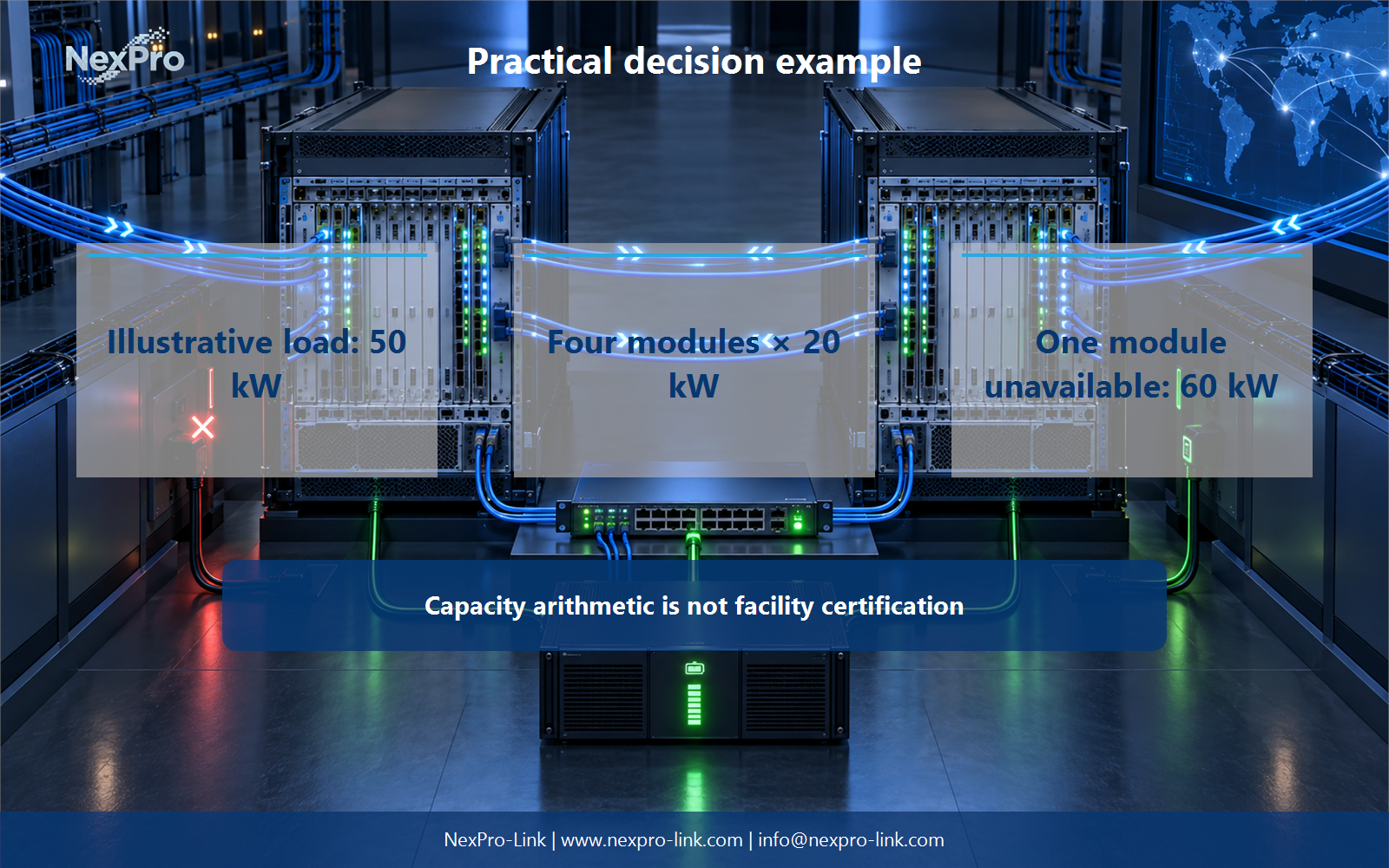
For the article's practical example, the stated teaching inputs are: Illustrative load: 50 kW. Four modules × 20 kW. One module unavailable: 60 kW. Capacity arithmetic is not facility certification. Treat these figures as planning assumptions, then replace them with measured or manufacturer-supported project data.
Engineering references
These sources support the general planning principles. Always use the selected product's current datasheet and applicable project standards for final design.