Protect both the network-operation path and the observation path; do not size a UPS from wall area or center name. Plan the project from the NOC service map, rack loads and operator continuity requirements.
Section 01
Define What the NOC Must See
Protect both the network-operation path and the observation path; do not size a UPS from wall area or center name.
Identify the networks, management platforms and operator displays needed to observe and respond. A center can remain electrically energized yet lose visibility if collectors or communication paths fail. Define the required service before counting equipment.
The working question is simple: What is the minimum useful NOC during an outage? Record the answer as a service requirement before comparing UPS ratings or battery options.
| Decision area | Project question | Required output |
|---|---|---|
| Define What the NOC Must See | What is the minimum useful NOC during an outage? | Approved service objective |
| Map Core Network Dependencies | Which devices should share the continuity objective? | Defined load and dependency boundary |
| Separate Wall and Essential Workstations | Should every display remain fully powered? | Reviewed power-path decision |
Section 02
Map Core Network Dependencies
Include core routing, essential switching, management servers and any required authentication or time services. Trace their power and communication dependencies separately. This makes hidden shared points visible without assuming every nearby rack belongs on the same UPS.
Keep the load list, operating state and supporting dependencies in the same schedule. This makes omissions visible before runtime or capacity is discussed.
- Confirm the answer to: Which devices should share the continuity objective?
- Separate measured demand, nameplate limits and committed growth.
- Identify the owner of each external service or approval.
Section 03
Separate Wall and Essential Workstations and Calculate Redundancy in Fault States
Use the operating plan to decide which views and operator positions are essential. Reduced-display operation can be compared with full-wall operation using actual demand. Keep the decision with the service owner rather than shedding equipment merely to make a smaller UPS fit.
It protects only the nominated capacity or path loss under the defined architecture. Calculate remaining output and battery support after the chosen event, and mark shared dependencies. Do not turn an N+X label into a universal reliability claim.
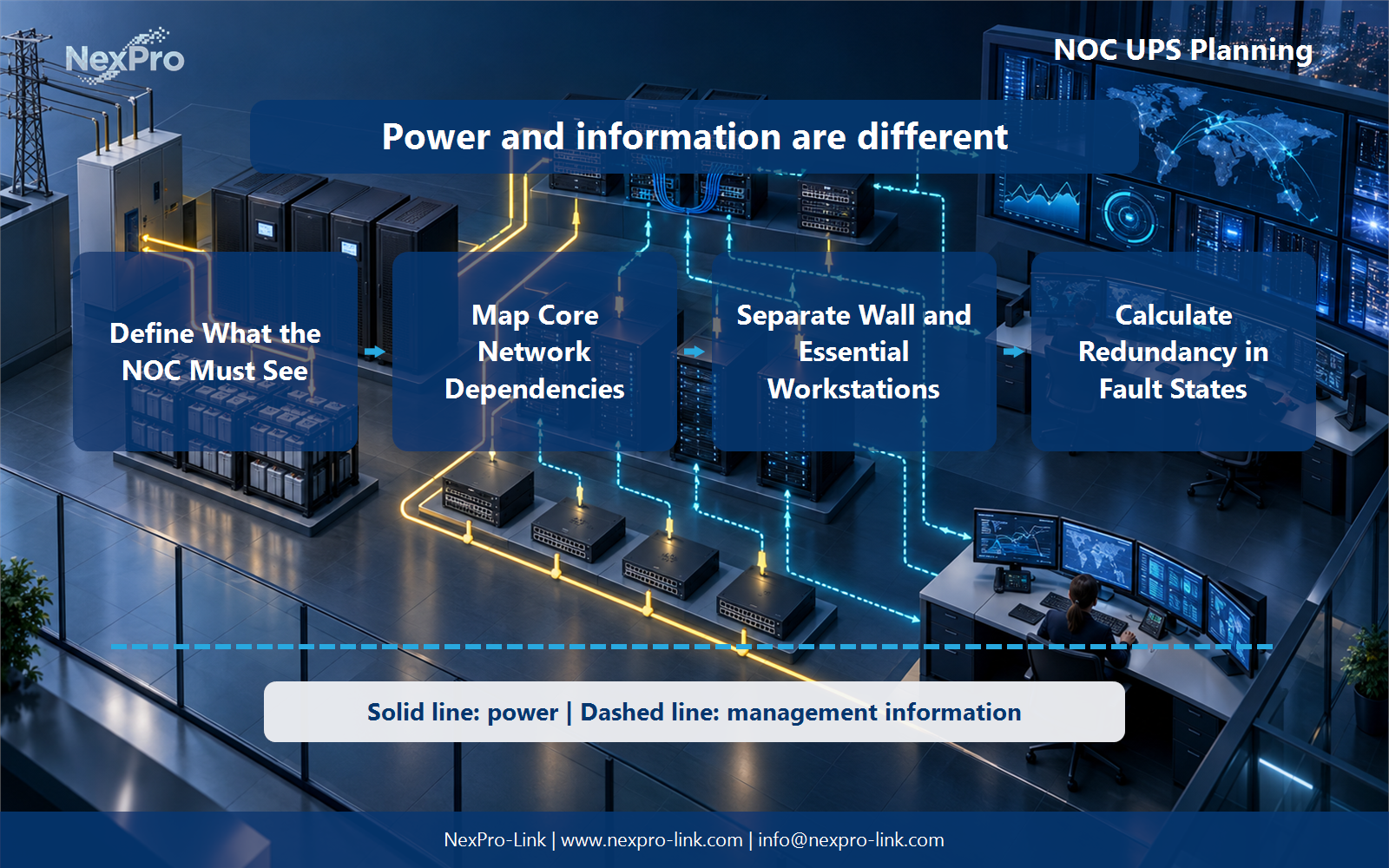
Draw power delivery as a solid path and management information as a separate dashed path. That distinction prevents an alarm or software command from being mistaken for an electrical protection function.
Section 04
Retain Independent Alarm Delivery
Plan a viable alarm route and local fallback rather than assuming ordinary monitoring remains available. Distinguish out-of-band communication from a route that still depends on the same failed switch. Assign an operational owner and response condition for each critical alert.
Assign the action, acknowledgement, timeout and escalation owner before commissioning. The useful battery interval is the time needed for this approved sequence plus reserve, not an arbitrary marketing duration.
Section 05
Prepare the NOC Equipment Brief
Provide protected functions, demand, room limits and the required fault or maintenance states. NexPro-Link can discuss UPS and rack-power equipment on that basis. For a project-specific decision, record services, W and VA, redundancy, interfaces and room in the brief. This keeps the equipment inputs and intended service outcome aligned.
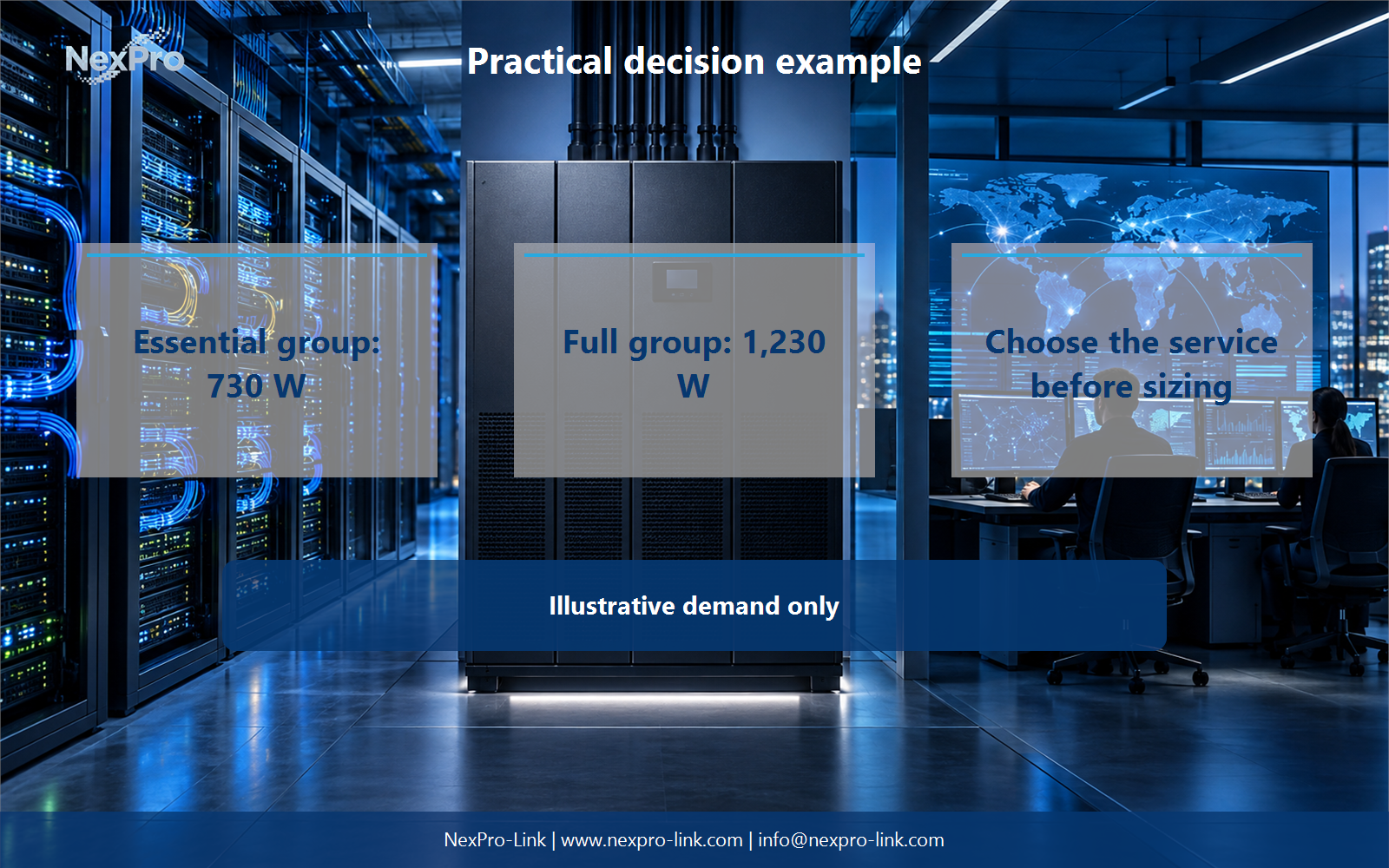
For the article's practical example, the stated teaching inputs are: Essential group: 730 W. Full group: 1,230 W. Choose the service before sizing. Illustrative demand only. Treat these figures as planning assumptions, then replace them with measured or manufacturer-supported project data.
Engineering references
These sources support the general planning principles. Always use the selected product's current datasheet and applicable project standards for final design.