
Define maintenance and fault objectives first, then count surviving capacity and shared dependencies, without equating N+1 or 2N directly with a Tier certification.
Section 01
Define the outcome before naming the topology
Define maintenance and fault objectives first, then count surviving capacity and shared dependencies, without equating N+1 or 2N directly with a Tier certification.
N+1 and dual path describe different design ideas. N+1 usually addresses spare capacity within a defined system. Dual path addresses independent routes to equipment that can accept them. The project must state which failures and maintenance states the pod is expected to tolerate.
Map the outcome at the server inlet as well as the UPS output. A dual-corded server can still lose both inputs when the paths share upstream switchgear, controls, cooling or a maintenance procedure.
| Question | N+1 review | Dual-path review |
|---|---|---|
| Capacity | Can the remaining modules carry the load? | Can either complete path carry its assigned load? |
| Distribution | What remains common downstream? | Where do A and B paths become independent? |
| Maintenance | Can one module be isolated safely? | Can one path be maintained while the other serves the pod? |
| IT load | Single or dual-corded? | How are single-cord loads supported? |
Section 02
Count surviving capacity in the required state
Calculate capacity after the stated unavailable element, then compare it with the pod load and operating ceiling. Repeat the check for planned maintenance, because the maintenance arrangement may remove more capacity than a single module event.
Capacity, runtime and distribution are separate. Enough UPS kilowatts do not prove that a feeder, PDU or battery arrangement supports the same state.
- Use the same unit and load basis on both paths.
- Include single-cord transfer equipment where required.
- List common controls and mechanical dependencies explicitly.
Section 03
Trace A and B paths from source to server
Draw source, switchgear, UPS, battery, distribution and rack connection for each path. A shared device should appear once and be marked as common; duplicating its symbol does not make it independent.
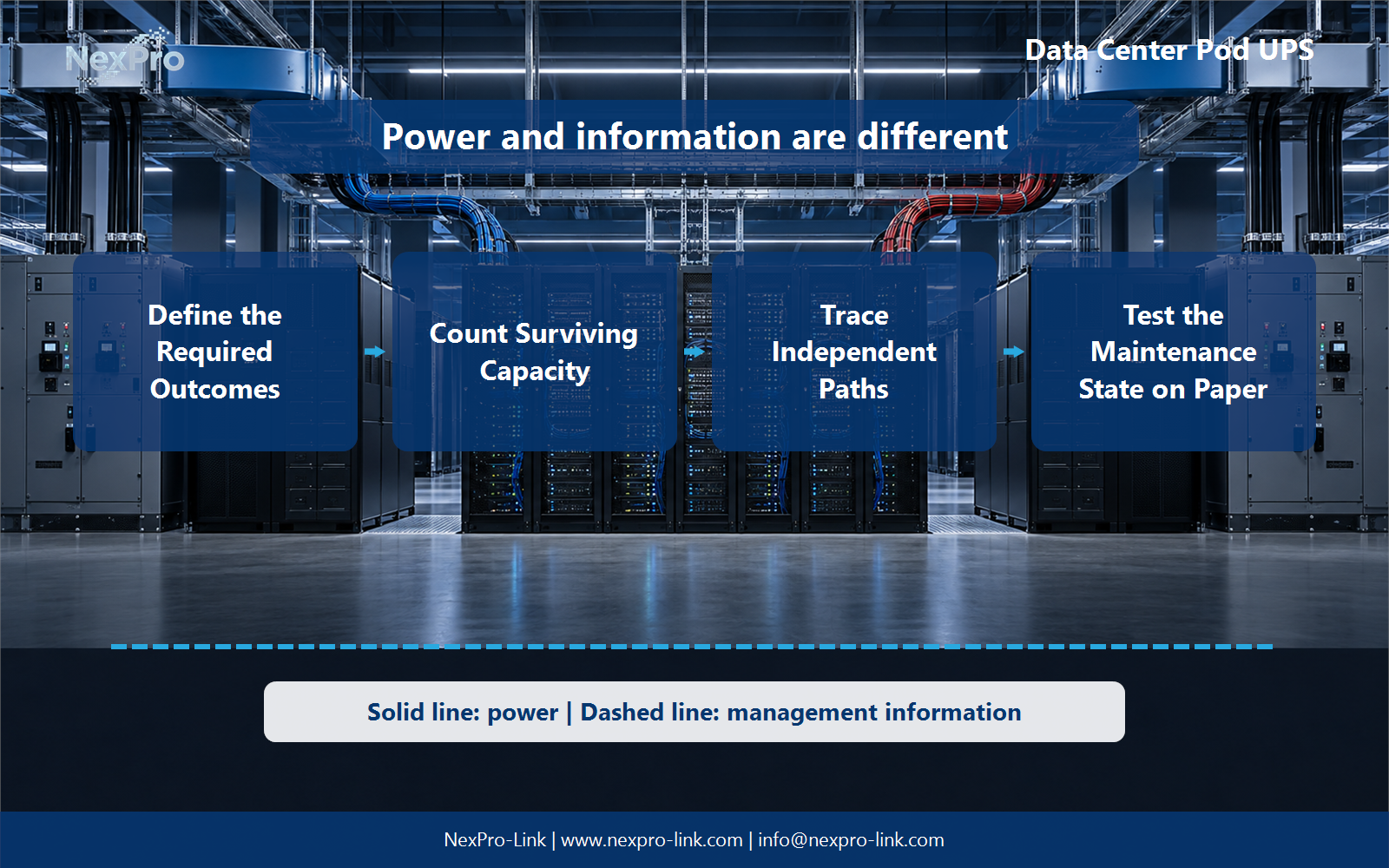
Power and monitoring links should remain separate. Common management can be reasonable, but it must not create an unrecognized control dependency that can interrupt both paths.
Section 04
Test maintenance, battery and cooling states on paper
Review module service, battery work, bypass operation and upstream maintenance one state at a time. Confirm safe access and the remaining load path for every planned activity.
Also review battery-room and cooling dependencies. Two electrical paths housed in one unsupported environment may share a failure mode that the single-line diagram does not show.
Section 05
Use capacity arithmetic without calling it certification
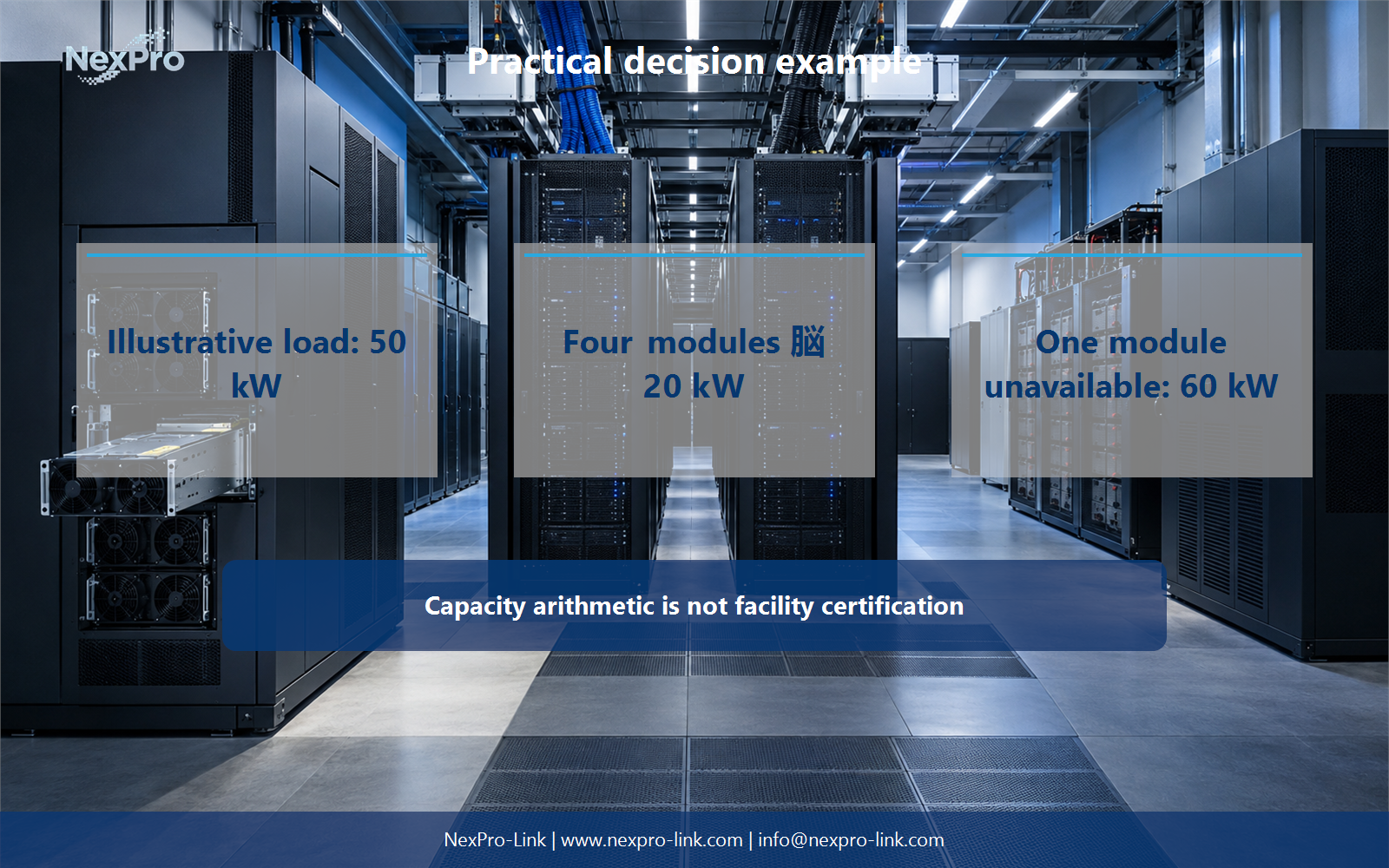
For a 50 kW illustrative pod supported by four 20 kW modules, one unavailable module leaves 60 kW. The pod then uses 83.33 percent of surviving capacity. This result helps review the N+1 state and the operating ceiling.
It does not establish path independence, runtime, maintainability or a data-center Tier result. Facility certification requires a broader design and assessment process.
Engineering references
These sources support the general planning principles. Always use the selected product's current datasheet and applicable project standards for final design.