Must every bank data center meet Tier IV? No. A banking use by itself does not impose a Tier IV requirement on the building.
Section 01
State the Facility Objective
Must every bank data center meet Tier IV? No. A banking use by itself does not impose a Tier IV requirement on the building. The obligation comes from the institution's own availability, maintenance and fault-tolerance objectives, plus whatever regulation, contract and site conditions apply to this specific project. Those objectives are the baseline, and the complete infrastructure, with the UPS as one part of it, is measured against that baseline. This article works through that measurement, using a small capacity example and the records a project team should keep before it approaches suppliers.
A banking use alone does not establish a universal Tier IV requirement. Start with the institution's availability, maintenance and fault-tolerance objectives and the requirements applicable to the specific project. Compare the complete infrastructure against that basis; the UPS is one component of the resulting design.
The working question is simple: Must every bank data center meet Tier IV? Record the answer as a service requirement before comparing UPS ratings or battery options.
| Decision area | Project question | Required output |
|---|---|---|
| State the Facility Objective | Must every bank data center meet Tier IV? | Approved service objective |
| Distinguish Components from Facility Certification | Can a UPS product carry a data-center Tier rating? | Defined load and dependency boundary |
| Trace Dual-Bus Architecture | What does a dual-bus diagram need beyond two UPS blocks? | Reviewed power-path decision |
Section 02
Distinguish Components from Facility Certification
A UPS can be part of a facility design, but selecting it does not establish the facility's Tier certification. Keep equipment data, full infrastructure design and certification assessment as separate records. This prevents a component quotation from being presented as an approved data-center outcome.
Keep the load list, operating state and supporting dependencies in the same schedule. This makes omissions visible before runtime or capacity is discussed.
- Confirm the answer to: Can a UPS product carry a data-center Tier rating?
- Separate measured demand, nameplate limits and committed growth.
- Identify the owner of each external service or approval.
Section 03
Trace Dual-Bus Architecture and Check Generator Coordination
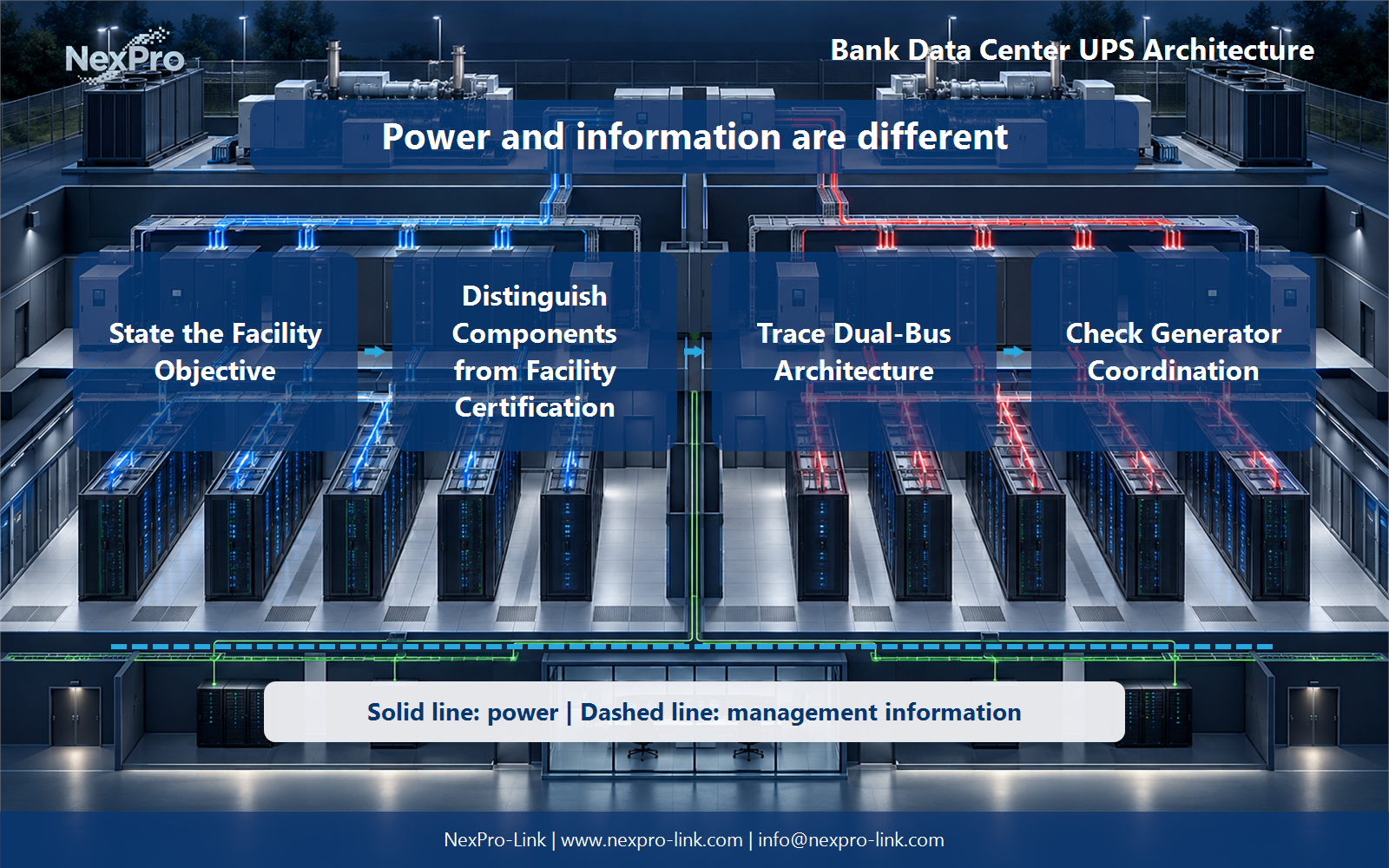
Show sources, batteries, distribution and load connections with shared dependencies marked. Include maintenance and failure cases as distinct states. The diagram should explain which path remains available, not merely use symmetry to imply independence.
Describe the accepted supply sequence, stabilization conditions, transfer arrangement and battery bridging objective. Coordination depends on both systems and their loads. Avoid assigning a universal generator multiplier or start time from an illustrative diagram.
Draw power delivery as a solid path and management information as a separate dashed path. That distinction prevents an alarm or software command from being mistaken for an electrical protection function.
Section 04
Analyze Phased Capacity
Evaluate each phase with the required spare capacity, distribution limits and battery support. A future module addition should not be assumed to solve upstream or cooling constraints. Use release milestones that maintain the chosen availability target as demand grows.
Assign the action, acknowledgement, timeout and escalation owner before commissioning. The useful battery interval is the time needed for this approved sequence plus reserve, not an arbitrary marketing duration.
Section 05
Prepare a Facility-Aligned Equipment Schedule
Provide the engineered capacity, topology, battery and interface requirements with the project scope clearly defined. NexPro-Link can discuss equipment matching and documentation. Facility certification, site installation and operational approval remain explicitly separate from a generic product-family statement.
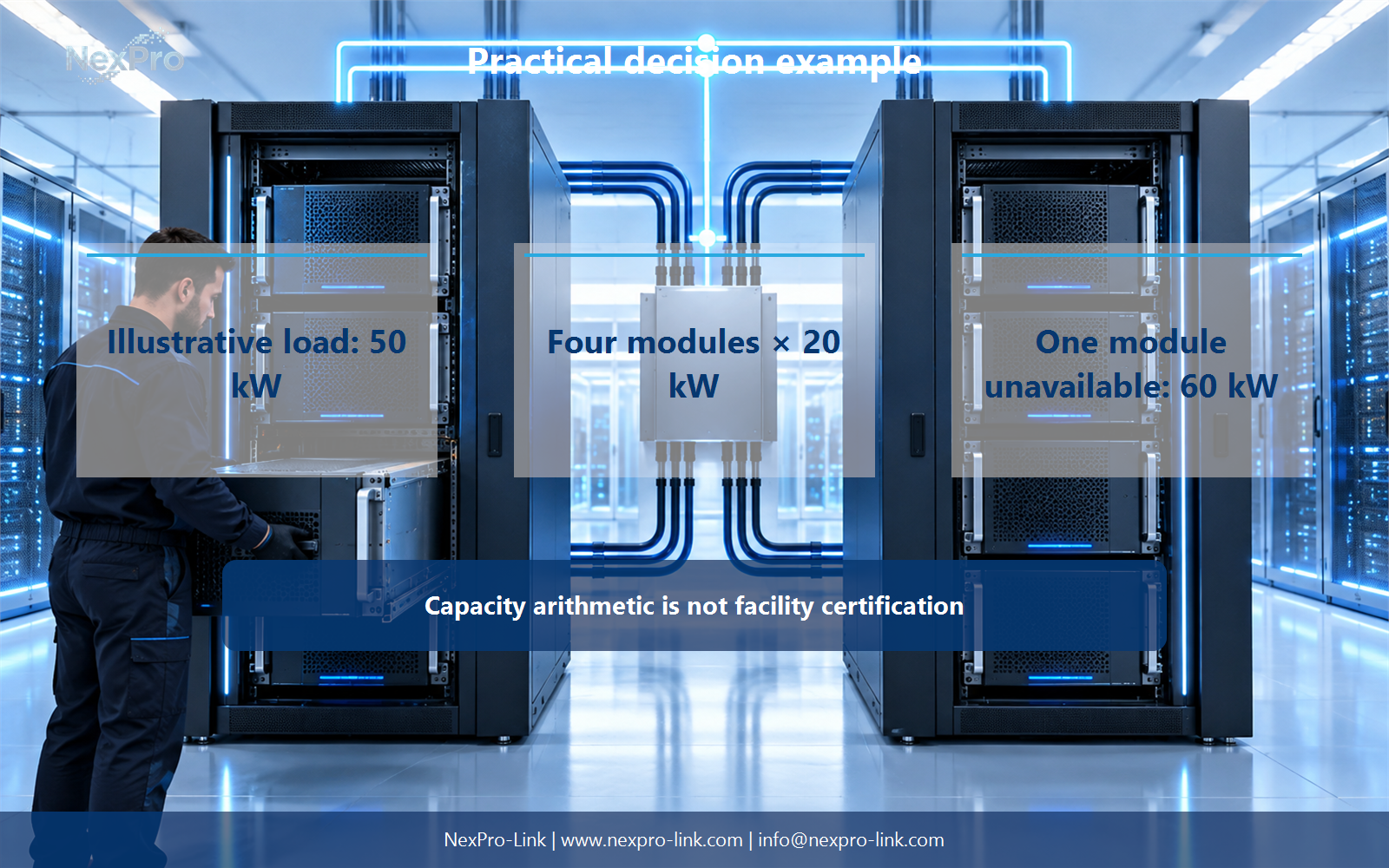
For the article's practical example, the stated teaching inputs are: Illustrative load: 50 kW. Four modules × 20 kW. One module unavailable: 60 kW. Capacity arithmetic is not facility certification. Treat these figures as planning assumptions, then replace them with measured or manufacturer-supported project data.
Engineering references
These sources support the general planning principles. Always use the selected product's current datasheet and applicable project standards for final design.