Compare total cost on the same load, runtime objective and service scope without deriving an eighteen-month failure rule from a low price.
Section 01
Normalize the service before comparing prices
Compare total cost on the same load, runtime objective and service scope without deriving an eighteen-month failure rule from a low price.
Two quotations are comparable only when they protect the same load, deliver the same runtime objective and include the same installation and management scope. A lower-capacity unit, a smaller battery set or a quotation without commissioning can look cheaper while solving a different problem.
Create one comparison sheet for input voltage, output capacity, topology, battery arrangement, bypass, communication, warranty, delivery and site services. Mark exclusions explicitly. Price differences then become explainable instead of being hidden inside mismatched scopes.
Share two comparable quotations, the expected load, battery assumptions and service scope so lifecycle costs are compared on the same basis.
| Field | Option A | Option B |
|---|---|---|
| Protected load and runtime | Same confirmed requirement | Same confirmed requirement |
| Battery and cabinet scope | Included or priced separately | Included or priced separately |
| Commissioning and training | Named deliverables | Named deliverables |
| Support response | Defined period and channel | Defined period and channel |
Section 02
Model battery work as a project event
Battery cost includes more than replacement cells. Access, isolation, labor, disposal, testing and a planned service window can be material. Temperature and operating history influence battery life, so a single universal replacement interval is a weak budgeting assumption.
Build a scenario using the specified battery technology and the site conditions. Keep inspection and expected replacement as separate lines. This makes it easier to revise the model when the selected configuration or maintenance plan changes.
- State whether transport and disposal are included.
- Include the access and isolation method for the site.
- Price a verification test after battery work.
Section 03
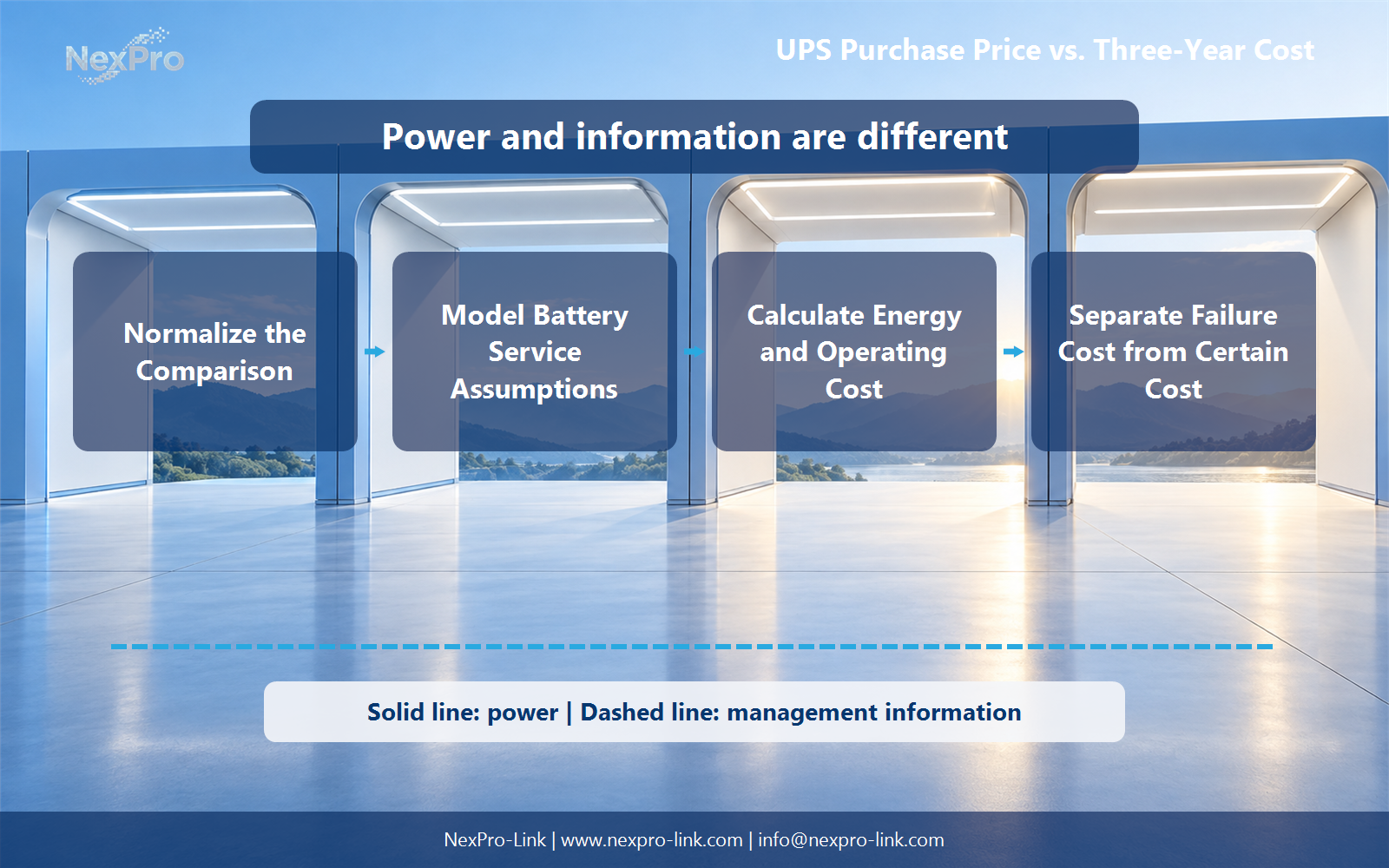
Calculate energy and operating cost consistently
Efficiency should be compared at the expected operating load, not only at a headline point. The annual loss is the difference between input energy and useful output energy over the operating hours. Cooling impact may be evaluated separately when the UPS is inside a conditioned technical space.
Use the same load profile and electricity price for every option. If one configuration has an energy-saving mode, describe the operating conditions and transfer behavior before assigning savings. A mode that changes the power path also changes the technical comparison.
Section 04
Separate certain costs from failure scenarios
Purchase, planned maintenance and calculated energy are expected costs. Downtime exposure is conditional. Mixing them into one guaranteed total creates false precision, especially when the probability and business impact of an incident are unknown.
Present failure scenarios separately with named assumptions. A critical server room may justify a different service response than a small office load even when the electrical capacity is similar. The cost model should make that operational difference visible.
Section 05
Buyer questions for UPS Purchase Price vs. Three-Year Cost: Batteries, Energy and Support
For Procurement managers and facility operators, these six checks separate cheap UPS versus total ownership cost decisions from assumptions that belong to the wider project.
| Buyer question | Practical answer | Project output |
|---|---|---|
| Can purchase price alone identify a reliable UPS? | No. Compare equivalent output limits, backup objectives, management features and included services before discussing price. A less expensive unit may suit a lower-risk application, while a higher-priced quotation may include batteries or support omitted elsewhere. | Quote normalization: rating / battery / interface / warranty scope |
| Do inexpensive UPS batteries always fail in eighteen months? | No fixed eighteen-month life should be assumed from purchase price alone. Battery chemistry, temperature, cycling, loading and service conditions influence replacement needs. Compare documented operating conditions and maintenance assumptions across quotations, and use different replacement intervals as cost scenarios rather than guaranteed predictions. | Scenario table: service interval / battery cost / labor / assumptions |
| How should energy cost enter a UPS comparison? | Use the same useful output load, operating hours and mode-specific efficiency basis for each option. Calculate input energy and losses without assuming peak efficiency applies at all loads. Electricity price and operating schedule belong to the customer scenario, so the result remains transparent and can be recalculated for another site. | Cost model: output kW / efficiency / hours / tariff / losses |
| Should a guessed outage cost be added as a certain expense? | No. Known purchase and maintenance costs can be shown directly; uncertain failure consequences should be scenario-based and labeled. Compare what happens under credible interruptions rather than inventing an annual failure probability. This allows procurement to see risk without hiding speculation inside a precise total-cost number. | TCO split: committed cost / planned service / conditional disruption |
| What should be fixed in the tender before seeking prices? | State useful output limits, protected loads, runtime conditions, interfaces, installation constraints and the commercial scope. These fields make quotations comparable without prescribing a brand or unverified service life. Keep numerical thresholds tied to the actual project and do not add generic certification claims as substitutes for performance requirements. | Tender fields: load / runtime condition / output / support / exclusions |
| How can NexPro-Link support a fair comparison? | Share the same load schedule and scope for each requested option, including batteries and management accessories. NexPro-Link can discuss equipment alternatives against that basis. For a project-specific decision, record included, optional, excluded and client action in the comparison summary. This keeps the equipment inputs and intended service outcome aligned. | Comparison summary: included / optional / excluded / client action |
Section 06
Use a transparent three-year teaching model
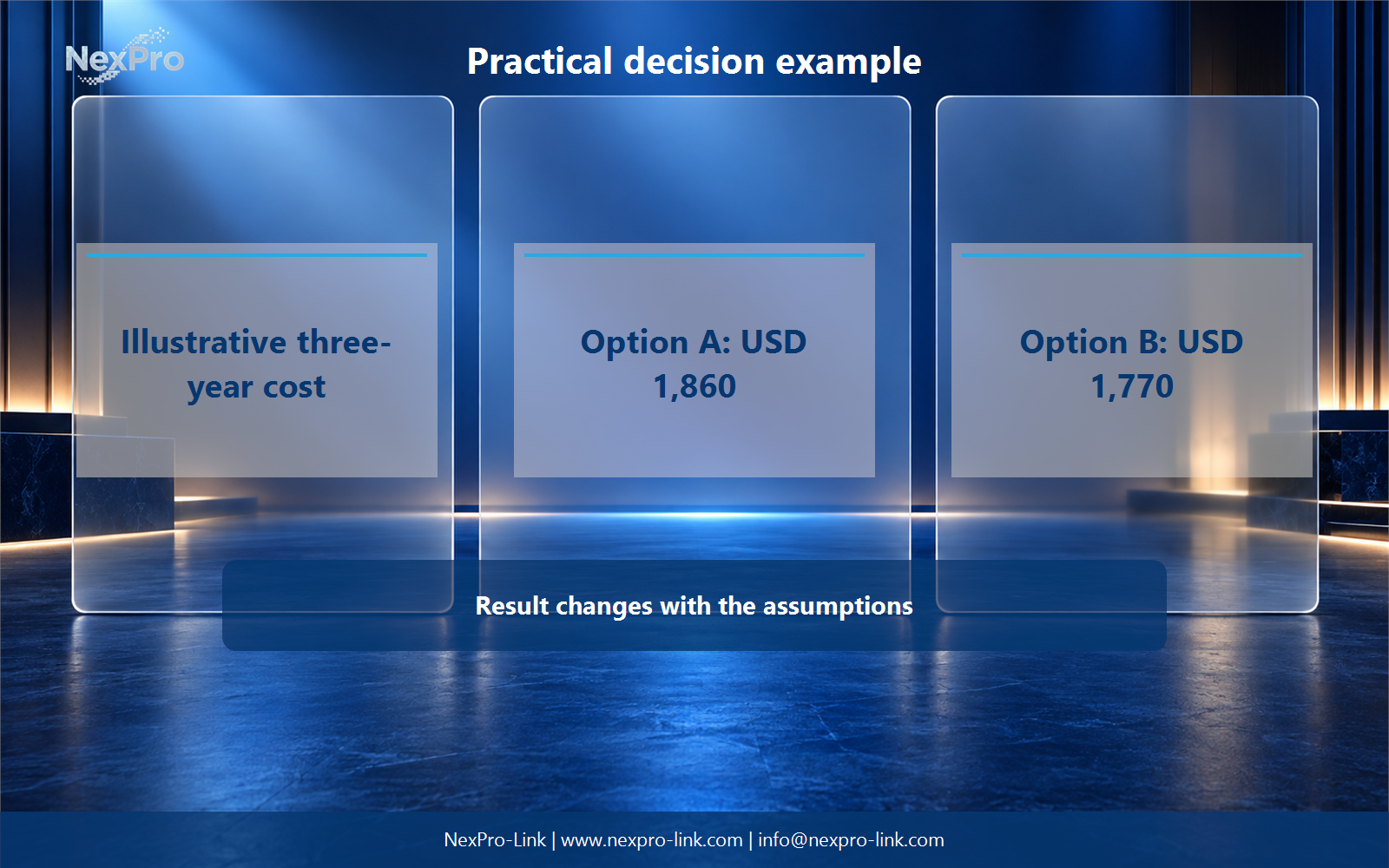
An illustrative worksheet gives Option A a three-year total of USD 1,860 and Option B a total of USD 1,770 after purchase, planned battery work, energy and support are entered. The result changes whenever the battery event, electricity price, load profile or service scope changes.
The correct conclusion is the method, not the sample winner. Keep every input editable and attach the current product configuration to the comparison. Procurement can then see which cost is quoted, calculated or scenario-based.
Engineering references
These sources support the general planning principles. Always use the selected product's current datasheet and applicable project standards for final design.