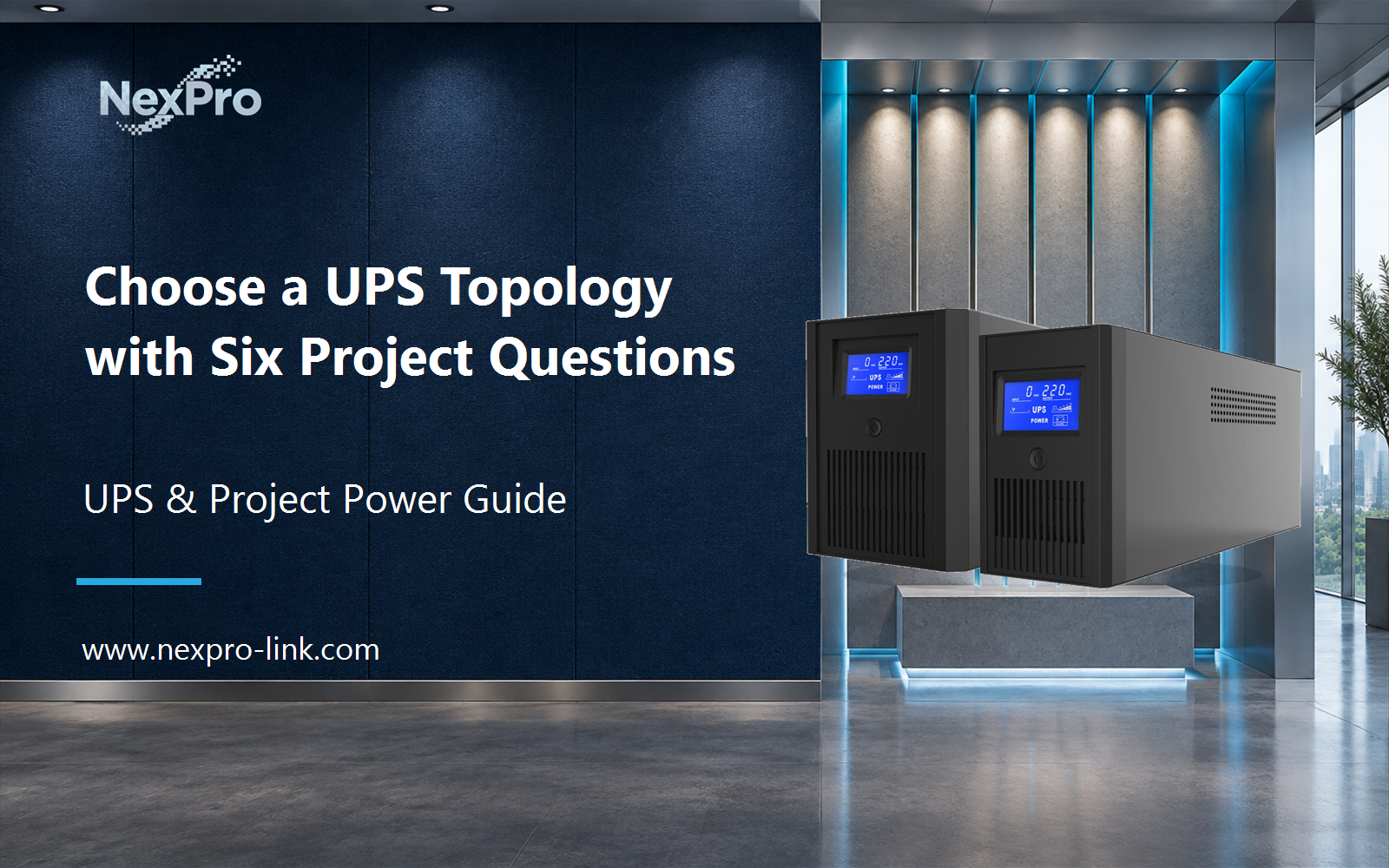
The first question in UPS selection is about what has to keep running and for how long. That includes the shutdown or transfer behavior the connected equipment can tolerate.
Section 01
Start with the continuity outcome
The first question in UPS selection is about what has to keep running and for how long. That includes the shutdown or transfer behavior the connected equipment can tolerate. Set that outcome first and the rest of the decision narrows quickly. A list of equipment names without continuity objectives cannot tell a buyer whether a basic backup unit fits or the project needs a different power path.
A UPS topology can only be evaluated after the project team names the service that must remain available. That may be a short interval for an orderly stop, a period of normal operation while another source starts, or a protected path for a small group that cannot share the same interruption as the rest of the site.
Write the result in operational language before discussing equipment. A buyer who records the protected service, the acceptable interruption and the time objective gives the electrical team a usable target. A list of device names alone cannot establish whether standby, line-interactive or online operation belongs on the shortlist.
| Service | Interruption tolerance | Duration objective | Selection implication |
|---|---|---|---|
| Small NAS and router | Orderly stop is acceptable | 10 minutes | Focus on clean shutdown support and a defined load boundary |
| Floor PoE cabinet | Short transfer must be reviewed against connected devices | 20 minutes | Check load behavior, DC inputs and local distribution |
| Expanding data room | Service target must survive planned maintenance states | Project-defined | Assess online architecture, staged capacity and bypass arrangement |
Section 02
Describe the supply environment as a pattern
Record the conditions that the site has actually seen or expects to see: extended outages, repeated transfer events, voltage variation, generator operation and maintenance switching. The useful input is the event and its effect on the protected service. Country, building type or an electrical-room label does not describe a disturbance profile by itself.
This part of the discussion should also establish where an alternative source joins the path. Generator starting behavior, upstream switching and local distribution can change what the UPS must ride through. The topology comparison becomes much clearer when each event is connected to the required response rather than placed in a generic power-quality checklist.
- State whether the protected load may transfer, must remain stable, or may stop in an ordered way.
- Record generator start and transfer arrangements separately from the expected battery interval.
- Keep known supply events distinct from assumptions that still need site confirmation.
Section 03
Read the load as an electrical and operational pattern
IT servers, switches, storage shelves, motors and specialist equipment can ask different things of a power path. The relevant questions include running watts, apparent power, start or inrush behavior, input interface, operating mode and protective constraints. Treating every connected load as an interchangeable office device makes the topology decision look easier than the installation will be.
Separate specialist or safety-related equipment at this stage. Its design basis may include requirements outside a general UPS selection discussion. The six-question method can identify the need for a separate interface review, while the responsible system design defines the final arrangement.
Section 04
Make growth and resilience separate design choices
A planned load increase belongs in the capacity plan as a named addition. Reserve for measurement uncertainty or ordinary operating variation has a different job. Combining both under one undefined margin hides whether the initial arrangement can accept the next stage without new distribution work, battery changes or a different maintenance plan.
Redundancy also needs its own statement. It may describe installed capacity, a bypass path, an alternate feed or an operational procedure. A project can have spare kW without a resilient downstream distribution path, so the proposal should state the surviving condition that the team expects to achieve.
| Question | Example input | Why it changes the shortlist |
|---|---|---|
| Committed growth | One additional storage shelf in the next phase | May require dedicated capacity and space rather than a generic reserve |
| Maintenance objective | Service continues during a planned UPS maintenance window | May require a reviewed bypass and distribution arrangement |
| Expansion limit | No spare rack position or feeder route | Can eliminate an otherwise suitable staged option |
Section 05
Test physical fit before a candidate survives the shortlist
Electrical ratings do not answer every installation question. Rack depth, access for replacement work, floor loading, ventilation path, noise, local heat rejection and monitoring access can decide whether a topology is workable in the proposed room. Add these factors while several choices remain available, not after a model has already been priced.
The maintenance route deserves the same attention as the initial installation. A system that can be positioned but cannot be isolated, observed or serviced within the site's operating rules will create a future constraint. The quote request should therefore include the intended location and service-access assumptions.
Section 06
Apply the six questions to three different project paths
The same six questions can produce different candidates because the protected outcome changes. The comparison below is illustrative. It is a way to organize a project conversation, not a universal topology recommendation for each type of installation.
| Situation | Dominant question | Useful candidate discussion |
|---|---|---|
| Small NAS cabinet | Can files close cleanly within a short interval? | Define the shutdown path, connected load and interface before selecting a compact backup option |
| Floor PoE room | What happens to network and endpoint power during transfer? | Review cabinet load, PoE source boundary and whether devices tolerate the operating event |
| Expanding data room | Which capacity and maintenance condition must remain available? | Compare online architecture, staged capacity, bypass and distribution options from the load roadmap |
Section 07
Write a request that produces comparable quotations
A useful RFQ identifies the chosen service, supply environment, load types, planned growth, room conditions and the equipment boundary. Add battery objective, distribution interfaces, monitoring expectation and local work that remains outside the UPS supply. Suppliers can then respond to the same technical question instead of pricing unrelated assumptions.
Share the six completed question cards and a short load list with NexPro-Link when the team is ready to discuss equipment, interfaces and supply scope. The final selection still follows the confirmed rating, runtime basis and project responsibilities.
Section 08
FAQ: project questions before selecting a UPS
What is the first question in UPS selection? Name the service that must remain available, its interruption tolerance and the time objective. Those three facts define the outcome that the power path must support.
How should poor mains power change the shortlist? Describe known events, generator behavior and the required load response. Compare those conditions with the selected equipment's current operating data.
When should growth change the topology discussion? Bring it in when a known expansion, maintenance objective or room limit changes the first-stage installation. State reserve and planned capacity separately.
Why finish with supply scope? Batteries, interfaces, distribution and local responsibilities determine whether two quotations describe the same solution. A topology name alone does not do that work.
Engineering references
These sources support the general planning principles. Always use the selected product's current datasheet and applicable project standards for final design.