Separate the operating topology from the transformer arrangement and switching design; weigh isolation requirements, dynamic response, footprint and efficiency.
Section 01
Separate topology from implementation details
The immediate issue for STEM/ELV designers and low-voltage general contractors is: Is high-frequency online an alternative to double conversion? Not necessarily. High-frequency or transformerless construction can be an implementation of an online double-conversion UPS. Separate the operating topology from transformer arrangement and switching design so buyers compare like-for-like architectures instead of treating overlapping terms as mutually exclusive categories. This article turns that answer into terminology map: topology / transformer / switching / form factor and a supplier brief based on load profile, isolation requirement and room constraints.
Both transformer-based and transformerless products can use online double conversion. The transformer question concerns isolation, voltage adaptation, neutral arrangements, physical construction and the way the design meets project requirements. It should not be used as a shortcut for overall quality.
Start with the one-line diagram, source and load voltages, earthing arrangement, bypass path and fault-clearing requirements. A product family can contain several implementations, so the selected configuration matters more than a broad label.
Share the load profile, isolation requirement, source conditions and room constraints so topology and transformer arrangement are compared separately.
| Requirement | Question | Verification |
|---|---|---|
| Galvanic isolation | Where is it required? | One-line and project specification |
| Voltage adaptation | Is conversion required? | Source and load data |
| Neutral and earthing | How is the system referenced? | Electrical design review |
| Fault performance | What clears downstream faults? | Coordination study and product data |
Section 02
State the isolation requirement precisely
If isolation is needed, name the location and purpose. It may sit inside the UPS, at the input, at the output or elsewhere in the distribution. The correct position depends on bypass behavior, earthing, maintenance and fault coordination.
An internal transformer can simplify some project arrangements, while an external transformer can provide flexibility. Either option adds space, losses and maintenance considerations that belong in the complete system comparison.
- Mark the bypass path on the same one-line diagram.
- Confirm neutral behavior in every operating mode.
- Include transformer access, heat and sound in the room layout.
Section 03
Compare load behavior and fault performance
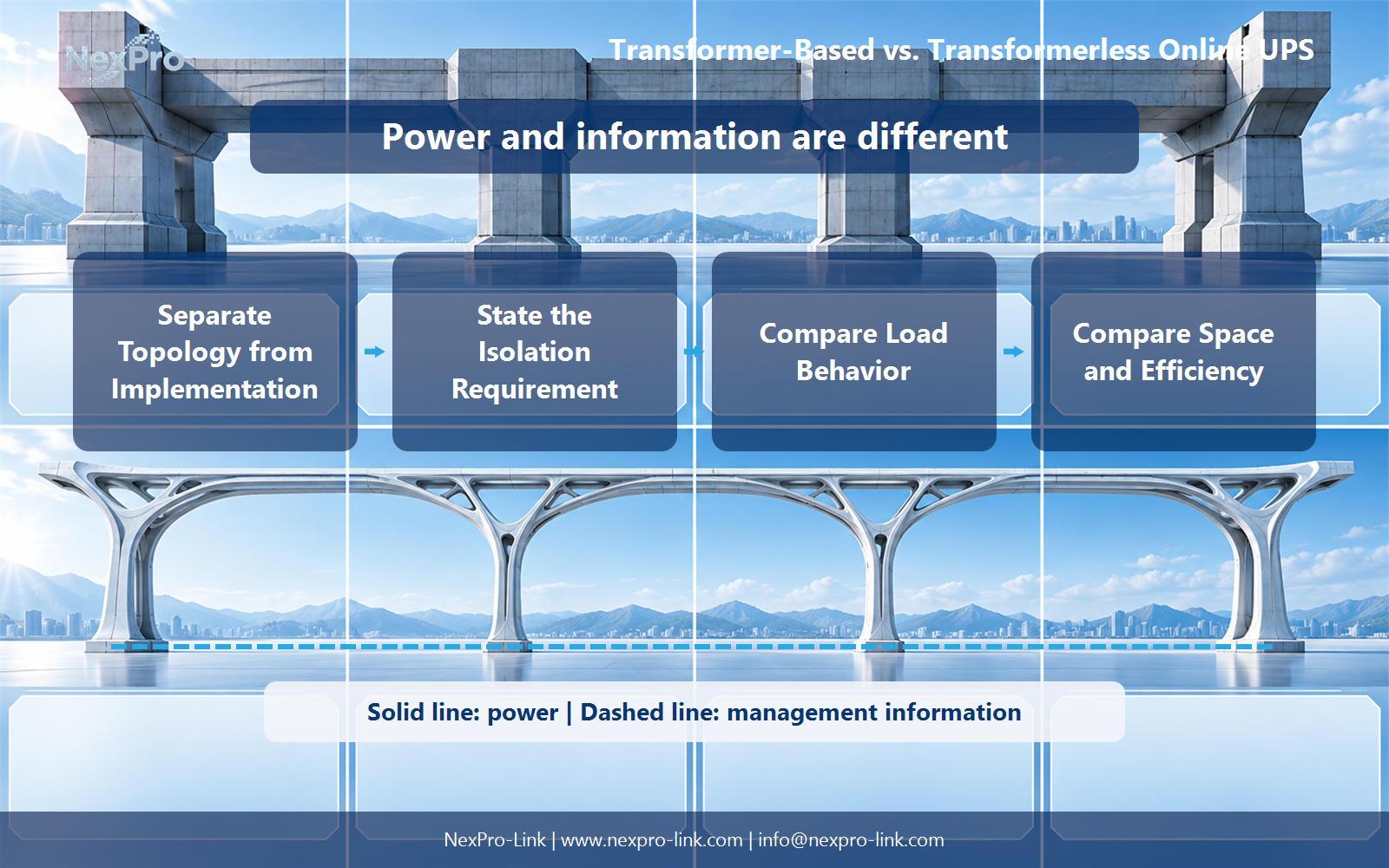
Review crest factor, harmonic current, regenerative behavior, step loads and downstream fault requirements for the actual equipment. A transformer may influence impedance and fault behavior, while a transformerless design can use different converter and control strategies. Current technical data is required for either choice.
Do not infer short-circuit performance from the kVA rating. Check inverter limits, bypass operation, protection coordination and the conditions under which the UPS transfers or limits current.
Section 04
Compare space, efficiency and service access together
Transformerless designs often support a smaller and lighter installation, but the whole system footprint can change when external isolation or voltage conversion is added. Transformer-based arrangements may occupy more space and add losses, yet they can meet a project requirement directly.
Evaluate ventilation, cable routing, battery layout, replacement access and floor loading. A compact footprint that blocks service work is not a good room design.
Section 05
Use efficiency examples without turning them into claims
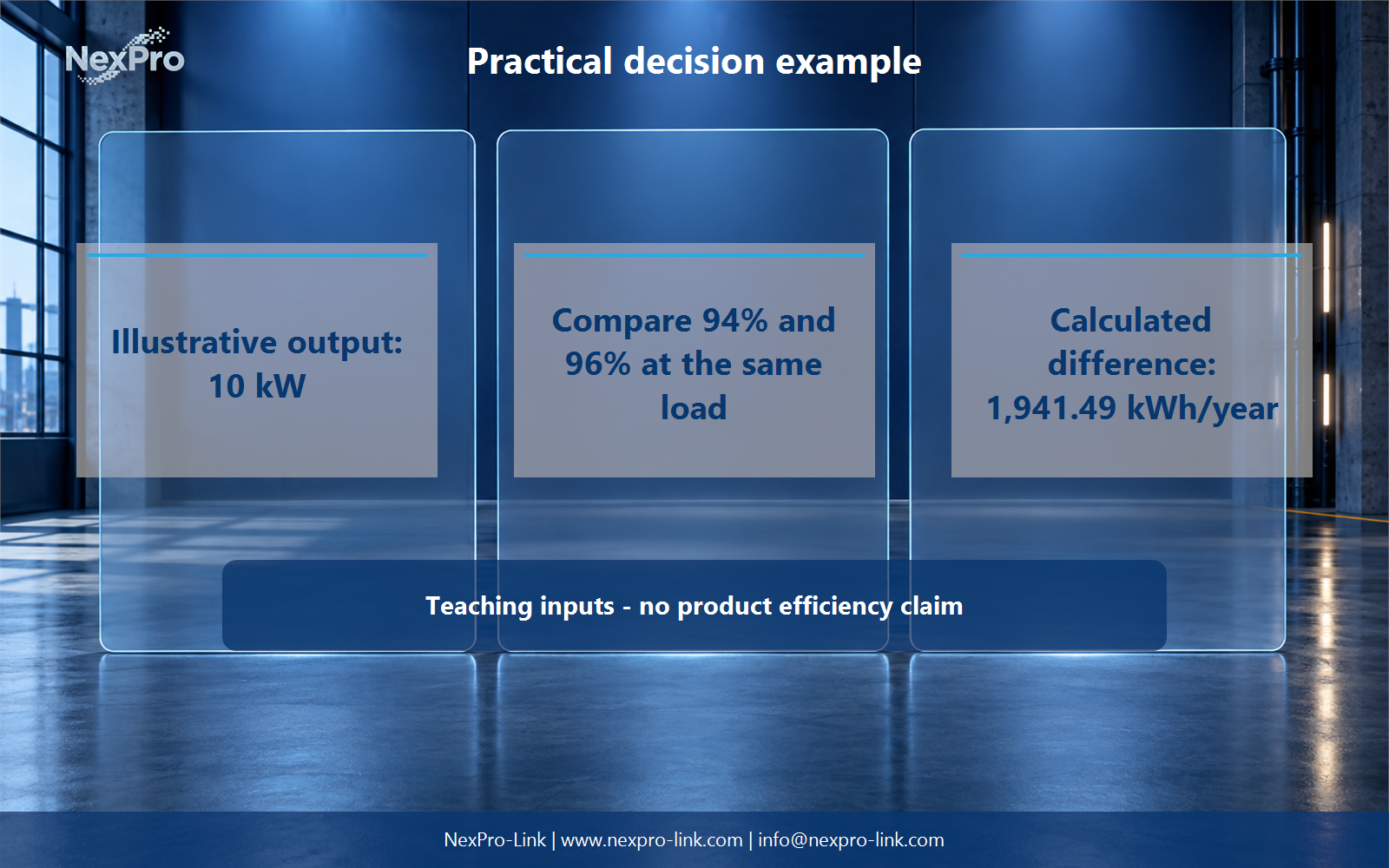
At an illustrative 10 kW output, comparing 94 percent and 96 percent efficiency over a full year produces a calculated input-energy difference of about 1,941.49 kWh. The calculation shows why a small efficiency difference can matter at continuous load.
These percentages are teaching inputs, not values for a named product. Use the efficiency curve for the selected configuration at the expected load, then add cooling and electricity-price assumptions separately.
Engineering references
These sources support the general planning principles. Always use the selected product's current datasheet and applicable project standards for final design.