A general UPS guide cannot determine operating-room power design on its own. It can organize the selection inputs. The patient-care loads and the medical electrical installation still require a qualified design.
Section 01
Start with the clinical system boundary
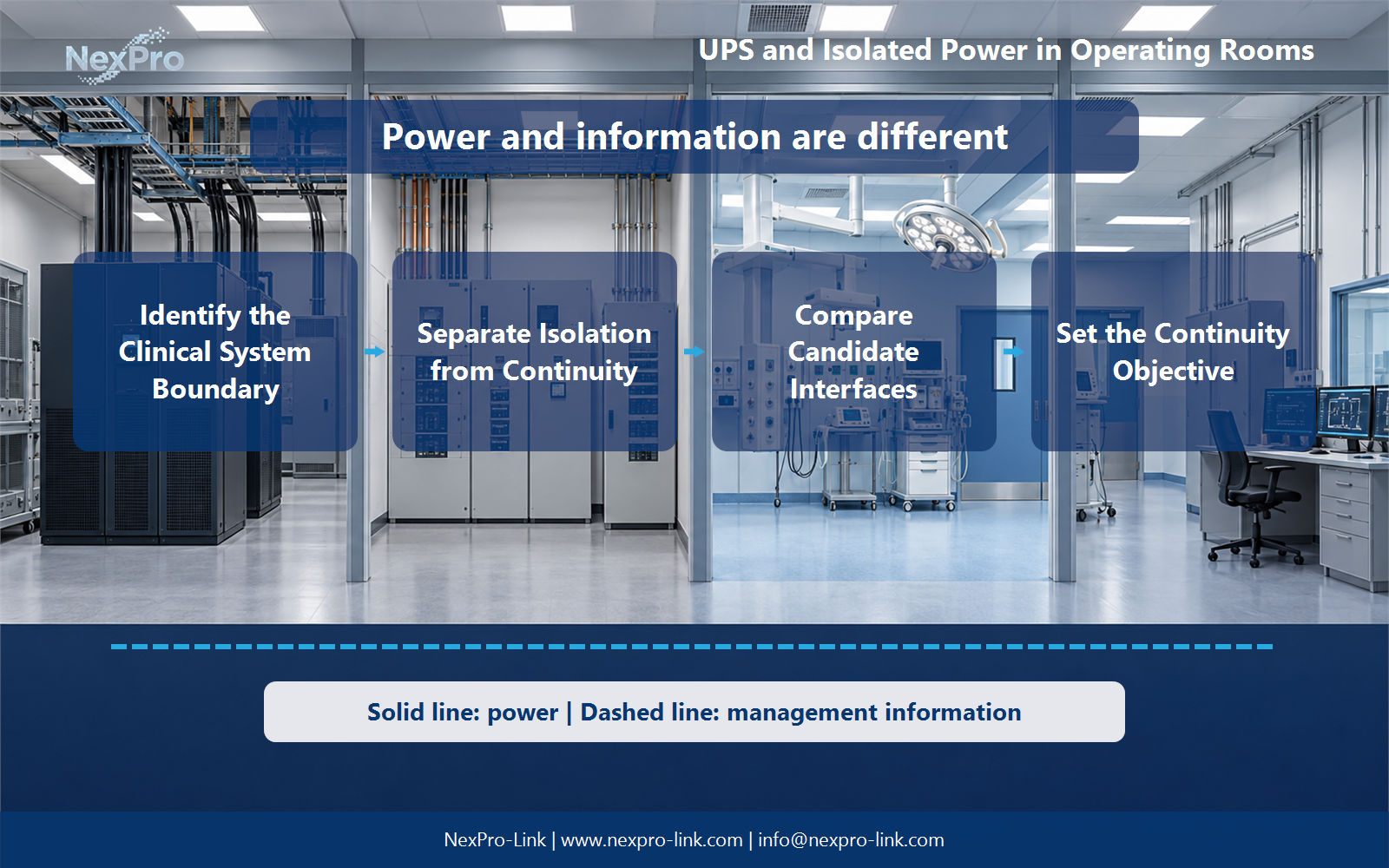
A general UPS guide cannot determine operating-room power design on its own. It can organize the selection inputs. The patient-care loads and the medical electrical installation still require a qualified design process, and that process starts before any UPS is chosen. Separate clinical devices, room infrastructure, and ordinary IT, then bring in the equipment data. This article turns that ordering into a practical project decision: a worked example, the interfaces worth recording, and the inputs for a defined equipment proposal.
An operating room contains clinical equipment, building systems, communication, lighting and support loads with different ownership and risk controls. The first task is to identify which system needs continuity, who approves its behavior and what must happen when normal supply is disturbed.
Do not treat a room label as a load schedule. The project team should identify each circuit and interface with the healthcare facility, clinical engineering, electrical designer and equipment supplier before a UPS is proposed.
| Boundary | Question | Required owner |
|---|---|---|
| Clinical equipment | What continuity behavior is approved? | Clinical engineering and equipment supplier |
| Isolated power system | Where is isolation provided and monitored? | Electrical designer and facility |
| UPS | Which defined loads receive stored energy? | Project electrical team |
| Maintenance | How is the system tested and isolated safely? | Facility and service organization |
Section 02
Separate electrical isolation from continuity
An isolated power system and a UPS solve different problems. Isolation, fault monitoring and protective measures belong to the medical electrical installation design. A UPS supplies stored energy and may condition its defined output. One function cannot be assumed to replace the other.
Show the isolation boundary, UPS boundary and normal or emergency source boundary on separate layers. This lets reviewers see where each safety and continuity function begins and ends.
- Do not bypass or redraw a protected medical circuit without the responsible designer.
- Confirm grounding and monitoring interfaces for the complete system.
- Treat alarms as information, not as a substitute for the power design.
Section 03
Compare candidate interfaces without assuming compatibility
A candidate UPS may sit upstream of a defined distribution section, serve a dedicated support circuit or be integrated by a medical equipment supplier. Each position changes fault behavior, maintenance access, monitoring and responsibility.
Confirm voltage, phase, leakage and protective-device implications, transfer behavior, bypass arrangement and any manufacturer limitations. The interface decision should be reviewed as part of the healthcare electrical system, not as a stand-alone product substitution.
Section 04
Set the continuity objective and testing governance
Define the approved outcome for each load: uninterrupted operation, brief ride-through, orderly stop or transfer to another source. A runtime request without that outcome can keep the wrong equipment energized or create an untestable brief.
Document commissioning, periodic testing, alarm ownership, maintenance isolation and return-to-service approval. Work near clinical systems must follow the facility's procedures and the responsible professionals' design decisions.
Section 05
Turn the boundaries into a safe procurement package
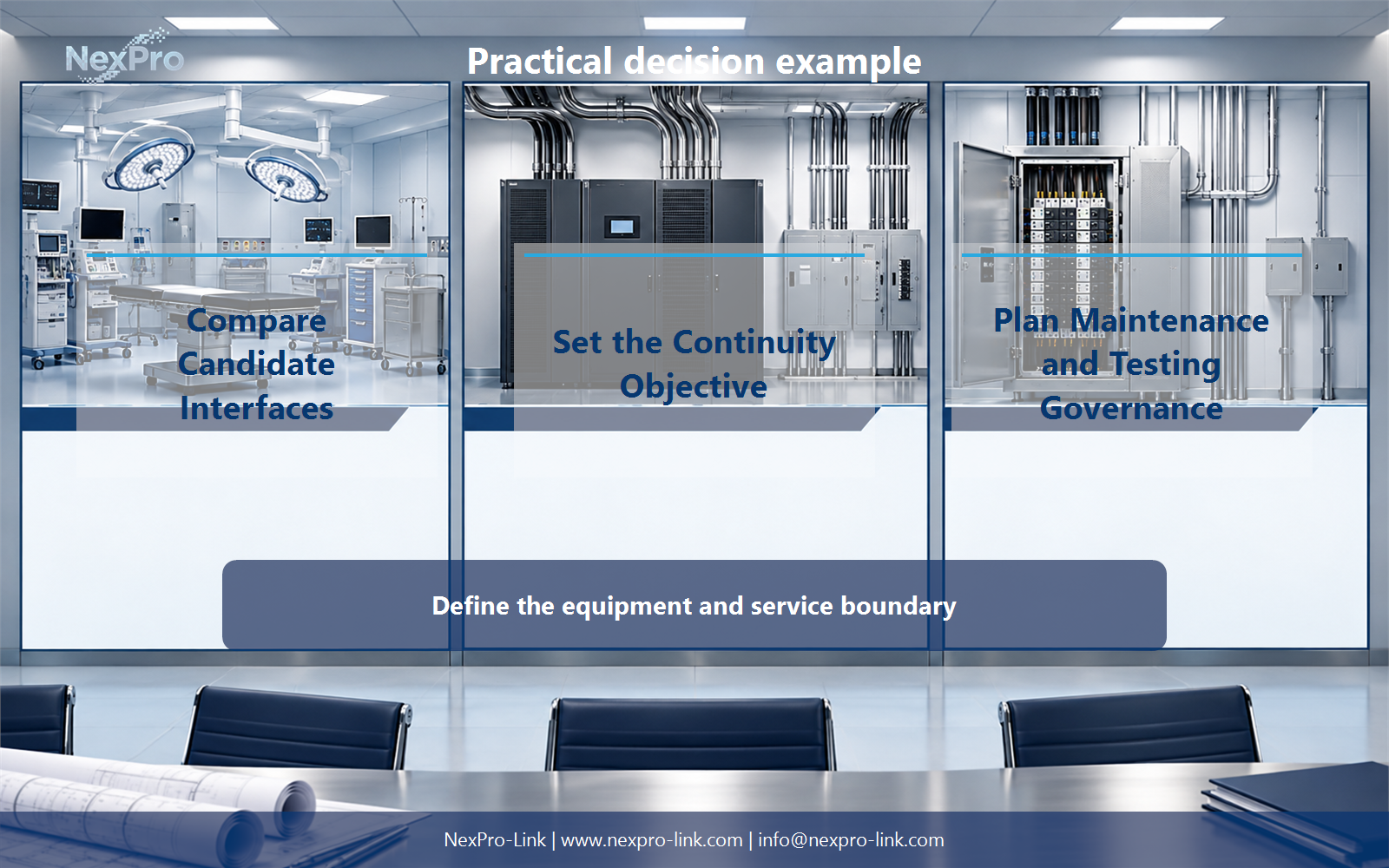
The equipment brief should name the approved circuits, operating objective, source arrangement, isolation boundary, UPS interface, bypass, alarms, maintenance access and required project documentation. Leave clinical performance and facility compliance conclusions to the authorized design and acceptance process.
This is a decision framework rather than a numerical sizing shortcut. Candidate interfaces, continuity objectives and maintenance governance must agree before a product configuration can be evaluated responsibly.
Engineering references
These sources support the general planning principles. Always use the selected product's current datasheet and applicable project standards for final design.