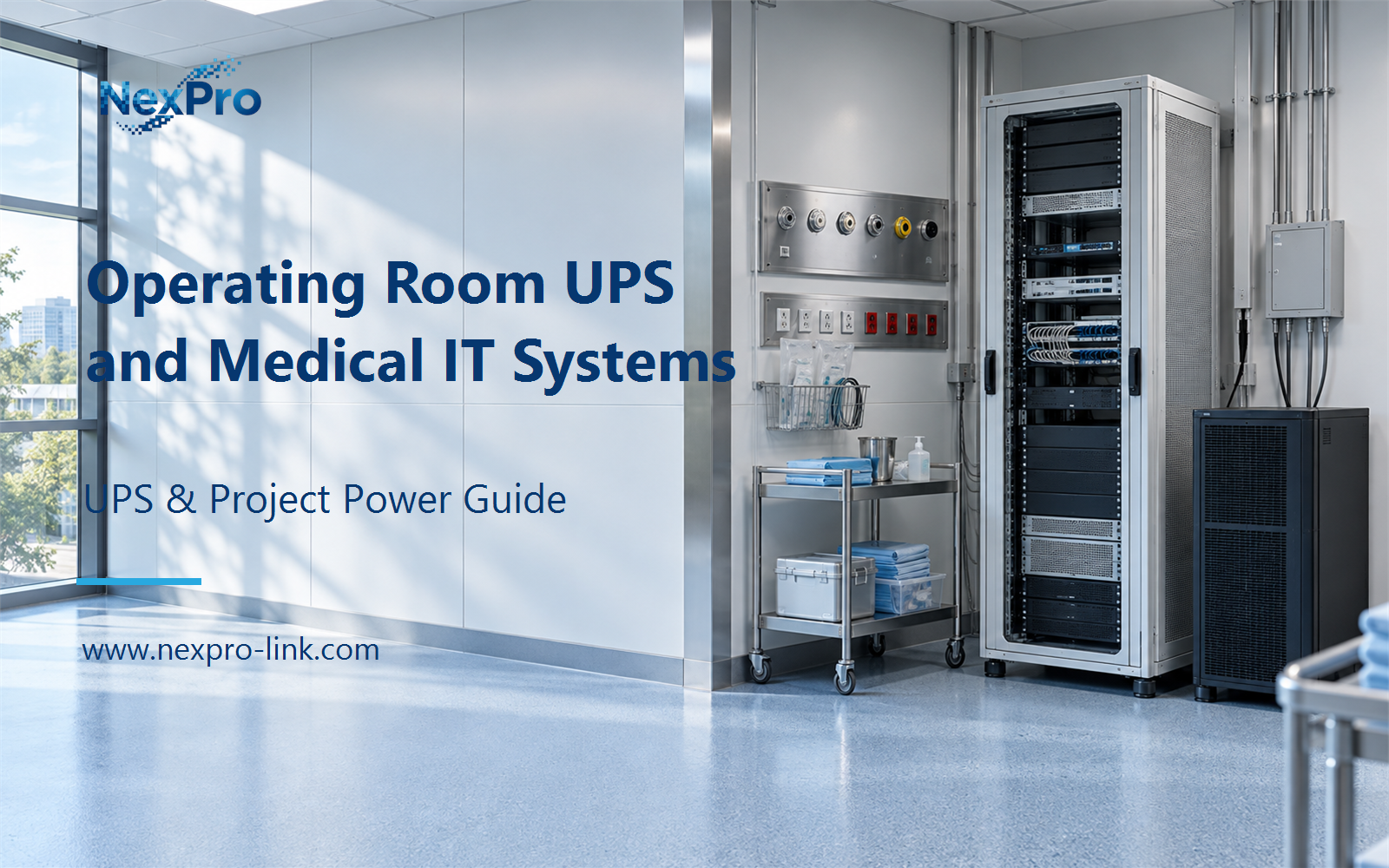
UPS continuity and medical IT isolation are different functions. A transformer-equipped UPS does not by itself prove operating-room suitability.
Section 01
Distinguish Isolation from Continuity
UPS continuity and medical IT isolation are different functions. A transformer-equipped UPS does not by itself prove operating-room suitability.
Isolation limits how fault current, leakage and touch voltage can travel between the supply and the equipment. In a medical IT system this usually involves a transformer, an insulation monitoring device and alarms. A single earth fault does not trip the supply, and clinical staff get a signal before a second fault develops. Continuity is different. It stores energy and bridges a short loss of input power.
The two functions can sit in the same room and even in the same cabinet, but they answer different questions. A UPS answers what happens when input power fails or sags. An isolation arrangement answers what happens when a fault or leakage develops on the protected circuit. A UPS with an output isolation transformer still stores its energy in batteries. The transformer does not add runtime. The batteries do not add medical-grade isolation.
| Decision area | Project question | Required output |
|---|---|---|
| Distinguish Isolation from Continuity | Does an isolation transformer provide battery backup? | Function table: isolation / continuity / monitoring / protection |
| Identify the Actual Equipment Scope | Which equipment inputs are needed for an operating-room UPS request? | Scope schedule: device / clinical role / input / specified supply |
| Read Standards by Their Scope | Does IEC 60601-1-11 automatically govern every operating room? | Scope comparison: setting / equipment / standard purpose / applicability |
Section 02
Identify the Actual Equipment Scope
Start from the approved equipment list, the supply interfaces, the operating states and the installation constraints in the responsible design. Patient-connected and specialized medical devices keep their own boundary. Their supply follows the device instructions and the applicable system requirements. A general IT UPS watt figure cannot stand in for those.
A scope schedule lists each item, its clinical role, its input and the supply it is actually specified for. This matters because one operating room often mixes support IT, safety monitoring and patient-connected equipment. Assigning all of them to a single UPS is usually the wrong starting point.
The watt column is where proposals go wrong. An apparently sufficient watt rating says nothing about isolation, changeover behavior, alarms or the clinical boundary. For a support IT rack the sizing step can be short. Illustrative only: two 300 W workstations, a 250 W switch and a 150 W display total 1,000 W. At an assumed power factor of 0.8 that becomes 1,250 VA. A published 2,000 VA / 1,800 W configuration would leave headroom. A 1,000 VA / 900 W configuration would not. These are teaching inputs for the VA and W distinction. They are not a measured runtime statement and not a recommendation for any specific room.
Section 03
Read Standards by Their Scope
A standard number works only inside its stated scope. IEC 60601-1-11 concerns medical electrical equipment in the home healthcare environment. Citing it as a blanket operating-room approval is a scope error, even when the equipment itself is medical. The room, the equipment, the standard's purpose and its applicability have to be checked together.
Record the same four fields whenever a standard appears in a tender. Setting and equipment look obvious until the team has to write them down, and that is where the mismatch usually shows up.
- Confirm the answer to: Does IEC 60601-1-11 automatically govern every operating room?
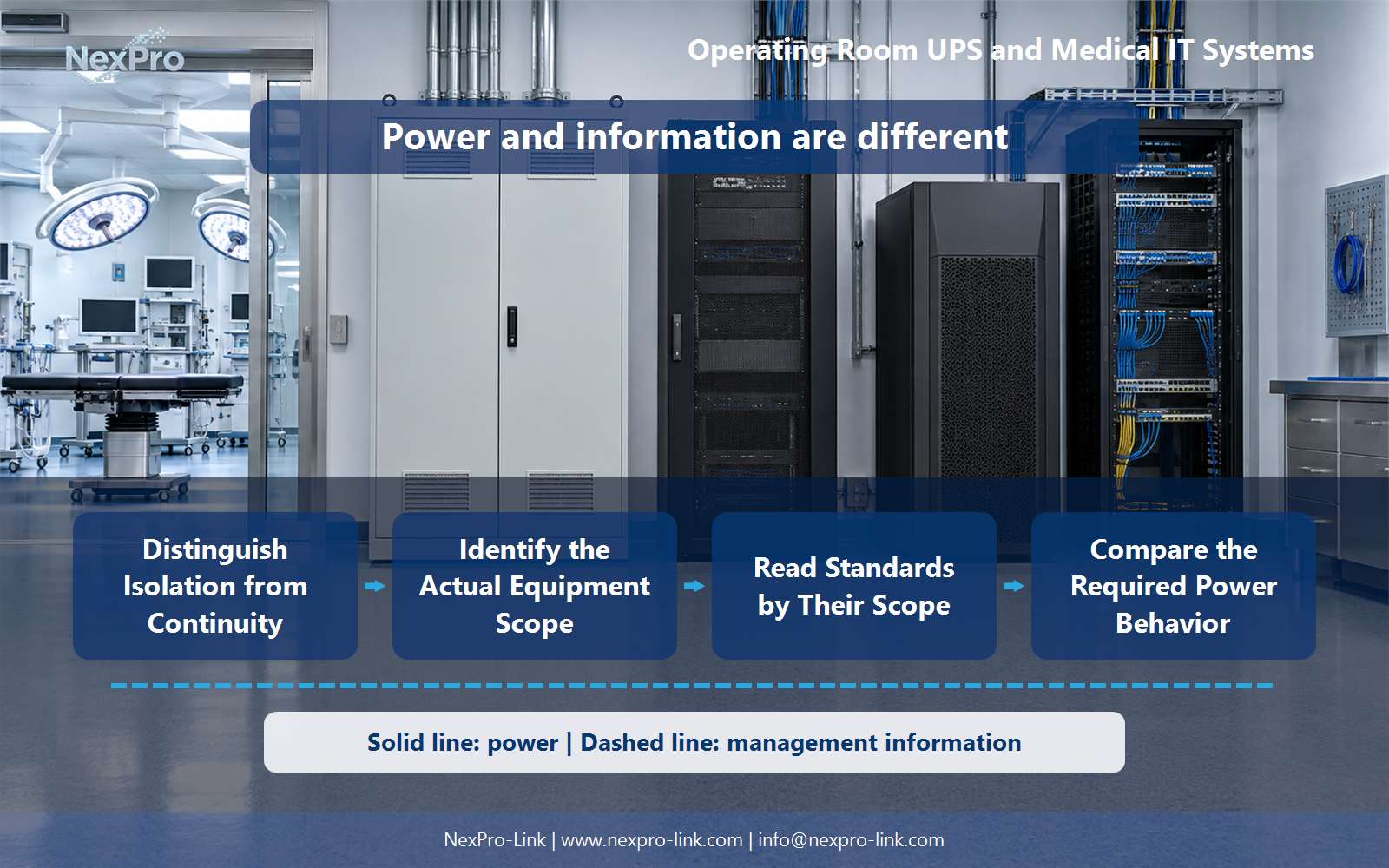
- Draw electrical power as a solid path and management information as a separate dashed path.
- Keep external services and specialist approvals outside the UPS equipment claim.
Section 04
Compare the Required Power Behavior
Topology arguments are weak without the requirements they serve. The useful comparison starts from output, continuity, interface and installation, each stated as a selection input.
NexPro-Link publishes configurations that serve as capacity reference points once the design provides a real load. The NX-UP-RM-001 rack online series lists C1KR(S), C2KR(S) and C3KR(S) at 1,000, 2,000 and 3,000 VA. The NX-UP-HF-001 tower series lists SP1K, SP2K and SP3K at the same ratings. The NX-UP-RM-002 lithium rack series lists SP1KR(S), SP2KR(S) and SP3KR(S). These are published configurations, not operating-room approvals. Which one fits depends on the requirement matrix above.
Section 05
Coordinate Maintenance and Testing
A power-changeover test on an operating-room circuit is a clinical event, not a routine UPS feature. The hospital's authorized clinical and facilities teams define the test, its safeguards and the restoration criteria. Record the observations and responsibilities before any work starts.
The UPS supplier can describe how the equipment signals state and how to coordinate a controlled transfer inside the defined boundary. It does not design the patient-safety procedure, and a selection method cannot stand in for the approved test plan.
Section 06
Prepare the Specialist RFQ
A request that reaches a supplier as "operating-room UPS, please quote" wastes a round trip. The RFQ should carry the approved design inputs, the load, the interfaces, the installation constraints and the scope. The answer then comes back against the same boundary the team already agreed.
Engineering references
These sources support the general planning principles. Always use the selected product's current datasheet and applicable project standards for final design.