The phrase "medical UPS" hides more than it reveals. It can name a unit that keeps a home ventilator running through a short outage. It can also name a rack unit that feeds the servers in a hospital billing office.
Section 01
Identify the Healthcare Setting
Why distinguish hospital and home healthcare settings? For Healthcare electrical designers, clinical engineers and procurement teams, the answer must stay inside the project boundary: Applicable requirements depend on the equipment and intended environment. A standard addressing home healthcare should not be automatically applied as a universal operating-room requirement. Begin with the actual setting and role rather than the broad word medical. The next step is setting table: home / hospital / support IT / patient-connected role, using healthcare setting, equipment role and the responsible design specification.
The phrase "medical UPS" hides more than it reveals. It can name a unit that keeps a home ventilator running through a short outage. It can also name a rack unit that feeds the servers in a hospital billing office. The two machines face different standards, different environments, and different acceptance duties. The label on the tender does not settle any of those questions. The setting and the equipment role do.
The hospital column and the home column answer different questions. A home ventilator has to keep running when the household supply drops, and the standard that addresses that use is about the home environment. A hospital operating room has its own clinical system design, its own isolated supply rules, and its own acceptance chain. Naming the setting first keeps a buyer from pasting the wrong standard into the wrong room.
| Decision area | Project question | Required output |
|---|---|---|
| Identify the Healthcare Setting | Why distinguish hospital and home healthcare settings? | Setting table: home / hospital / support IT / patient-connected role |
| Explain IEC 60601-1-11 Scope | What does IEC 60601-1-11 cover at a high level? | Scope map: intended environment / equipment-system / stated boundary |
| Separate Isolation and Backup | Does an isolation function establish backup continuity? | Function table: isolation / continuity / monitoring / system responsibility |
Section 02
Explain IEC 60601-1-11 Scope
IEC 60601-1-11 sits in the IEC 60601 family, which addresses medical electrical equipment. The -1-11 part deals with equipment and systems used in the home healthcare environment. The publication description is the safe reference here. It states a home healthcare scope, not a hospital wide or operating room approval.
This map matters because a scope that is right in one place is wrong in another. Equipment built and assessed for home use answers a particular set of conditions: a household supply, a patient or caregiver nearby, and the duty to keep a device running in that room. A hospital theatre, a ward, or a data room introduces different conditions. When a project cites IEC 60601-1-11, check the intended environment and the equipment system against the cited boundary before the specification goes any further.
Section 03
Separate Isolation and Backup
A common shortcut treats a transformer or an online topology as proof that a UPS is "medical". The shortcut merges three functions that the design keeps separate.
Isolation, stored-energy continuity, and monitoring are distinct jobs. A transformer addresses part of the isolation question. An online topology addresses how the output is produced. Neither answers whether the unit, as installed, meets the clinical system's requirements. That decision belongs to the responsible specialist, who states how the system must behave. Keep the three functions in separate rows so a supplier does not claim one on the strength of another.
- Confirm the answer to: Does an isolation function establish backup continuity?
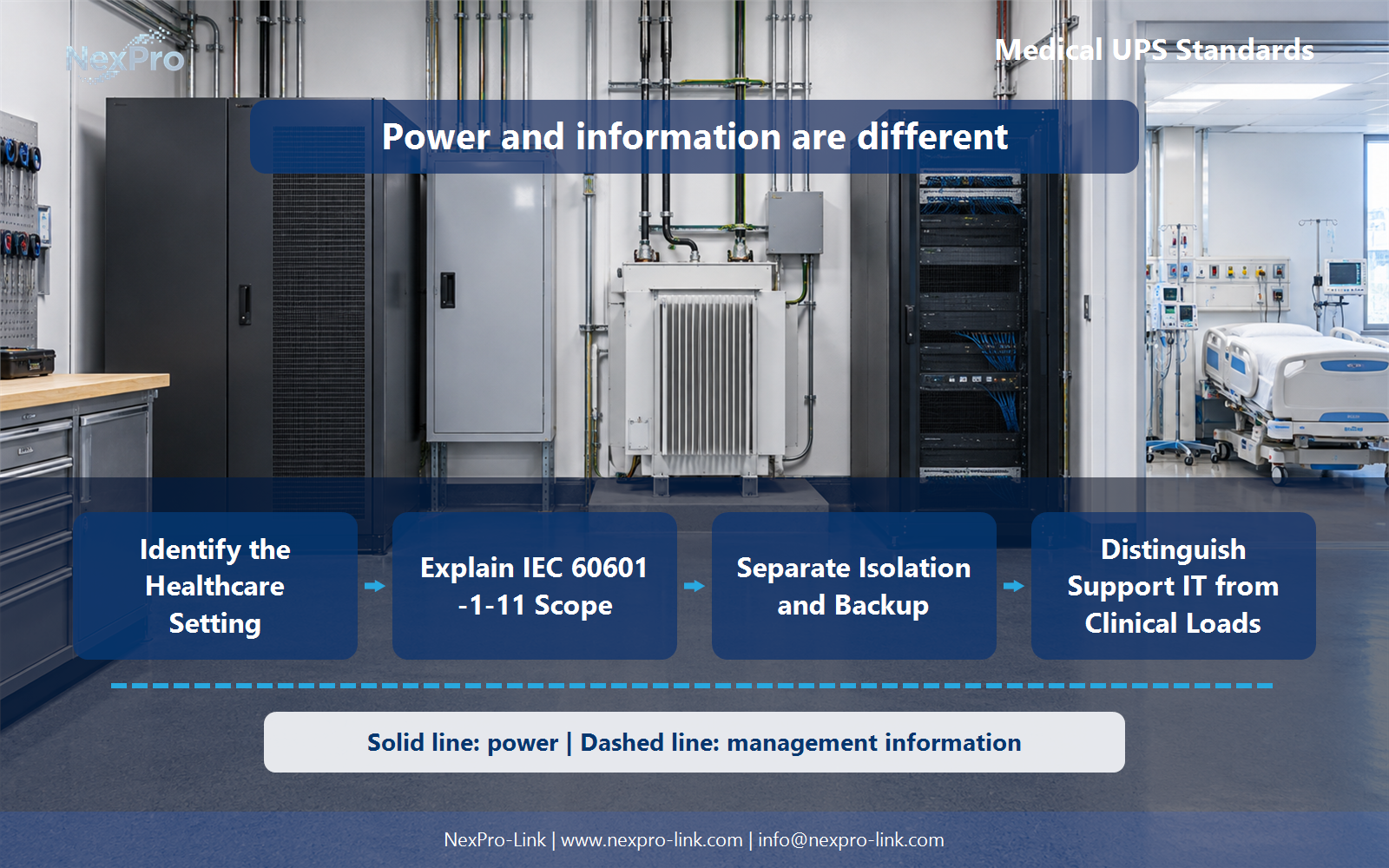
- Draw electrical power as a solid path and management information as a separate dashed path.
- Keep external services and specialist approvals outside the UPS equipment claim.
Section 04
Distinguish Support IT from Clinical Loads
Support IT and clinical devices can share a building without sharing a requirement. Their functions and their acceptance paths differ.
A commercial UPS that runs an administrative workstation is fine for that job. It should not be described as suitable for patient-connected or life-support equipment just because it sits in the same hospital. Draw the boundary before discussing the UPS. Once the load class is named, the team knows whether it is specifying an IT continuity unit, a clinical support unit, or a device whose safety and continuity duties belong to a specialist design.
Section 05
Write a Requirement-Led Specification
A medical project request should name the approved electrical requirements, the intended equipment role, and the installation conditions. It should also state the required interfaces and the applicable standards by scope. Recording these fields keeps the equipment inputs and the intended service outcome consistent with each other.
Five fields are enough to start. Setting names the environment. Role names what the equipment must do. Input-output fixes where power enters and leaves. Interfaces name the signals the UPS must exchange with operators or software. Applicable scope states which standard and which load class the request covers. A request with all five filled lets a supplier answer one question at a time instead of guessing at the boundary.
Section 06
Limit Brand Claims to the Actual Scope
When the decision reaches a supplier discussion, send the approved electrical requirements, the intended equipment role, the interfaces, and the installation constraints. That package is enough to discuss relevant supply options.
NexPro-Link supplies UPS and backup power equipment and works from the scope the project provides. The NexPro-Link UPS Power catalog lists the current series for model matching. Clinical system design, patient-connected equipment suitability, and final acceptance remain with the roles assigned to them. A general product family does not establish those outcomes. The brand scope table keeps the equipment supply on one side and the clinical design on the other, which is what a clean tender needs.
Engineering references
These sources support the general planning principles. Always use the selected product's current datasheet and applicable project standards for final design.