Separate the IEC 62040 parts and the certification mechanism instead of treating a standard name as proof that a product holds a certificate.
Section 01
Separate the Three Questions
For Technical buyers, consultants and tender engineers, the first project decision is this: What does the IEC 62040 family address? Distinguish safety, electromagnetic compatibility and performance topics by the relevant part. They answer different questions about a UPS. A reference to the family name alone should not be treated as proof that a product meets every applicable requirement. The practical output is scope table: safety / EMC / performance / relevant part, supported by destination, UPS configuration and the exact safety, EMC and performance requirements.
Separate the IEC 62040 parts and the certification mechanism instead of treating a standard name as proof that a product holds a certificate.
IEC 62040 is a family of requirements published in parts. The parts a project team meets most often are IEC 62040-1 for safety, IEC 62040-2 for electromagnetic compatibility, and IEC 62040-3 for performance and test methods. Each part answers a different question, so quoting the family name without the part leaves the requirement unspecified.
Safety covers construction, protection against electric shock, fire, and energy hazards. EMC covers emissions into the surrounding electrical environment and immunity to disturbances already present there. Performance covers output characteristics, classification, and the test methods used to measure them.
A buyer who writes "IEC 62040" on a purchase order has stated an intent. The supplier still needs to know which part and which requirement class applies, because a safety document and an EMC document do different work.
| Decision area | Project question | Required output |
|---|---|---|
| Separate the Three Questions | What does the IEC 62040 family address? | Scope table: safety / EMC / performance / relevant part |
| Distinguish Standard and Certification | Is a standard number the same as a product certificate? | Term map: standard / test / declaration / certification / scope |
| Read the Configuration Boundary | Why does the configuration matter? | Configuration table: UPS / batteries / accessory / statement scope |
Section 02
Distinguish Standard and Certification
A standard number sets requirements or test methods. A certificate is a third party's confirmation that a defined product, in a defined configuration, meets a defined requirement. Between the two sit test reports and supplier declarations, each with a narrower or wider scope.
Procurement documents blur these lines. A datasheet may cite a standard. A test report may cite the same standard and add the measured results. A certificate cites the standard, names the product and scope, and is issued by a body that reviewed the evidence. All three can be legitimate, and none of them stands in for the others.
Section 03
Read the Configuration Boundary
A conformity statement is tied to a configuration. The same series can contain models with different ratings and battery arrangements, and an accessory can change what a statement covers. Read the defined equipment boundary in the document before extending its reach.
For NexPro-Link equipment, the series name and the configuration name are separate identifiers. NX-UP-HF-001 names the series. SP2K names the configuration within it. The published 2,000 VA / 1,800 W rating and the 12 V / 7 Ah × 4 battery field belong to that configuration. A document that names the series but not the configuration tells a tender reviewer less, because it does not say which machine the statement describes.
- Confirm the answer to: Why does the configuration matter?
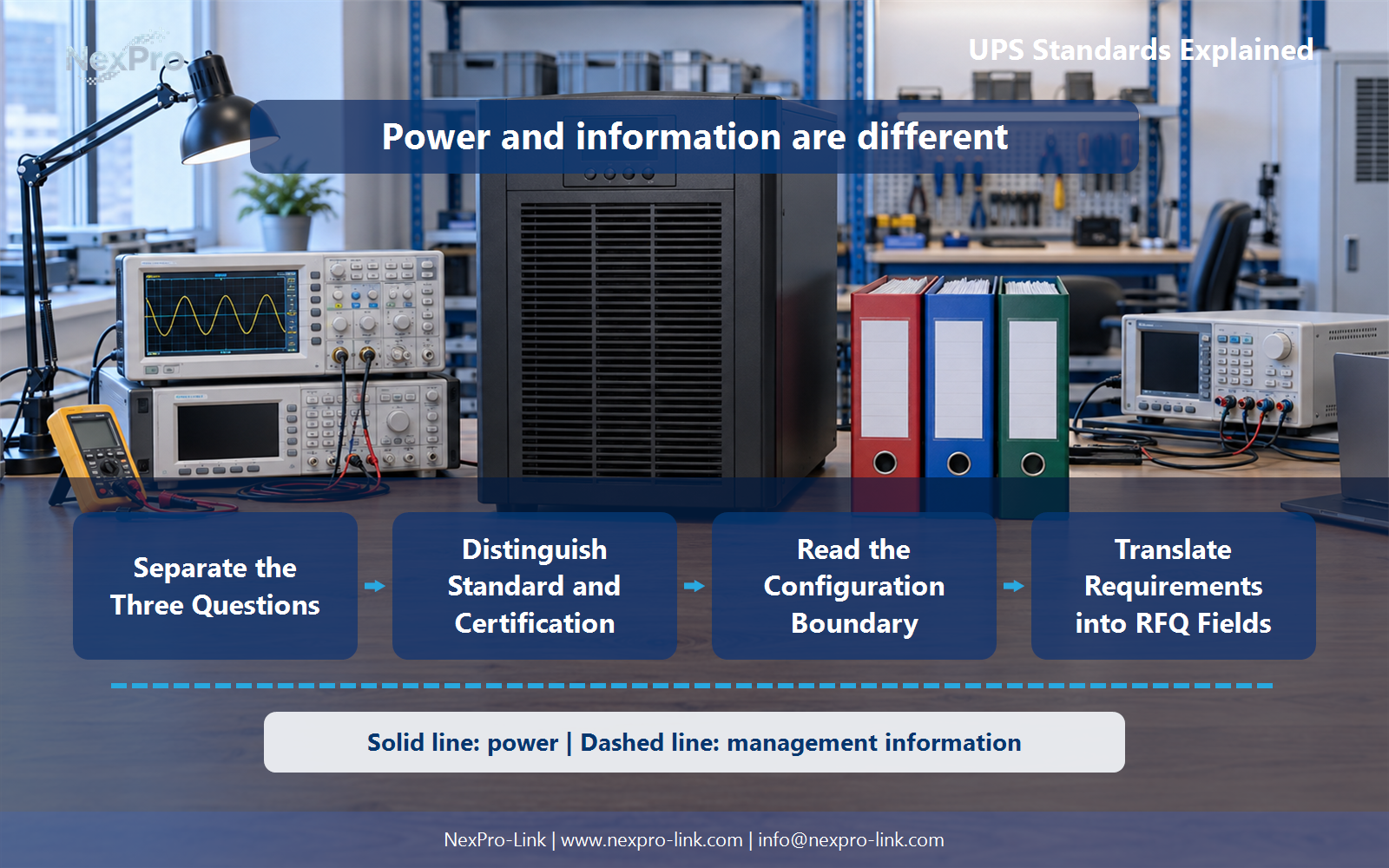
- Draw electrical power as a solid path and management information as a separate dashed path.
- Keep external services and specialist approvals outside the UPS equipment claim.
Section 04
Translate Requirements into RFQ Fields
A clear requirement names the destination, the configuration, and the objective for safety, EMC, or performance. It also states the form of information needed. Asking for "all certificates" without these fields invites a folder of images that no two suppliers will assemble the same way.
Markets do not require identical documents. A project in one country may accept a supplier declaration where another asks for third party certification. The destination field is what lets a supplier prepare the right conformity route instead of guessing.
Section 05
Keep Facility Suitability Separate
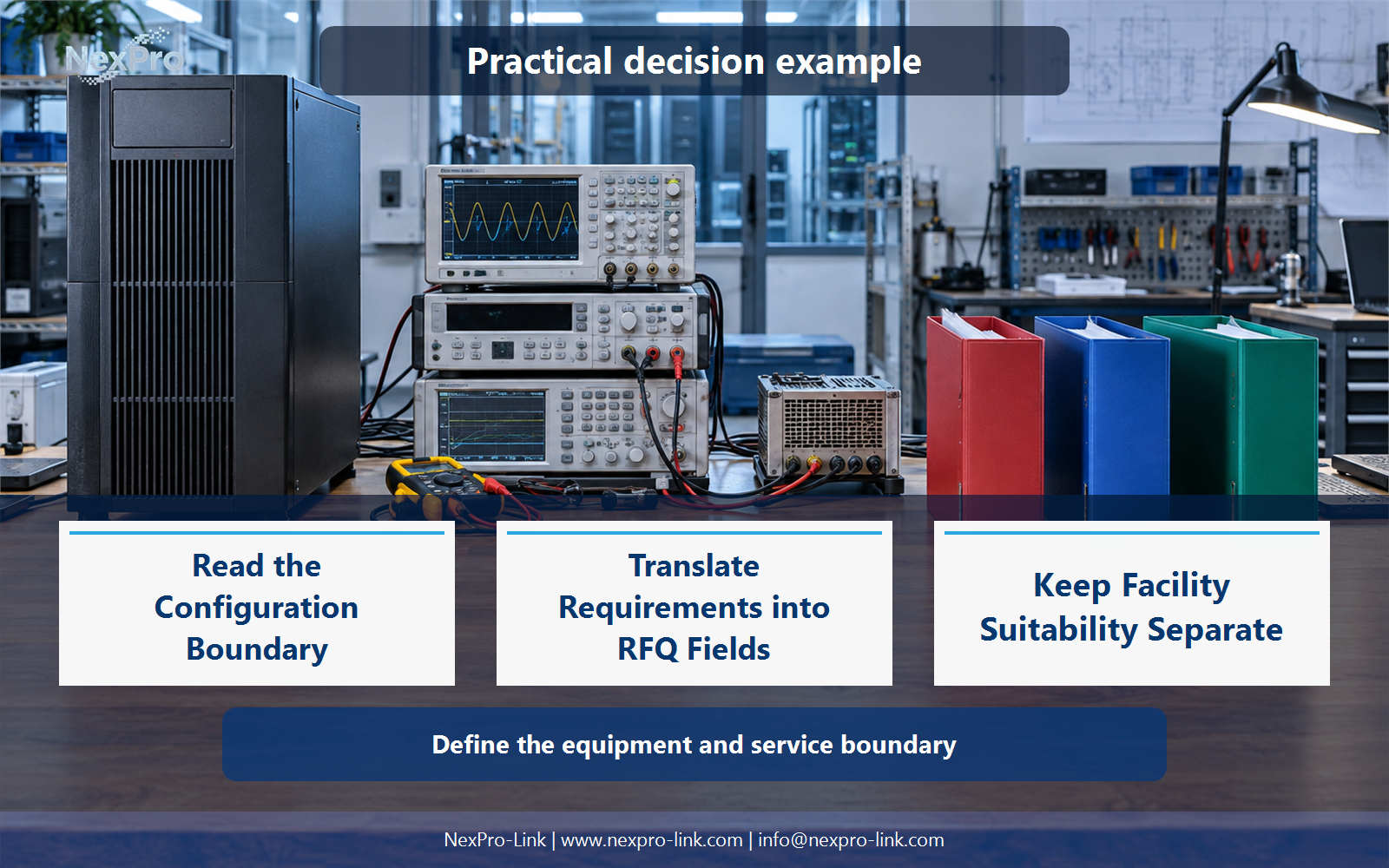
A product document covers the product. The wiring, the room, the interfaces to the load, and any approvals the building itself must hold sit in a separate layer. Distribution, environment, and system interfaces introduce requirements of their own.
This separation keeps the discussion honest. A UPS document that supports equipment selection is not a substitute for the electrical design, the shutdown integration, or any building level approval. Each layer stays in its own column.
Section 06
Present NexPro-Link Accurately
When the decision reaches a supplier discussion, send the inputs the article has been building: the destination, the configuration, and the exact safety, EMC, and performance requirements. Ask for information tied to that model and scope, rather than a stack of certificate images with no model attached.
NexPro-Link can then respond with the product information available for the named configuration and clarify what falls to the equipment scope and what belongs to the installation. That split is the same one the earlier sections drew, carried into the supply conversation.
Engineering references
These sources support the general planning principles. Always use the selected product's current datasheet and applicable project standards for final design.