
Organize requirements by destination market and product scope instead of treating CE, UL and CCC as one universal certification set.
Section 01
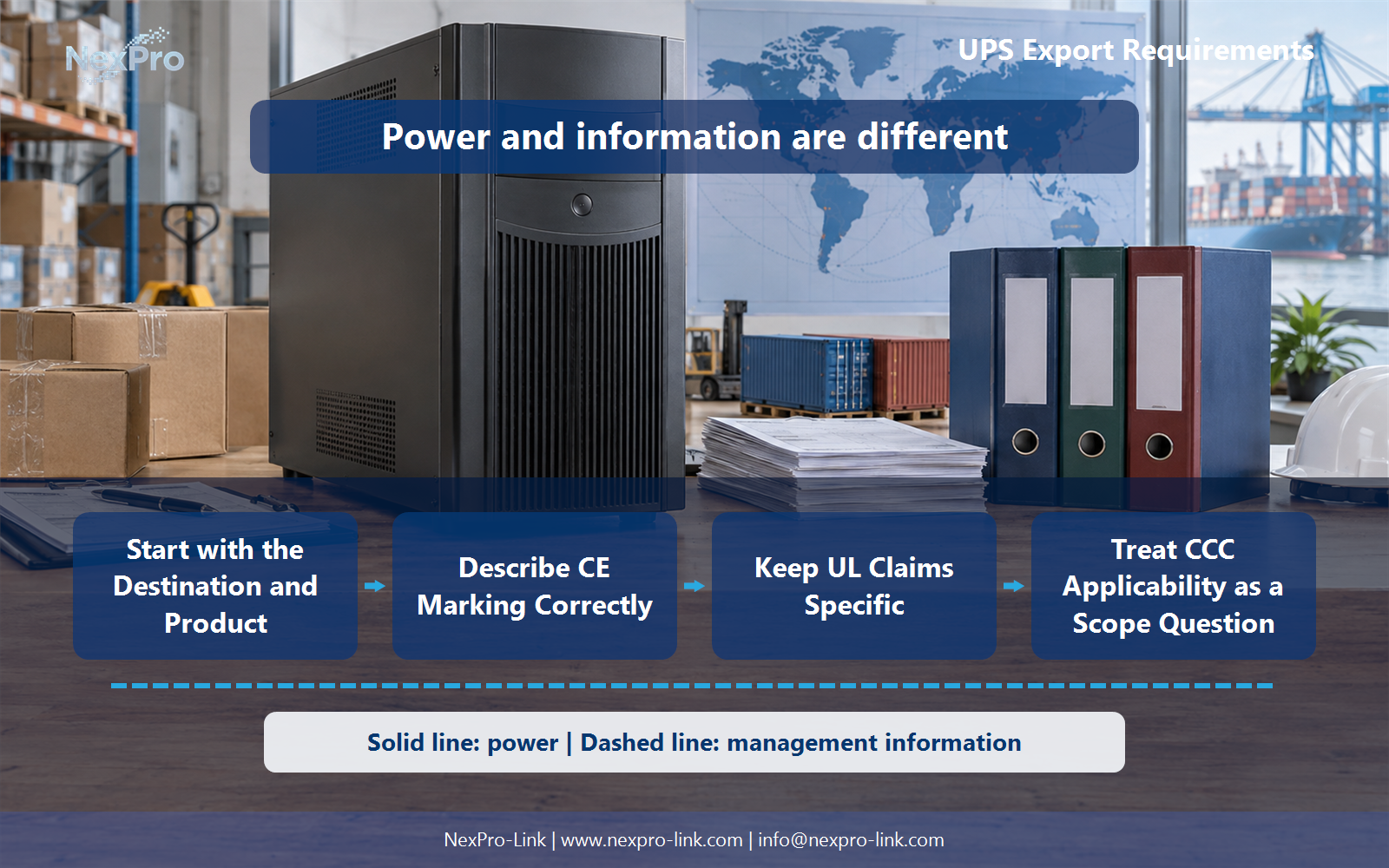
Start with the Destination and Product
Organize requirements by destination market and product scope instead of treating CE, UL and CCC as one universal certification set.
An export requirement is never a single list attached to the word UPS. The same product can face different obligations in Germany, the United States and China because each market applies its own legislation to a defined product category. Two factors set the boundary: where the equipment lands and what the equipment actually is. The importer's role matters too, since the party that places the product on the market usually carries the conformity duties.
For the illustrative scenario used throughout this article, one contractor quotes the same rack-mounted online UPS for three buyers. The equipment stays identical while the documentation changes per market.
With this table in place, the team stops asking for "the export certificate" and starts asking which requirement applies to this destination and this product. The scope table is the input that keeps every later document tied to one real configuration.
| Decision area | Project question | Required output |
|---|---|---|
| Start with the Destination and Product | Why should market requirements start with the exact product? | Scope table: destination / product / configuration / importing role |
| Describe CE Marking Correctly | Is CE marking simply a universal third-party certificate? | CE map: applicable requirement / product / assessment route / declaration |
| Keep UL Claims Specific | What should a UL-related statement identify? | UL statement fields: product / program / scope / applicable conditions |

Section 02
Describe CE Marking Correctly
CE marking is the manufacturer's declaration that the product meets the applicable European Union requirements. The manufacturer, or its authorized representative, draws up a declaration of conformity and keeps the technical documentation behind it. The mark shows that the product can be placed on the EU market under the legislation that covers it.
Which legislation applies depends on the product. Low voltage and electromagnetic compatibility rules commonly apply to this equipment, and battery chemistry can add further obligations on substances, labelling or end of life. The assessment route differs by product. Some categories use a manufacturer assessment, while others require a notified body. A statement that every CE-marked product has passed the same external certification process would overstate how the system works.
The CE map above keeps the requirement, the product, the route and the declaration in separate rows. That separation matters because the mark attaches to a product and its applicable legislation, not to a factory or a sales region.
Section 03
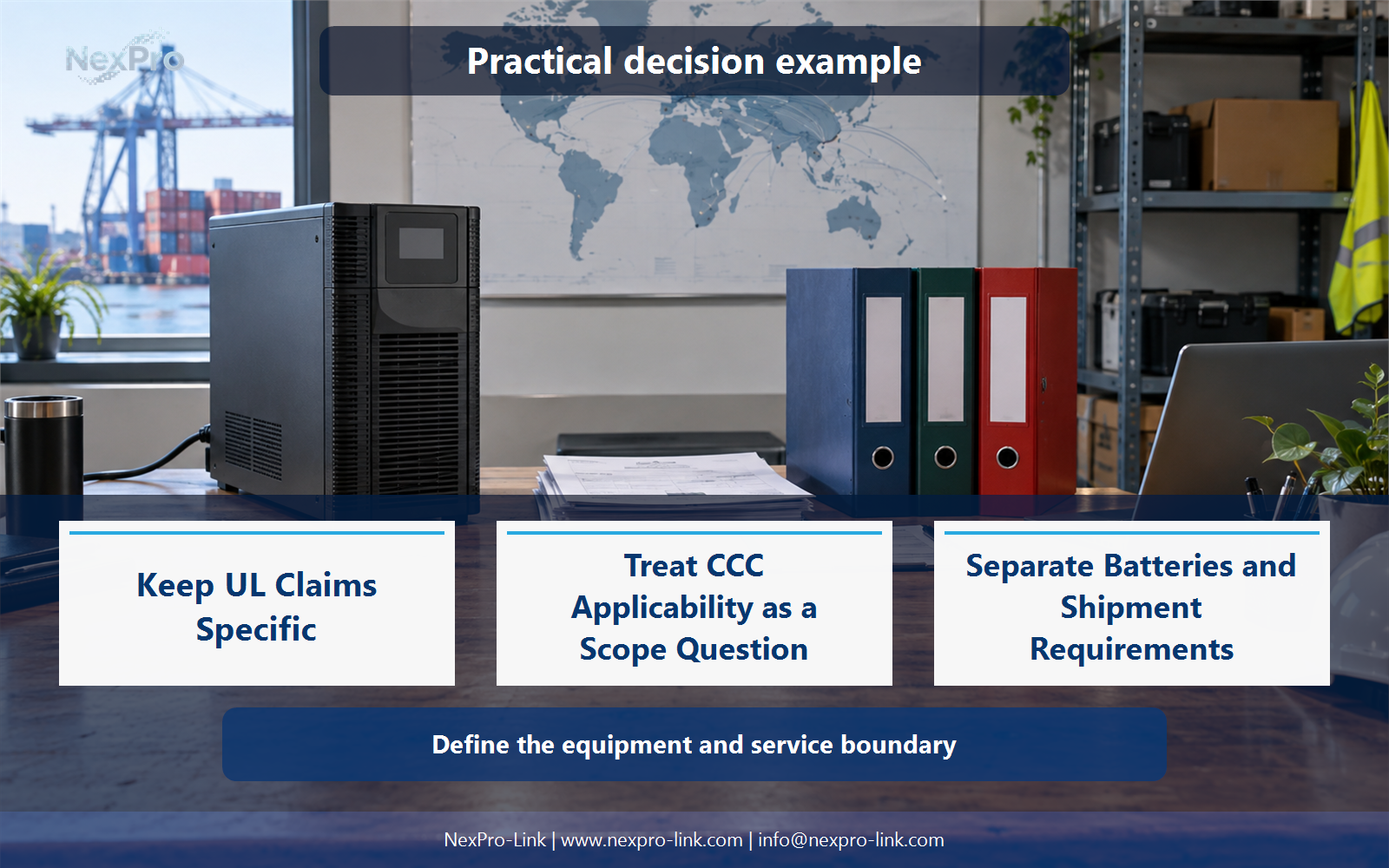
Keep UL Claims Specific
A UL-related statement should name the product, the program and the scope. UL Solutions offers certification and evaluation services, and a mark applies to a specific product tested against a named standard. For uninterruptible power systems, that standard is commonly UL 1778. A listing for one model and configuration does not carry over to another model or another market.
Keep the buyer's requirement and the product's actual status in separate rows. A project may ask for a UL listing while the product holds a different evaluation, or while no evaluation has been completed. Those two statements describe different things, and merging them creates a false approval claim. The UL name identifies a defined program and scope; it does not stand for worldwide approval.
- Confirm the answer to: What should a UL-related statement identify?
- Draw electrical power as a solid path and management information as a separate dashed path.
- Keep external services and specialist approvals outside the UPS equipment claim.
Section 04
Treat CCC Applicability as a Scope Question
CCC is China Compulsory Certification. It applies to products listed in the current catalogue, not to every exported item that happens to be a UPS. Whether a specific configuration falls within the catalogue depends on the product category and the current rules. The importer or the party placing the product on the Chinese market usually holds the responsibility to confirm this.
Ask the question per destination and per product category. CCC applicability is a scope question, not a blanket requirement attached to every exported UPS. A team that treats the three marks as one global set will ask the wrong question and receive documents that do not match the market.
Section 05
Separate Batteries and Shipment Requirements
Product conformity and battery transport answer different questions. A product can meet the market rules for its destination while its batteries still need a separate transport arrangement. Lithium-ion cells and lead-acid batteries travel under different rules, and the mode of transport changes the obligations again.
A lithium-ion battery shipped by air is handled as dangerous goods and normally needs UN 38.3 test documentation plus packaging that matches the current transport regulation. Lead-acid batteries follow a different set of provisions. Recording the battery chemistry and the shipment mode separately keeps a conformity question from being mistaken for a shipping question.
Section 06
Prepare a Destination-Aware RFQ
A supplier can act on a brief that names the destination, the configuration and the conformity information the buyer needs. That brief is the RFQ. It does not need to be a complete certification file; it needs enough scope for NexPro-Link to confirm which equipment and documentation fit.
For a catalog reference, the rack-mounted online range NX-UP-RM-001 includes configuration C2KR(S) rated 2,000 VA and 1,800 W with internal VRLA batteries. That line shows how a series, a configuration and a rating sit together. It is not a claim that this configuration already holds a particular CE, UL or CCC status. NexPro-Link confirms the fitting and the available documentation within the stated scope.
Engineering references
These sources support the general planning principles. Always use the selected product's current datasheet and applicable project standards for final design.