Keep the original GR-771 reference but state plainly that it covers fiber optic splice closures, so it cannot serve as UPS certification.
Section 01
Identify the Telecom Power Equipment
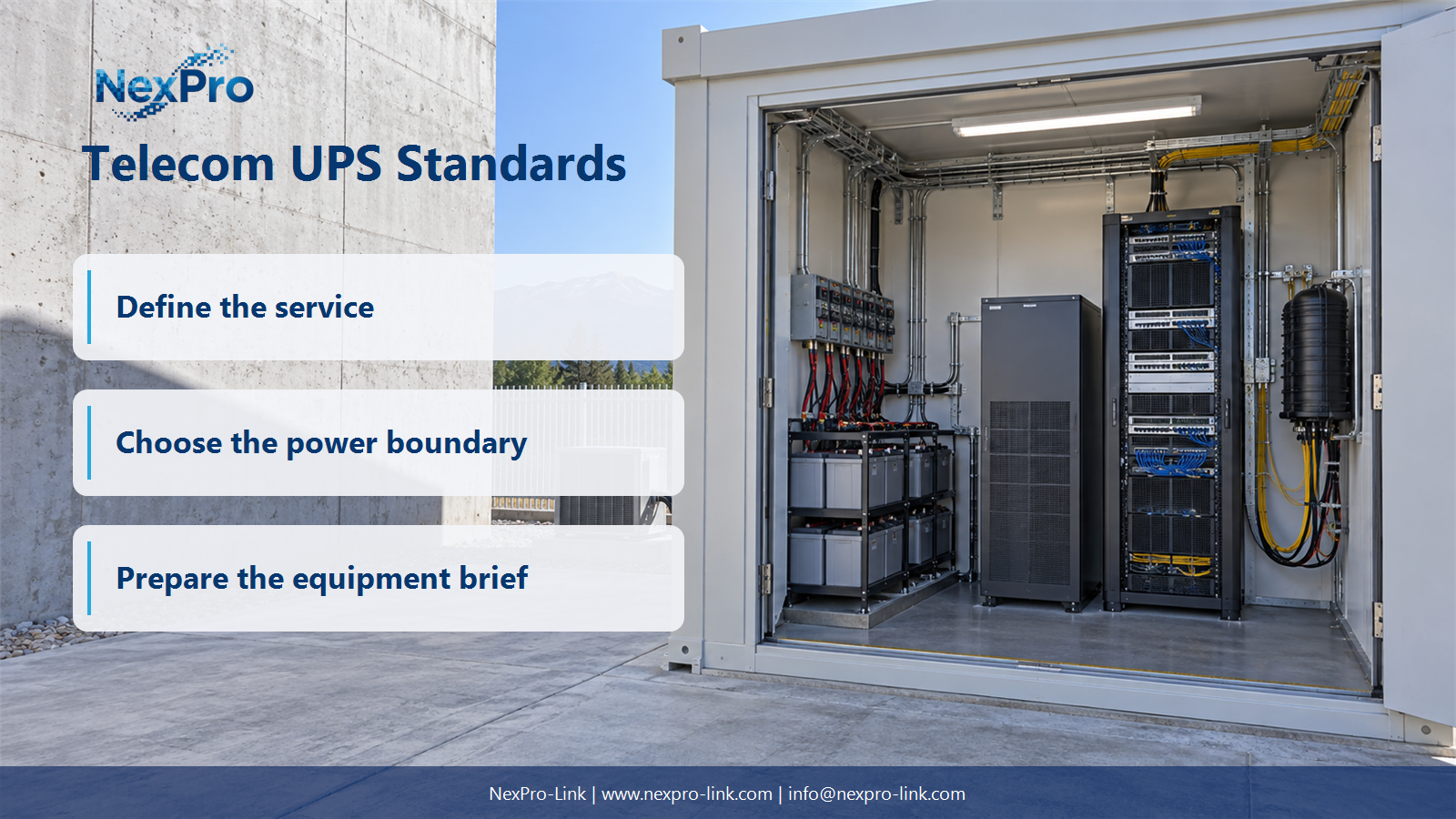
Which equipment is being specified? Distinguish AC UPS, DC power plants, rectifiers and distribution equipment. They may serve different roles and requirements. The word telecom does not establish one universal product standard or allow a requirement for one component to be applied to every power device. Telecom procurement and tender engineers can use that boundary to build the equipment map: AC UPS / rectifier / DC plant / distribution and prepare telecom equipment power requirements and the exact operator specification before selection.
Keep the original GR-771 reference but state plainly that it covers fiber optic splice closures, so it cannot serve as UPS certification.
Start with the equipment list before the standard. In a telecom site the power path can contain several devices that look similar in a bill of quantities but behave differently. They do not all need the same specification.
The distinction matters because a GR-771 entry usually lands on a UPS line when someone has copied the wrong column. Knowing which device the line actually describes is the first step in fixing it. A site can have an AC UPS for its management and network loads, a DC plant for radio equipment, and distribution gear for both, all under the same telecom label.
| Decision area | Project question | Required output |
|---|---|---|
| Identify the Telecom Power Equipment | Which equipment is being specified? | Equipment map: AC UPS / rectifier / DC plant / distribution |
| Explain the GR-771 Reference | Does GR-771 specify requirements for a telecom UPS? | Scope comparison: source reference / publisher subject / UPS relevance |
| Avoid Replacing One Guess with Another | How should an incorrect standard reference in a telecom specification be resolved? | Requirement table: operator / equipment / installation / specified document |
Section 02
Explain the GR-771 Reference
The Telcordia catalog entry for GR-771 addresses fiber optic splice closures. Those are enclosures that protect fiber splices against weather, moisture and mechanical stress. The subject is the enclosure, its sealing and its cable entries, not the electrical output of a power device.
A fiber enclosure reference cannot establish UPS output performance, battery suitability or operator acceptance. If a tender asks for GR-771 on the UPS line, treat it as a scope question to resolve, not as a compliance mark to tick.
Section 03
Avoid Replacing One Guess with Another
When a specification names the wrong reference, the worst response is to guess a replacement and write it in. A guessed standard or number looks confident but has no basis, and it can move the error from one line to another. Ask the specification owner instead.
Record the clarification against the relevant bill-of-quantities item rather than substituting another number without a basis. The corrected line should say what the power equipment needs to achieve and which documentation applies.
- Confirm the answer to: How should an incorrect standard reference in a telecom specification be resolved?
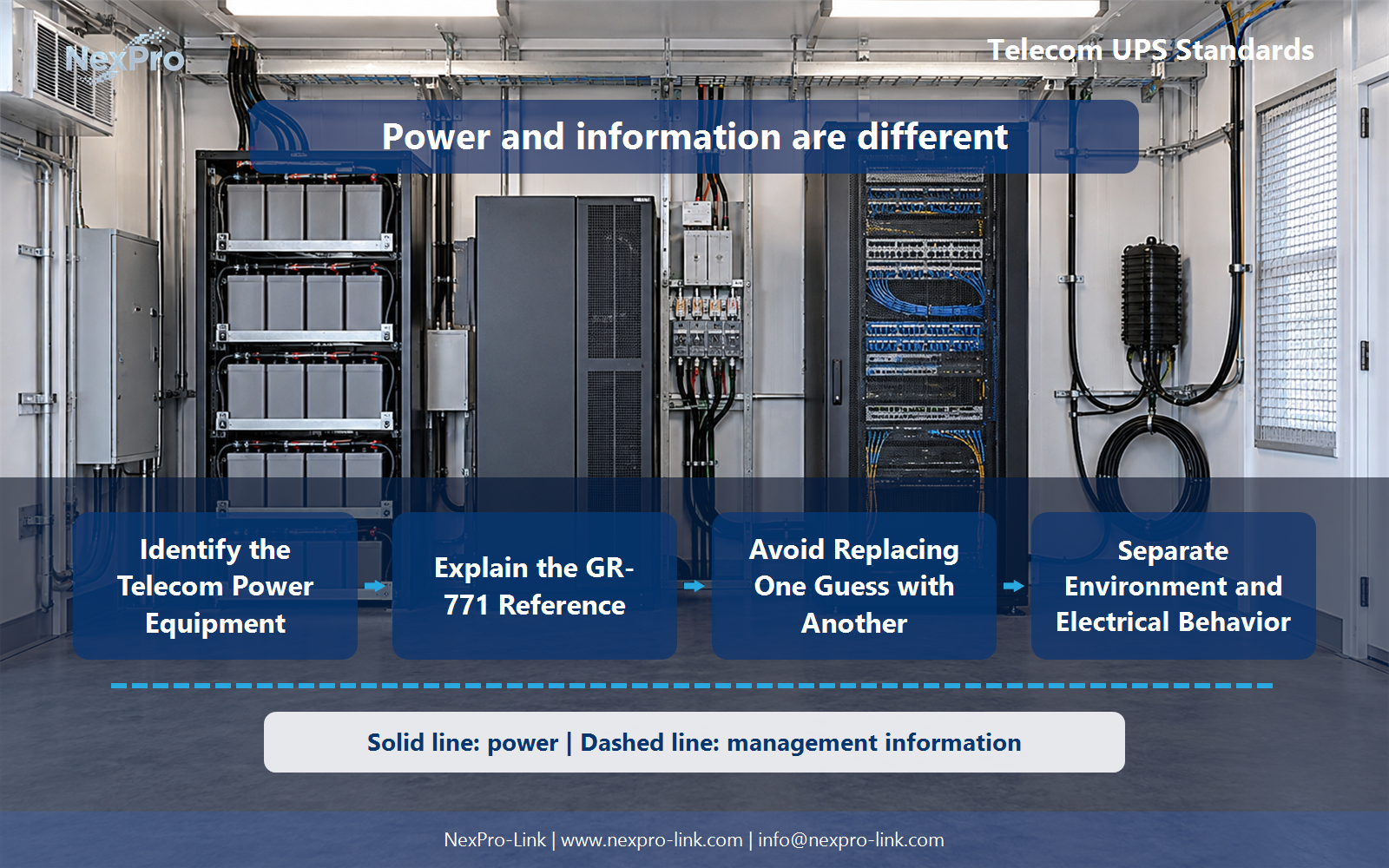
- Draw electrical power as a solid path and management information as a separate dashed path.
- Keep external services and specialist approvals outside the UPS equipment claim.
Section 04
Separate Environment and Electrical Behavior
One reason a GR-771 entry slips into a UPS line is that environment and electrical behavior get merged. A closure standard describes the physical environment a fiber splice sits in. A power requirement describes what the equipment must do electrically. Keep them in separate fields.
A fiber enclosure standard cannot establish UPS output performance or battery suitability. Component-level properties stay separate from the complete site's continuity objective.
Section 05
Build a Clear Tender Response
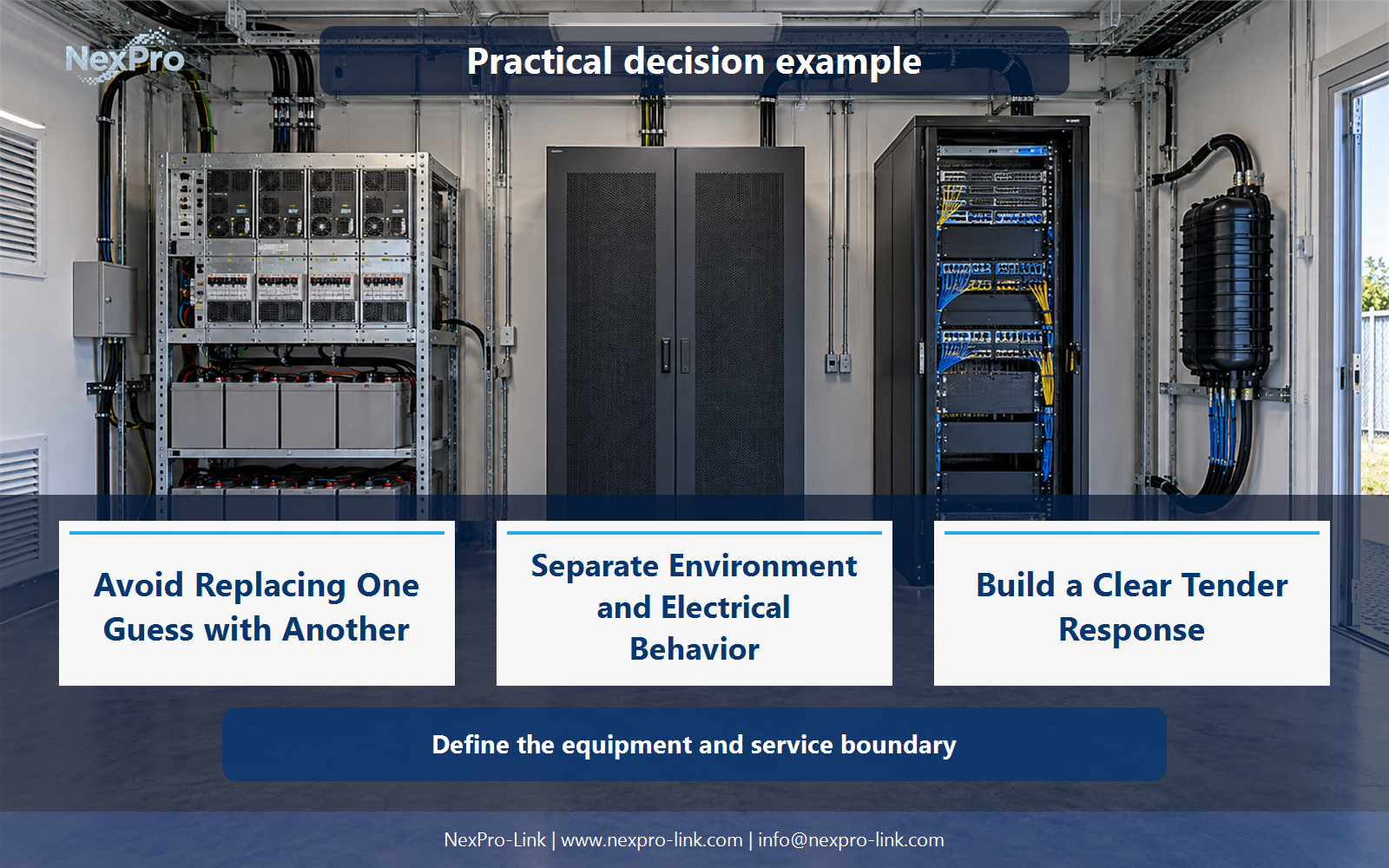
A supplier should identify the equipment boundary and ask for the intended requirement while providing the product information it has. It should not silently mark a non-applicable reference as compliant, because that creates a false record for the owner and the audit trail.
A clear technical clarification is more useful than an unsupported certificate claim. It keeps the response accurate and gives the owner something to correct in the next revision.
Section 06
Position NexPro-Link as a Power-Supply Partner
To turn the decision into a quote, send the equipment power interfaces, the protected load schedule, the operating objective and the exact operator specification.
NexPro-Link can use those inputs to discuss UPS equipment, interfaces and supply scope. On its catalog, the rack-mounted online range NX-UP-RM-001 lists configuration C2KR(S) at 2,000 VA and 1,800 W with internal VRLA batteries. That example shows how a series, a configuration and a rating line up. It is not a preselected answer for any site. Fiber enclosure requirements and other component properties stay separate, since they do not establish UPS certification or approval of the complete site.
Engineering references
These sources support the general planning principles. Always use the selected product's current datasheet and applicable project standards for final design.