A server-room label does not decide the UPS topology. The topology follows from three questions: what must keep running, for how long, and what happens when utility power fails.
Section 01
Define the server-room service objective
A server-room label does not decide the UPS topology. The topology follows from three questions: what must keep running, for how long, and what happens when utility power fails. Answer those first, then compare the two designs against the same load, the same runtime objective, and the same installation site. This guide works through that comparison for a typical office server room and ends with a worked sizing example and the inputs NexPro-Link needs for an equipment discussion.
Begin with the required outcome: bridge short disturbances, support an orderly shutdown or continue service for a stated interval. Add the tolerated interruption, the quality of the incoming supply and the consequence of a restart. These requirements determine which topology characteristics matter.
A quiet office location may also care about heat, acoustics, floor or rack space and maintenance access. Keep those project constraints beside the electrical load so the selected UPS fits the room as well as the power requirement.
| Question | Why it matters | Project evidence |
|---|---|---|
| How sensitive are the loads? | Defines transfer and output needs | Current equipment data |
| How unstable is the source? | Changes how often correction is needed | Site event or voltage record |
| What must stay online? | Sets the protected boundary | Dependency and load list |
| How long is required? | Sets battery configuration | Timed operating sequence |
Section 02
Compare the normal power paths
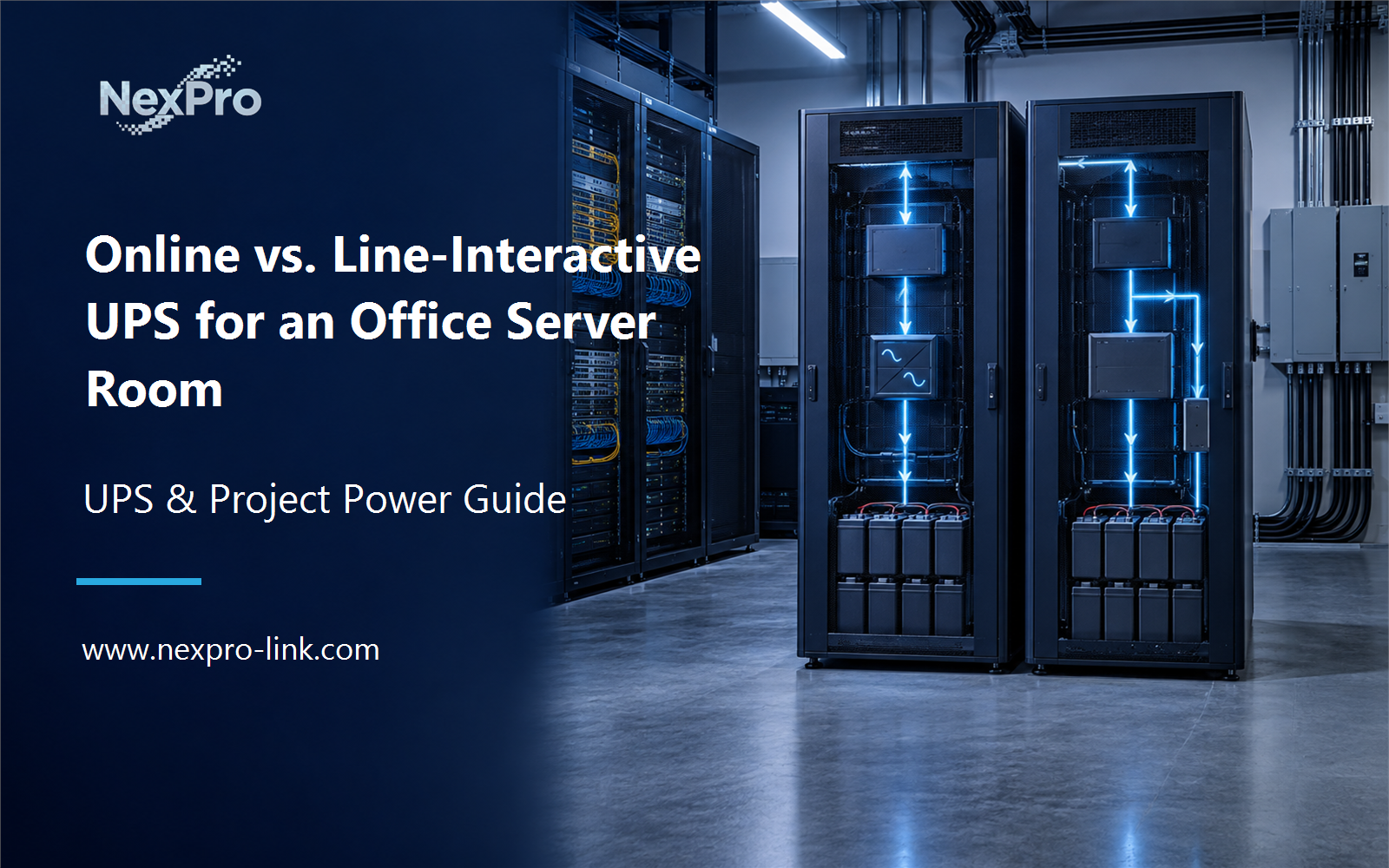
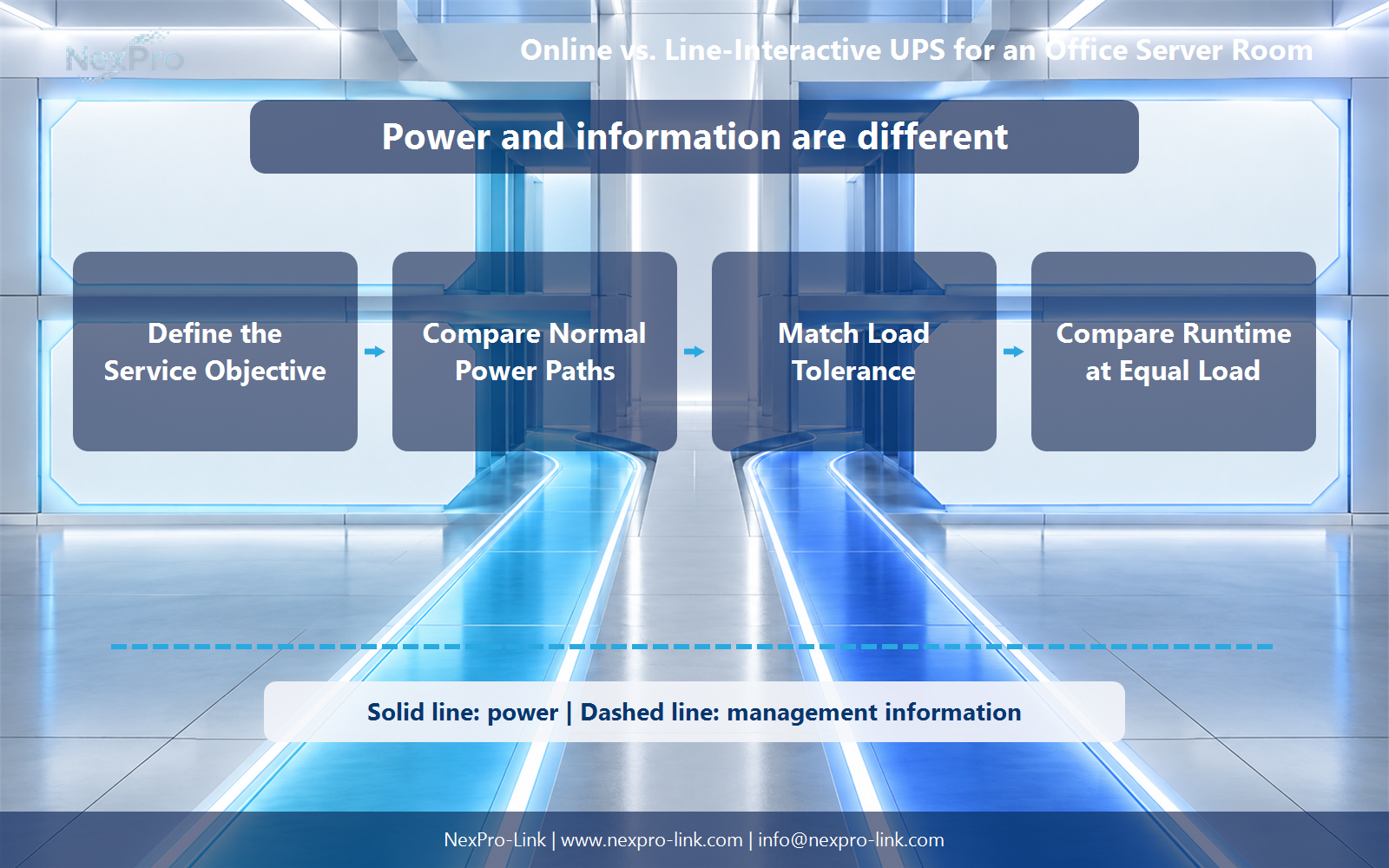
An online double-conversion UPS normally supplies the load through its conversion stages, while a line-interactive design normally supplies the load from the input path with voltage regulation and transfers to the inverter when required. That difference affects transfer behavior, conditioning, losses and thermal design.
Topology alone does not prove compatibility. Confirm output waveform, voltage range, frequency behavior, overload capability and the power supplies used by the actual servers, storage and switches.
- Use current technical data for the selected model and load.
- Check bypass behavior as well as battery operation.
- Include the management and cooling dependencies in the room scope.
Section 03
Match the topology to load tolerance and source quality
Frequent voltage variation, a generator source or highly sensitive equipment can make continuous conditioning more valuable. A stable office supply and tolerant switch-mode loads may allow a line-interactive option, provided the transfer and waveform are compatible.
Do not decide from building size alone. Two small server rooms can have very different source quality, equipment behavior and recovery costs. Record the disturbances and the load response that the project must handle.
Section 04
Compare runtime at the same measured load
Runtime comparisons are meaningful only when the protected watts, power factor assumptions, battery configuration and condition are aligned. A larger VA label does not guarantee a longer runtime, and a topology choice does not set the battery duration by itself.
Include the shutdown switch and any network service required for automation. Then check the selected manufacturer's runtime information and keep reserve for battery ageing, environmental conditions and a delayed command.
Section 05
Work through a small server-room example
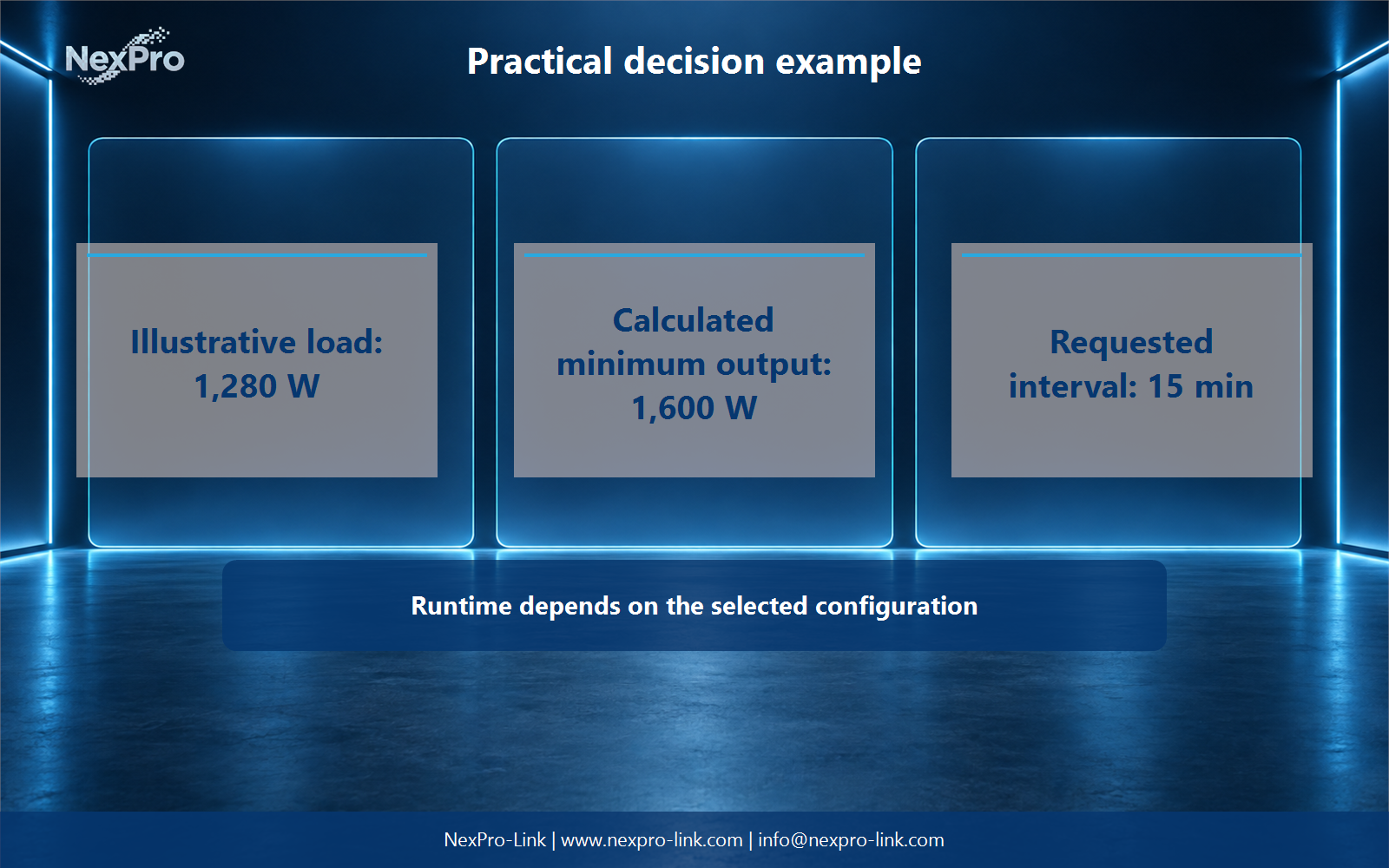
For an illustrative 1,280 W protected group, a 25 percent capacity allowance gives a 1,600 W planning minimum. The requested operating interval is 15 minutes. That arithmetic defines the initial output requirement, but it does not predict runtime.
The final brief should list source quality, load compatibility, rack or floor format, battery objective, management interface, bypass need and support access. Online and line-interactive quotations can then be compared against one service definition.
Engineering references
These sources support the general planning principles. Always use the selected product's current datasheet and applicable project standards for final design.