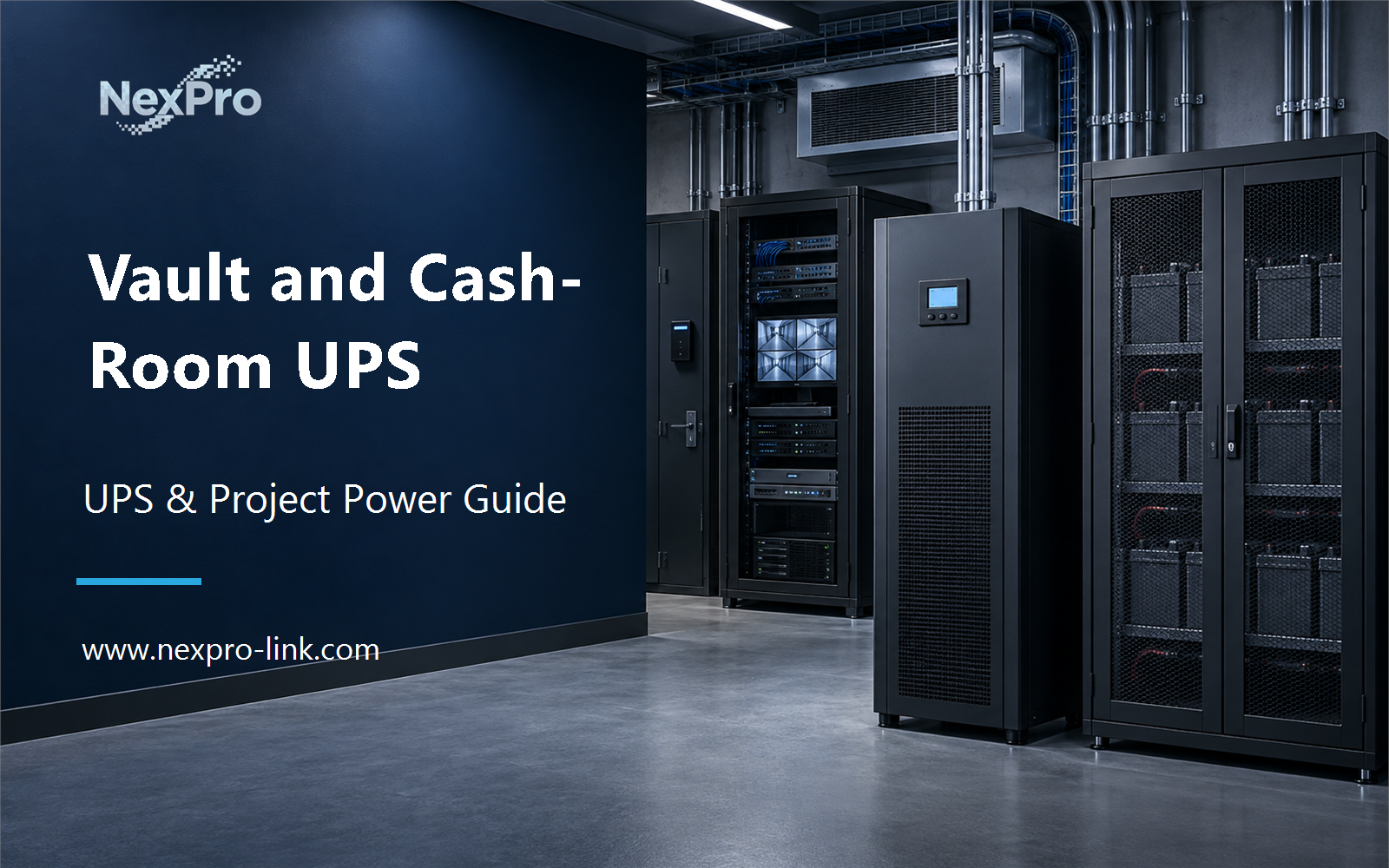
Must every vault UPS provide at least two hours? The interval has to come from the applicable security design, the contract and local requirements, so the answer is project-specific.
Section 01
Set the security continuity objective
Must every vault UPS provide at least two hours? The required interval must come from the applicable security design, contract and local requirements. A two-hour target can be evaluated for a particular project, but should not be assumed for every vault. List the protected devices and their required operating states before calculating load and battery capacity. Bank security manager can use that boundary to build the requirement schedule: function / stated interval / project basis and prepare security load schedule and the buyer-defined continuity period before selection.
Define what must remain available during an outage: access decisions, door-state monitoring, recording, local communication, alarms or a controlled reduced state. The objective should come from the approved security plan, not from a generic request for the longest possible runtime.
Record how every controlled opening, lock and emergency function behaves when normal power or communications are unavailable. A UPS supports the selected design; it does not replace the security and life-safety logic.
| Function | Continuity question | Evidence |
|---|---|---|
| Access control | Which decisions remain local? | Controller and door schedule |
| Video recording | Which streams and retention state continue? | Recorder and camera load map |
| Network | Which switch and router are required? | Communication dependency map |
| Alarm and monitoring | Who receives which event? | Response and escalation plan |
Section 02
Map the whole security chain
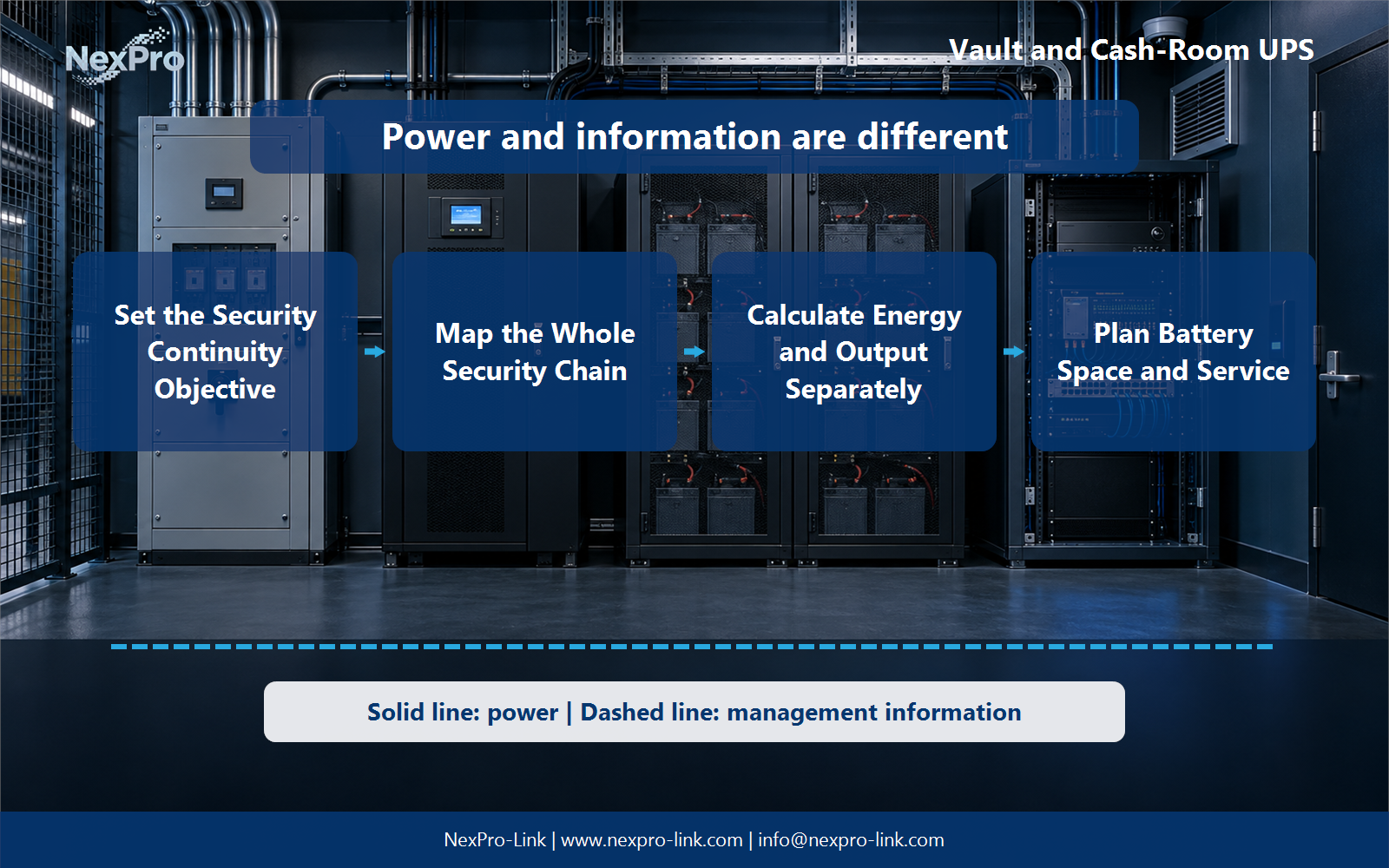
Trace controllers, readers, door power, cameras, recorder, switches, router and the monitoring interface. Count shared equipment once and identify loads supplied from separate DC power systems.
A protected recorder does not preserve evidence when the required cameras or switches are off. Likewise, powered access control does not guarantee a remote alarm when the communication path is unavailable.
- Separate essential and nonessential camera groups.
- Record local behavior when the wide-area network is lost.
- Keep emergency and life-safety functions under their responsible design process.
Section 03
Calculate output and energy separately
UPS output capability must carry the active watts and VA, including any short peaks. Battery energy must support the requested interval under the selected configuration, efficiency, discharge limits, aging and environmental conditions.
Do not turn watt-hours into a runtime promise. Use the calculation to prepare the battery objective, then verify it against current runtime data and the complete installed load.
Section 04
Plan battery space, service and the reduced state
Long runtime can require substantial battery space, ventilation, weight allowance, isolation and service access. Confirm how batteries are inspected and replaced without exposing the secure area or disabling every protected function.
A reduced state may preserve core access, recording and communication while nonessential displays or camera groups stop. Defining that state can produce a more maintainable design than extending every load for the full interval.
Section 05
Calculate an illustrative long-runtime load
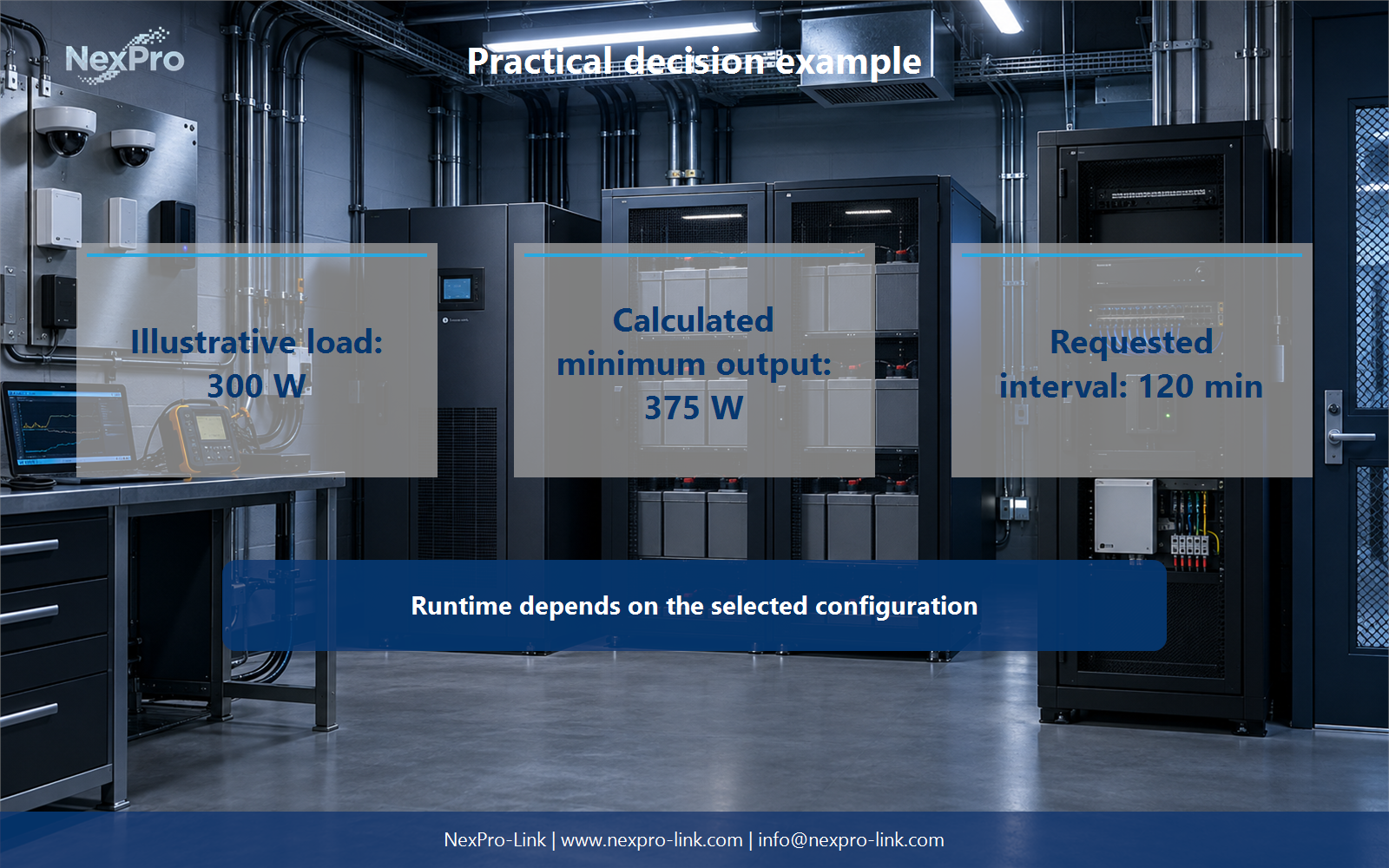
For a 300 W essential group at 0.90 power factor, the apparent load is 333.33 VA. At an 80 percent operating ceiling, the planning minimum is 375 W and 416.67 VA. The requested interval is 120 minutes.
The idealized energy requirement is 600 Wh before conversion loss, battery limits, aging, temperature and reserve. Use the value to frame the battery request, then select and verify the actual configuration.
Engineering references
These sources support the general planning principles. Always use the selected product's current datasheet and applicable project standards for final design.