Compare energy reserve location, maintenance isolation and common risk separately, without equating a centralized or distributed label with a safety conclusion.
Section 01
Define the Energy Architecture
Compare energy reserve location, maintenance isolation and common risk separately, without equating a centralized or distributed label with a safety conclusion.
State whether the discussion concerns batteries, UPS modules, distribution or the whole power system. These can be arranged differently. For a project-specific decision, record UPS, battery, distribution and load in the architecture map. This keeps the equipment inputs and intended service outcome aligned.
The working question is simple: What exactly is centralized or distributed in this comparison? Record the answer as a service requirement before comparing UPS ratings or battery options.
| Decision area | Project question | Required output |
|---|---|---|
| Define the Energy Architecture | What exactly is centralized or distributed in this comparison? | Approved service objective |
| Compare Footprint and Access | How should space be compared? | Defined load and dependency boundary |
| Analyze Common Failure Domains | Does distributing batteries eliminate common-mode failure? | Reviewed power-path decision |
Section 02
Compare Footprint and Access
Include battery cabinets, required access, replacement routes and any supporting room services. Count usable installation space rather than only product dimensions. The footprint decision should remain connected to the chosen chemistry, configuration and site requirements.
Keep the load list, operating state and supporting dependencies in the same schedule. This makes omissions visible before runtime or capacity is discussed.
- Confirm the answer to: How should space be compared?
- Separate measured demand, nameplate limits and committed growth.
- Identify the owner of each external service or approval.
Section 03
Analyze Common Failure Domains and Compare Service and Monitoring
No. Shared controls, room conditions, distribution and operating procedures can still create common exposure. Identify the events the design is meant to isolate. Compare complete arrangements rather than equating more locations with automatically better resilience.
Central arrangements can concentrate work, while distributed arrangements can create more service points and local variation. Compare access, replacement scope and monitoring ownership. The useful result is a service model matched to staff and site constraints, not a universal winner.
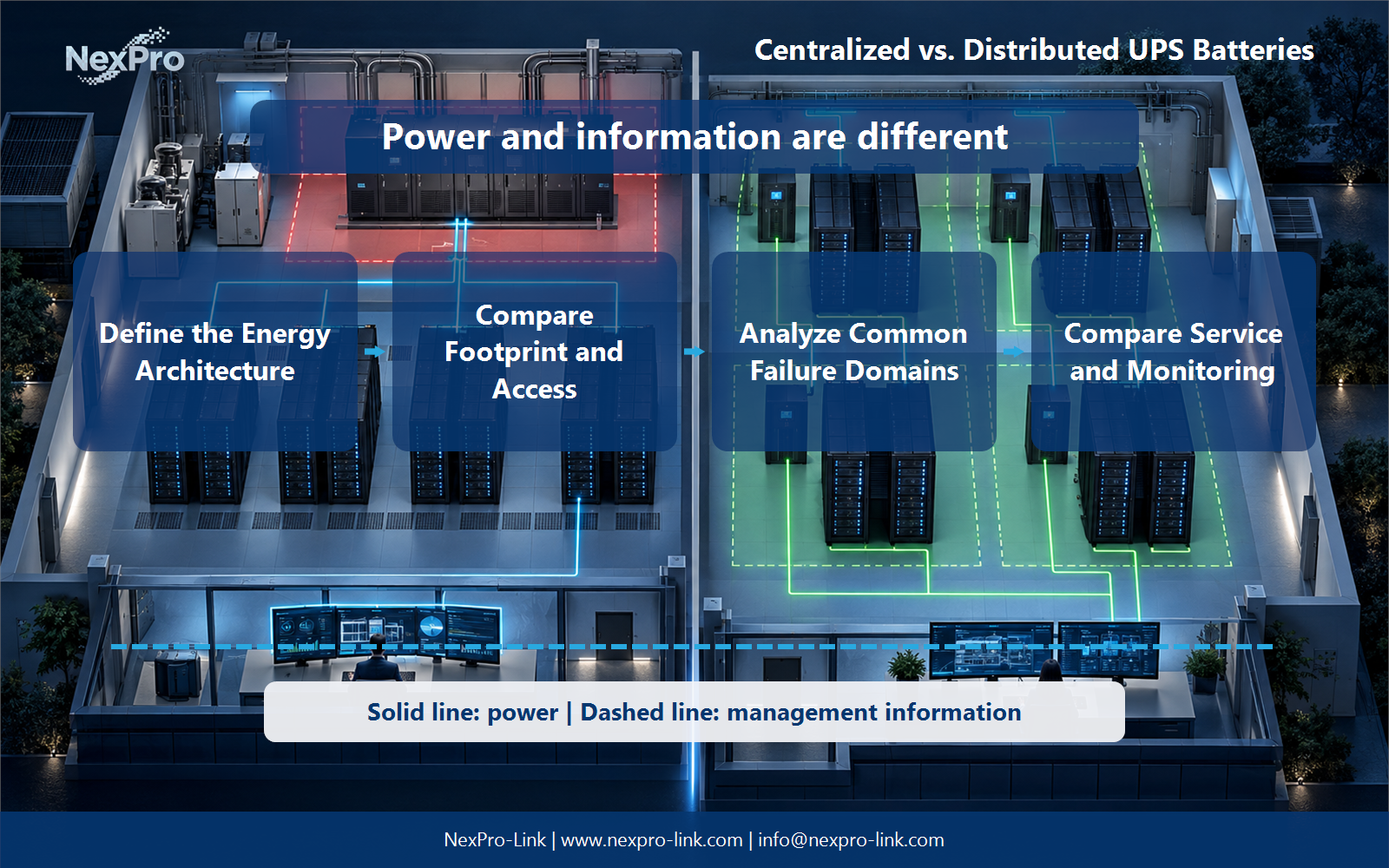
Draw power delivery as a solid path and management information as a separate dashed path. That distinction prevents an alarm or software command from being mistaken for an electrical protection function.
Section 04
Check Recharge and Expansion
After an outage, the system must recover its intended reserve within the project's operating plan. Charger capability, battery configuration and repeated-event expectations matter. Additional battery capacity should not be assumed compatible with every UPS or charger simply because it fits physically.
Assign the action, acknowledgement, timeout and escalation owner before commissioning. The useful battery interval is the time needed for this approved sequence plus reserve, not an arbitrary marketing duration.
Section 05
Frame the Supply Request
Share the required energy architecture, loads, battery environment and service boundaries. NexPro-Link can discuss applicable equipment options or functional requirements. High-energy battery design and installation remain specialist tasks rather than an improvised combination of cabinets and cells.
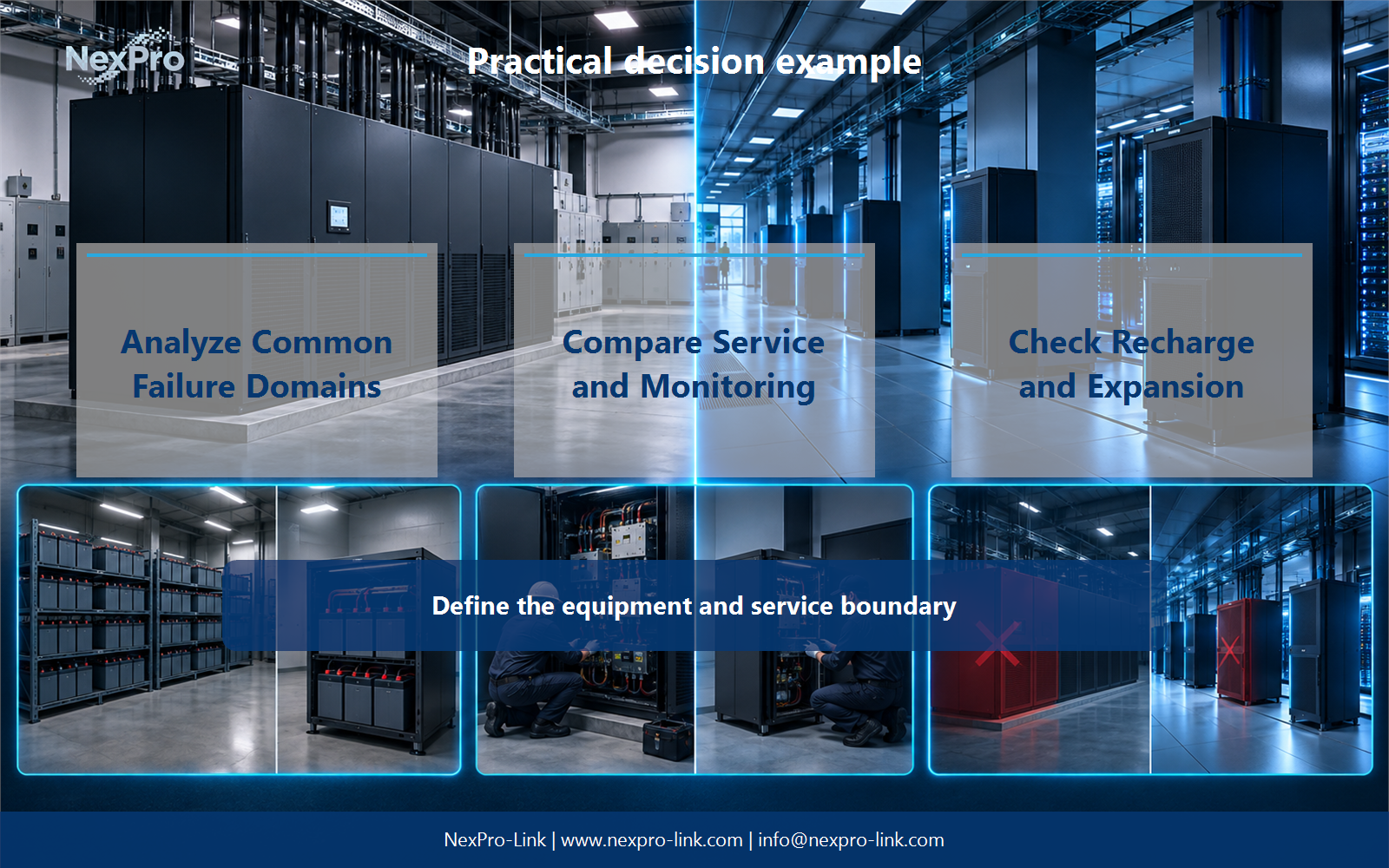
For the article's practical example, the stated teaching inputs are: Analyze Common Failure Domains. Compare Service and Monitoring. Check Recharge and Expansion. Define the equipment and service boundary. Treat these figures as planning assumptions, then replace them with measured or manufacturer-supported project data.
Engineering references
These sources support the general planning principles. Always use the selected product's current datasheet and applicable project standards for final design.