A one-hour surveillance target starts with load-side watt-hours. Separate that requirement from theoretical battery energy and the configuration-specific evidence needed for procurement.
Section 01
Calculate delivered energy before discussing battery size
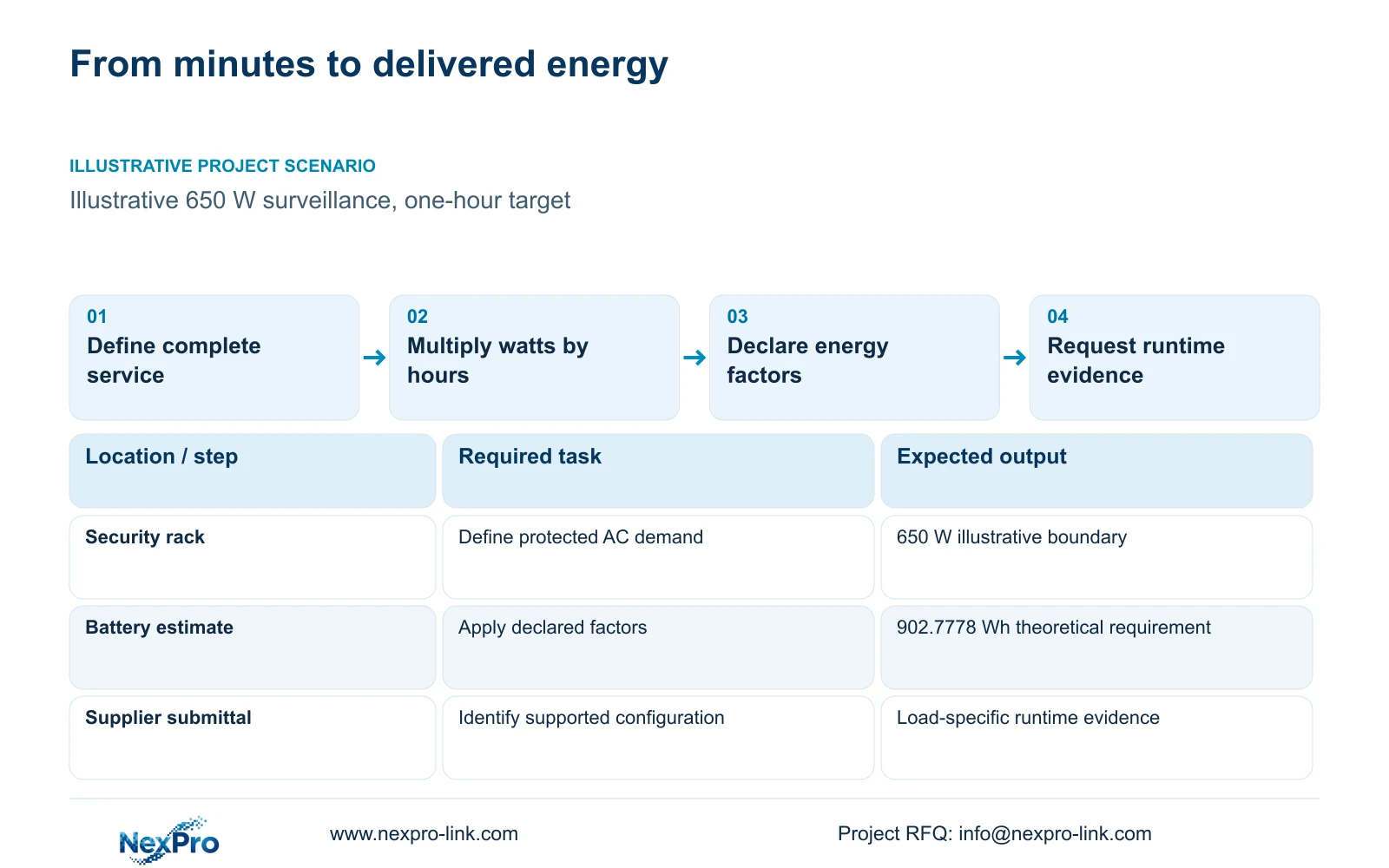
Convert a factory UPS runtime target into an output-energy requirement by multiplying complete protected AC demand in watts by operating time in hours. Then state any conversion and usable-energy assumptions separately. This produces a useful battery request, but a theoretical watt-hour estimate cannot establish the operating duration of an unspecified UPS configuration.
Illustrative project scenario: A plant wants one hour of surveillance during outages. Use an assumed complete protected load of 650 W to demonstrate the energy method, with 30 minutes retained as a comparison. The security tasks follow the supplied CNC factory reference, but 650 W is a separate teaching boundary, not its calculated 682.7407 W recording-first total.
Define what 'surveillance' includes before applying the formula. Cameras, loaded switches, recording equipment and necessary links must remain powered. Add operator equipment only where live observation is required. A request that leaves these dependencies unspecified may receive a valid battery calculation for a smaller service than the owner intended.
Section 02
Give each efficiency and reserve factor a clear meaning
The supplied illustration assumes battery-to-load conversion of 0.90 and usable stored-energy fraction of 0.80. The first describes an assumed conversion allowance; the second limits the portion of nominal stored energy used in the estimate. Their product is 0.72. Neither value is a measured characteristic of the NexPro-Link UPS series.
Use nominal_battery_Wh = load_Wh/(0.90 × 0.80). Keep the original load-side energy alongside the resulting nominal estimate so reviewers can see where the increase comes from. Do not label the combined allowance as guaranteed ageing compensation or use it to conceal missing temperature and discharge data.
When a supplier provides configuration-specific runtime evidence, ask how its conditions already account for losses, cutoff and usable energy. Do not apply the same allowance again without a reason. The purpose of explicit factors is to make the estimate reviewable, not to replace the manufacturer's supported operating envelope with a more elaborate spreadsheet.
Section 03
Request evidence for the actual UPS and battery combination
Ask the supplier to identify the exact UPS variant, compatible battery system and runtime curve or supported runtime data at the declared demand. State the required initial battery condition and installation environment. A response that lists only nominal battery watt-hours leaves discharge behavior, cutoff and system compatibility unresolved.
The rack series provides capacity references of SP1KR(S), 1 kVA/900 W; SP2KR(S), 2 kVA/1800 W; and SP3KR(S), 3 kVA/2700 W. W and VA determine whether a candidate can support the instantaneous load. They cannot determine whether its selected battery arrangement supports one hour. The APC/Schneider buying guide similarly separates output capacity from runtime.
The engineer should review temperature, ageing basis, discharge rate, BMS limits, UPS self-consumption and recharge assumptions with the supplier. Procurement should retain the accepted battery identity in the order. Do not copy a default 960 Wh field from another selected variant or propose an unsupported external battery solely because its arithmetic energy appears sufficient.
Section 04
Keep the 30- and 60-minute calculations at the same load
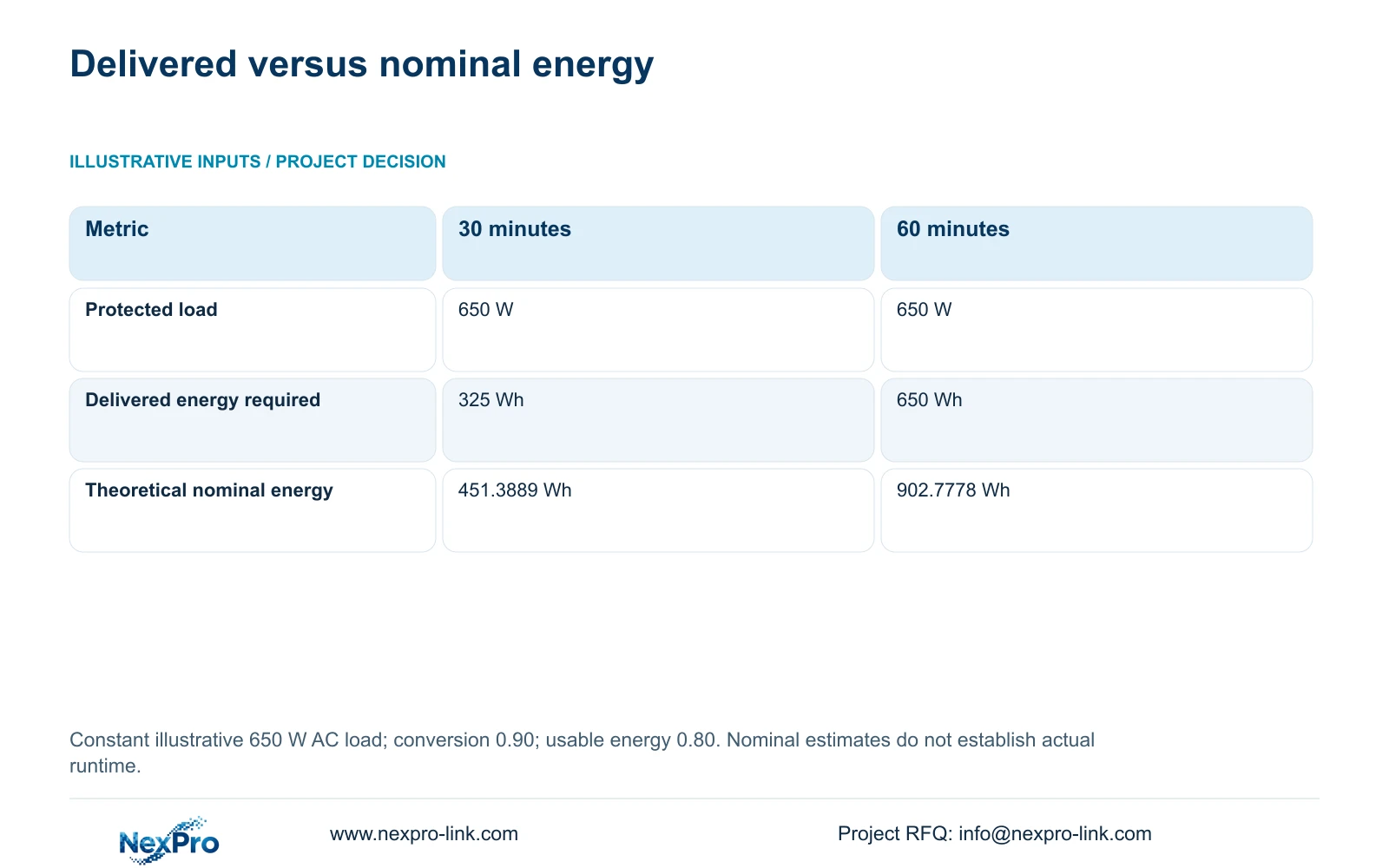
At 650 W, load_Wh = P_W × minutes/60 gives 650 × 30/60 = 325 Wh for 30 minutes and 650 × 60/60 = 650 Wh for one hour. Applying the declared factors gives 325/0.72 = 451.3889 Wh and 650/0.72 = 902.7778 Wh of theoretical nominal battery energy.
The decisive difference is time: no equipment was added or removed. Doubling duration doubles both energy figures in this constant-load model. It does not require doubling the UPS output rating, although the longer-duration battery configuration must be supported by the chosen unit and installation.
For comparison, CASE01's 682.7407 W recording-first load needs 341.3704 Wh at 30 minutes, while its wall-backed 1,262.7407 W load needs 631.3704 Wh. Those values belong to different declared loads. Keeping them separate prevents an attractive 650 W estimate from becoming an unsupported runtime claim for the complete case.
| Metric | 30-minute option | 60-minute option |
|---|---|---|
| Complete protected AC load | 650 W | 650 W |
| Operating duration | 30 minutes | 60 minutes |
| Load-side requirement | 325 Wh | 650 Wh |
| Nominal estimate at 0.72 factor | 451.3889 Wh | 902.7778 Wh |
Section 05
Approve one hour as a service requirement with conditions
For the stated plant objective, request a configuration supporting the complete approved service for one hour. Keep the 30-minute alternative separately priced so the owner can see the consequence of a reduced operating window. Do not recommend the shorter option simply because its battery estimate is smaller when the owner still needs extended observation.
Specify whether the hour begins at loss of acceptable mains input and whether all listed devices operate throughout. If displays are shed partway through, that becomes a time-varying load schedule requiring a revised energy calculation and a supported control method. It should not be represented by the original constant 650 W comparison.
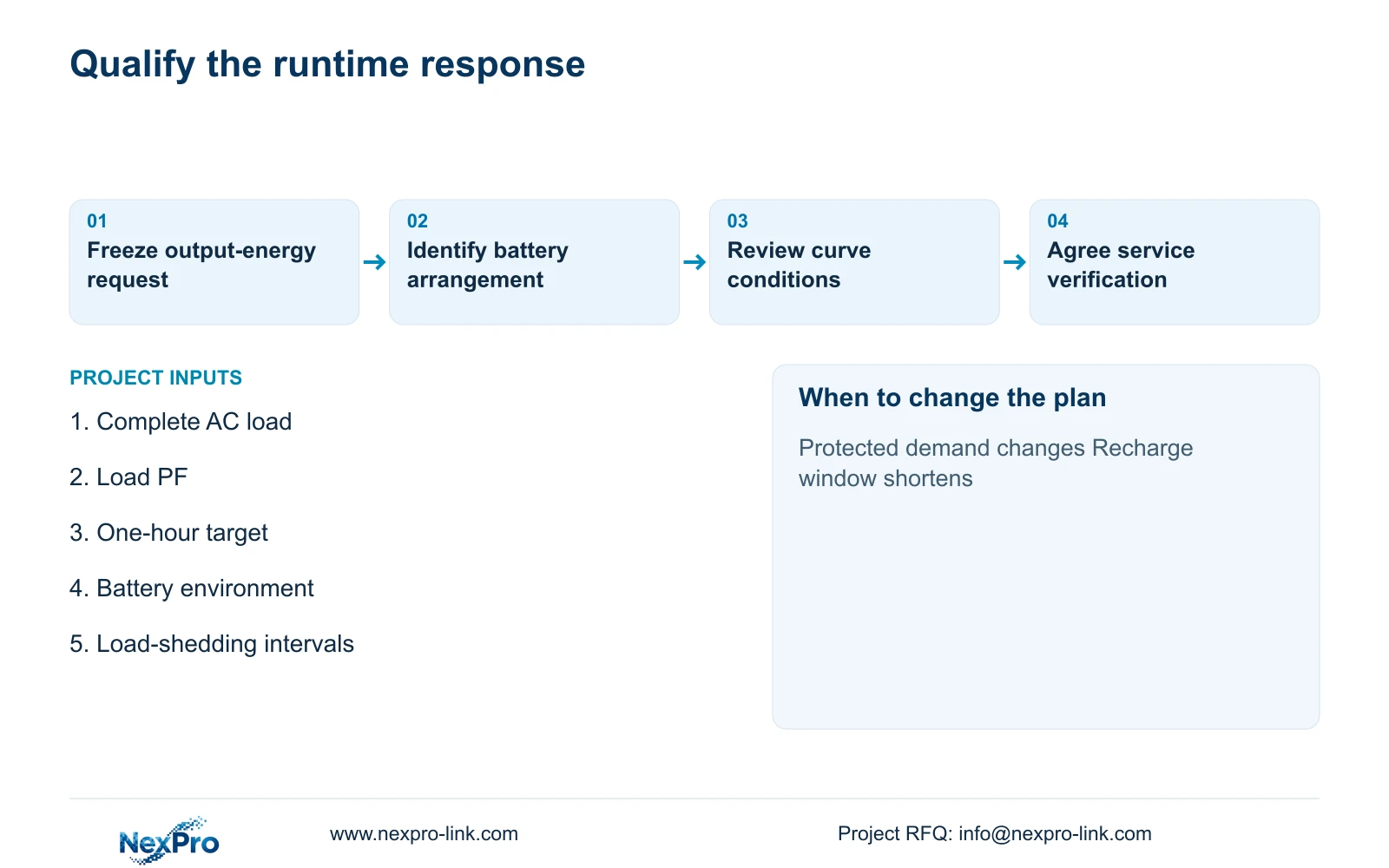
Revisit the requirement when demand, duration, battery location or outage recurrence changes. Initial state of charge matters when interruptions repeat before recharge completes. Ask how the proposed configuration restores readiness while carrying normal load, and avoid promising a second full hour immediately after a deep discharge without supporting evidence.
Section 06
Make runtime conditions part of the technical submittal
Issue a runtime request containing the load schedule revision, required W and VA capacity, duration and actual electrical nodes. The supplier response should distinguish nominal battery information, modeled runtime data and any available test evidence. State the conditions attached to each so the buyer can compare equivalent configurations.
Agree a commissioning method with the local team that verifies the security service as well as the power equipment. Record camera availability, saved footage and the required viewing task during the accepted interval. Plan the test and restoration procedure around site operations; a calculation alone does not authorize an interruption.
NexPro-Link can discuss UPS model matching, coordinated CCTV equipment and technical documentation within its project supply scope. Local electrical installation, operational test authorization and final acceptance remain separately assigned. The procurement result should be an identifiable battery/runtime configuration with clear conditions, not an isolated Wh figure attached to a generic series name.
Section 07
Buyer questions
Can we specify runtime while some loads remain provisional? Yes, as a conditional request. State the provisional load and require the offer to identify its basis. Requalify the configuration when final demand changes rather than retaining the original minutes.
Is nominal battery energy enough to compare two offers? No. Compare supported runtime at the same AC load, battery condition and environment, together with compatible hardware and recharge scope. Equal nominal energy does not establish equal delivered service.
How should load shedding appear in the calculation? Show each operating interval and its load, then sum watts multiplied by hours across those intervals. Qualify the actual switching method and battery configuration separately.
Section 08
Turn the one-hour target into a configuration request
Send your complete AC load with PF, required operating duration, battery-location conditions and permitted load-shedding schedule to info@nexpro-link.com for a runtime-focused equipment discussion.
Engineering references
These sources support the general planning principles. Always use the selected product's current datasheet and applicable project standards for final design.