Plan CCTV battery backup runtime with practical guidance on define the outage outcome and use the correct runtime curve. NexPro-Link project guide.
Section 01
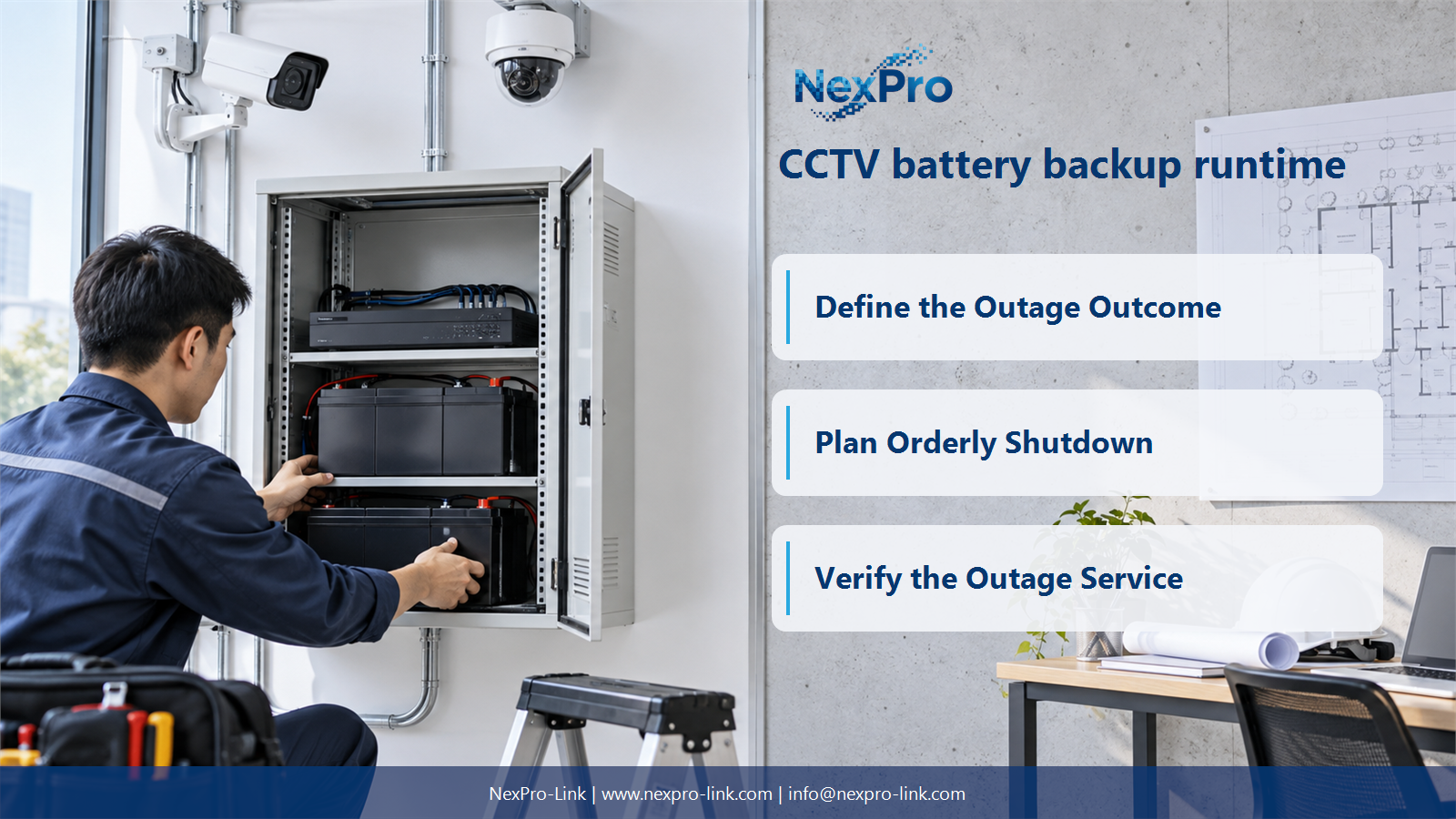
Define the Outage Outcome
Decide whether the system must bridge a short disturbance, wait for another power source, support an incident response or shut down in a controlled way. Each objective creates a different duration and load requirement. Choose the operational outcome before comparing battery sizes.
Turn the answer into a working record using Outage purpose, Required action, Protected load, Time target.
| Decision area | Buyer question | Required output |
|---|---|---|
| Define the Outage Outcome | How should CCTV backup duration be chosen? | Decide whether the system must bridge a short disturbance, wait for another power source, support an incident response or shut down in a controlled way. |
| Coordinate Generator Handover | Is generator start time the only runtime requirement? | No. |
| Plan Orderly Shutdown | What must be considered for a safe recorder shutdown? | Confirm the recorder or server's supported shutdown and restart behavior, plus any control interface involved. |
Section 02
Coordinate Generator Handover
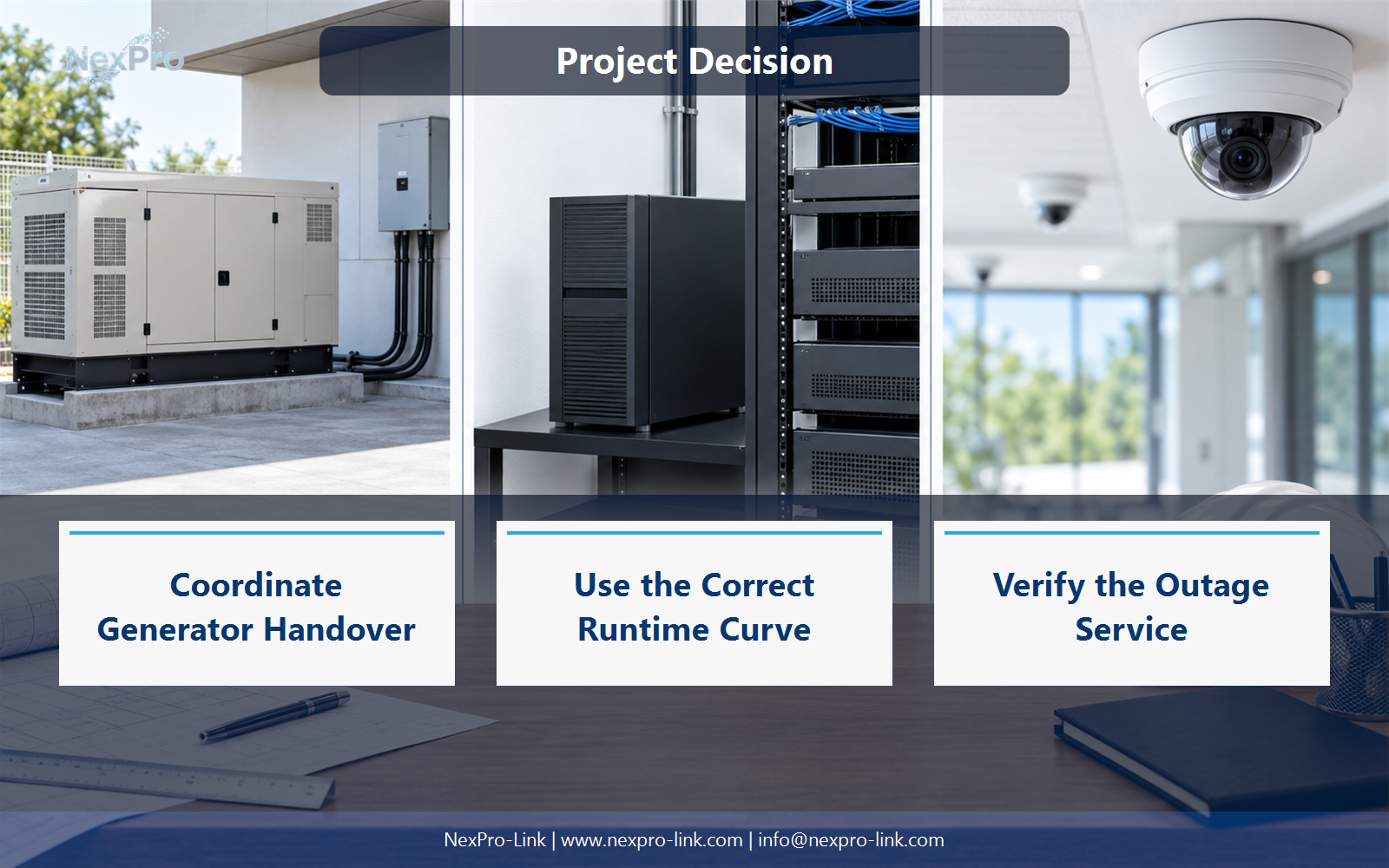
No. The system may also need to cover stabilization, transfer, failed-start attempts and the site's operating procedures. Use the actual electrical design and service objective. Do not equate one nominal start time with a complete continuity requirement.
Use Event, Duration basis, Failure allowance, Responsible system to compare options on the same basis. Keep product capability, project assumption and operating responsibility in separate columns.
Section 03
Plan Orderly Shutdown
Confirm the recorder or server's supported shutdown and restart behavior, plus any control interface involved. Allow time for the complete process under the intended load. A UPS lasting a specified number of minutes does not automatically ensure that connected devices shut down correctly.
The project output should make Device, Shutdown method, Required time, Restart behavior traceable from input to acceptance.
- Confirm the answer to: What must be considered for a safe recorder shutdown?
- Record the project fields: Device / Shutdown method / Required time / Restart behavior.
- Keep product capability, project assumptions and site responsibility in separate records.
Section 04
Use the Correct Runtime Curve
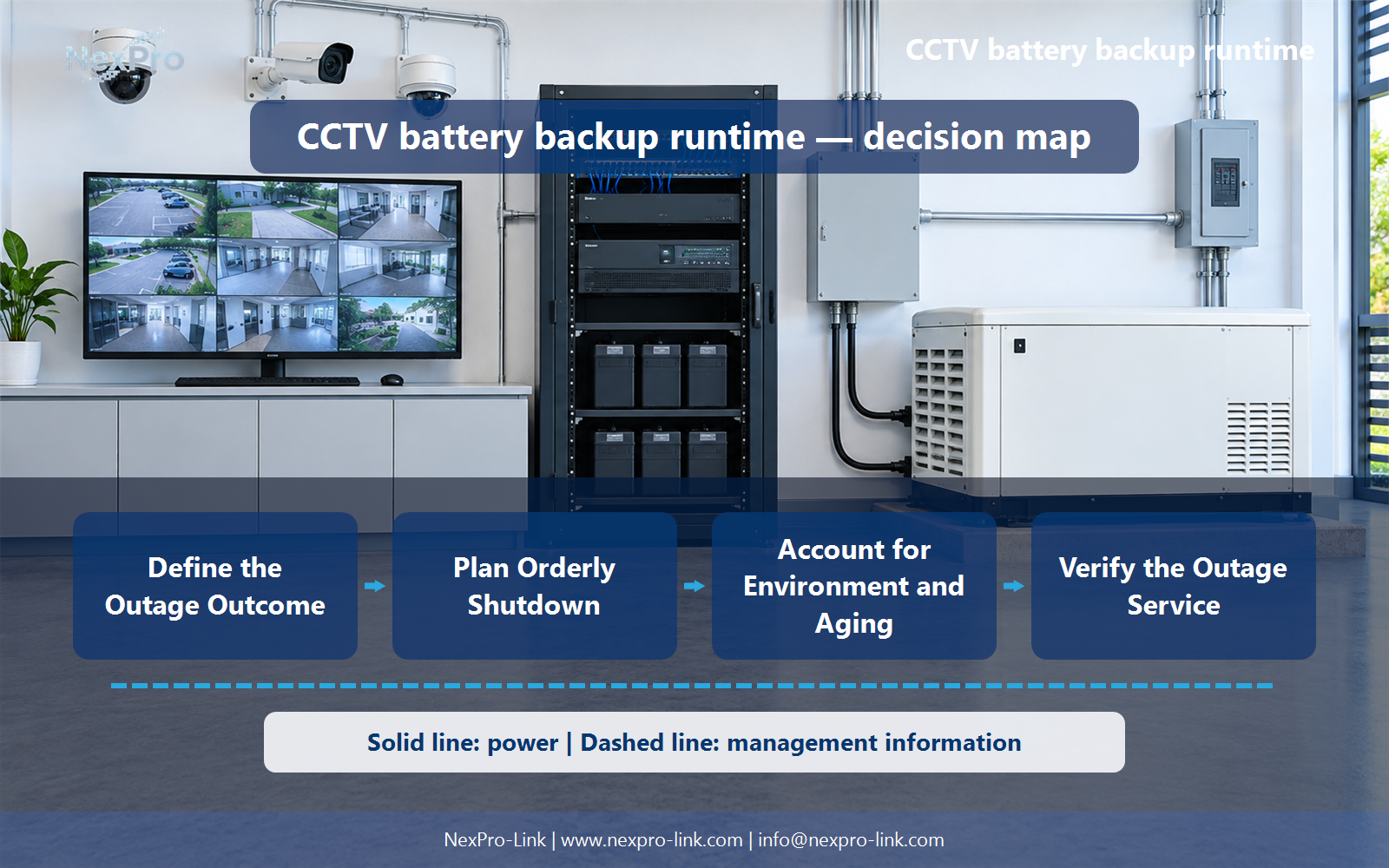
A rough energy estimate may support early comparison, but actual runtime behavior depends on battery and UPS conditions and may not be linear. Use applicable runtime data for the selected configuration and load. Keep theoretical estimates distinct from a supplied-system duration claim.
Record Configuration, Load point, Curve basis, Estimated duration before selecting a product family. That makes later substitutions possible without silently changing the operational requirement.
Section 05
Account for Environment and Aging
No. Consider the service conditions and the intended maintenance policy, including relevant temperature and battery condition. Design assumptions should state the point in the service period they address. Avoid promising the same duration indefinitely from a single new-battery result.
Review Battery condition, Temperature, Service stage, Runtime assumption with the party that will operate or maintain the system.
Section 06
Verify the Outage Service
Observe whether the required recording and network functions remain available throughout the agreed test, not just whether the UPS stays on. Coordinate the test safely with the site team. Record load and conditions so the result is not misrepresented as universal for every configuration.
Use Test condition, Load, Service continuity, Duration, Restoration as the handoff between design and procurement.
Engineering references
These sources support the general planning principles. Always use the selected product's current datasheet and applicable project standards for final design.