A footage-retrieval business case can use documented handling time even when theft-loss records are unreliable. Separate released staff capacity from cash savings and test the workflow before buying.
Section 01
Choose a retrieval task that can be measured
Build a factory security ROI case around an operating task with a repeatable start, a defined completion point and documented handling effort. Faster footage retrieval can support a business case when reliable theft-loss history is unavailable. Keep unmeasured prevention benefits outside the financial calculation, and describe the result as conditional break-even arithmetic until the project has evidence.
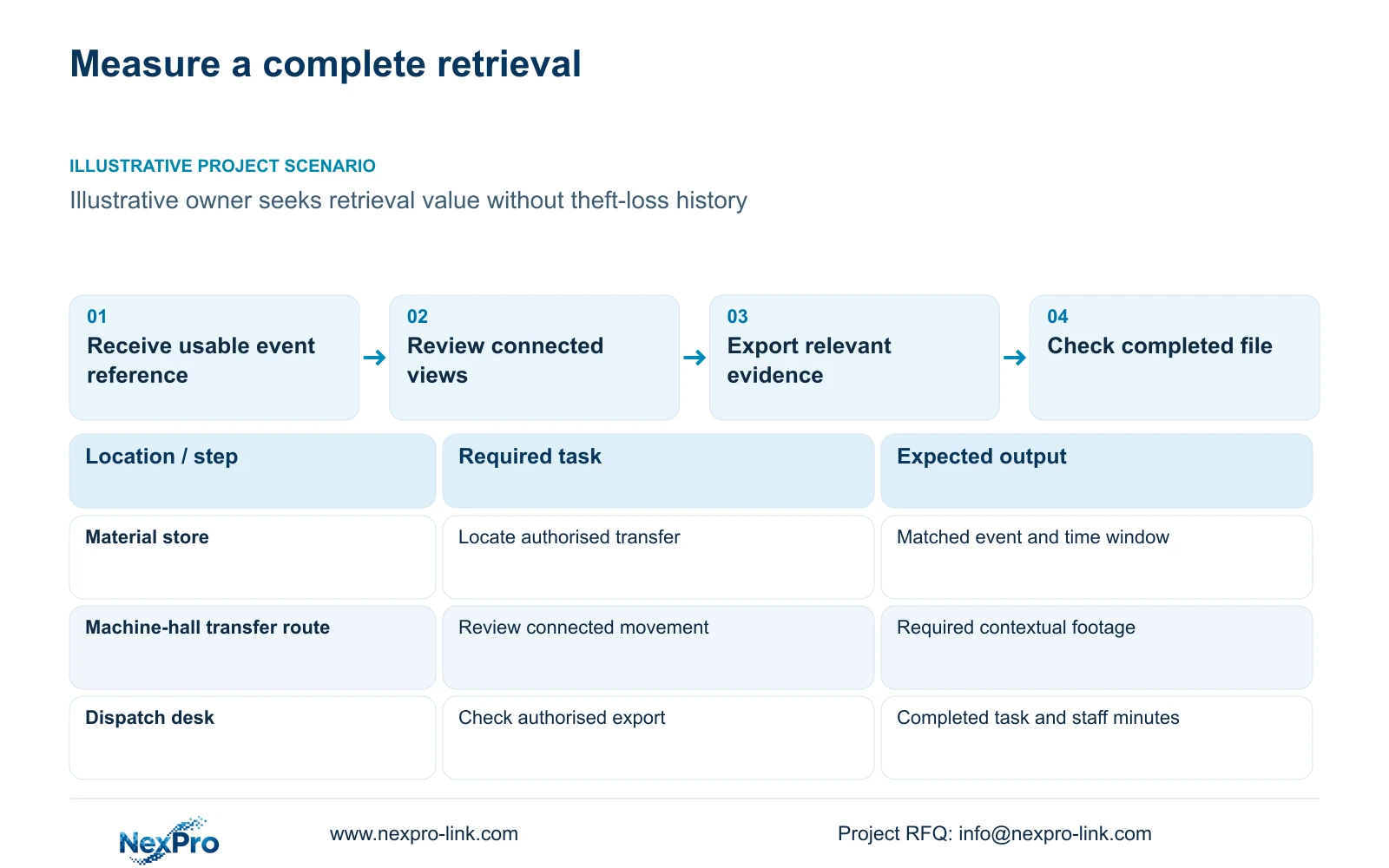
Illustrative project scenario: The owner of a hypothetical new CNC factory wants a business case for faster footage retrieval but has no reliable theft-loss history. Use CASE01's 32-camera ordinary-security layout as the operating context. Assume staff need to review material transfers between stores, permitted machine-hall routes and dispatch. The proposed workflow change concerns finding and exporting relevant footage, not machine inspection or safety control.
Define a task such as locating a dispatch handover from a supplied time reference, reviewing the connected views and delivering an authorised export. Start the timer when the operator receives a usable request; stop when the export has been checked. Record requests with missing information separately. Otherwise, a change in request quality could be mistaken for a camera or software improvement.
Section 02
Value handling effort without promising cash savings
Collect task frequency and staff minutes from a representative operating period before pricing the proposed improvement. Include locating the event, reviewing related views, exporting footage and checking the file. Record waiting time separately from active staff work. If two people participate, count their person-minutes rather than treating elapsed clock time as the whole labour input.
Ask the owner's finance or cost team to approve the hourly valuation. An internal labour rate can estimate released staff capacity, but that capacity becomes cash savings only when an identifiable expense changes. If staff remain employed on the same hours, the useful outcome may be more time for other duties. Present this distinction explicitly instead of booking the full labour value as a reduction in payroll.
Keep one-time configuration, operator training and any necessary hardware separate from recurring support or software charges. Record costs omitted from an early proposal as unresolved, not zero. The comparison should cover the same completed retrieval task and evidence quality, whether the existing system is retained, reconfigured or replaced.
Section 03
Keep investigation efficiency separate from incident prevention
Assign the financial model only to the workflow being evaluated. A shorter search may help investigate a disputed transfer, but it does not establish that fewer incidents will occur. Without a reliable baseline and a defensible method, do not multiply supposed prevented incidents by a guessed loss value. The owner can still document prevention as an unpriced objective.
Preserve the investigation result when defining a faster workflow. Relevant footage may require the approach, handover and departure across several views. Reducing unnecessary exports is reasonable; cutting out context to meet a timing target is not. Record which views and time windows the reviewer needs, and verify that the exported files are usable outside the operator's viewing session.
The reference case assumes 30 days of continuous recording at 4 Mbps per camera. That produces 41.472 TB of video against its already-reserved 48.64 TB video budget. These illustrative quantities establish a retention basis, not a search-speed result. If the workflow trial changes recording settings or event-only capture, reassess whether the same events remain available before comparing handling time.
Section 04
Calculate a conditional break-even from declared inputs
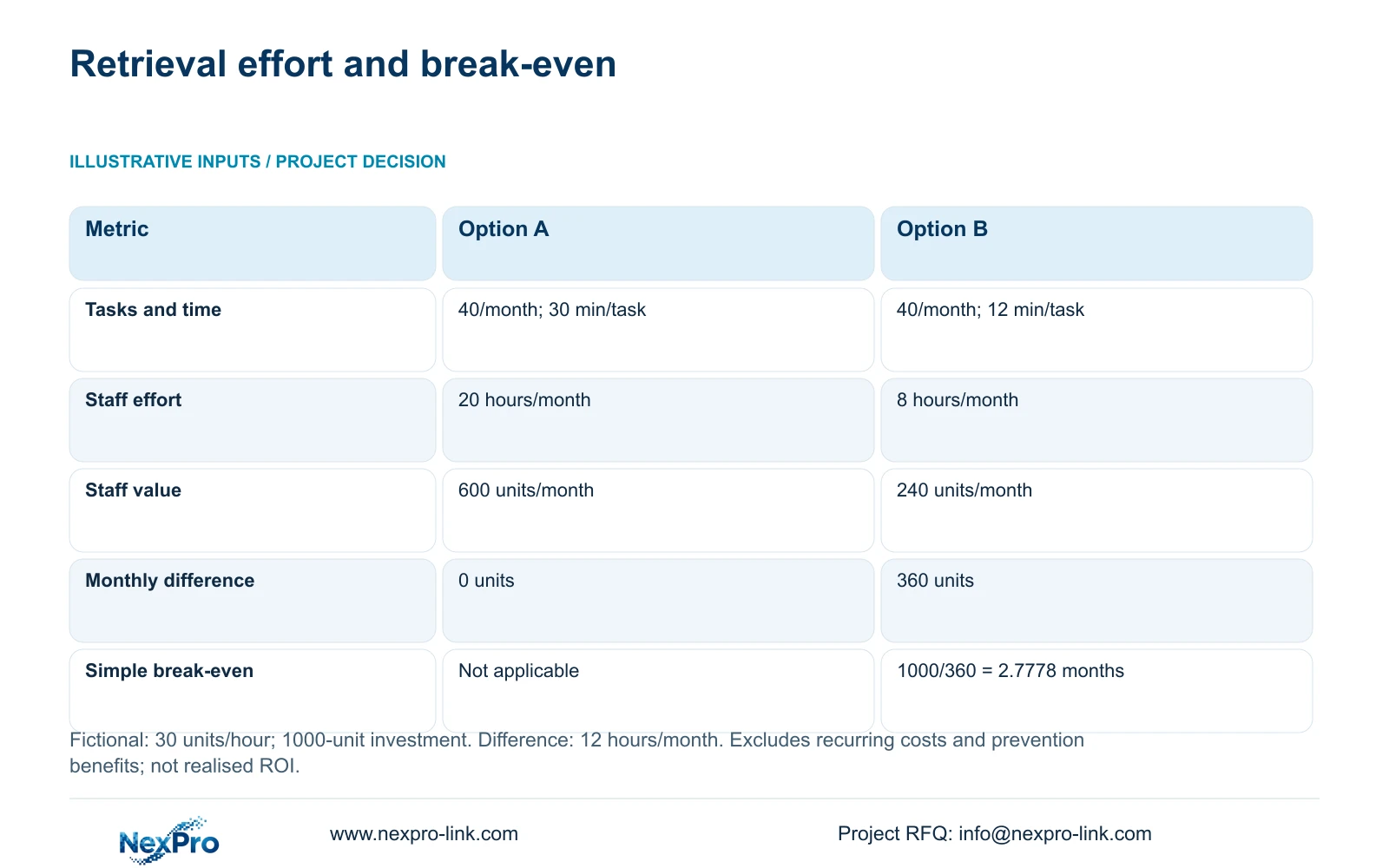
Use the supplied fictional inputs: 40 retrieval tasks per month, 30 minutes per task for Option A and 12 minutes for Option B, with staff effort valued at 30 monetary units per hour. Assume a one-time workflow investment of 1,000 units. These are editorial planning values, with no specified currency, market quotation or loss-prevention benefit.
The formulas are monthly_hours = tasks × minutes / 60 and monthly_staff_value = monthly_hours × hourly_rate. Option A requires 40 × 30 / 60 = 20 hours, valued at 600 units per month. Option B requires 40 × 12 / 60 = 8 hours, valued at 240 units. The difference is 12 hours and 360 units per month. Simple_break_even_months = 1,000 / 360 = 2.7778, approximately 2.78 months.
The decisive input is the assumed 18-minute reduction on the same complete task. No recorder specification establishes it. The table values released capacity; the payback depends on whether the owner accepts that value as a benefit. Recurring charges reduce the monthly difference, while transition effort can increase the investment. If the resulting net monthly benefit is zero or negative, there is no positive simple break-even on this basis.
| Metric | Option A: existing workflow | Option B: proposed workflow |
|---|---|---|
| Tasks per month | 40 | 40 |
| Minutes per completed task | 30 | 12 |
| Staff hours per month | 20 | 8 |
| Staff value per month | 600 units | 240 units |
| Monthly difference | 0 units | 360 units |
| Simple break-even | Not applicable | 2.7778 months |
Section 05
Test the workflow before funding a wider replacement
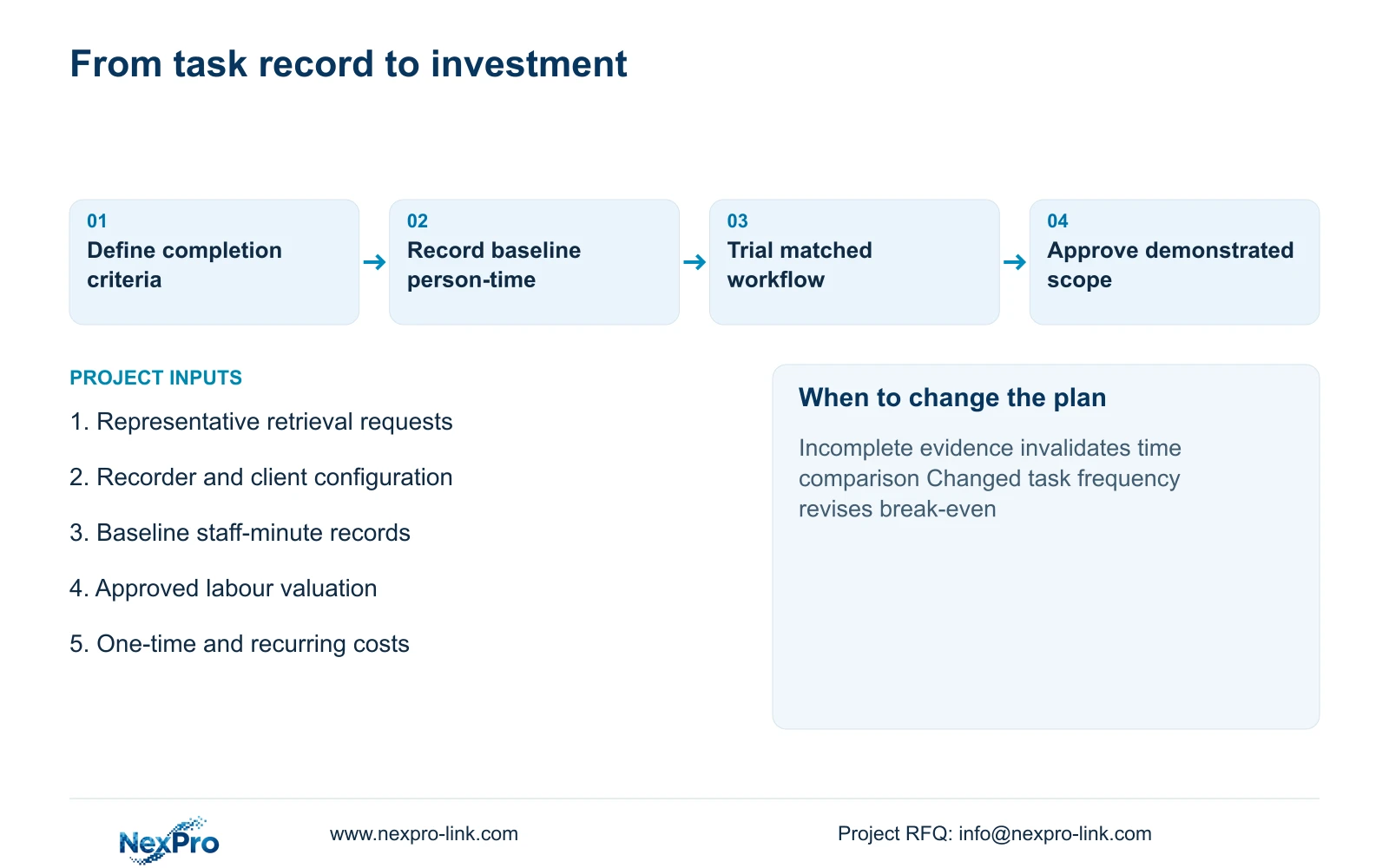
Prefer a bounded workflow trial before replacing cameras or adding a display wall. Begin with location naming, a usable event-reference format, operator permissions and an agreed export procedure. Keep the underlying observation and retention tasks unchanged. Where the existing equipment can complete the task, a configuration or training change may be the appropriate investment to evaluate.
For CASE01, the NexPro-NVR4449-4K is a recording candidate with a listed 49-channel catalogue, 320 Mbps input and four SATA bays. Those fields can inform equipment suitability, but they do not quantify retrieval time, simultaneous playback or export speed. Request a demonstration using the required views, stream settings and operator procedure. Any proposed Seetong client workflow should also be demonstrated on the exact configuration rather than assumed from general app availability.
Run comparable requests through both workflows and retain the original task records. Note unsuccessful searches, incomplete exports and operator assistance alongside time. Change the recommendation if faster handling requires missing integration, additional concurrent playback capacity or an enterprise workflow the existing configuration cannot support. Compare qualified alternatives on that required function and complete cost scope, without assigning a brand-wide performance winner.
Section 06
Turn the accepted business case into a limited supply scope
Convert the trial result into a purchase scope with clear deliverables. Identify retained cameras and recording hardware, any justified replacements, configuration work, operator instruction and the acceptance demonstration. Specify who supplies event references and who may authorise exports. An equipment supplier cannot correct an undefined request process solely by changing a recorder.
NexPro-Link's Factory & Warehouse project-supply and BOQ support scopes provide routes for discussing equipment matching, technical documents and quotation coordination. Ask for a task-based proposal showing what is supplied and what the local integrator or owner must provide. If replacement hardware is justified, project labels and packing can preserve the connection between each device and its approved location.
After implementation, compare observed task frequency and handling effort with the approved assumptions. Record released staff capacity separately from realised cash savings, and revise the business case when requests, staffing or recurring costs change. Preserve any required platform, specialist scope and local installation responsibilities. The procurement decision should remain traceable to the demonstrated retrieval outcome rather than the original 2.78-month illustration.
Section 07
Buyer questions
Can we use the model when the factory has not opened? Yes, as a conditional planning comparison. Use representative staged retrieval requests and label task frequency as an assumption. Replace it with operating records after opening before reporting achieved savings or payback.
What if some footage requests take much longer than others? Group requests by comparable task, such as a single-location handover or a multi-view transfer review. Keep each group's frequency and handling time visible so easy requests do not conceal difficult or unsuccessful searches.
Does exporting less video prove the operator saves time? No. File volume can be calculated from bitrate and duration, but locating, reviewing and checking evidence are separate activities. Measure the complete workflow and preserve the necessary event context.
Section 08
Scope a footage-retrieval workflow trial
Send representative retrieval requests, the current recorder and client configuration, baseline handling records, and the proposed investment scope to info@nexpro-link.com to discuss a task-based demonstration and equipment proposal.
Engineering references
These sources support the general planning principles. Always use the selected product's current datasheet and applicable project standards for final design.