A hotel operator receives a NexPro-Link CCTV package and needs staff to handle normal viewing, playback and support requests. Teach the tasks staff are authorized to perform most often: finding views, retrieving a time period and requesting assistance.
Section 01
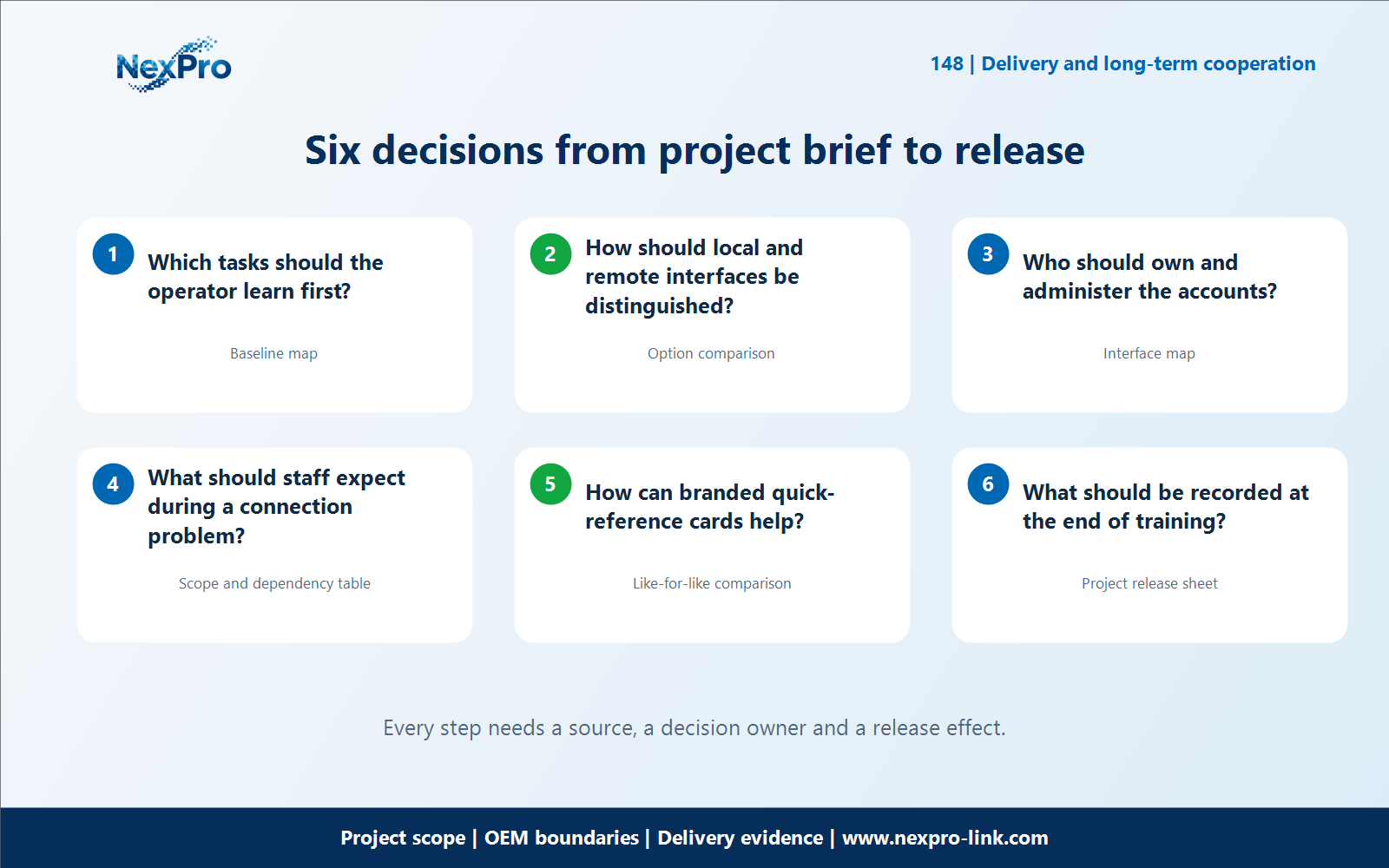
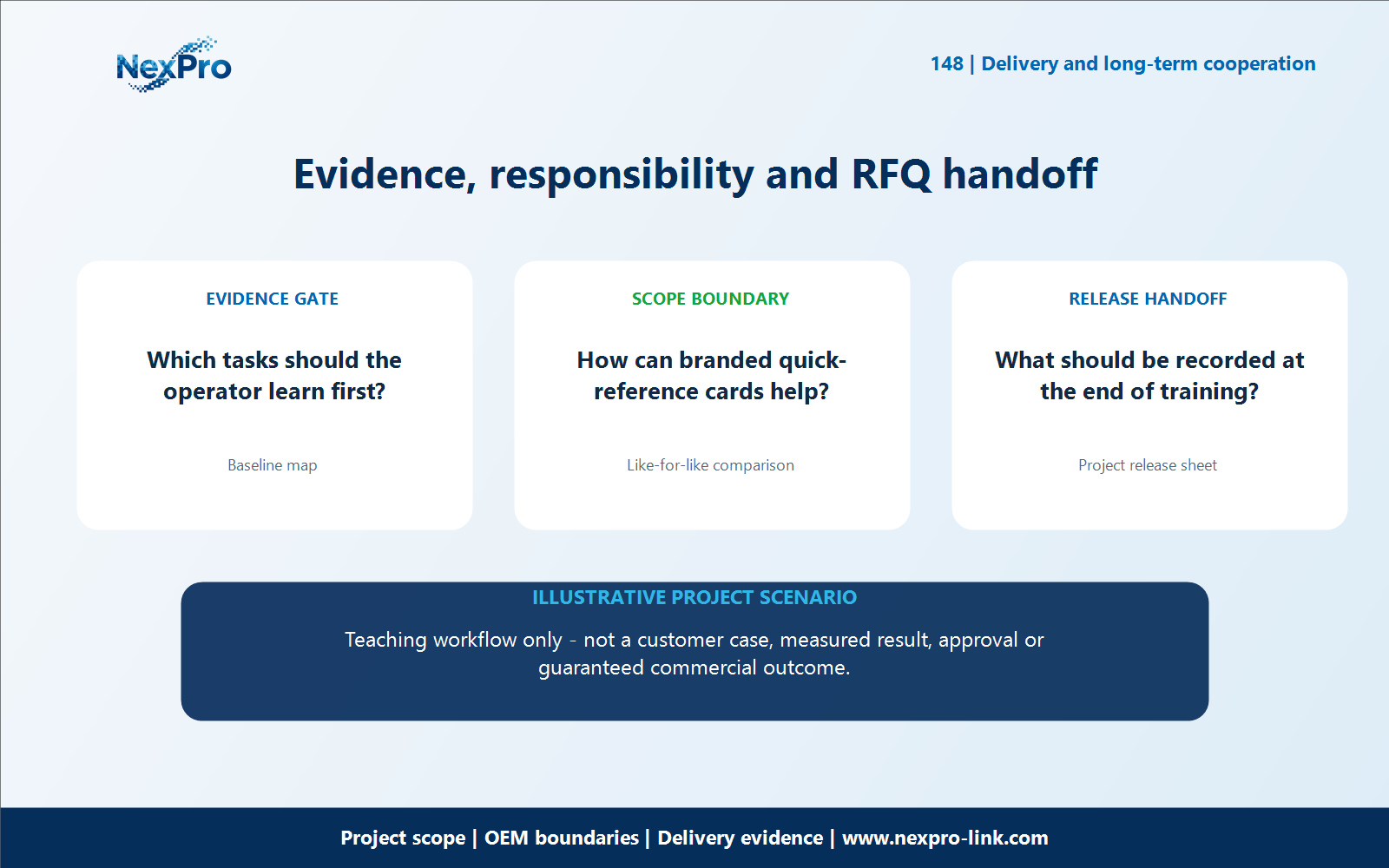
Which tasks should the operator learn first?
A hotel operator receives a NexPro-Link CCTV package and needs staff to handle normal viewing, playback and support requests. Teach the tasks staff are authorized to perform most often: finding views, retrieving a time period and requesting assistance. Add export or event handling where those functions are part of the agreed workflow. A useful session follows the operator's job rather than every available settings page.
For the "Which tasks should the operator learn first" decision, use the baseline map fields Area or item, Required task, Current assumption, Decision owner. Apply it to seetong project operator training so the buyer, supplier and local integrator can see which input is confirmed, who owns it and which evidence remains open.
Evaluate which tasks should the operator learn first against the stated site task and the surrounding equipment, documentation, packing and handover dependencies for seetong project operator training. For which tasks should the operator learn first in seetong project operator training, record the confirmed condition, chosen option and remaining evidence separately; an open value is not a price, test, approval or customer-result claim.
Carry the which tasks should the operator learn first decision into the RFQ, BOQ, configuration or release record for seetong project operator training. For which tasks should the operator learn first in seetong project operator training, name the equipment, artwork, network, installation and acceptance owner; site-specific work remains with the buyer or integrator unless the signed scope says otherwise.
Section 02
How should local and remote interfaces be distinguished?
How should local and remote interfaces be distinguished? Show the local recorder interface separately from the relevant PC or mobile client. Their controls and available functions may differ. Training should use the selected devices and versions so operators do not expect a step shown on one interface to exist identically on another. For Seetong-Based Project Handover: Train Operators on Tasks, Not Every Menu, keep this decision tied to the same project brief rather than opening a separate generic specification exercise.
For the "How should local and remote interfaces be distinguished" decision, use the option comparison fields Position or option, Suitable condition, Trade-off, Next choice. Apply it to seetong project operator training so the buyer, supplier and local integrator can see which input is confirmed, who owns it and which evidence remains open.
Evaluate how should local and remote interfaces be distinguished against the stated site task and the surrounding equipment, documentation, packing and handover dependencies for seetong project operator training. For how should local and remote interfaces be distinguished in seetong project operator training, record the confirmed condition, chosen option and remaining evidence separately; an open value is not a price, test, approval or customer-result claim.
Carry the how should local and remote interfaces be distinguished decision into the RFQ, BOQ, configuration or release record for seetong project operator training. For how should local and remote interfaces be distinguished in seetong project operator training, name the equipment, artwork, network, installation and acceptance owner; site-specific work remains with the buyer or integrator unless the signed scope says otherwise.
Section 03
Who should own and administer the accounts?
Who should own and administer the accounts? Assign account ownership and administration to the authorized organization and roles. Review installation access at handover and define how staff changes are handled. Training should explain the approved access process without distributing one permanent administrator credential to every user. For Seetong-Based Project Handover: Train Operators on Tasks, Not Every Menu, keep this decision tied to the same project brief rather than opening a separate generic specification exercise.
For the "Who should own and administer the accounts" decision, use the interface map fields Device or record, Input, Output, Responsible party. Apply it to seetong project operator training so the buyer, supplier and local integrator can see which input is confirmed, who owns it and which evidence remains open.
Evaluate who should own and administer the accounts against the stated site task and the surrounding equipment, documentation, packing and handover dependencies for seetong project operator training. For who should own and administer the accounts in seetong project operator training, record the confirmed condition, chosen option and remaining evidence separately; an open value is not a price, test, approval or customer-result claim.
Carry the who should own and administer the accounts decision into the RFQ, BOQ, configuration or release record for seetong project operator training. For who should own and administer the accounts in seetong project operator training, name the equipment, artwork, network, installation and acceptance owner; site-specific work remains with the buyer or integrator unless the signed scope says otherwise.
| Project question | Project-oriented treatment | Keep equal when comparing offers |
|---|---|---|
| Which tasks should the operator learn first? | Teach the tasks staff are authorized to perform most often: finding views, retrieving a time period and requesting assistance. | Actual supplied equipment and stage |
| How should local and remote interfaces be distinguished? | Show the local recorder interface separately from the relevant PC or mobile client. | Ownership of installation and support tasks |
| Who should own and administer the accounts? | Assign account ownership and administration to the authorized organization and roles. | Branding and configuration references |
| What should staff expect during a connection problem? | Explain the difference between a remote-viewing problem and a recording failure. | Confirmed order versus planned follow-up |
Section 04
What should staff expect during a connection problem?
What should staff expect during a connection problem? Explain the difference between a remote-viewing problem and a recording failure. Staff should know what they can check safely and what information to report. An unavailable app view is not by itself proof that local recording has stopped or that footage has been lost. For Seetong-Based Project Handover: Train Operators on Tasks, Not Every Menu, keep this decision tied to the same project brief rather than opening a separate generic specification exercise.
For the "What should staff expect during a connection problem" decision, use the scope and dependency table fields Item, Included, Dependency, Separate option. Apply it to seetong project operator training so the buyer, supplier and local integrator can see which input is confirmed, who owns it and which evidence remains open.
Evaluate what should staff expect during a connection problem against the stated site task and the surrounding equipment, documentation, packing and handover dependencies for seetong project operator training. For what should staff expect during a connection problem in seetong project operator training, record the confirmed condition, chosen option and remaining evidence separately; an open value is not a price, test, approval or customer-result claim.
Carry the what should staff expect during a connection problem decision into the RFQ, BOQ, configuration or release record for seetong project operator training. For what should staff expect during a connection problem in seetong project operator training, name the equipment, artwork, network, installation and acceptance owner; site-specific work remains with the buyer or integrator unless the signed scope says otherwise.
Section 05
How can branded quick-reference cards help?
How can branded quick-reference cards help? Use a concise card with the agreed task steps and support contact, in the appropriate language where arranged. Keep credentials and private project data out of general copies. Branding helps staff identify the service route while accurate instructions make the card worth keeping. For Seetong-Based Project Handover: Train Operators on Tasks, Not Every Menu, keep this decision tied to the same project brief rather than opening a separate generic specification exercise.
For the "How can branded quick-reference cards help" decision, use the like-for-like comparison fields Requirement, Baseline, Proposed treatment, Remaining difference. Apply it to seetong project operator training so the buyer, supplier and local integrator can see which input is confirmed, who owns it and which evidence remains open.
Evaluate how can branded quick-reference cards help against the stated site task and the surrounding equipment, documentation, packing and handover dependencies for seetong project operator training. For how can branded quick-reference cards help in seetong project operator training, record the confirmed condition, chosen option and remaining evidence separately; an open value is not a price, test, approval or customer-result claim.
Carry the how can branded quick-reference cards help decision into the RFQ, BOQ, configuration or release record for seetong project operator training. For how can branded quick-reference cards help in seetong project operator training, name the equipment, artwork, network, installation and acceptance owner; site-specific work remains with the buyer or integrator unless the signed scope says otherwise.
Section 06
What should be recorded at the end of training?
What should be recorded at the end of training? Record the tasks covered, the relevant materials and any unresolved questions. Keep the record specific to what actually occurred. Training supports effective operation, but it should not be described as proof that every user has mastered every function or will never need further assistance. For Seetong-Based Project Handover: Train Operators on Tasks, Not Every Menu, keep this decision tied to the same project brief rather than opening a separate generic specification exercise.
For the "What should be recorded at the end of training" decision, use the project release sheet fields Configuration, Artwork, Quantity, Location, Release stage. Apply it to seetong project operator training so the buyer, supplier and local integrator can see which input is confirmed, who owns it and which evidence remains open.
Evaluate what should be recorded at the end of training against the stated site task and the surrounding equipment, documentation, packing and handover dependencies for seetong project operator training. For what should be recorded at the end of training in seetong project operator training, record the confirmed condition, chosen option and remaining evidence separately; an open value is not a price, test, approval or customer-result claim.
Carry the what should be recorded at the end of training decision into the RFQ, BOQ, configuration or release record for seetong project operator training. For what should be recorded at the end of training in seetong project operator training, name the equipment, artwork, network, installation and acceptance owner; site-specific work remains with the buyer or integrator unless the signed scope says otherwise.
Engineering references
These sources support the general planning principles. Always use the selected product's current datasheet and applicable project standards for final design.