Rank missing inputs by the decision they block: task definition, environmental suitability, route quantity or recording resources. Ask for the smallest next input that closes the current decision, while retaining provisional assumptions elsewhere.
Section 01
Send the operating brief with the site information you have
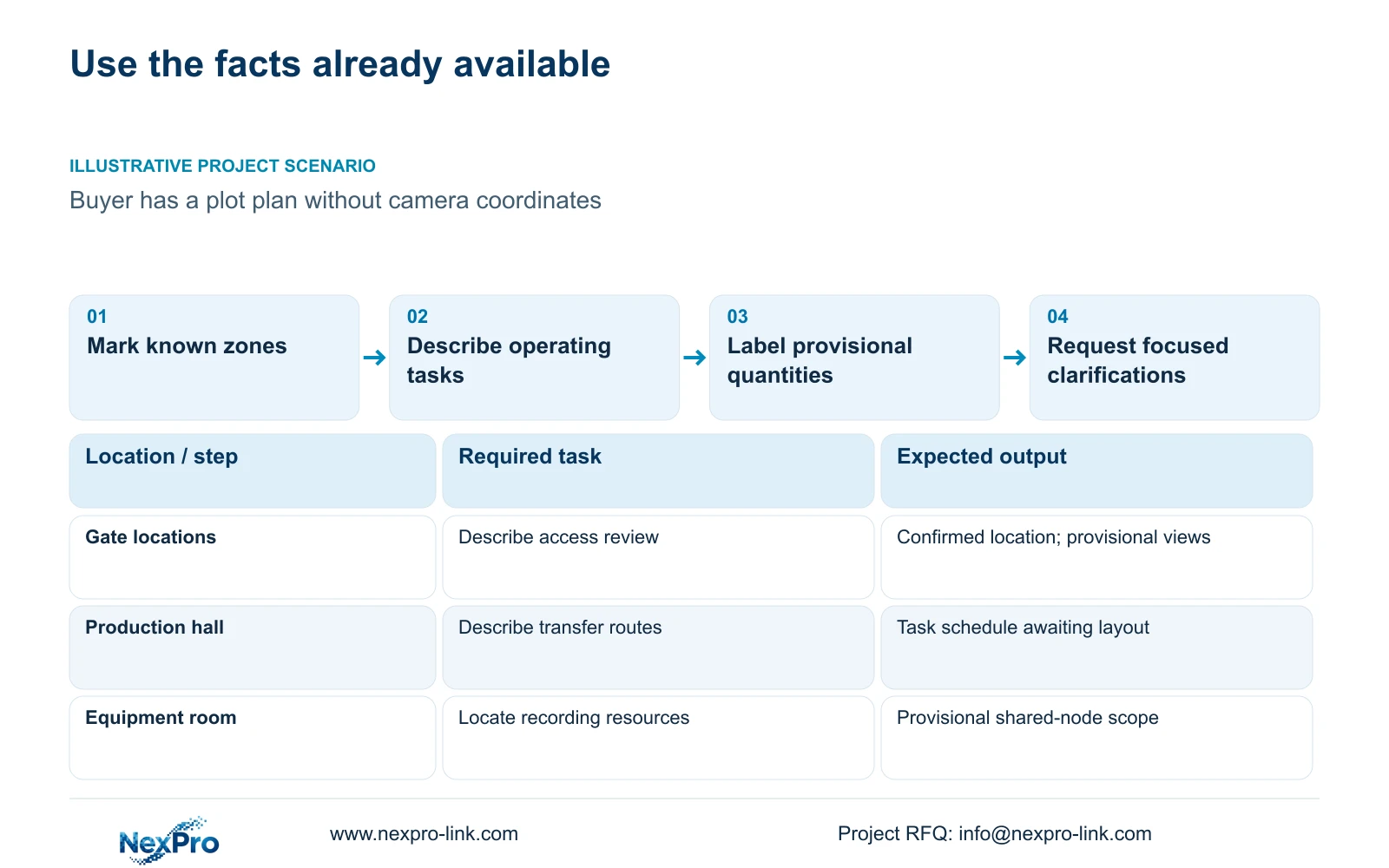
Rank missing inputs by the decision they block: task definition, environmental suitability, route quantity or recording resources. Ask for the smallest next input that closes the current decision, while retaining provisional assumptions elsewhere. This staged response can advance discussion without issuing final installation quantities or treating photographs as a complete design.
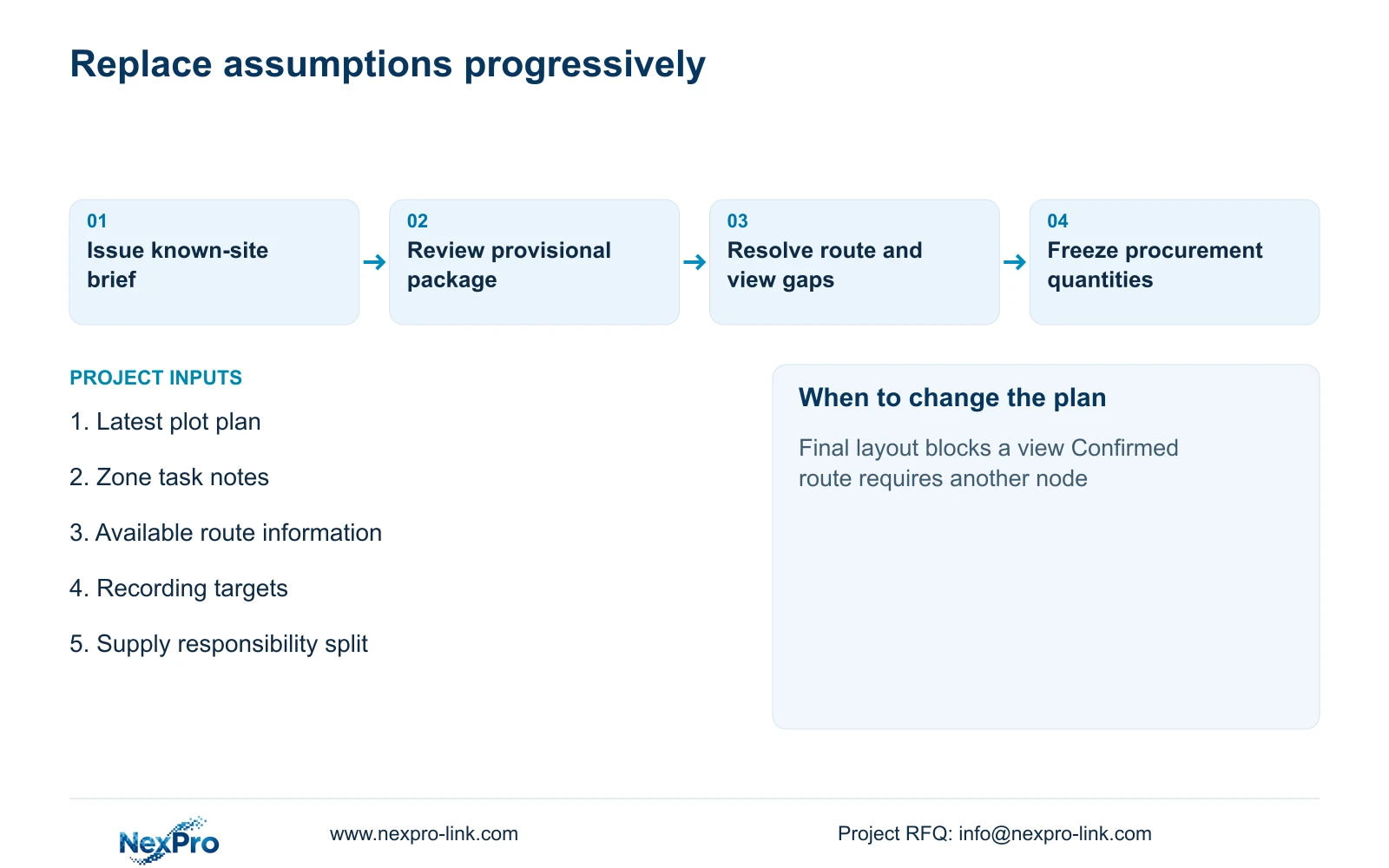
For a factory security RFQ with incomplete drawings, send the available plot plan, zone purposes, known access routes and recording goals first. Ask for a preliminary equipment package with declared assumptions and a short list of missing information. Do not describe that response as a finished installation design. A supplier can discuss a useful scope before final coordinates exist, provided the uncertainty remains visible.
Illustrative project scenario: The buyer has a plot plan and gate count but no final camera schedule. Assume the owner wants access and material-transfer review in a new CNC factory, while production layouts and cable routes remain unfinished. The supplied 32-camera reference can illustrate how tasks become a package, but its quantities are not automatically the correct answer for this buyer.
Mark the drawing's revision and distinguish surveyed dimensions from schematic lines. Describe what happens at the gates, stores, transfer routes and dispatch areas, including operating hours and who retrieves footage. Include any known mandatory brand or platform condition. A gate count alone does not determine camera quantity, plate-reading equipment or barrier-control scope.
Section 02
Give fixed facts and provisional quantities different statuses
Create a first schedule with confirmed, provisional and unresolved fields. Known gate locations can be confirmed while their camera positions remain provisional. An owner-approved retention target can be fixed even when final camera count is unknown. Do not label every line provisional merely because the drawing is incomplete; that hides the decisions the project team has already made.
CASE01 allocates four gate views, six store views, ten transfer views, four common-route views, six dispatch views and two equipment-room views. Those total 32 cameras through named tasks. Use that method to build the buyer's own schedule. Ask the owner to accept the task groups before the engineer refines their actual views and mounting locations.
Keep cable routes and local electrical nodes separate from the camera count. CASE01's 1,872 m and seven 305 m reels depend on its assumed 41 to 76 m continuous links and cutting plan. An unfinished tray layout cannot justify copying those quantities into a firm order. Record what route information would allow the estimate to be replaced.
Section 03
Request a response that identifies the next decisions
The first supplier response should contain a zone-task schedule, candidate equipment roles, a shared-infrastructure outline, scope status and focused clarifications. Preserve any existing BOQ references and units. If there is no BOQ yet, use stable provisional zone tags that can later be mapped to the tender. Avoid asking for an unexplained total price based only on floor area.
A useful clarification asks for a decision-changing input. Examples include whether recording is continuous, whether the network is owner-provided, where suitable equipment rooms are located and whether gate footage must connect to another platform. Assign one owner to each interface. The local contractor should identify installation and route constraints rather than leaving those duties implicitly with the equipment supplier.
Candidate models can be discussed before final placement, but qualify the selection. A motorized lens offers adjustment within its stated range; it cannot recover a view blocked by the final machine layout. A recorder candidate needs the accepted stream modes and storage demand. Keep those dependencies beside the proposed equipment instead of treating the catalogue as a complete design.
Section 04
Compare a recording-first allowance with a defined expanded scope
Use two preliminary options only where they answer a real owner choice. Option A provides the required recording and retrieval scope, with installation quantities still identified as provisional. Option B retains that outcome and adds a defined management or integration workflow. An incomplete drawing should not become a reason to include every possible software or display addition.
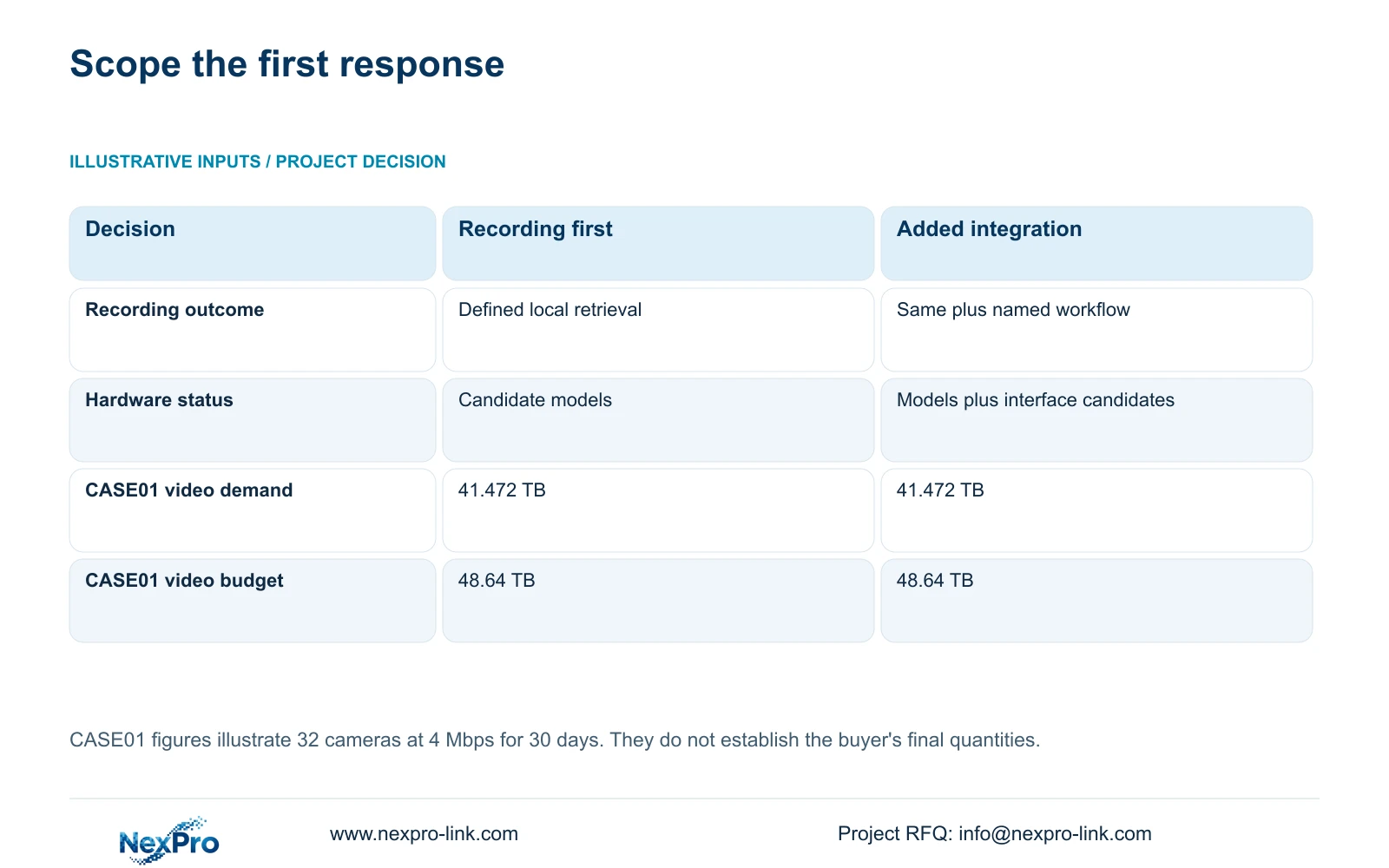
The supplied scope matrix becomes a practical RFQ comparison below. The decisive difference is the added workflow and its dependencies, not confidence in camera placement. Both options still need a completed view schedule and routes. Where an external interface is mandatory, include it in the required option and request evidence rather than presenting it as an enhancement.
For a clearly labelled 32-camera allowance, the CASE01 formula is video_TB = 32 × 4 × 10^6 × 86400 × 30 / 8 / 10^12 = 41.472 TB. Its four 16 TB drives yield 64 × 0.95 × 0.80 = 48.64 TB of illustrative video budget. This explains the scale of the shared storage line without asserting a fixed bitrate or final disk order.
| RFQ decision | Option A: recording first | Option B: defined integration |
|---|---|---|
| Required outcome | Local recording and authorised retrieval | Same outcome plus named workflow |
| Hardware identity | Candidate models and provisional tags | Same plus interface candidates |
| Network and power | Required nodes provisionally identified | Added processing resources identified |
| Software and access | Necessary roles and export | Additional workflow subject to evidence |
| Pricing status | Declared quantity and route assumptions | Same assumptions plus integration boundary |
Section 05
Decide what can progress before final drawings
Recommend a preliminary recording-first response when the immediate goal is a concept budget or supplier discussion. It lets the owner confirm scope and the cost team identify major package components. Keep route-sensitive materials, mounts and installation quantities open until the relevant information arrives. A preliminary quote can be useful without being safe to release unchanged for construction.
Revisit the package when final layouts change sightlines, a remote node becomes necessary or the buyer changes retention. A longer route can affect cabling architecture and local power rather than just metres. A new display or processing server changes the load list. These changes should be traced through the affected items instead of applying a broad percentage adjustment to the old total.
Known mandatory platform, specialist environment and approval conditions should be disclosed in the first RFQ. They may determine the architecture before camera coordinates are available. Supplier registration and model approval can proceed under the buyer's process, but neither transforms assumed quantities into verified installation requirements.
Section 06
Turn the preliminary package into a controlled procurement issue
As information improves, replace assumptions with drawing references and named decisions. Keep a revision record showing which zone quantities, routes or interfaces changed and why. The first schedule should remain useful as a comparison baseline, with superseded assumptions clearly identified. This prevents a later supplier response from looking cheaper solely because it uses a different scope.
NexPro-Link's Factory & Warehouse project-supply scope provides a relevant starting point for equipment-package discussion. BOQ & Tender Support can connect the developing schedule to model matching, technical documents and quotation coordination. Configuration and project packing should follow the approved revision, while local design and installation remain assigned to the project team.
The next-information request should be small enough to answer. Ask for the missing camera task, route, recording or responsibility input that changes the package, not an entire confidential project archive. A scoped preliminary response should make the next engineering action obvious and keep the buyer in control of which assumptions become procurement commitments.
Section 07
Buyer questions
Can site photographs replace a drawing in the first RFQ? They can supplement a marked sketch and explain obstructions or mounting conditions. Identify where each photograph was taken; photographs alone usually do not establish measured routes or a complete point schedule.
What if we have no baseline model list? State the required observation and recording tasks and any mandatory platform conditions. Ask for candidate roles and a provisional schedule rather than inventing model references to complete the form.
Should a preliminary price include installation? Specify the requested boundary. If installation is included, identify route and access assumptions separately so its allowance is not confused with a firm equipment-supply price.
Section 08
Start with a scoped preliminary factory RFQ
Send your latest plot plan, zone-and-route notes, recording targets and known owner-supplied or installer scope to info@nexpro-link.com for a preliminary package with explicit assumptions and a focused next-information request.
Engineering references
These sources support the general planning principles. Always use the selected product's current datasheet and applicable project standards for final design.