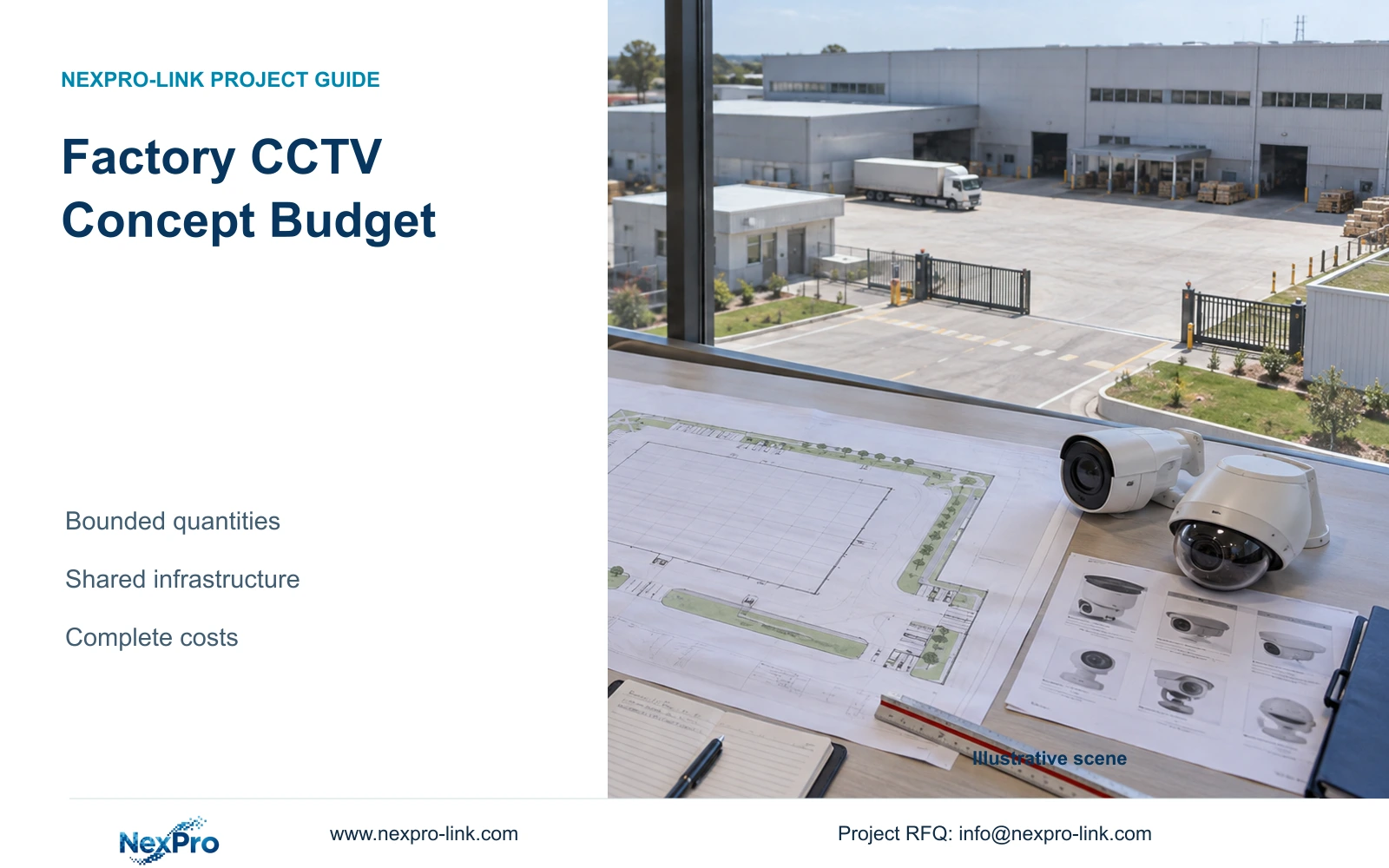
A building outline can support a useful CCTV concept budget when camera quantities remain bounded assumptions and shared infrastructure is priced separately.
Section 01
Estimate defined tasks from the geometry available
A factory CCTV concept budget can estimate task groups, provisional equipment quantities and shared infrastructure before a site survey. It cannot settle mounting positions, routed cable lengths or image acceptance from a building outline alone. Present a lower-scope option and a broader option with explicit differences, then identify what information will convert each allowance into a purchase quantity.
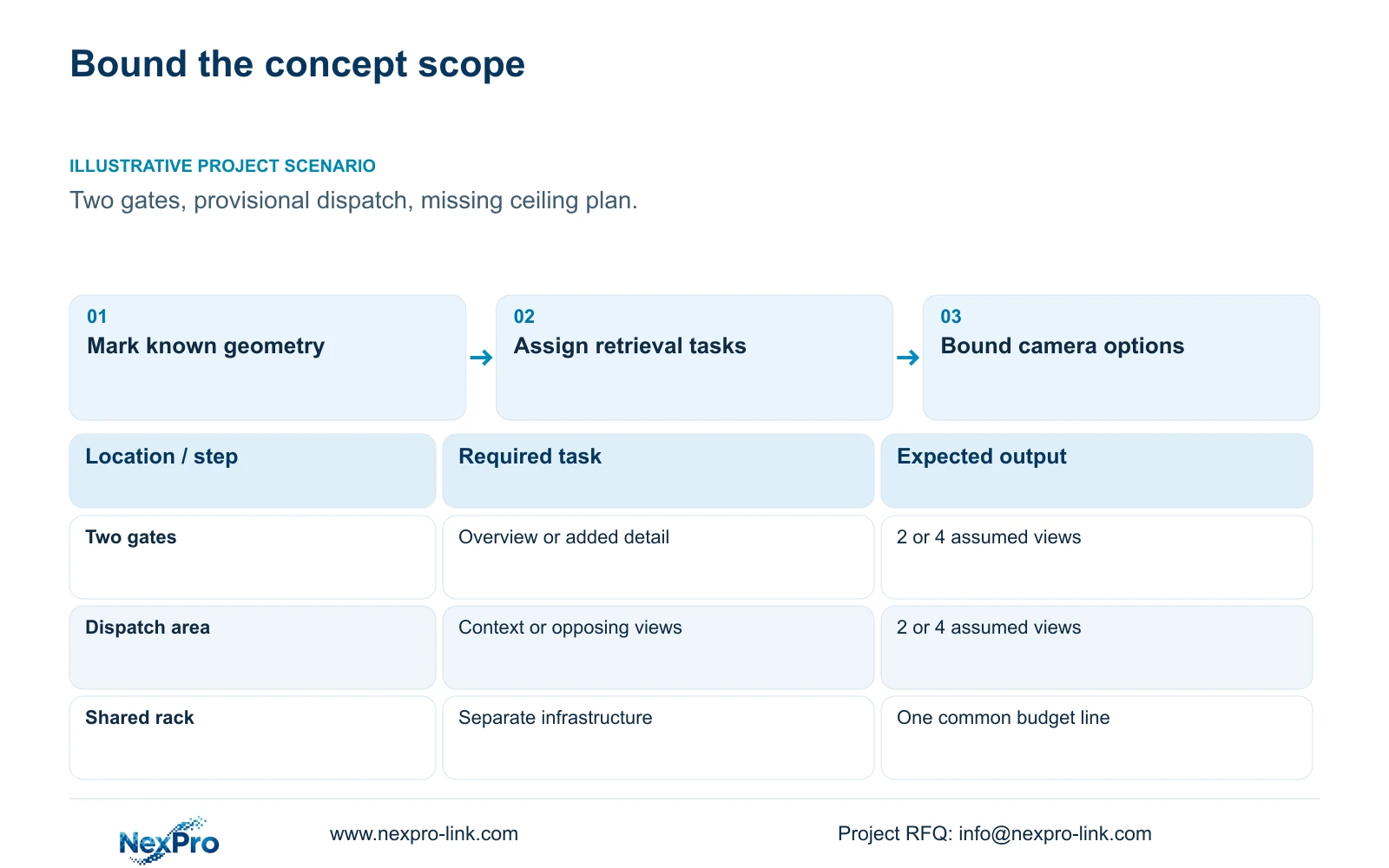
Illustrative project scenario: An overseas estimator has a building outline, two gates and a provisional dispatch area but no reflected ceiling plan. Assume the owner wants to review site access and material handovers. Gate locations provide a reasonable starting point, while dispatch positions remain conditional on the final loading arrangement. These are planning assumptions, not findings from an inspected factory.
Mark the drawing with its revision, available dimensions and confidence limits. Ask the owner which events must be retrievable and during which shifts. A fixed gate location does not establish its useful camera angle, and a provisional dispatch rectangle does not establish how parked vehicles will obscure loading. Record those gaps beside the affected scope rather than burying them in a general exclusion.
Section 02
Build low and high quantities from named views
For this scenario, a lower-scope planning option could allow one overview at each gate and two provisional dispatch views, giving four camera positions. A broader option could add one dedicated detail view at each gate and two opposing dispatch views, giving eight positions. These illustrative counts describe different tasks; they are not lower and upper guarantees for the entire factory.
Keep stores, internal routes and machine-hall transfers outside that four-to-eight-position boundary until their tasks are defined. The supplied 32-camera CNC reference illustrates a fuller schedule: four gate overviews, six store views, ten permitted machine-hall transfer views, four common-route views, six dispatch views and two equipment-room approaches. Its count follows those declared tasks and should not be copied into this incomplete outline.
Show the infrastructure consequences beside each option. Extra detail cameras require recording channels, power and terminations, while a new remote cabinet may introduce a separate backbone and electrical supply. A common recorder or cabinet should appear once in the budget. Special environments need their own requirement and allowance because an ordinary camera quantity cannot represent specialist protection.
Section 03
Keep estimating allowances separate from order lines
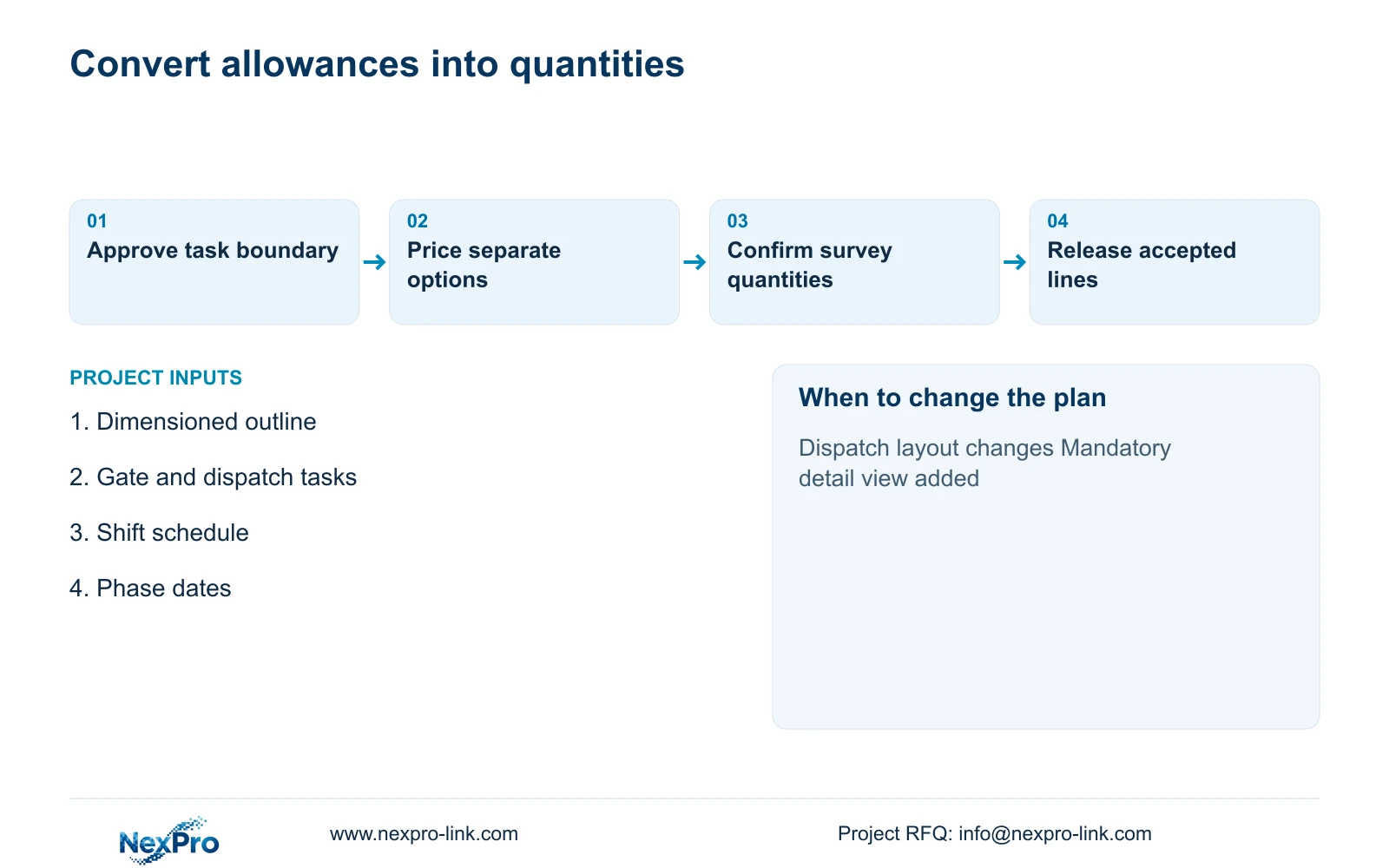
Give every allowance a status and a conversion condition. The estimator owns the provisional quantity; the engineer confirms the view and connection; the local installer confirms mounting and routing. For example, the two dispatch views become orderable only after the loading positions and required handover detail are accepted. Until then, quote them as a defined option with their dependencies.
Separate camera supply from brackets, junction boxes, cable, containment and installation access. A high mounting point may require a different bracket and access method without changing camera quantity. Similarly, a route crossing buildings may change the backbone rather than the camera. Unknown work remains an allowance or unresolved item, never an implied zero.
The NexPro-NVR4449-4K provides a recording reference with 320 Mbps input and four SATA bays supporting up to 18 TB per drive. Its published summary distinguishes 49×5MP from 9×4K. Those fields can inform a provisional recording line, but they do not settle retention, simultaneous decoding or RAID. Confirm the stream schedule before turning that candidate into a firm specification.
Section 04
Normalize complete scope before comparing totals
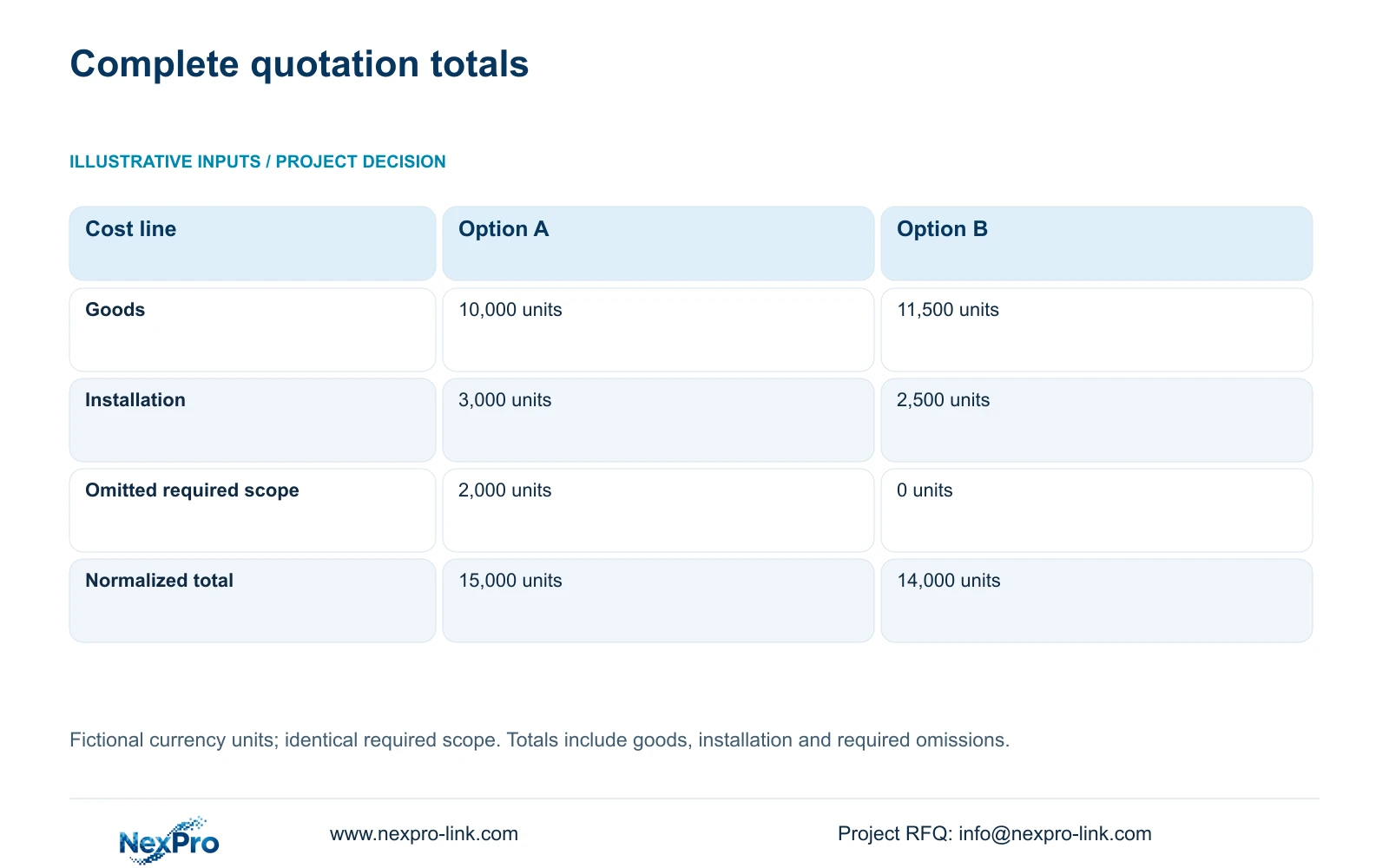
The following comparison uses fictional currency units and identical required outcomes. Option A quotes goods at 10,000 units, installation at 3,000 units and omits required scope valued at 2,000 units. Option B quotes goods at 11,500 units, installation at 2,500 units and includes that required scope. These figures are a method example, not supplier prices.
Use normalized_total = goods + installation + required_omitted_items. Option A becomes 10,000 + 3,000 + 2,000 = 15,000 units. Option B becomes 11,500 + 2,500 + 0 = 14,000 units. The difference, A_total − B_total, is 1,000 units. The lower goods quotation therefore has the higher complete total.
The decisive difference is the omitted required work, together with installation scope. This table compares completeness, unlike the earlier four-position and eight-position options, which intentionally differ in coverage. Obtain quotations using the same date basis, quantities, currency and delivery boundary before drawing a price conclusion. An unresolved freight or local-work line prevents a reliable final comparison.
| Cost line | Option A | Option B |
|---|---|---|
| Quoted goods | 10,000 units | 11,500 units |
| Installation | 3,000 units | 2,500 units |
| Required omitted scope | 2,000 units | 0 units |
| Normalized total | 15,000 units | 14,000 units |
Section 05
Approve an operating baseline and explicit additions
Use the lower-scope option as the estimating baseline only if overview and dispatch-context footage answer the owner's immediate questions. If a gate handover requires detail that the overview cannot provide, move that detail position into the baseline. The broader option should identify the extra evidence it preserves, so the owner can approve a consequence rather than simply a higher count.
Price shared recording, networking and essential power separately from optional coverage. This makes additions easier to trace and prevents a cheaper camera schedule from hiding an incomplete operating package. Keep process inspection and machine safeguarding with their appropriate systems; adding security views near machines does not transfer those functions to CCTV.
Reopen the budget when dispatch moves, operating hours extend or the project introduces a specialist environment or mandatory platform. Retain required Hikvision, Dahua or other interfaces when comparing an alternative. NexPro-Link's BOQ and tender support can help map equipment and deviations, while the buyer decides whether the revised scope meets the project.
Section 06
Issue a budget brief that suppliers can price consistently
The budget brief should contain a marked outline, a short view schedule and a boundary sheet. Use the same position identifiers in both quantity options, with additions clearly identified. State whether the price covers equipment delivery, preparation or local installed work. Suppliers should be able to explain their differences without reconstructing the estimator's assumptions.
Request separate prices for the baseline, coverage additions and unresolved infrastructure allowances. Include technical submittals appropriate to the selected equipment, and identify who will confirm routes and mounting before ordering. NexPro-Link's factory project supply scope can coordinate cameras, recording, protected nodes and related cabling; local construction responsibilities must remain explicit.
Set a survey checkpoint before releasing uncertain quantities. At that checkpoint, replace assumed views with accepted positions, revise affected cable and power lines, and keep the original option comparison for budget reconciliation. The resulting zone brief becomes a practical handoff from concept estimate to the first complete operating package.
Section 07
Buyer questions
Can a supplier provide a budget while ceiling information is missing? Yes, using stated mounting assumptions and separately identified access and bracket allowances. The supplier should distinguish budget candidates from confirmed installation quantities and state which ceiling details will change the price.
Should every provisional item receive a contingency percentage? Avoid stacking a blanket contingency over allowances that already cover the same uncertainty. Identify the unresolved quantity or service first, then record any separately approved contingency and its purpose.
Does the broader camera option need a larger recorder? Not automatically. Check channels, supported stream modes, input bandwidth and retention together. A recorder may accommodate additional channels while its storage or supported viewing workload still needs revision.
Section 08
Request a bounded factory CCTV estimate
Email info@nexpro-link.com with your dimensioned building outline, gate and dispatch retrieval tasks, operating shifts and intended phase dates. NexPro-Link can discuss a baseline equipment scope and separately priced additions.
Engineering references
These sources support the general planning principles. Always use the selected product's current datasheet and applicable project standards for final design.