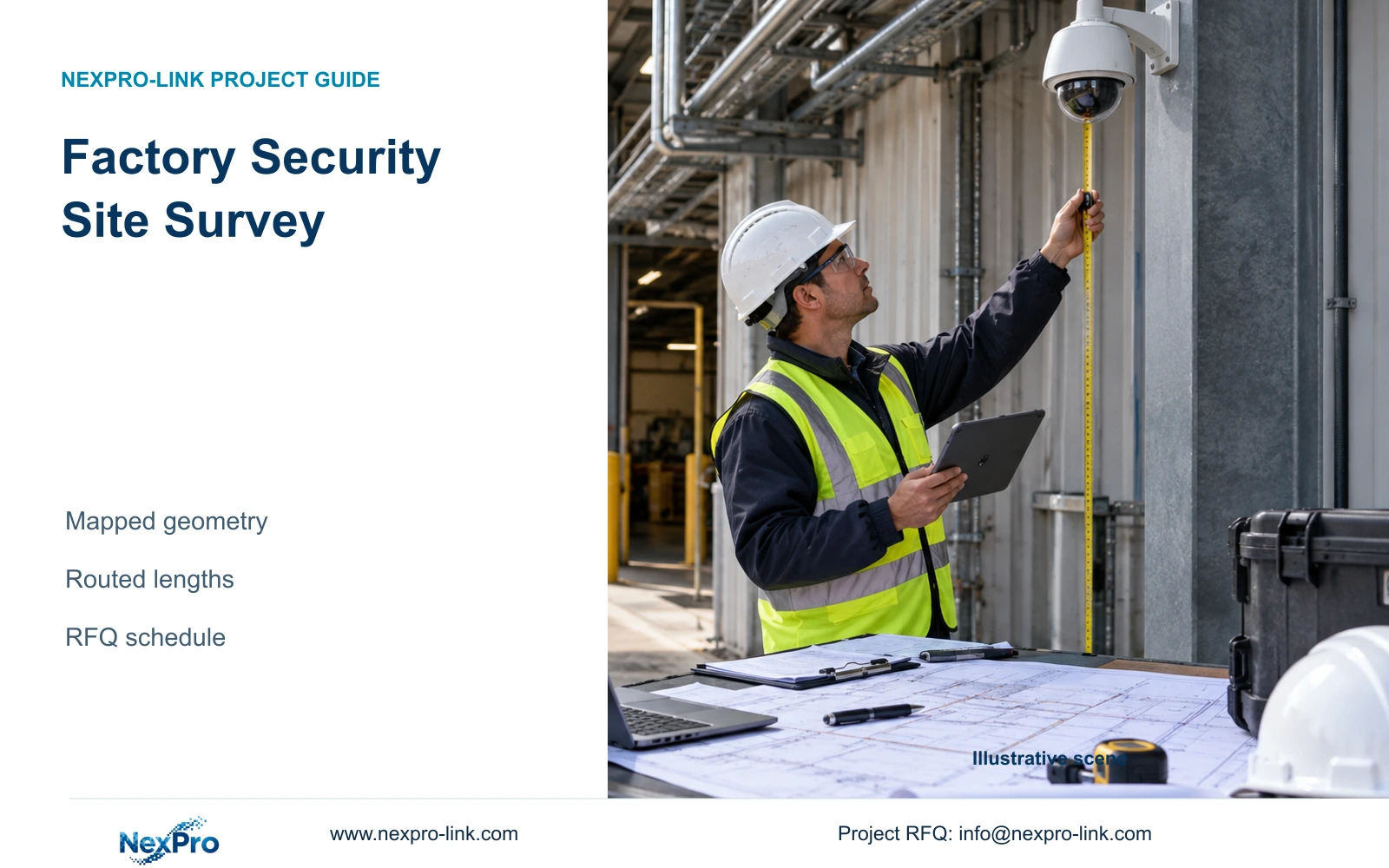
A useful factory survey gives remote suppliers and local installers the same mapped position schedule, including geometry, routed links and unresolved interfaces.
Section 01
Capture the geometry that changes equipment selection
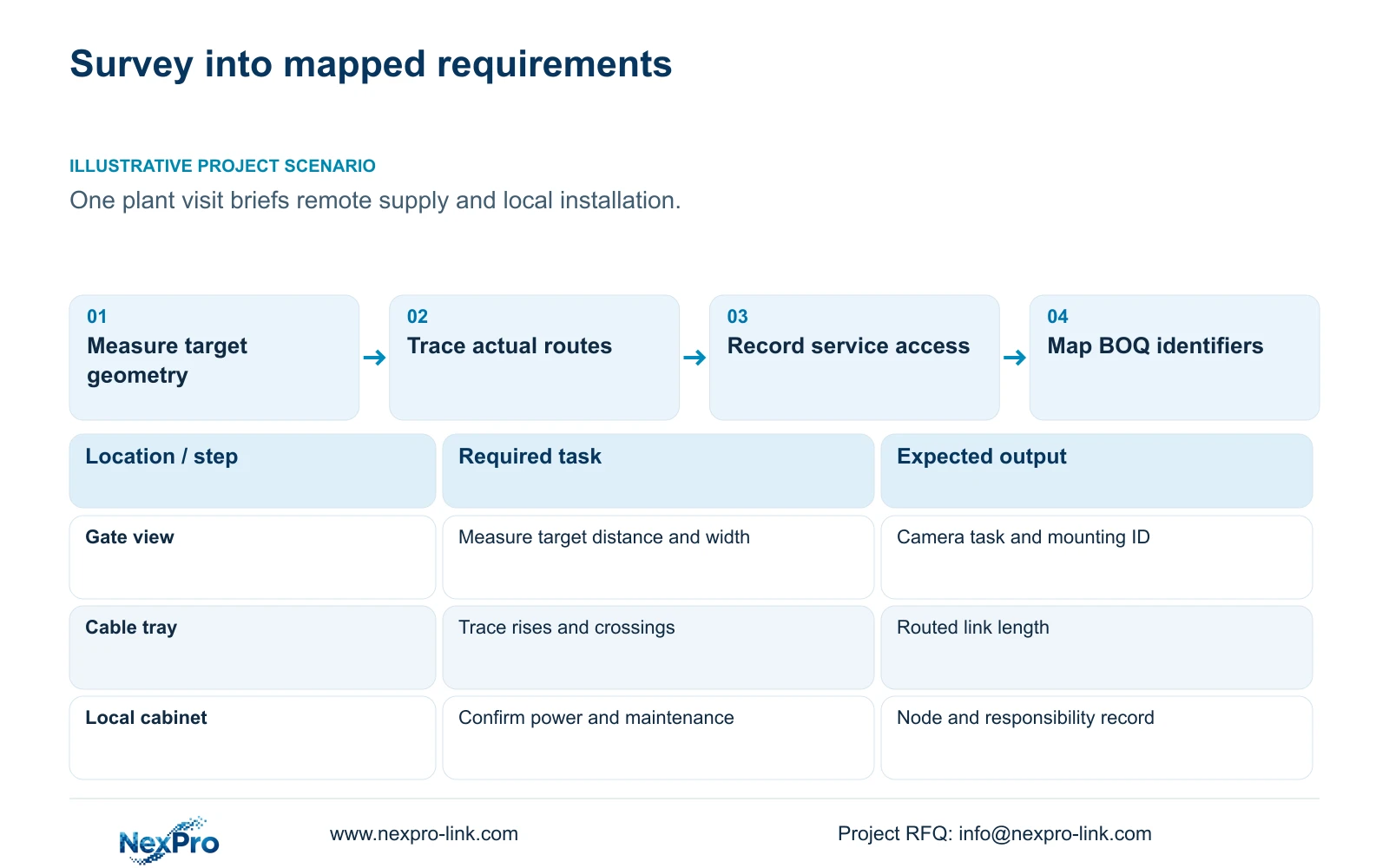
A factory security site survey should produce a mapped position schedule that explains what each camera must show and how it will connect. Capture target distance, width, mounting constraints and environmental conditions because those inputs change lens, bracket, enclosure and power choices. Photographs are useful evidence when they refer to the same position identifiers as the schedule.
Illustrative project scenario: A project engineer visits a plant once and must brief a remote supplier and local installation crew. Assume the visit covers a gate, material store, transfer route and dispatch area. The engineer assigns a position ID at each location and records the required event, target plane and likely mounting point before photographing it.
Measure target width at the plane where the event occurs, not simply the width nearest the camera. Record mounting height, approximate direction and the obstructions expected during normal operation. Distinguish confirmed structures from movable equipment. A supplier can then evaluate a view requirement without interpreting an unlabeled image or assuming that an empty aisle represents the operating state.
Section 02
Trace the cable route and maintenance approach
Follow each planned link from the selected cabinet to its endpoint. Record tray sections, vertical rises, wall crossings and agreed service allowances separately, then sum them. Identify where a route is inaccessible or still proposed. A measured direct distance can remain a useful reference, but it must not silently become the cable order quantity.
Inspect cabinet access and mounting service conditions at the same time. Confirm available space, the intended power source and whether an installer can reach the camera after equipment is in place. An apparently convenient location may require shutdown access or another route. These constraints affect installation scope even when the camera specification stays unchanged.
Keep data paths and protected-power paths distinct on the marked plan. A remote switch connected by fibre still requires its own suitable power arrangement. Record special environmental boundaries explicitly and request the applicable specialist input. An ordinary security camera or cabinet should not be selected on the assumption that CCTV observation includes process control or machine safeguarding.
Section 03
Translate each observation into a priced requirement
Connect survey observations to BOQ lines through position IDs and route IDs. A gate view should identify the camera role, target geometry, bracket condition, link destination and installation access. A cable route should identify its endpoint method and test basis. Shared cabinets and backbone items receive their own IDs and appear once in the quantities.
For example, record the dispatch camera and selected mounting accessories as supplier-provided, the routed containment and installation as local work, and a second context view as optional pending owner acceptance. Name the engineer responsible for closing the optional view decision. This assignment prevents a survey note from becoming an unpriced obligation for the installer.
The supplied 32-camera CNC reference uses module-ended permanent links and allows two modules per camera link, giving 64 modules. NexPro-Link lists the DT968MX Cat6 tool-less module and SP5648 48-port patch panel. A direct-plug arrangement changes the termination and testing method, so neither the module count nor a patch-panel reference should be copied without confirming the surveyed endpoint design.
Section 04
Check routed lengths before converting metres into reels
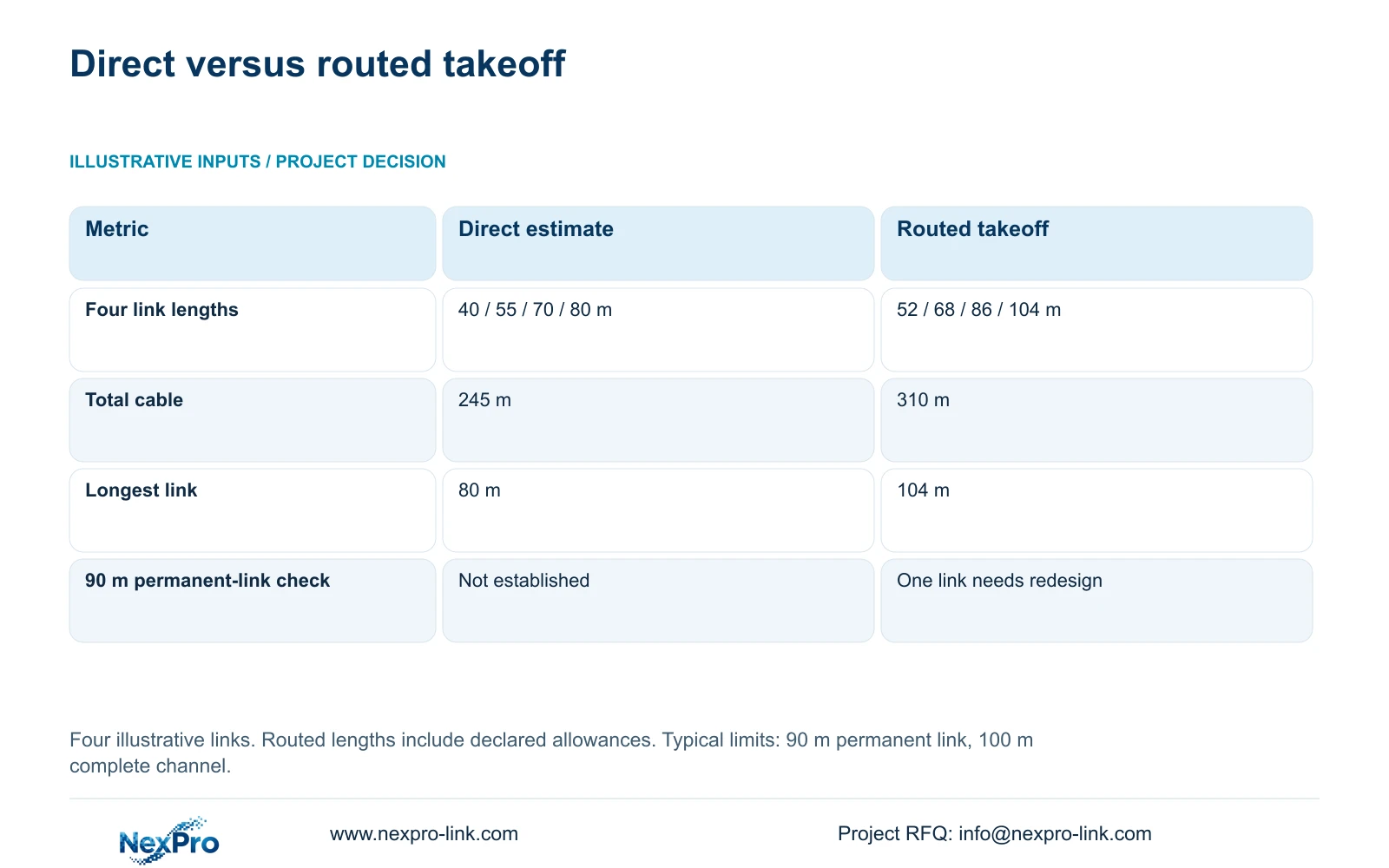
Consider four illustrative links estimated directly at 40, 55, 70 and 80 m. Their total is 40 + 55 + 70 + 80 = 245 m. Following trays and vertical rises with declared installation allowances changes them to 52, 68, 86 and 104 m, totalling 52 + 68 + 86 + 104 = 310 m. Use total_m = sum(individual_link_lengths).
The routed estimate adds 65 m, but the decisive issue is the individual 104 m permanent link. Fluke guidance distinguishes a typical 90 m copper permanent link from a 100 m complete channel. The 104 m plan needs redesign against the actual link technology and installation requirements; it cannot be accepted merely because the total cable order appears sufficient.
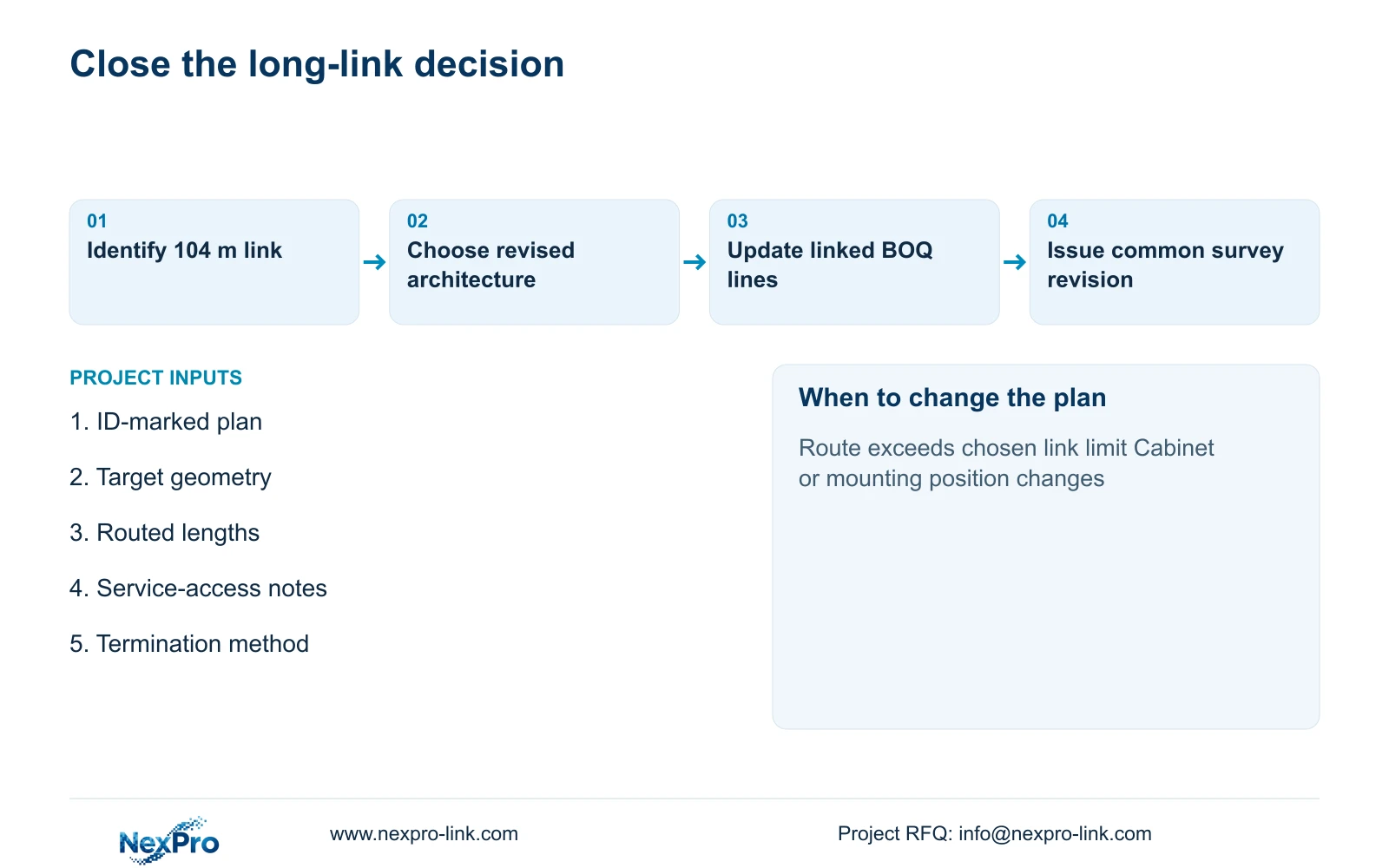
Relocate the cabinet, find an approved shorter route or specify an appropriate alternative architecture before ordering. Then check each revised link and only afterward calculate reel quantities. The separate CNC reference has 32 assumed continuous cuts totalling 1,872 m and a supplied feasible seven-reel cutting plan for 305 m reels. That plan applies to its declared cuts, not to these four links.
| Metric | Option A: direct | Option B: routed |
|---|---|---|
| Individual links | 40 / 55 / 70 / 80 m | 52 / 68 / 86 / 104 m |
| Total cable | 245 m | 310 m |
| Longest planned link | 80 m | 104 m |
| Typical 90 m permanent-link check | Route compliance unconfirmed | 104 m link needs redesign |
Section 05
Resolve architecture-changing gaps before firm pricing
Recommend a routed schedule as the RFQ basis, with unresolved items visible at the affected position. Release confirmed camera and accessory requirements where their tasks are stable, but hold the long-link architecture for a decision. A single unresolved route should not prevent useful work on the rest of the schedule or be hidden inside a general caveat.
Compare long-link alternatives by their complete consequences. Moving a cabinet changes camera routes, local power and service access. A fibre-backed remote node adds appropriate link equipment and a local power dependency. An extender proposal needs its exact supported configuration and power limits checked. The installer and engineer should agree the chosen arrangement before quantities are firmed.
Revisit view geometry if racks, loading positions or mounting points move. A supported 2.8–12mm motorized camera candidate may allow adjustment, but the source specification alone cannot promise the accepted framing. Retain specialist or mandatory platform requirements in alternatives. NexPro-Link's BOQ support can help match documented requirements and deviations rather than substituting models against incomplete survey notes.
Section 06
Issue one mapped schedule to supplier and installer
The survey handoff should include the annotated plan, position schedule, route takeoff and a compact indexed photograph set. Use one revision across these records. Each open decision needs an owner and the input required to close it, such as a confirmed tray route or the approved night lighting state.
Request quotations that follow the same IDs and distinguish equipment, installation and retained assets. NexPro-Link's structured-cabling and project support references can inform component matching and technical documents, while the local crew confirms actual route execution and testing. Project labels and packing should use the accepted identifiers so site receipt can be reconciled with the BOQ.
Before purchase release, close the long-link decision and update dependent terminations, ports and power lines. Preserve the original direct-distance comparison as an explanation of the quantity change. The resulting RFQ schedule gives procurement a traceable estimate and gives the installer enough context to identify a changed condition without guessing the engineer's intent.
Section 07
Buyer questions
What if a route cannot be accessed during the only site visit? Mark the inaccessible section and its length basis explicitly. Assign confirmation to the local team before purchase release, especially where the uncertainty could change the cabinet location or link architecture.
Can existing cable be listed as retained without testing? It can be a conditional retention proposal. Record the link identity, required test and responsible party, then approve retention from the appropriate result. Until then, show the replacement alternative separately.
Should camera photographs include account or device credentials? No. The supplier needs position context, labels and relevant hardware information. Transfer any necessary configuration access through the project's approved process rather than embedding credentials in the general survey pack.
Section 08
Convert your survey into a quotation schedule
Send your ID-marked plan, target-distance and width schedule, routed link lengths and service-access notes to info@nexpro-link.com. NexPro-Link can discuss equipment matching and clearly separated supply and installation lines.
Engineering references
These sources support the general planning principles. Always use the selected product's current datasheet and applicable project standards for final design.