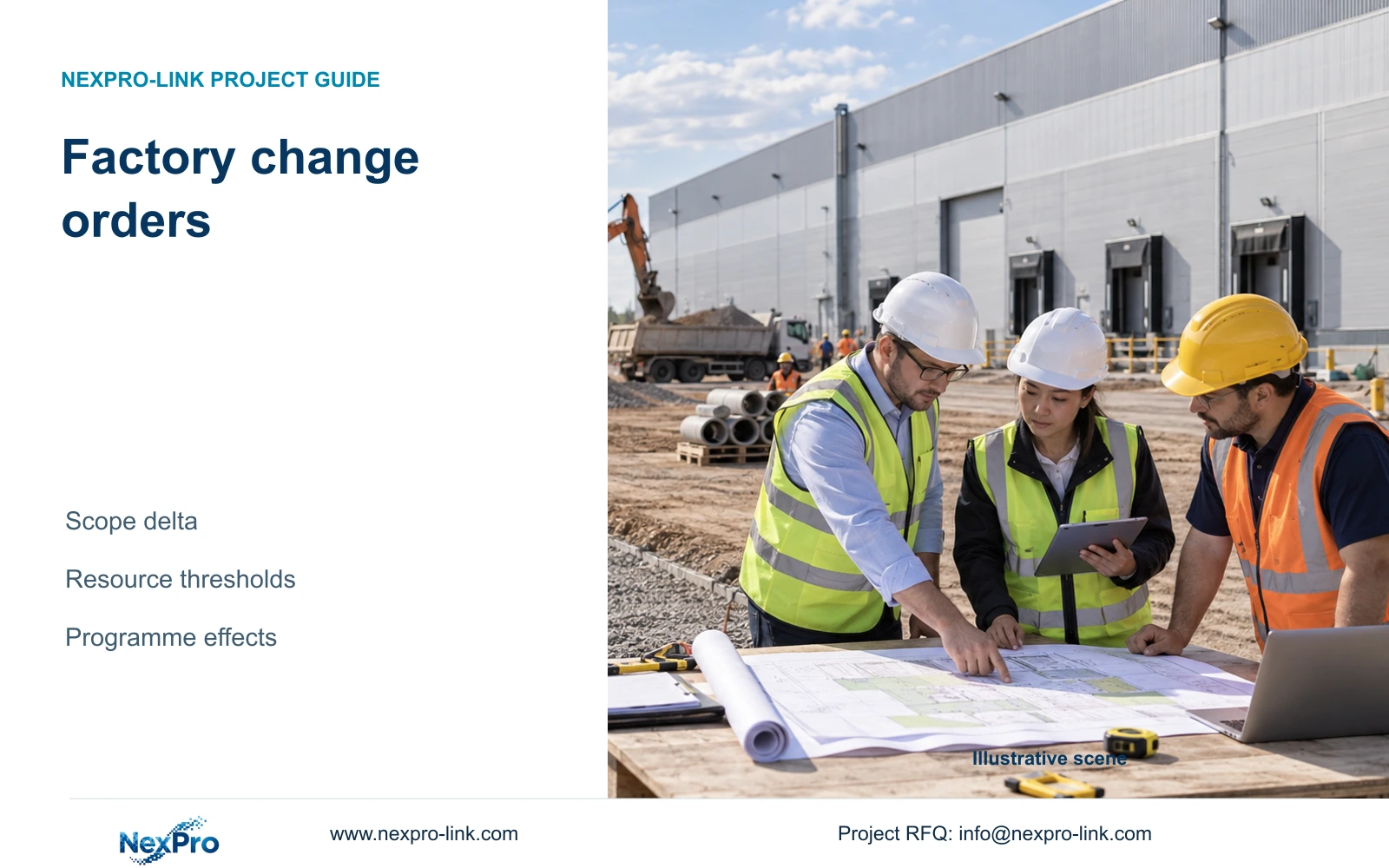
Map the variation to prerequisite approvals, equipment availability and permitted site access before stating a programme effect. Separate additional labor from calendar delay and identify any concurrent work.
Section 01
Define the change against the approved baseline
Map the variation to prerequisite approvals, equipment availability and permitted site access before stating a programme effect. Separate additional labor from calendar delay and identify any concurrent work. Where dates or float are unavailable, request them instead of calculating a delay from camera count. Preserve the dependency basis with the change quotation.
A factory project change order should identify the revised operating requirement, show incremental quantities against the approved BOQ, and explain the activities affected before presenting a revised total. Keep added equipment separate from replacement, abortive work and delivery changes. This lets the quantity surveyor establish what the owner is buying and which existing prices remain applicable.
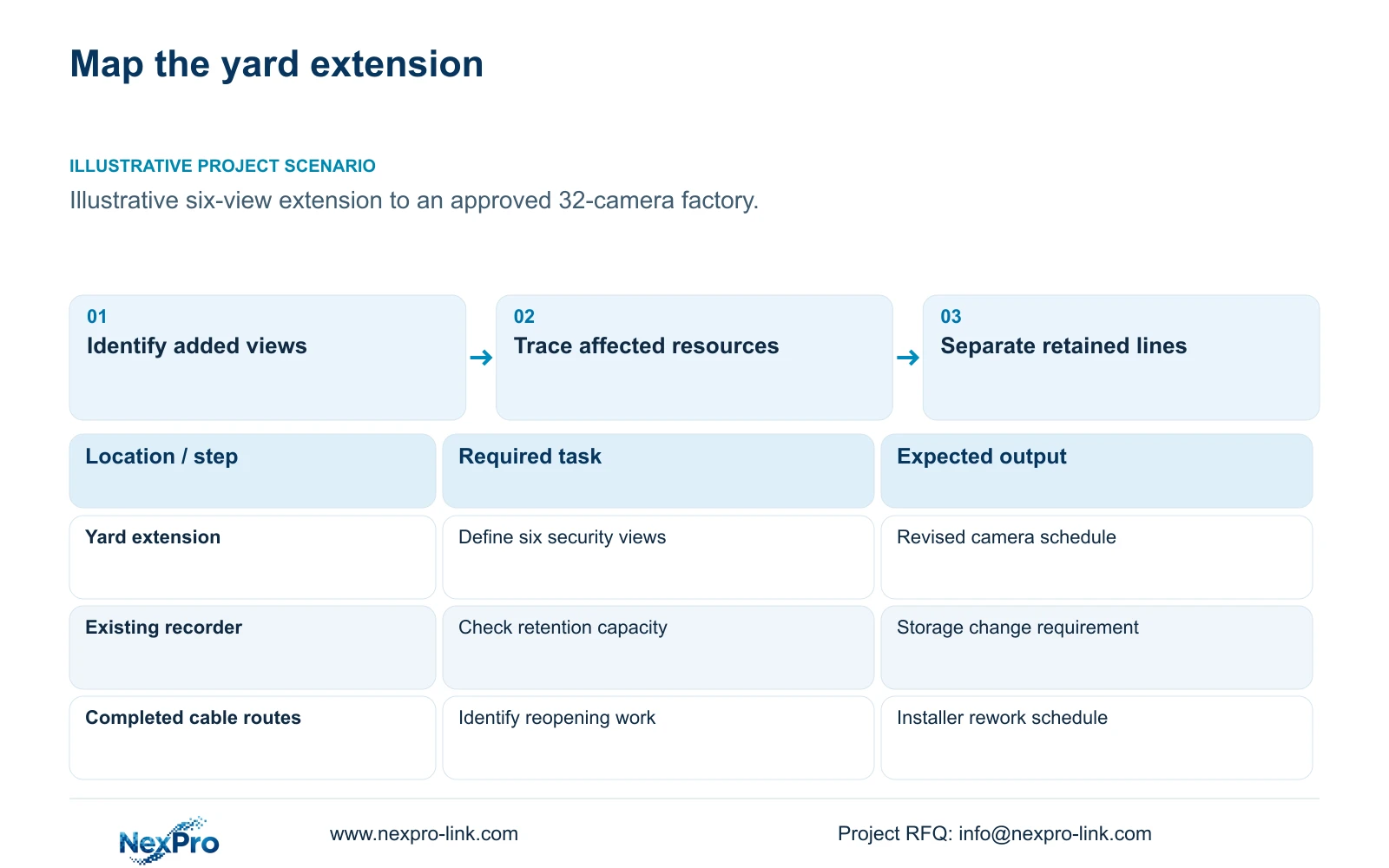
Illustrative project scenario: An owner adds a yard extension after approving the original security BOQ. Use CASE01's hypothetical 32-camera CNC factory as the baseline and assume six additional ordinary security views are needed for authorised transfers and access review. The resulting 38-camera proposal retains 30-day continuous recording. These are planning assumptions, not a completed customer project or a surveyed yard layout.
Record the instruction reference, drawing revision and original BOQ line beside each proposed change. State whether the six views cover new activity or replace inadequate existing views. The owner confirms the task, the engineer defines acceptance, and the cost team measures the delta. Keep supplier registration, brand approval, equipment submittal and purchase authorisation as separate approval records.
Section 02
Check shared resources before pricing six camera units
Trace each added camera to its access switch, recorder, cable route and protected electrical circuit. CASE01 has four eight-camera load groups, so its original grouping does not allocate connections for the six additions. Check actual spare ports and PoE budget. An eight-device calculation group does not establish the physical switch's port count or remaining output capacity.
The recorder candidate, NexPro-NVR4449-4K, lists 49 channels, 320 Mbps input and four SATA bays with up to 18 TB per drive. Those ratings support a capacity review, but channel headroom alone cannot approve the extension. Verify the proposed stream mode and recording configuration separately from playback and decoding. Multiple bays do not establish RAID support.
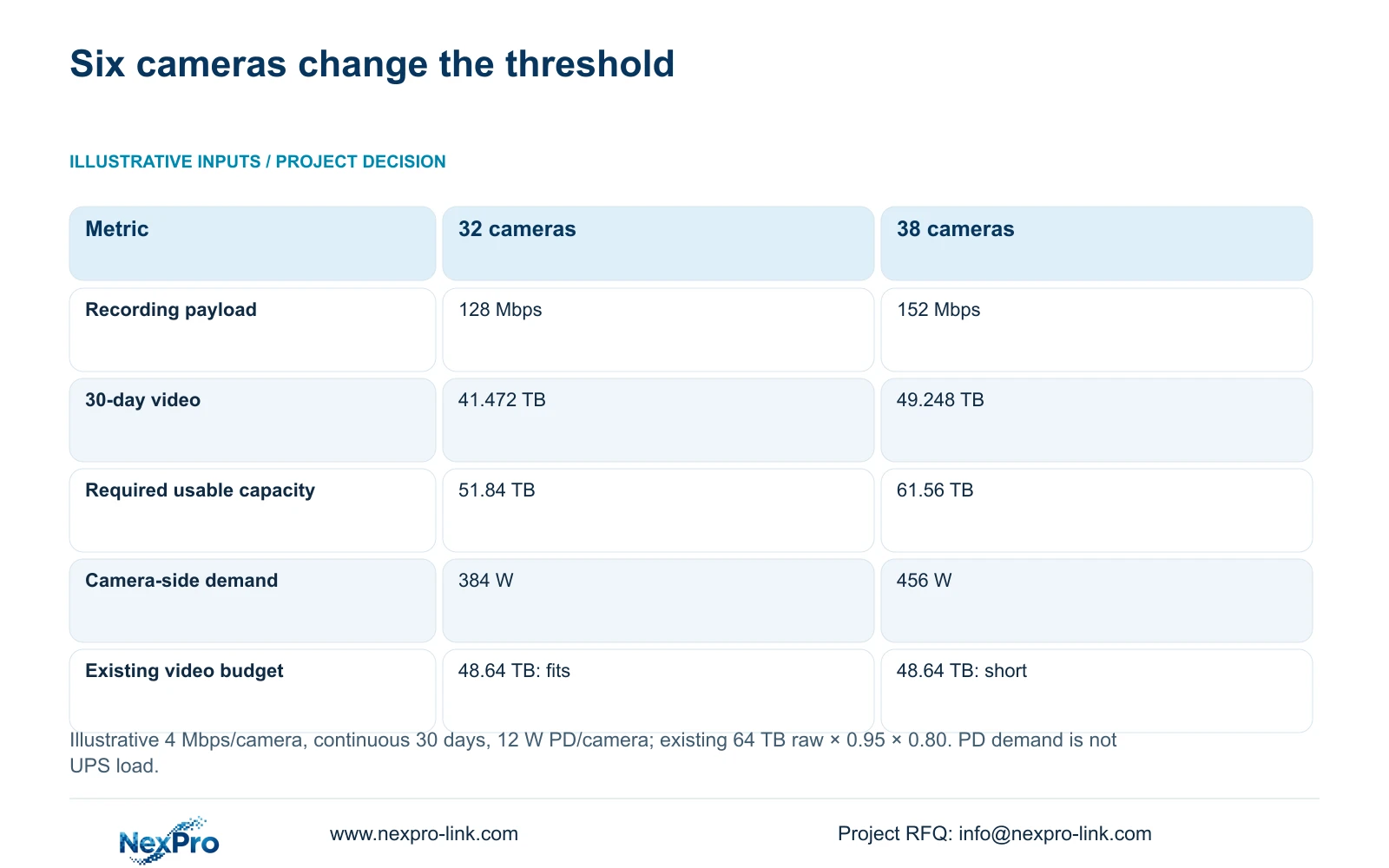
Storage creates a definite threshold in this illustrative design. The existing four 16 TB drives provide 64 TB raw capacity and a 48.64 TB video budget after the stated formatting and reserve assumptions. The revised 49.248 TB video requirement exceeds that budget by 0.608 TB. The engineer must therefore resolve storage even if the cameras fit the channel schedule.
Section 03
Preserve unchanged lines and identify rework explicitly
Issue a delta schedule alongside the baseline BOQ rather than replacing the entire quotation with an unexplained new total. Classify lines as retained, added, replaced or omitted. Keep original units: camera quantities remain units, cable remains measured length or specified reels, and installation activities retain their agreed measurement basis.
For this extension, retain the existing recorder as a candidate subject to verification, add six cameras and their mounting accessories, and show any disk replacement as its own transaction. If existing drives are removed, state the treatment of retained recordings and any agreed credit separately. Do not deduct an assumed resale value or describe unknown disposal and preservation work as free.
The installer should distinguish new cable pulling from opening completed routes, moving brackets or revisiting commissioned equipment. The supplier identifies equipment and preparation changes; the installer measures site work; the quantity surveyor reconciles their boundaries. Revised rates should have a stated reason, such as a changed specification, rather than silently altering unaffected original lines.
Section 04
Calculate the demand increase on one consistent basis
The comparison assumes 4 Mbps average recording bitrate and 12 W camera-side powered-device demand per camera, with continuous recording for 30 days. Recording payload in Mbps equals n × 4. Video_TB = 0.0108 × n × 4 × 30, using decimal TB. Required usable capacity equals video_TB / 0.80, and assumed camera-side demand equals n × 12 W.
The decisive difference is storage occupancy. CASE01's 60.8 TB usable planning capacity, calculated as 64 × 0.95, covers the original 51.84 TB usable requirement but falls short of the revised 61.56 TB requirement. Compare these figures directly. The alternative comparison is 49.248 TB of video against the existing 48.64 TB video budget; applying another reserve factor would count the reserve twice.
The additional 72 W is camera-side demand, not the complete increase at the UPS. Recalculate the affected switches using actual device demand, delivery losses and switch consumption, then include any changed disks or link equipment. CASE01's original recording-first AC load is 682.7407 W. Neither that baseline nor the new camera total establishes the revised UPS load or battery runtime.
| Metric | Approved baseline | Yard extension |
|---|---|---|
| Cameras | 32 | 38 |
| Recording payload | 128 Mbps | 152 Mbps |
| 30-day video | 41.472 TB | 49.248 TB |
| Required usable capacity | 51.84 TB | 61.56 TB |
| Assumed camera-side demand | 384 W | 456 W |
Section 05
Explain programme effects through actual dependencies
Recommend retaining verified baseline equipment and changing only resources affected by the extension. A compatible higher-capacity disk arrangement may preserve the recorder, but it requires confirmation of drive support, recording preservation and commissioning procedure. A separate yard node becomes a reasonable alternative if routes, power distribution or operating responsibility make central connection unsuitable.
Show the programme as dependent activities: revised yard drawing, technical approval, equipment release, route readiness, installation and acceptance. Identify which can proceed independently and which must wait. For example, mounting preparation may continue while a disk substitution is reviewed, whereas final cable cutting needs approved route lengths. Do not convert supplier lead time automatically into an equal delay to factory opening.
Ask each responsible party for a dated dependency statement, including available float and any effect on existing recording. Mandatory brands, specialist environmental requirements or necessary platform interfaces may change the preferred configuration. Compare alternatives against the same observation and retention tasks, and show additional services explicitly. Without matched quotations, no cost advantage or fixed delay can be concluded.
Section 06
Release a mapped change package for procurement
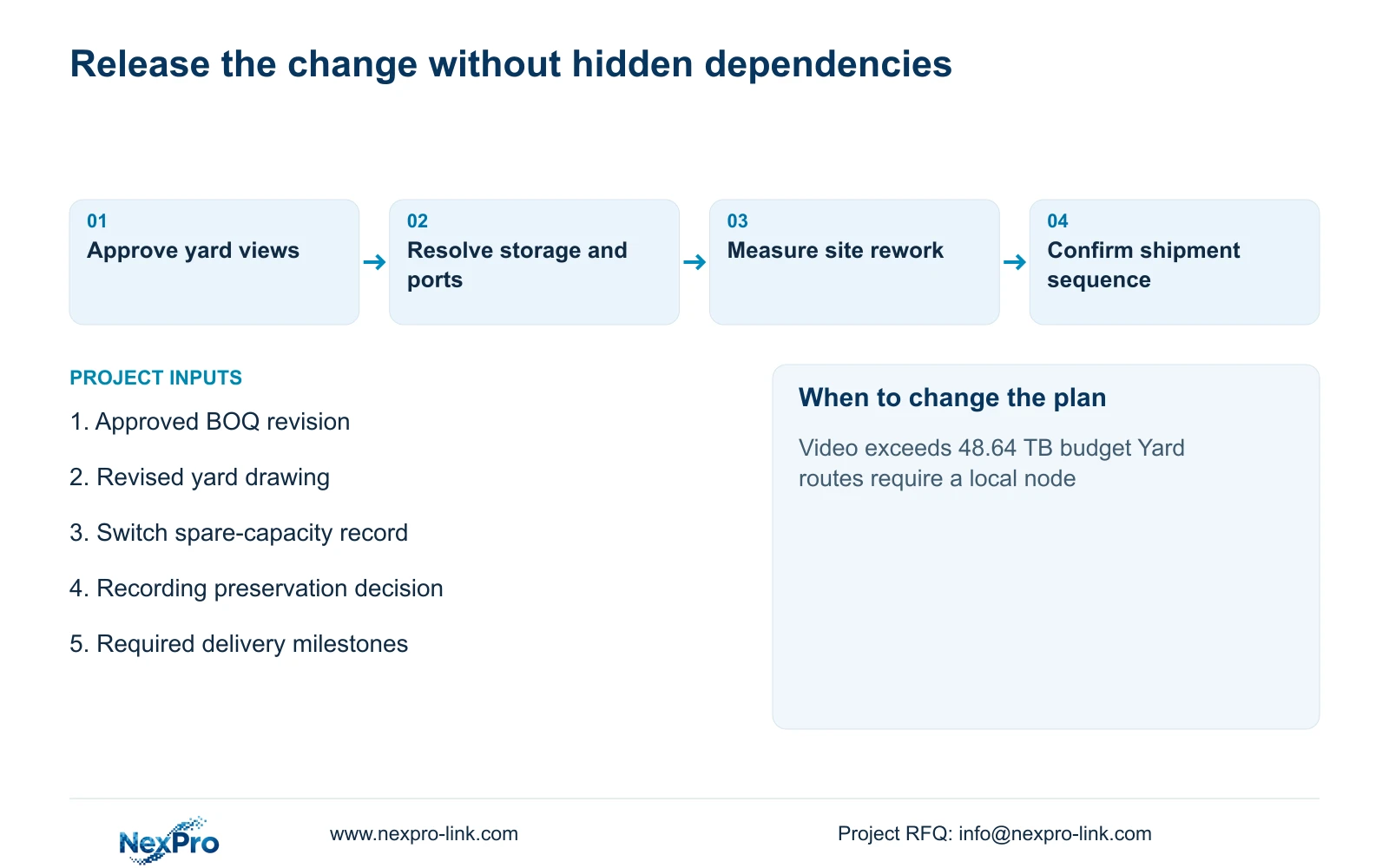
The release package should contain the baseline reference, revised location schedule, equipment delta and programme explanation. Every changed line needs a disposition and responsible party. Unresolved matters should identify the next required input, such as yard route lengths, spare switch capacity or the owner's recording-preservation decision, rather than disappear into a general contingency.
NexPro-Link's BOQ and Tender Support scope can assist with model matching, technical documents, deviations and quotation coordination. Its factory project supply scope can coordinate the relevant equipment package. Ask for a response mapped to the existing BOQ so the cost team can review added equipment without confusing it with local installation or specialist design responsibilities.
Before release, reconcile quantities across the quotation, submittal and packing schedule. Record whether the extension ships separately or joins the original consignment, and which preparation changes depend on approval. A change order is ready for a procurement decision when its scope, resource checks and delivery consequences agree, even if clearly identified site details still require confirmation.
Section 07
Buyer questions
Can the six cameras be ordered while storage approval remains open? They can be released separately if their models, locations and interfaces are settled and the buyer accepts the staged-release risk. Keep storage as an unresolved dependency with an owner and deadline; camera delivery alone does not make the extended recording service ready.
Does a change require repricing every original BOQ line? No automatic conclusion follows. Preserve unaffected lines and identify any proposed rate change with its contractual and scope basis. Separate changed quantities from changed specifications so the buyer can review each effect.
How should an unconfirmed programme effect be shown? State the pending dependency, responsible party and information needed to establish timing. Present any conditional sequence explicitly instead of inserting an unsupported number of delay days.
Section 08
Request a mapped extension quotation
Send the approved BOQ and model schedule, the revised yard drawing, the retention and backup targets, and the required delivery milestones to info@nexpro-link.com for a mapped equipment change quotation.
Engineering references
These sources support the general planning principles. Always use the selected product's current datasheet and applicable project standards for final design.