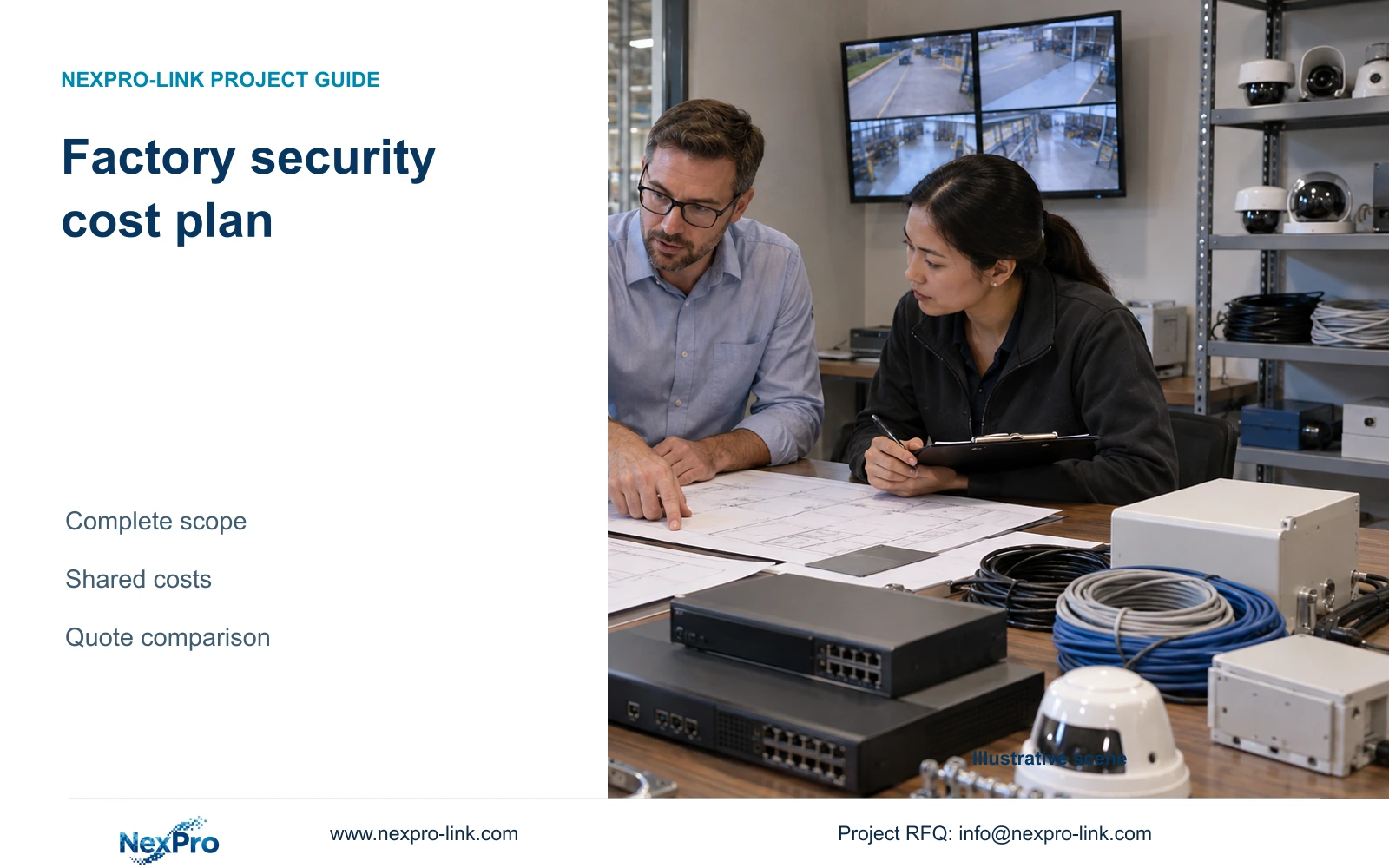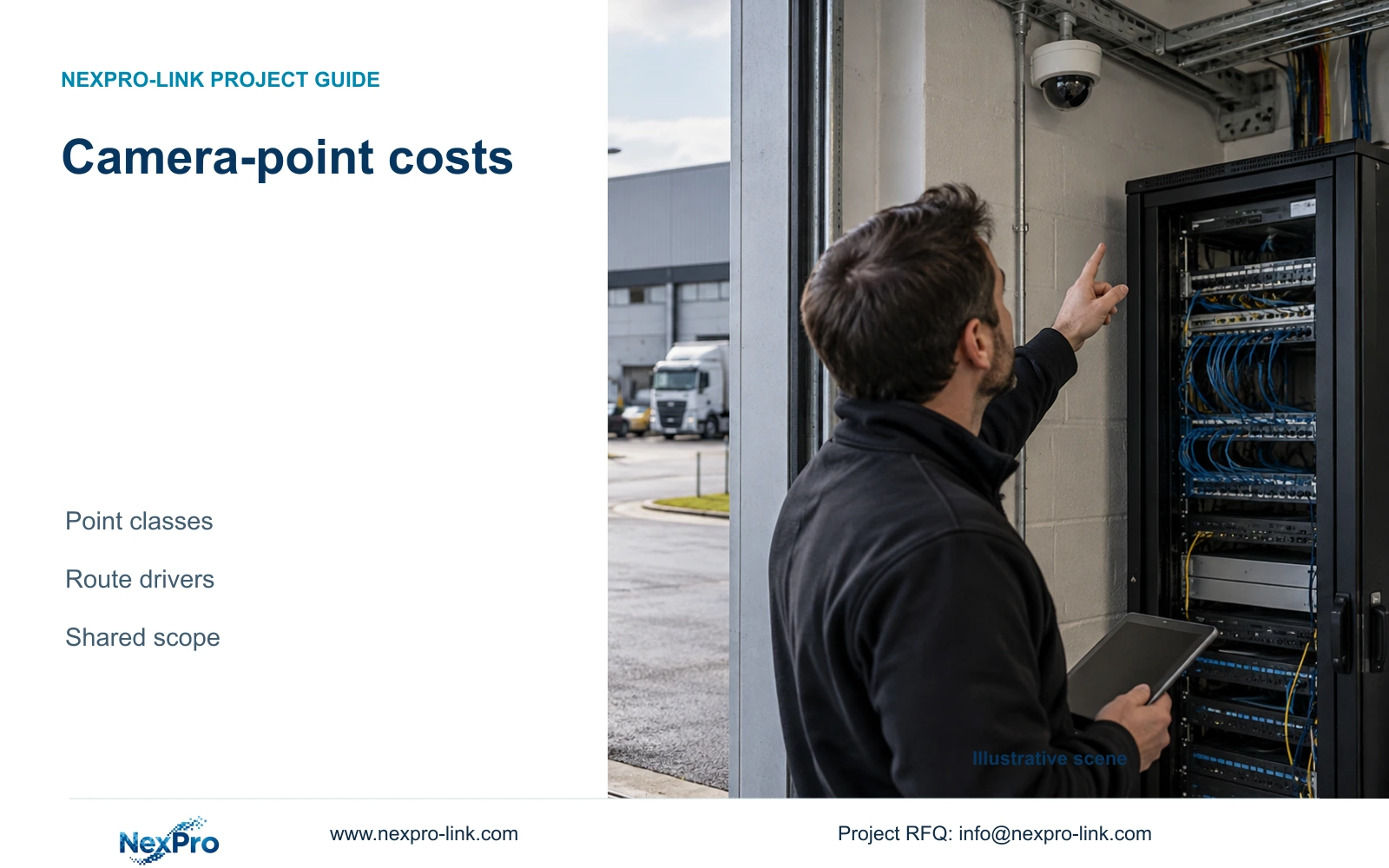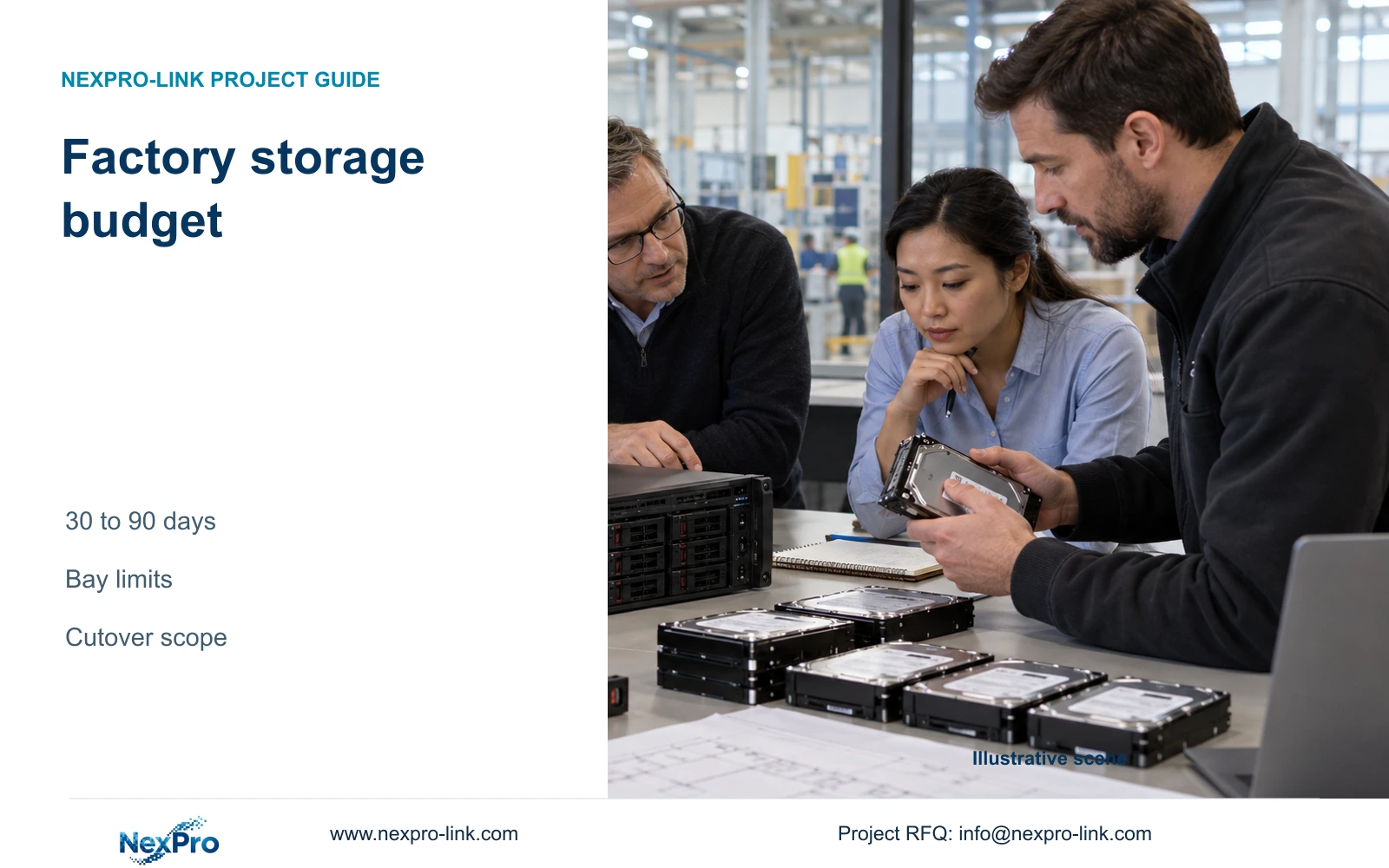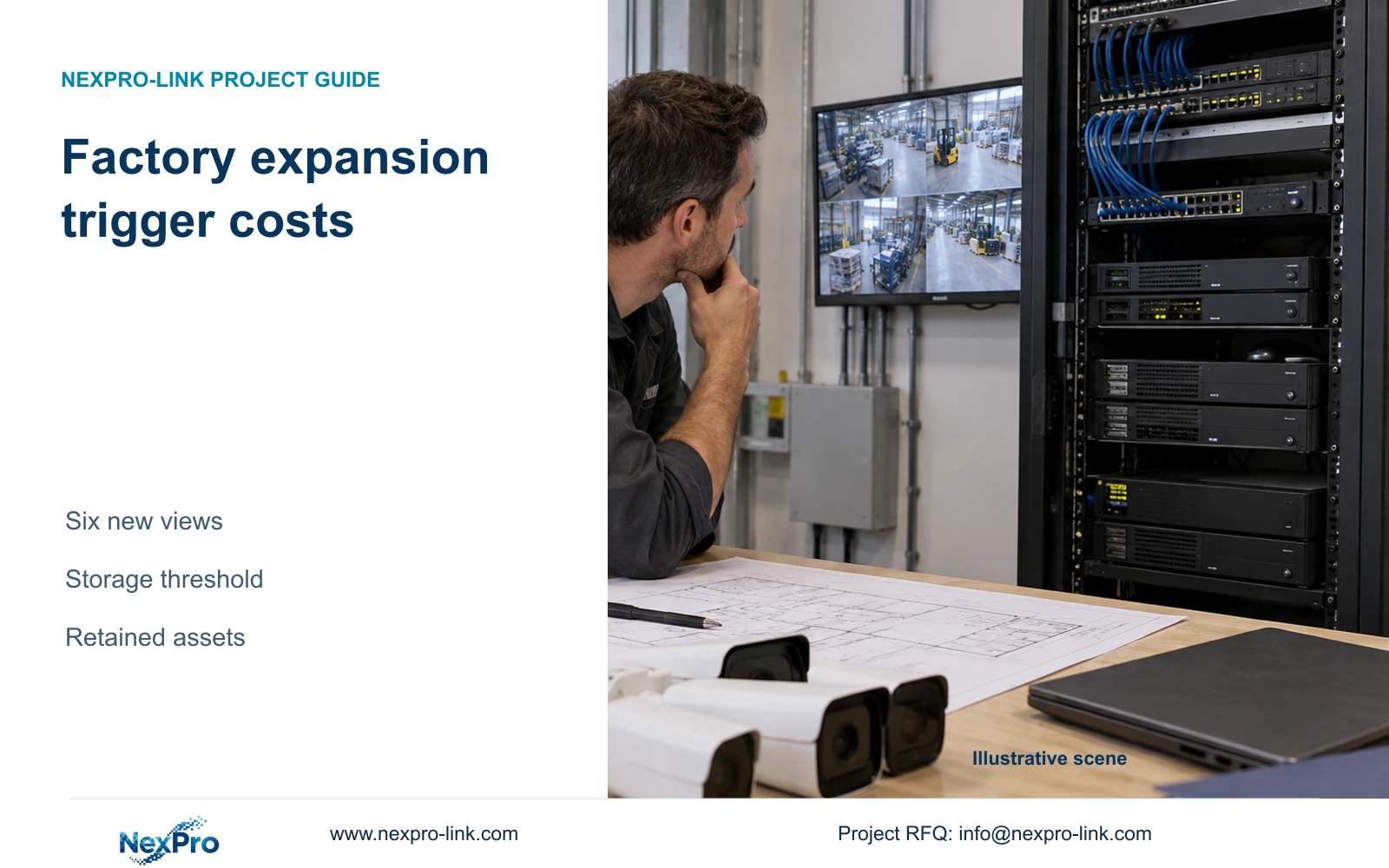
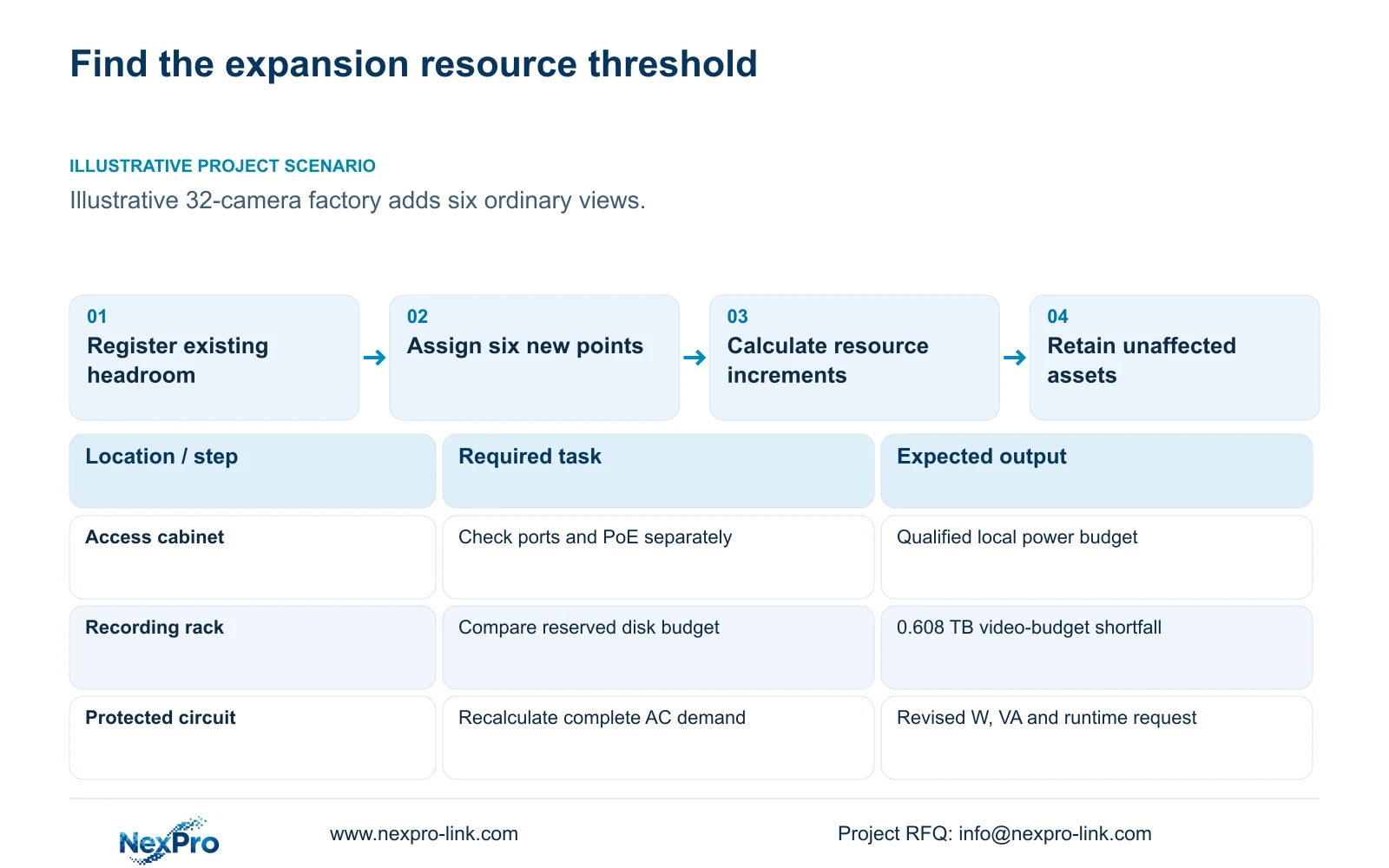
Add proposed views in their actual cabinet groups and record the first resource requiring a change. Continue the check after pricing that remedy, because storage, local power and recording modes remain independent.
Section 01
Check the resource the added cameras will consume
Add proposed views in their actual cabinet groups and record the first resource requiring a change. Continue the check after pricing that remedy, because storage, local power and recording modes remain independent. Keep unaffected baseline costs out of the variation. A staged trigger register explains discontinuous costs without inventing unit-price savings.
Price factory security expansion by the resource limit crossed by the added views. Spare ports do not establish spare PoE output, recording capacity or protected power. Keep suitable existing equipment, identify the incremental demand and price the specific changes needed to preserve the accepted service. The original system cost should not be charged again to the new cameras.
Illustrative project scenario: The system has spare ports but little remaining PoE and recording capacity. Use CASE01's hypothetical 32-camera CNC factory as the baseline and examine the supplied increase to 38 cameras. Both options assume 4 Mbps per camera, 30-day continuous recording and 12 W camera-side demand. These inputs are planning assumptions, not measurements of installed cameras or switches.
Create a resource register for each affected cabinet and recorder. Record used and available ports, qualified PoE output, stream modes, input bandwidth, disk configuration and UPS loading. The engineer should mark each input as measured, documented or assumed. That register identifies whether the expansion needs only six point installations or also a shared-system change.
Section 02
Calculate new demand separately from existing demand
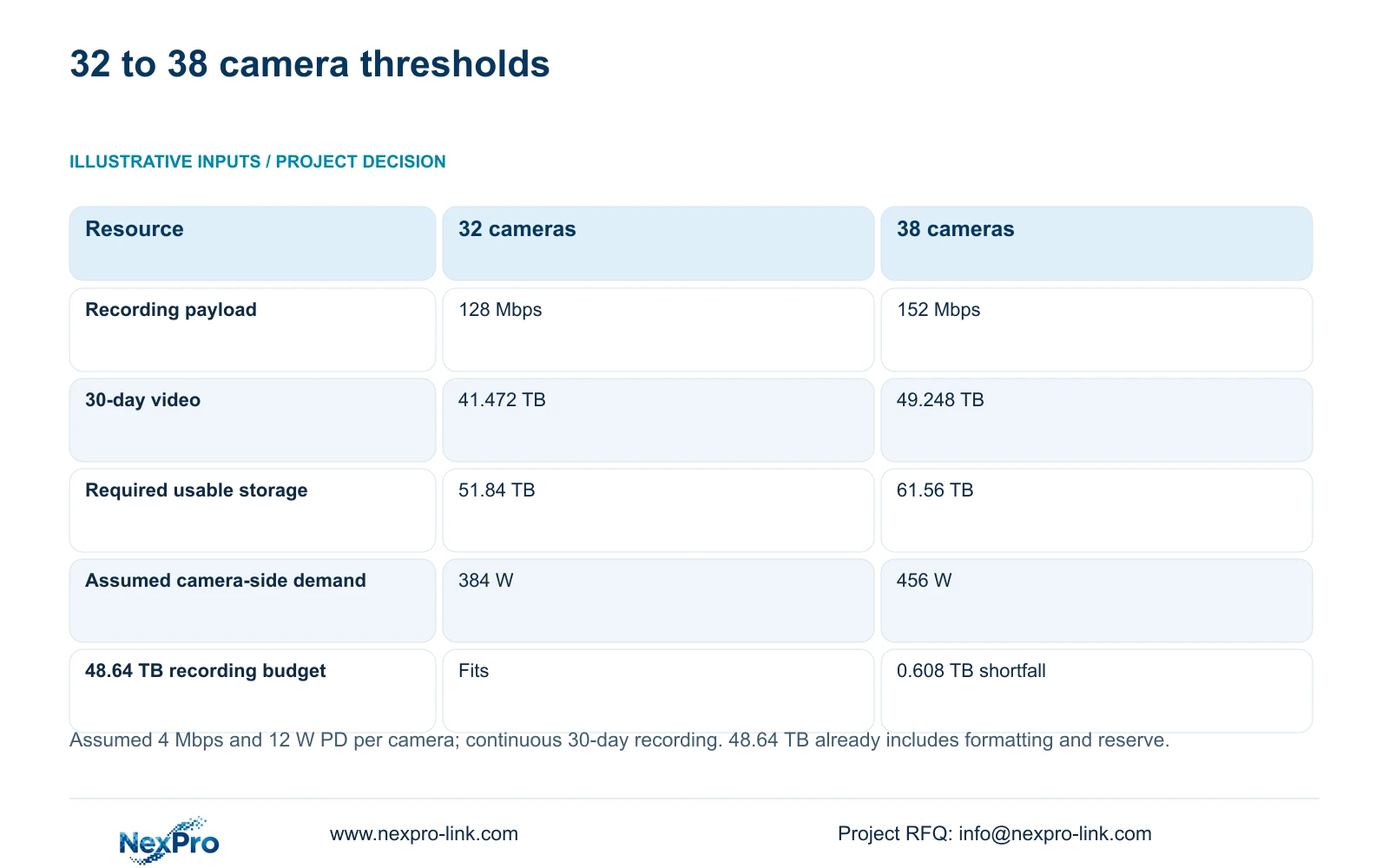
Use Mbps = n × 4 and video_TB = 0.0108 × n × 4 × 30. Increasing from 32 to 38 cameras raises assumed recording payload from 128 to 152 Mbps and video volume from 41.472 to 49.248 TB. The increments are 24 Mbps and 7.776 TB. These are the quantities attributable to the added cameras under unchanged settings.
Keeping 20% of usable storage free gives usable_required = video_TB/0.80, or 51.84 TB for the baseline and 61.56 TB after expansion. The added usable requirement is 9.72 TB. Compare that with the actual storage arrangement before selecting more disks. A bay already occupied by an existing disk is not an expansion slot.
The supplied camera-side power formula is PD_W = n × 12, giving 384 W and 456 W, an increase of 72 W. This is device-side demand, not complete switch AC input or UPS load. Assign the six cameras to actual access groups, then apply the relevant delivery, switch and conversion assumptions at those groups. Site-wide totals cannot establish a particular cabinet's fit.
Section 03
Preserve existing equipment unless a limit requires change
Classify the expansion BOQ as new point equipment, shared capacity changes, retained equipment and cutover work. Existing cameras, valid links and suitable mounts should remain unchanged when they still meet the approved task. A shared upgrade should name the limit it resolves, such as disk capacity or a local PoE budget, rather than being described as a general modernization.
The NexPro-NVR4449-4K reference lists 49 channels and 320 Mbps input. The illustrative 38-camera payload of 152 Mbps is below that published input figure, but the selected stream modes and firmware still need qualification. Its summary distinguishes 49×5MP from 9×4K. Channel and bandwidth headroom alone do not authorize an all-8MP expansion or establish the required decoding workflow.
For the CASE01 baseline, all four SATA bays are occupied by 16 TB disks. Storage expansion therefore requires a supported replacement or architecture decision, not simply another drive added to a free bay. Before replacing storage, agree how existing footage remains available. Price preservation and reconfiguration work separately from the hardware that resolves the capacity threshold.
Section 04
Identify the first storage threshold in the worked example
CASE01's 64 TB raw disk installation has an illustrative recording budget of 64 × 0.95 × 0.80 = 48.64 TB. The original 41.472 TB video demand fits. The expanded 49.248 TB demand exceeds that budget by 0.608 TB. Compare video directly with this already-reserved budget; applying another reserve would overstate the requirement.
The same result can be expressed as required usable capacity. The installation provides 64 × 0.95 = 60.8 TB, below the expanded requirement of 61.56 TB by 0.76 TB. These are alternative expressions of the same shortfall. The expanded volume is below raw capacity, but still fails the stated free-space planning target. That distinction explains why apparently available disk space is insufficient for this accepted basis.
At the recorder's listed maximum of four 18 TB drives, 72 TB raw would provide a 54.72 TB recording budget under the same illustrative factors. This is a possible capacity route subject to compatible drives and supported configuration, not a purchase instruction. Compare it with other qualified arrangements and their preservation work. The exact disk replacement plan should follow the supported configuration and migration decision.
| Metric | 32-camera baseline | 38-camera expansion |
|---|---|---|
| Recording payload | 128 Mbps | 152 Mbps |
| Video volume | 41.472 TB | 49.248 TB |
| Required usable storage | 51.84 TB | 61.56 TB |
| Assumed camera-side demand | 384 W | 456 W |
| 64 TB raw recording budget | 48.64 TB: fits | 48.64 TB: short by 0.608 TB |
Section 05
Price local power and storage changes without replacing everything
Recommend retaining the qualified recorder where its supported modes and functions still fit, while comparing the storage changes needed to preserve the 30-day policy and reserve. Retain access switches only after checking both per-port compatibility and remaining aggregate PoE output. Their actual total-W ratings were not supplied, so spare ports cannot settle that decision.
Update protected AC demand for each affected electrical node. CASE01's recording-priority load is an illustrative 682.7407 W, with SP1KR(S) as a capacity candidate under its stated assumptions. The model's published 1 kVA/900 W rating does not prove capacity after expansion or preserve the original duration. Added camera and switch demand needs a revised W, VA and runtime check.
Choose a local node or another recorder when distance, supported stream allocation or concentrated power demand makes the retained arrangement unsuitable. Price the new connection, cabinet and protected supply where needed. A central UPS cannot protect a separately powered remote node through a data link. Preserve unchanged resources elsewhere rather than applying a rack-wide replacement allowance without a technical reason.
Section 06
Issue an incremental quotation with a verified baseline
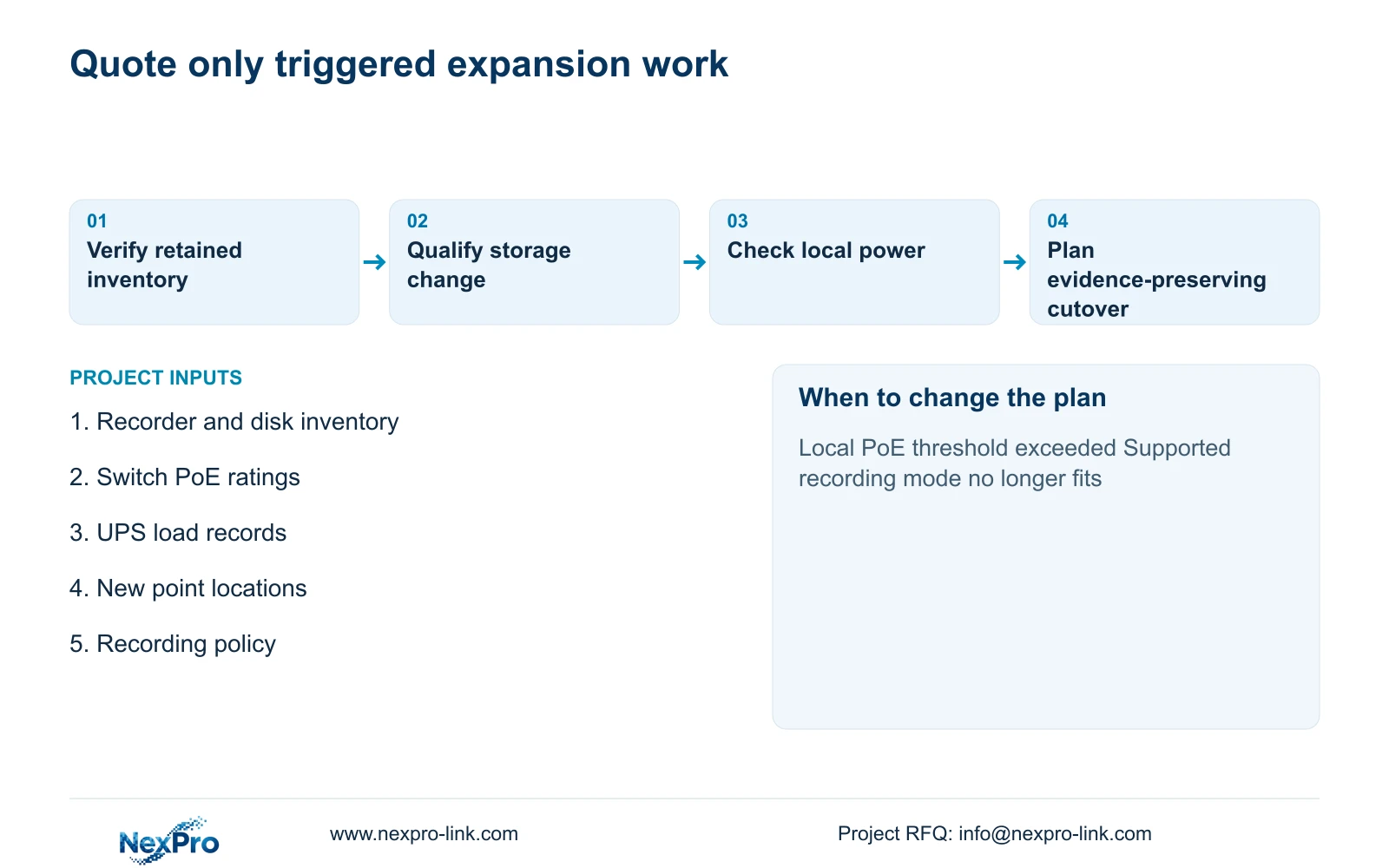
The expansion request should contain existing model and firmware identities, disk inventory, actual switch budgets and the six proposed camera locations. Show their route and node assignments. Ask bidders to distinguish point costs from the shared changes their design triggers, with explicit quantities and exclusions. This keeps a resource upgrade from disappearing inside a camera unit rate.
NexPro-Link's BOQ support can help match the incremental equipment and document departures from the retained baseline. Relevant recorder and UPS references can be considered against the declared limits. The local project team should confirm existing link condition, electrical scope and cutover arrangements, including protection of stored evidence.
After the change, verify recording assignments, retained settings and the expected retention basis. Record the revised capacity register for the next addition. Expansion cost is easier to defend when the owner can see which threshold was crossed, which equipment resolved it and which original assets remain in service.
Section 07
Buyer questions
Why can one added camera trigger a shared upgrade? Resources have discrete limits. A single point can use the last qualified port, exceed a local PoE budget or consume the remaining storage allowance. Price that threshold change separately from the point itself.
Can lower recording quality avoid the storage upgrade? It may reduce demand, but it changes the evidence basis. Test and approve any revised stream settings explicitly. Do not describe reduced quality as equivalent expansion under the original requirements.
Should the full new recorder cost be charged to the expansion? Show the actual procurement cost and why replacement is required. For internal allocation, distinguish the expansion trigger from capacity serving retained and future cameras. Do not add the historical original-system cost again.
Section 08
Identify the expansion threshold before ordering
Send your recorder/disk inventory, switch PoE and UPS capacity records, six proposed point locations and recording-policy inputs to info@nexpro-link.com for an incremental equipment-scope discussion.
Engineering references
These sources support the general planning principles. Always use the selected product's current datasheet and applicable project standards for final design.